


Cartoon – I can’t remember


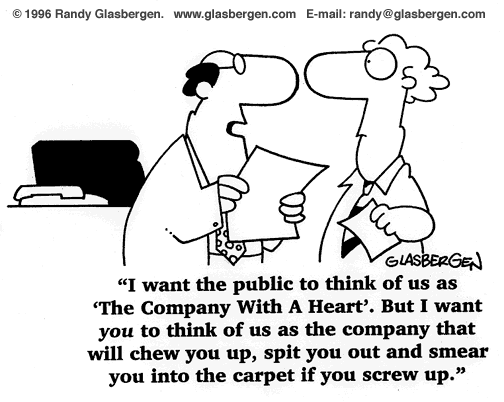

I love organizational leadership. I especially love attempting to lead healthy organizations. I have been in both environments – healthy and non-healthy. I prefer healthy.
If truth be told, I’ve probably been the leader in both extremes. And, there are seasons when every organization is healthier than others.
Over the years of leading I’ve observed a few things which can be the enemy of organizational health. They keep health from happening and – if not dealt with – can eventually destroy an organization – even a local church.
Shortcuts – There are no shortcuts to creating a healthy organization. I’ve known leaders who think they can read a book, attend a conference, or say something persuasive enough so everything turns out wonderful. Organizational health is much more complicated. Success is not earned through a simple, easy-to-follow formula. It takes hard work, diligence and longevity. Leaders must be committed to the process through good times and bad.
Satisfaction – Resting on past success is a disruption to future growth, which ultimately impacts organizational health. When an organization gets too comfortable – boredom, complacency and indifference are common results. The overall vision must be attainable in short wins, but stretching enough to always have something new to achieve.
Selfishness – Organizational health requires a team environment. There’s no place for selfishness in this equation. When everyone is looking out for themselves instead of the interest of the entire organization – and this starts with the leader – the health is quickly in jeopardy.
Sinfulness – This one is added for those who feel every one of my posts must be spiritual. (Just kidding.) Seriously, healthy organizations are not perfect (and we all sin), but it doesn’t matter if it is gossip or adultery – sin ravages through the integrity of the organization. When moral corruption enters the mix, and is not addressed, the health of an organization will soon suffer. This is why it is so important a leader stays healthy spiritually, relationally and physically.
Sluggishness – Change is an important part of organizational health. In a rapidly changing world, organizations must act quickly to adapt when needed. Some things never change, such as vision and values, but the activities to reach them must be fluid enough to adjust with swiftness and efficiency.
Stubbornness – Let me be clear. There are some things to be stubborn about, again, such as vision and values. When the organization or it’s leaders are stubborn about having things “their way”, however, or resistant to adopt new ways of accomplishing the same vision, the health of the organization will suffer. Most people struggle to follow stubborn leadership, especially when it’s protecting self-interest rather than organizational interests.
Structure – As much as we need structure, and even though we should always be working to add better structure, bad structure can be damaging to organizational health. When people feel they are being controlled by rules, more than empowered by their individuality and passions, progress is minimized and growth stalls. People become frustrated under needless or burdensome structure.
What enemies of organizational health would you add to my list?

Let me be honest. I can be a controlling person. It’s part of my character. I know that. I test that way with StrengthsFinders. If no one is taking charge, I’ll take over the room. (And, not because I’m extroverted. I’m not.) If we both come to a four-way stop at the same time – as nice as I try to be and as much as I love others – I won’t stall long for you to decide if you’re going. It’s just how I’m wired. If the leader isn’t in the room, I’ll lead.
I think my team, however – or at least I hope – would tell you I don’t perform as a controlling leader. Some may even wish I controlled more. It’s been a long process to discipline myself not to respond how I am naturally inclined to do.
Leaders, if you want to to have a healthy team environment, you must learn to control less and influence more. The differences are measured in the results of creating a healthy team.
I have learned thought that successful leaders understands the difference in leading with influence and leading with control.
Here’s what I mean by the results of controlling versus influence:
But,
Leaders, take your pick – control or influence. You can’t have it both ways. One will always be more dominant. Granted, I could write a whole blog post (and, I have) on the messiness of leading by influence. There will often be confusion, lack of clarity, and misunderstandings. It comes when all the rules aren’t clearly defined. This, however, is a tension to be managed not a problem to be solved. (I think Andy Stanley said that first.)
When it comes to creating organizational health – influence will always trump control. Every time.
Have you ever been or worked for a controlling leader?
Have you been in an environment where influence is dominant?
Which did you prefer?

Is prevention medicine the future?
This program is an example of the booming interest in prevention-oriented medicine.
The current health care system in the U.S. is often more aptly described as a disease-care system. “It’s reactive,” says Mitesh Patel, a physician and assistant professor of health care management at The Wharton School at the University of Pennsylvania. “We wait until people get sick and then spend lot of resources helping them get better.”
But Patel says there are signs this is beginning to change. “I think the paradigm shift has already begun,” he told us. Patel’s take on Geisinger’s new Fresh Food Pharmacy program: It includes the kind of financial and social incentives that can help motivate people to make changes.
For instance, the Fresh Food Pharmacy gives free, fresh food not just to the patients enrolled but to everyone in their household as well.
“The way we behave is really influenced by others around us,” says Patel. So promoting a group effort could “make the program a lot more sticky and more likely to succeed.”
It’s always a challenge to get people to maintain lifestyle changes over the long term. But, Patel says, “If you get the entire family to change the way they eat, you’re much more likely to improve health.”

As Medicare’s reviled Sustainable Growth Rate (SGR) formula for physician reimbursement fades to extinction, its replacement, the Medicare Access and CHIP Reauthorization Act (MACRA) of 2015, is posing a new set of challenges.
This week Black Book Research identified 10 of the top MACRA challenges that physician practices are facing. The survey is based on responses from 8,845 physician practices collected from February to April.
1. MIPS compliance technology: Physician practices are seeking technological solutions to help them achieve reporting compliance, with 77% of practices that have at least three clinicians mulling the purchase of Merit-Based Incentive Payment System Compliance Technology Solutions (MIPS) software.
2. Electronic Health Record (EHR) optimization: MACRA appears to be a golden opportunity for the largest EHR vendors. For the top eight EHR companies, 83% of their physician-practice users reported working to upgrade their system for MIPS compliance. At physician practices with smaller EHR vendor partners, however, 72% reported they were not working with their vendor partner to upgrade their system for MIPS compliance.
3. Consultant opportunity: The EHR capabilities required for participation in MIPS or Alternative Payment Models (APMs) represent a business opportunity for EHR consultants. Most (80%) of physician practices report that conducting a technology inventory is key to strategic planning for a value-based payment system.
4. Data wrangling: Taming data to conform with the reporting requirements of MIPS and APMs is daunting for many physician practices. At practices with at least four clinicians, 81% of physicians report being unable to align their data with the new reporting requirements.
5. Paying for procrastination: Physician practices that have not developed an in-house strategy for participating in MIPS or an APM are looking for outsourcing options. Of these practice procrastinators, 80% are planning to find turnkey software or a MACRA-administration partner this year.
6. MACRA-induced physician-practice consolidation: Black Book found that three-quarters of independent physician practices surveyed are considering selling their practice to a health system, hospital, or large group practice because of the regulatory and capital-cost burdens of MACRA.
In an equally dour data point, 68% of independent physicians predicted that MACRA would either burden or bankrupt their practice by 2020.
7. Economic incentives: For the first five years of the Quality Payment Program, there are powerful economic incentives to beat the MIPS performance threshold.
In 2019, MIPS is set to redistribute about $199 million from physicians who perform below the performance threshold to physicians above the threshold, and this redistribution mechanism is set to expand over time.
There also is $500 million in supplemental funding available for each of the first five years of MIPS implementation. To chase these opportunities, 64% of hospital-networked physician organizations reported including incentives in physician-compensation packages to boost MIPS performance.
8. Reputation risk: A majority (54%) of those surveyed did not know that MACRA would result in performance data being reported publicly through Medicare’s Physician Compare website and other rating systems.
9. ACO appeal: Joining an accountable care organization can increase the odds of MIPS success through penalty avoidance and resource utilization bonuses. Small physician practices have taken notice, with 67% considering joining an ACO to increase the likelihood of MIPS success.
10. Cost and quality transparency: Based on its physician-practice survey and other research, Black Book Research expects MACRA to be one of the market factors driving healthcare cost and quality transparency.
One survey noted 52% of large group practices, independent practice associations, ACOs, and integrated delivery networks reported they were preparing to release cost and quality measures for individual physicians by next year.

Providers continue to take a cautious approach as they prepare their organizations for a value-based future, focusing their efforts on making the necessary changes to care delivery, finance, and infrastructure they will need to transition from fee-for-service successfully. While their approach has generally been one of restraint, there are reasons for optimism given the level of progress that has been made.
According to the 2017 HealthLeaders Media Value-Based Readiness Survey, for example, respondents have a much more positive appraisal when evaluating their organizations’ level of strength in preparing for value-based care compared with last year’s survey results. Seventy-three percent say that their level of strength is very strong (21%) or somewhat strong (52%) for overall preparation for value-based care delivery changes, up 18 percentage points, and preparation for value-based financial changes is also very positive, with 72% saying that their level of strength is very strong (16%) or somewhat strong (56%), up 21 percentage points. Further, preparation of a value-based infrastructure is also encouraging, with 65% reporting that their level of strength is very strong (14%) or somewhat strong (51%), up 21 percentage points.
However, while respondents paint an optimistic picture of their level of strength in these areas, survey results also reveal that gaps in value-based competencies still exist.
“People think that they’re ready for value-based care, but based on some of the other survey results, I’m not sure they are,” says Pamela J. Stoyanoff, MBA, CPA, FACHE, executive vice president, chief operating officer at Methodist Health System, a Dallas-based nonprofit integrated healthcare network with 10 hospitals and 28 family health centers, and the lead advisor for this Intelligence Report.
 HENRY KOTULA