


Leaders in Healthcare Celebrating Our 6,000th Post




As House Republicans on Thursday shoved their health care bill across the finish line, stuffing it with amendments and extra dollars to secure a hard-won majority, the lawmakers who will inherit the legislation delivered their own message from across the Capitol:
That’s cute.
On the Senate side, where several Republicans have long been deeply skeptical of the House effort, the bill is expected to undergo sweeping changes that might leave it unrecognizable — perhaps stripping away some of the provisions that helped earn the support of hard-right House members and ultimately secure its passage.
The Republicans’ narrow 52-member majority in the Senate leaves little room for defections, and several Republican senators have worried aloud about the House measure. Their concerns include insurance costs for poorer, older Americans and funding issues in states with high populations of hard-to-insure people.
http://www.politico.com/story/2017/05/04/house-health-care-bill-senate-doa-238000?cmpid=sf

After all the energy the House just expended on ramming through its Obamacare repeal, the Senate is about to start over.
“We’re writing a Senate bill and not passing the House bill,” said Sen. Lamar Alexander (R-Tenn). “We’ll take whatever good ideas we find there that meet our goals.”
They need to end up with a bill that can win over 50 of the 52 GOP senators in the narrowly divided chamber. And even if they accomplish that, their bill could be unpalatable to House conservatives. The House bill squeaked through on a 217-213 vote.
The two chambers have not coordinated much in recent weeks as the House — with an assist from the White House — frantically worked to kick the health care bill to the other side of the Capitol. Senate Republicans say they’ll take the time they need to understand the House bill’s ramifications. And they will insist on a score from the Congressional Budget Office before voting, unlike the House.
“Like y’all, I’m still waiting to see if it’s a boy or a girl,” said Sen. Lindsey Graham (R-S.C.). “Any bill that has been posted less than 24 hours, going to be debated three or four hours, not scored? Needs to be viewed with suspicion.”
Epic, Cerner hold majority of EHR market share in acute care hospitals

A new report from KLAS found Epic and Cerner each held about one-quarter of the acute care hospital EHR market share in 2016. Epic had 25.8 percent of the market, while Cerner had 24.6 percent. Meditech followed close behind, claiming the next biggest share of the market at 16.6 percent. McKesson and athenahealth were closer to the bottom of the pack, with 4.6 percent and 1.6 percent respectively.
These findings come as small hospitals are increasingly making EHR purchasing choices. KLAS found hospitals with less than 200 beds made 78 percent of EHR purchasing decisions in the United States in 2016.
Despite claiming their own unique portions of the market, each vendor went through a different experience in 2016.
With the largest market share, Epic is the “[s]ix-year leader in net acute care hospital growth.” Additionally, KLAS identified only two hospitals that left Epic in 2016, both of which did so involuntarily because they were spun off or acquired.
Cerner had the second-largest percentage of the market, primarily due to its wins in the small hospital space. “Small hospitals moved to Cerner more than any other vendor in 2016,” the KLAS report said. Though these hospitals seem to like Cerner CommunityWorks due to its integration functionalities, many community hospitals lamented both Cerner’s and Epic’s lack of customization capabilities.
Meditech claimed nearly 17 percent of the market, but many of its customers were wary of its ability to provide for their needs going forward. Still, Meditech snatched 17 new hospitals in 2016, and according to KLAS, “there are early indications that the release of Meditech’s integrated ambulatory offering and new development on the inpatient side are changing the market’s perception” of the vendor.
McKesson had 4.6 percent of the market. However, the vendor saw a “[s]ignificant decline in Paragon market share.” KLAS found few of McKesson’s Paragon EHR users were pleased with the system’s functionality.
athenahealth only claimed 1.6 percent of the market in 2016. Nevertheless, the vendor “[h]as maintained significant energy since entering the acute care market in 2015.” In fact, the “number of hospitals that contracted with athenahealth more than doubled in 2016,” according to KLAS. While one-third of its wins were in hospitals with more than 25 beds, the other two-thirds were in critical access hospitals.
Other notable vendors include CPSI, Medhost and Allscripts. Though it held 10.8 percent of the market, KLAS found CPSI wasn’t frequently considered among community hospitals. Medhost, which held 4 percent of the market, had a slight decrease in its overall acute care market share. Allscripts, however, had a net gain in 2016 and possessed 3.5 percent of the market.

Yesterday, House Republicans passed by a narrow 217–213 vote margin an amended version of the American Health Care Act (AHCA), their proposed repeal and replacement of the Affordable Care Act (ACA). Two amendments to the original AHCA won over members who had initially opposed the bill.
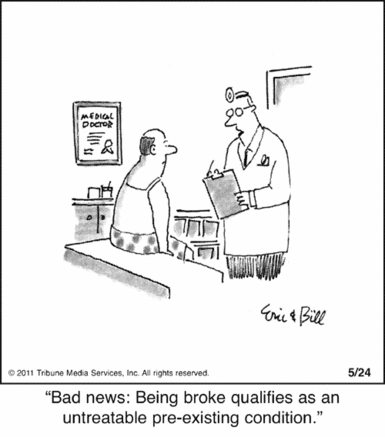
Projections of the amended bill’s effects on coverage and the federal budget are not yet available from the Congressional Budget Office. But it is still likely to significantly increase the numbers of uninsured Americans and raise the cost of insurance for many of the nation’s most-vulnerable citizens. Both the original and the new version dramatically cut and reconfigure the Medicaid program. And the latest amendments allow states to weaken consumer protections, particularly regarding preexisting conditions, while adding just $8 billion over five years to cover those with preexisting conditions who are unable to afford coverage.
The amended bill as passed does little to change many provisions of the original AHCA including:
The CBO estimated in March that the combined effects of these provisions would increase the number of people without health insurance by 24 million by 2026. Older Americans would be particularly hard hit by the bill, experiencing much higher premiums relative to the ACA and the greatest coverage losses.
The amendments offer states the option to apply for waivers to reduce ACA consumer protections that have enabled people with health problems to buy private health insurance. Beginning in 2019, states could waive the ban on charging people with preexisting conditions higher premiums for those who do not maintain continuous coverage. But states could only do this if they set up special programs to help people with conditions like cancer or heart disease who could no longer afford coverage. States could also change the ACA’s required minimum package of health benefits for health plans sold in the individual and small-group markets.
Despite the fact the federal ban on preexisting condition exclusions would remain under the AHCA, as Tim Jost points out, insurers could reach the same end by not covering services like chemotherapy that sick people need, or by charging very high premiums for individuals with expensive, preexisting problems. In addition, waiving the ACA’s essential benefit requirement could weaken other consumer protections like bans on lifetime and annual benefit limits and caps on out-of-pocket costs.
States that allowed higher premiums for people with health problems would be required to set up programs such as high-risk pools or reinsurance for high claims costs. Or under an AHCA amendment proposed earlier in the month, states could also participate in an “invisible risk-sharing” program, a hybrid between a high-risk pool and reinsurance for high claims costs. The federal government would provide $15 billion over 2018–2026 for states to share. But while reinsurance options might protect insurers from high claims costs, giving them the ability to charge premiums based on health status would result in many people with preexisting conditions facing unaffordable premiums. As for high-risk pools, prior research has found that such pools operated by states before the ACA were expensive both for states and for people enrolled in them, and covered only a small fraction of the individuals who would have benefited. Avalere estimates that there are currently more than 2.2 million people with preexisting conditions in the individual market. The new funding of $8 billion under the amended AHCA, in addition to the previously designated $15 billion, amounts to just $3.3 billion for states to share in 2019. Assuming states used this funding for high-risk pools, it is sufficient to help only 110,000 people, or 5 percent of those with preexisting conditions. Moreover, even this group of people could have critical services excluded from their benefits if their state weakened the essential benefit package.
Setting aside the amended AHCA’s potential effects on the health and health care of Americans, many questions and uncertainties remain about the bill’s timing and fate. First, the fate of the amended AHCA in the Senate remains uncertain. Some possible provisions—affecting essential health benefits, premium increases based on health, and other features—may not withstand scrutiny by the Senate parliamentarian as she evaluates whether they are appropriate parts of a budget reconciliation bill, and thus exempt from filibuster. Furthermore, many moderate Senate Republicans reportedly have concerns about the Medicaid provisions of the AHCA.
It now appears that the Senate may actually set aside the House legislation and write their own bill from scratch. The resulting bill would undoubtedly be designed to meet the requirements of the Senate reconciliation process, and thus be exempt from filibuster—something the House bill did not accomplish. Newly crafted Senate legislation might take a very different approach to the ACA’s Medicaid provisions, and even drop budget restrictions such as individual caps or block grants. Senators may also make the premium subsidies more generous to reduce the numbers of Americans who will lose private insurance under the AHCA.
From a legislative viewpoint, the greater the divergence between the House-passed and Senate-passed bills (if the Senate actually passes legislation), the more complicated it will be for House leadership to hold its fragile 217 vote majority together to pass a House–Senate compromise.
Second, the complex legislative maneuvering around the AHCA should not detract attention from the fundamental facts. Health insurance saves lives and protects Americans from crippling medical debt and even bankruptcy. Changes to existing legislation that result in fewer insured Americans will undermine the health and quality of life of millions of people, as well as increase economic inequality in this country.

 HENRY KOTULA