


Cartoon – Losers and Winners

In all of medical history, few names have been sung more brightly than Florence Nightingale, born on this day in 1820. Credited with founding the first modern, secular nursing school in 1860 (at St. Thomas’s Hospital in London, and currently part of King’s College, University of London), Florence’s birthday has been designated International Nursing Day.
Nicknamed “the Lady of the Lamp” by an intrepid journalist for the London Times, and subsequently immortalized by Henry Wadsworth Longfellow in his 1857 poem “Santa Filomena,” Florence Nightingale first came to prominence during the Crimean War.
In 1855, she organized and trained a group of nurses to help the soldiers injured during that conflict. Appalled by the primitive hospital facilities, the lack of beds, bandages, and bathing facilities, all wrapped into a decidedly filthy, vermin-ridden environment, Nightingale later wrote, “the British high command had succeeded in creating the nearest thing to hell on earth.” Initially, her nurses were not allowed to see the suffering soldiers and, instead, ordered to clean the hospital floors. As the casualties mounted and the physicians became overwhelmed, Nightingale’s nurses were finally enlisted to help.
READ MORE: Celebrating Rebecca Lee Crumpler, first African-American woman physician
Nightingale’s poetic moniker was the result of her late evening rounds visiting the wounded soldiers. When the war ended and she returned home to London, she was lauded as a national hero and showered with awards and medals including a jewel from Queen Victoria.
Nightingale’s 1859 book, “Notes on Nursing,” on the other hand, shed a far better light on the profession and soon became a standard textbook for training nurses around the globe.Ever busy with advancing the profession of nursing, Nightingale worked extraordinarily hard to counter the prevalent (and negative) view of nurses, such as that described by Charles Dickens in his 1842-1843 novel, “Martin Chuzzlewit.” One of the minor characters in this delightful tome is an incompetent, poorly trained and negligent nurse named Sarah Gamp. She is best recalled as an alcoholic, far more interested in her next glass of gin than the needs of her patients.
Florence was also consumed with advancing the causes of cleanliness in the hospital setting and beyond by using the newly developed mathematical methods of statistics to prove that such interventions made a difference.
Beginning with her war work, Nightingale noted that 10 times more soldiers died of the so-called filth diseases, such as cholera, dysentery, typhoid and typhus, than those who succumbed to bullets and cannon balls. She determined the cause to be related to the overcrowding of soldiers, paltry latrine and sewer facilities and, in an era when “poisonous miasmas” were still thought to the source of many infectious diseases, poor ventilation in the hospital wards. Indeed, her insistence on adequate ventilation led to a worldwide trend of building hospitals with large windows and cross-ventilation schemes, a design one can still see in the few 19th century hospital buildings that remain in various American and European cities.
READ MORE: How poet John Keats met his early end
Working with the pioneering British statistician William Farr and public health and urban poverty expert Edwin Chadwick, she compiled, analyzed and presented understandable and detailed information on the living conditions of England’s poorest citizens, as well as the living conditions, public health, and medical care of those living in India. Florence Nightingale pioneered in the graphical representation of the numbers she crunched. She was an early adopter of the “pie chart” and developed her own “rose diagram,” which is a circular histogram of data she called the “coxcomb” and used to describe seasonal changes in patient mortality, first in various military theaters and, subsequently, among Britain’s poor.
This work led to the passage of England’s Public Health Acts of 1874 and 1875, which required property owners to connect their sewage lines to main drain pipes, as a means of controlling the dumping of huge amounts of human waste onto city streets, and giving control of public health problems to local authorities who saw the unhealthy conditions first hand, rather than the previous system of granting those powers to centralized government officials in a faraway office. Both these reforms are credited with playing a vital role in extending the lifespan of British subjects (as well as citizens in other industrialized, western nations) by 20 years, between 1891 and the mid-1930s, when there were not yet the advantages of antibiotics, intravenous fluids or other modern medical conveniences.
A deeply religious woman, Florence was the advantaged child of a wealthy family. She managed to use those advantages, as well as surmount the disadvantages of being an ambitious, professional woman in Victorian England, to help the neediest and most vulnerable, both to the ravages of poverty and disease.
Today, on Florence Nightingale’s birthday and International Nurse’s Day (this year’s celebratory theme is “The Balance of Mind, Body and Spirit”), we celebrate her multitude of accomplishments and those of the legion of nurses who followed in her path and continue to make a huge difference in caring for the ill.
When reflecting on the life of this extraordinary woman, the doctor in me is forced to recall a lesson he learned the hard way as an intern: if you want to know what is really doing on with a patient, make sure you ask his or her nurse first.


Click to access PDF%20PoliticoProDatapointGOPSenatorsMedicaidCuts.pdf

Early negotiations over the shape and scope of the Senate’s bill to replace the ACA have divided conservative and moderate Republicans. One critical issue: the fate of the Medicaid program.

The Justice Department sued Minnetonka, Minn.-based UnitedHealth Group Tuesday, alleging the payer defrauded Medicare at least $1 billion in false claims.
In the 103-page lawsuit filed in a Los Angeles federal court, the Justice Department alleged the payer knowingly inflated risk adjustment payments by providing the government inaccurate data about the health status of its beneficiaries. Department officials cited UnitedHealth’s “one-sided” chart review process that reportedly didn’t address errors elevating its revenues.
The department also alleges the payer ignored “invalid diagnoses from healthcare providers with financial incentives to furnish such diagnoses.“
The move follows the department’s decision to intervene in a whistle-blower suit filed by James Swoben in 2009. That suit alleges UnitedHealth billed Medicare higher payments for patients by “making patients look sicker than they” were. In an earlier statement to Star Tribune, UnitedHealth spokesperson Matt Burns said the payer denied the claims and has “been transparent with [CMS] about our approach under its unclear policies. We reject these claims and will contest them vigorously.”
This is the second lawsuit the department has filed against the insurer this month. The other lawsuit concerns separate but similar allegations filed under seal in 2011 by Benjamin Poehling, former finance director of UnitedHealthcare Medicare and Retirement.
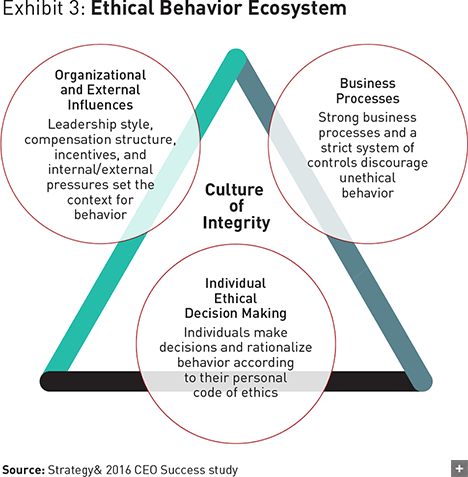
The job of a chief executive officer at a large publicly held company may seem to be quite comfortable — high pay, excellent benefits, elevated social status, and access to private jets. But the comfortable perch is increasingly becoming a hot seat, especially when CEOs and their employees cross red lines.
As this year’s CEO Success study shows, boards of directors, institutional investors, governments, and the media are holding chief executives to a far higher level of accountability for corporate fraud and ethical lapses than they did in the past. Over the last several years, CEOs have often garnered headlines for all the wrong reasons: for misleading regulators and investors; for cutting corners; and for failing to detect, correct, or prevent unethical or illegal conduct in their organization. Some high-profile cases, involving some of the world’s largest corporations, have featured oil companies bribing government officials and banks defrauding customers.
To be sure, the number of CEOs who are forced from office for ethical lapses remains quite small: There were only 18 such cases at the world’s 2,500 largest public companies in 2016. But firings for ethical lapses have been rising as a percentage of all CEO successions. (We define dismissals for ethical lapses as the removal of the CEO as the result of a scandal or improper conduct by the CEO or other employees; examples include fraud, bribery, insider trading, environmental disasters, inflated resumes, and sexual indiscretions. See “Methodology,” below.) Globally, dismissals for ethical lapses rose from 3.9 percent of all successions in 2007–11 to 5.3 percent in 2012–16, a 36 percent increase. The increase was more dramatic in North America and Western Europe. In our sample of successions at the largest companies there (those in the top quartile by market capitalization globally), dismissals for ethical lapses rose from 4.6 percent of all successions in 2007–11 to 7.8 percent in 2012–16, a 68 percent increase.
http://www.beckershospitalreview.com/finance/dignity-health-reports-85m-operating-loss-in-q3.html

San Francisco-based Dignity Health saw a decrease in revenue in the third quarter of fiscal year 2017, according to an unaudited quarterly report.
The nonprofit health system reported revenues of $3.14 billion for the three-month period ended March 31, down about 2 percent from $3.2 billion in the same period the year prior. Dignity partially attributed lower revenues to a $111.3 million decrease in net patient and premium revenue over the same period in the previous fiscal year.
The system’s operating loss more than doubled in the third quarter when compared with the same period last year. For the three-month period, the health system recorded operating losses of $85.4 million, up from $41.7 million in the same period the year prior.
Dignity attributed the loss to several factors, including unrecognized provider fee income during the period, which is pending CMS approval. The system recorded provider fee income of $108.9 million in the third quarter of the previous fiscal year.
For the nine months ended March 31, Dignity reported an operating gain of $79.5 million, up from an operating loss of $87.1 million for the same period in the prior year.
 HENRY KOTULA