

Leaving a high-flying job in consulting, Angela Lee Duckworth took a job teaching math to seventh graders in a New York public school. She quickly realized that IQ wasn’t the only thing separating the successful students from those who struggled. Here, she explains her theory of “grit” as a predictor of success.
Monthly Archives: April 2026
Happy Easter

Washington and Lee University’s Speaking Tradition
Washington and Lee University’s Speaking Tradition is a long-standing campus custom where students, faculty, and staff greet each other with a “hi” or “hello” while passing on campus. Promoting a welcoming, friendly atmosphere and a sense of community, it reflects the university’s values of civility and personal connection.
Key Aspects of the Speaking Tradition:
- Origin & Purpose: It is a deeply embedded, informal custom meant to foster community and ensure every individual feels acknowledged.
- Application: It involves smiling, nodding, or saying hello, especially when walking along the historic Colonnade or paths.
- “Say Hey” Day: Kathekon students often promote this tradition on campus.
- Challenges: The tradition faces pressure from technology, such as smartphone usage and headphones.
- Distinction: The “speaking” part refers to greeting others, not public speaking.
The tradition is considered a “positive chain reaction” that helps make the university feel like a welcoming community.
The Health of a Civilization
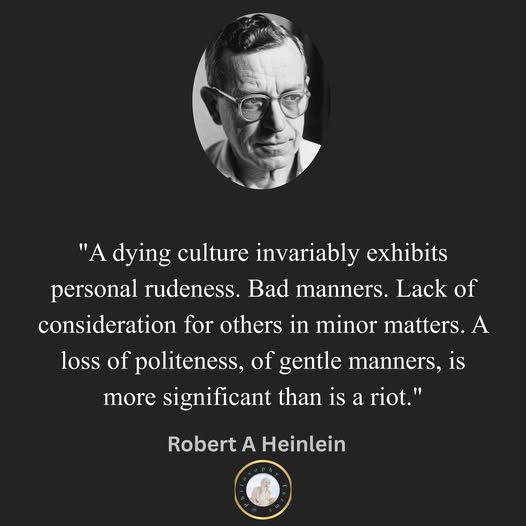
This insightful observation from science fiction author Robert A. Heinlein suggests that the health of a civilization is best measured by its smallest interactions, not its biggest conflicts.
Here is a breakdown of its meaning:
Civility as Social Glue: Politeness and “gentle manners” are more than just etiquette; they represent a fundamental respect for the social contract. When people stop showing consideration in “minor matters,” it signals that they no longer value their neighbors or the community at large.
The Subtle Rot vs. The Loud Event: A riot is an explosive, often temporary, reaction to a specific problem. However, widespread rudeness is a slow, pervasive rot. Heinlein argues that this quiet erosion of decency is more dangerous because it signifies a deep, internal collapse of shared values that is much harder to repair.
The Foundation of Order: Large-scale order is built upon small-scale respect. If a culture loses its ability to maintain daily politeness, it has lost the very foundation that prevents total chaos. Once mutual consideration is gone, the culture is essentially already “dead.”
In essence, when a culture stops practicing common decency in “minor matters,” it is already “dead”.
 HENRY KOTULA