Epic expanding its lead on EHR competitors

https://mailchi.mp/b7baaa789e52/the-weekly-gist-september-29-2023?e=d1e747d2d8
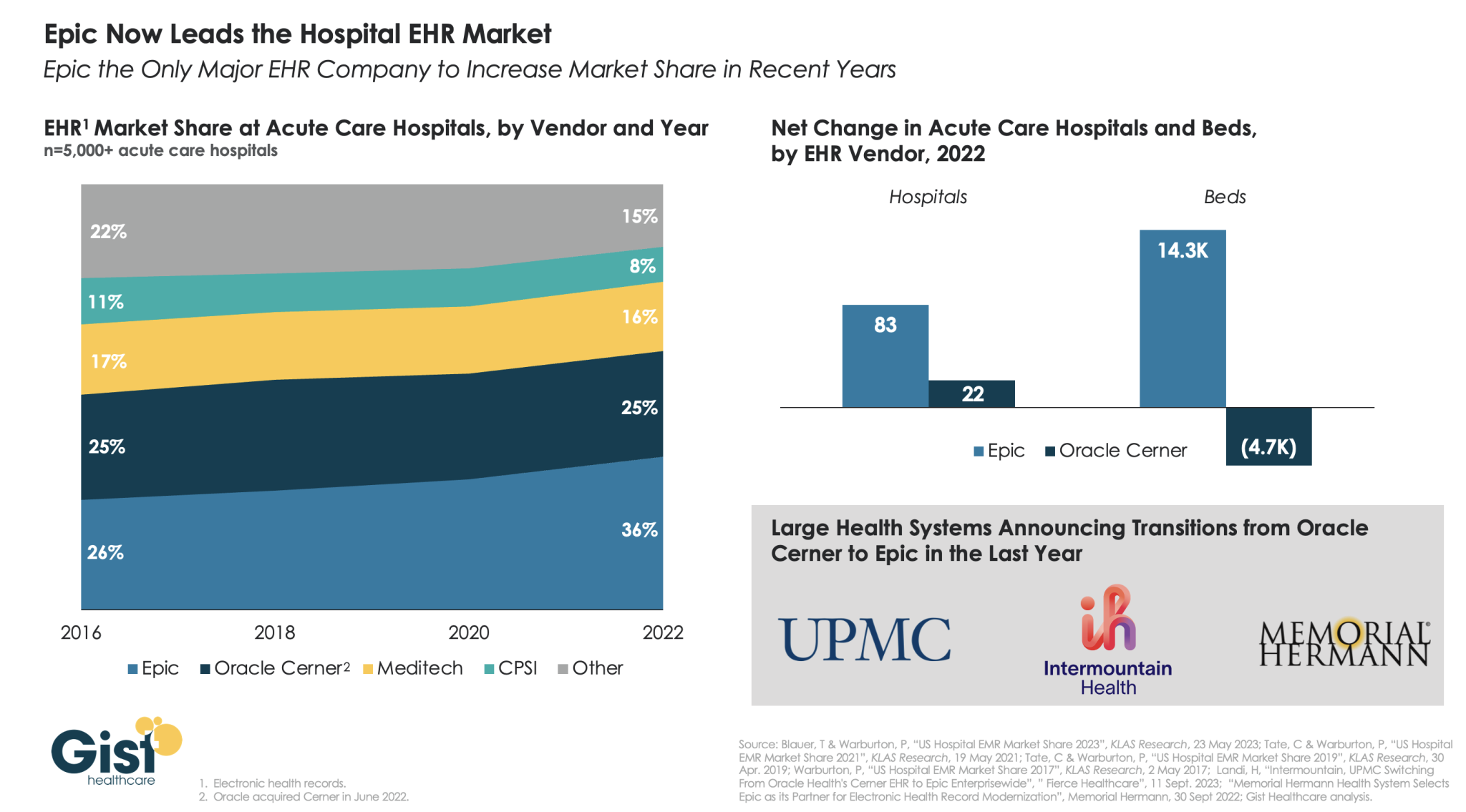
Two large nonprofit health systems made headlines earlier this month announcing that they plan to transition, enterprise-wide, from Oracle Cerner to Epic for their electronic health record (EHR) system.

Using data from KLAS Research, the graphic below shows how Epic has emerged in recent years as the leader in the hospital EHR market. From 2016 to 2022, Epic increased its acute care hospital market share from 26 percent to 36 percent, while its main rival, Oracle Cerner, held flat at 25 percent.

Moreover, Epic is gaining popularity among larger health systems, while Oracle Cerner lost almost 5K beds in 2022, despite gaining 22 hospitals, as it trades large systems for smaller hospitals. 

Epic’s ability to consolidate multiple archives into a single, more functional platform has made it popular with physicians, whose feedback was cited by Intermountain as a key reason behind the system’s decision to switch. 

With three quarters of Americans having an Epic record, the company is leveraging its pole position in aggregating healthcare data as healthcare approaches the cusp of a generative AI boom, recently announcing an expanded partnership with Microsoft focused on integrating AI tools into its EHR system. 

Intermountain and UPMC switching from Oracle Cerner to Epic

https://mailchi.mp/e1b9f9c249d0/the-weekly-gist-september-15-2023?e=d1e747d2d8

Two of the nation’s largest nonprofit health systems, Salt Lake City, UT-based Intermountain Healthcare and Pittsburgh, PA-based UPMC, have recently announced plans to end their electronic health record (EHR) contracts with Oracle Cerner and transition, enterprise-wide, to Epic.

Intermountain, which operates 33 hospitals across seven states, plans to integrate Epic’s EHR into all of its facilities by 2025; its legacy SCL Health hospitals in Colorado and Montana already use Epic.

UPMC, which operates 40 hospitals in three states, has set mid-2026 as the target for consolidating its nine EHRs into a single platform with Epic. It has been using Oracle Cerner in inpatient settings and Epic for ambulatory care.

Both systems cited provider feedback and a desire to simplify patient record-keeping as key reasons behind their decisions to switch. 

The Gist: With two more marquee health systems jumping ship for Epic, Oracle Cerner faces a steeper battle to maintain a foothold with health systems and may need to rethink its target market and value proposition. 

Cerner initially appealed to large, progressive, value-oriented systems with highly customizable offerings, but over the years the resulting “Franken-Cerner” systems (as one CIO put it) became hard to maintain and scale. 

Meanwhile, Epic continues to grow its lead in the domestic EHR market: it now covers roughly half of acute-care beds in the US and holds records on 78 percent of US patients. 

Sitting on troves of health data, Epic is also well-positioned to become a leader in the rollout of next-generation healthcare AI, which it has already set in motion through its partnership with Microsoft.

Epic, Microsoft expand generative artificial intelligence (AI) partnership

https://mailchi.mp/d29febe6ab3c/the-weekly-gist-august-25-2023?e=d1e747d2d8

On Tuesday, Verona, WI-based Epic and Redmond, WA-based Microsoft announced a suite of new AI-powered solutions available to users of Epic’s electronic health records (EHR) system.

In April 2023, Epic began integrating Microsoft’s Azure OpenAI Service, which utilizes GPT-4 capabilities, into its EHR. This next phase builds on that collaboration, introducing tools that support ambient notetaking, create clinical documentation summaries, and offer medical coding suggestions, all through generative AI. Epic is rolling out these services as it debuts its revamped third-party app market, which now hosts programs developed by Microsoft-owned Nuance as well as smaller startups. 

The Gist: Given the massive datasets required to train these AI programs, the competition to deploy AI-powered healthcare workforce at scale will likely be driven by the largest tech and healthcare data companies rather than smaller start-ups. 

Epic’s new app marketplace for third-party vendors is meant to ensure just that, by positioning it as the primary hub for many healthcare-specific AI programs in development. 

Health systems will race to take advantage of the cost savings unlocked by these technologies, which they will hope integrate seamlessly into their EHRs. 

As physicians stand to benefit from eased administrative burdens, but also have justified concerns over generative AI’s reliability, health systems should keep an open dialogue with frontline providers as they implement these new tools.