Straight repeal plan is a no go with 3 “no” votes

https://www.axios.com/repeal-then-replace-plan-is-a-no-go-with-3-no-votes-2461490907.html

Related image

Three GOP senators — Shelley Moore Capito, Susan Collins, and now Lisa Murkowski — all will vote “no” on the new plan to repeal and then replace the Affordable Care Act.

Why it matters: This guarantees what was already widely expected: that Senate Republicans wouldn’t be any more successful with a straight repeal plan, without a replacement, than they were with the repeal-and-replace legislation that stalled yesterday. Republicans could only lose two votes.

What’s next: Senate Republicans are still likely to schedule the vote — even if it fails — because they have to prove to conservative groups (and President Trump) that they’ve tried everything.


Trump says he’ll ‘let ObamaCare fail’

Trump says he’ll ‘let ObamaCare fail’

Image result for Trump says he'll 'let ObamaCare fail'

President Trump on Tuesday said he was disappointed in the Senate’s failure to repeal and replace the Affordable Care Act and argued that Republicans should now let the law fail on its own.

In his first on-camera remarks about the stalemate in the Senate, Trump said it “will be a lot easier” to allow ObamaCare to falter on its own.

“I think we’re probably in that position where we’ll let ObamaCare fail,” he told reporters in the Roosevelt Room. “We’re not going to own it. I’m not going to own it. I can tell you the Republicans are not going to own it. We’ll let ObamaCare fail and then the Democrats are going to come to us.”

Venting his frustration with Congress, Trump talked of how he had heard lawmakers for seven years talk about the need to repeal and replace ObamaCare.

Given the chance to do so, “they don’t take advantage of it,” he said.

“I’m sitting in the Oval Office right next door, pen in hand, waiting to sign something,” Trump added.

Despite the defeat on healthcare reform, Trump cast his presidency as a string of victories, saying the United States was winning in the war of terrorism and that it would secure an overhaul of the tax code.

Congress has not moved forward with Trump’s tax reform agenda so far, largely because of the time spent working on healthcare reform.

Trump promised to win repeal of ObamaCare upon his election, and the defeat is a significant loss for the White House.

Legislation to repeal and replace ObamaCare was approved by the House in May and was celebrated in a Rose Garden ceremony by Trump.

But it has come to a complete standstill in the Senate, where GOP leaders do not even have the votes to bring legislation repealing ObamaCare to the floor.

While Trump took a shot at Congress, he said he does not blame Senate Majority Leader Mitch McConnell (R-Ky.) for the defection of two Republican senators that effectively killed the measure.

Trump said he was “very surprised” that conservative Sens. Jerry Moran(Kan.) and Mike Lee (Utah) came out against the bill, evidence of the disconnect between the White House and Capitol Hill that has helped stymie the president’s agenda.

The White House and its allies have periodically lashed out at GOP opponents of the healthcare measure, reportedly threatening to back a primary challenge of Arizona Sen. Jeff Flake and to run attack ads against Nevada Sen. Dean Heller, both of whom are up for reelection next year.

But Trump said Tuesday the key to advancing his priorities was expanding the GOP’s 52-seat majority in the Senate.

“We’re going to have to go out and get more Republicans elected in ’18,” he said. “I’ll be working very hard for that to happen. It would be nice to get Democrat support but really they are obstructionists. They have no ideas.”

Some Republicans, however, believe the president is at fault. They say he failed to master the details of the healthcare initiative, did little to sell it and sent mixed messages about his desired outcome.

That was on display in the past 24 hours. Trump on Monday night called on the Senate to repeal ObamaCare and then pass a replacement later.

“Republicans should just REPEAL failing ObamaCare now & work on a new Healthcare Plan that will start from a clean slate. Dems will join in!”

But on Tuesday morning, he tweeted out a completely different proposal — letting former President Obama’s law fail on its own.

“As I have always said, let ObamaCare fail and then come together and do a great healthcare plan. Stay tuned!” he wrote.

GOP’s repeal-and-delay plan flops after 3 senators oppose it

http://www.fiercehealthcare.com/aca/gop-s-repeal-and-delay-plan-dies-after-3-senators-oppose-it?mkt_tok=eyJpIjoiTWpSbE9EVXdZekprT0dGayIsInQiOiJhZTUwUmloU3JtK3RGdXNJenNmSFwvRlpJaUlvbkRaZ3B1Q3kwYnFYS3hydUVQTGt0dE1CbFRMN2orMEgybjR0SjI1WXZuTHlkZ3BKS09kNlArVW1Vbm00QnZKMFNvTHorbkM2Ymw3Zk1ZTjM4UHBsQWlwQVg4TVwveFhPN1FBZ2E4In0%3D&mrkid=959610&utm_medium=nl&utm_source=internal

Sen. Susan Collins

Three moderate Republican senators now oppose a plan to repeal the Affordable Care Act and replace it later, leaving Senate Majority Leader Mitch McConnell lacking the votes he’d need to move the measure forward.

With the Better Care Reconciliation Act scuttled following news late Monday that two more senators would oppose it, McConnell said Tuesday that the Senate would vote on an ACA repeal measure “combined with a stable, two-year transition period” during which it will craft a replacement.

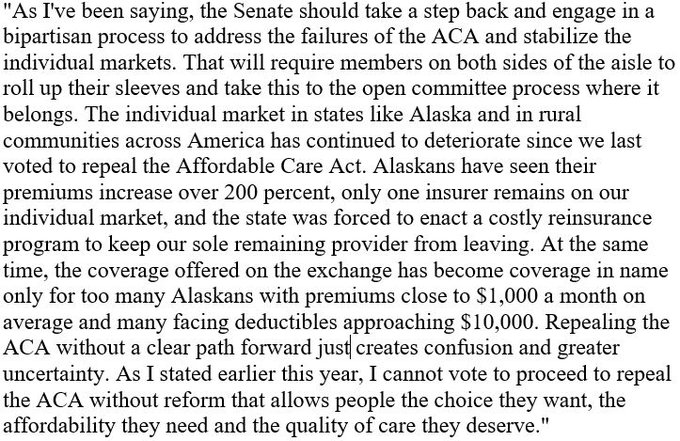
But the measure’s chances quickly died after Alaska Sen. Lisa Murkowski became the third GOP senator to announce her opposition to the bill.

“I cannot vote to proceed to repeal the ACA without reform that allows people the choice they want, the affordability they need and the quality of care they deserve,” she said in a statement posted on Twitter. Instead, she called for the Senate to undertake a bipartisan effort to fix the ACA exchanges.

Sen. Shelley Moore Capito of West Virginia was the first to announce her opposition to a repeal-and-delay plan. “As I have said before, I did not come to Washington to hurt people,” she said in a statement.

Maine Sen. Susan Collins—who was one of the four “no” votes that led to the demise of the BCRA—also quickly came out against McConnell’s new strategy.

“I will vote no on the motion to proceed to repeal the Affordable Care Act without a replacement,” she said.

“We can’t just hope that we will pass a replacement within the next two years,” Collins added. “Repealing without a replacement would create great uncertainty for individuals who rely on the ACA and cause further turmoil in the insurance markets.”

As with the BCRA, McConnell could only afford to lose two votes on a repeal-and-delay bill tailored to pass the chamber through the fast-track budget reconciliation process, given that such a measure was not expected to attract any Democratic support.

The White House, meanwhile, said it is willing to back whichever strategy results in repealing the ACA—whether that’s a repeal-and-delay bill or a “return to the legislation carefully crafted in the House and Senate,” Vice President Mike Pence said at a National Retail Federation event Tuesday.

“Inaction is not an option,” he added. “Congress needs to step up, Congress needs to do their job and Congress need to do their job now.”

Straight repeal of ACA back on the table after BCRA fails: 5 things to know

http://www.beckershospitalreview.com/hospital-management-administration/straight-repeal-of-aca-back-on-the-table-after-bcra-fails-5-things-to-know.html

Related image

Two more Republican senators defected from the revised Better Care Reconciliation Act Monday evening, effectively sinking the ACA repeal and replacement bill, according to The New York Times.

Here are five things to know about the bill’s collapse.

1. The two defectors were Republican Sens. Mike Lee of Utah and Jerry Moran of Kansas. Both are Tea Party senators who opposed the ACA, so their defections came as a surprise, according to BloombergMr. Moran said in a statement he opposed the BCRA because it “fails to repeal the ACA or address healthcare’s rising costs.” He added, “We should not put our stamp of approval on a bad policy.” Mr. Lee did not support the bill because it did not repeal all of the ACA’s taxes or lower premiums enough for the middle class, according to a statement.

2. Without the support of Mr. Lee and Mr. Moran, the bill is dead. Senate Republicans needed at least 50 votes to pass the bill via reconciliation. They hold 52 seats, but two Republicans already announced their opposition: Sens. Susan Collins of Maine and Rand Paul of Kentucky. “Regretfully, it is now apparent that the effort to repeal and immediately replace the failure of Obamacare will not be successful,” Senate Majority Leader Mitch McConnell, R-Ky., said in a statement.

3. Mr. McConnell now wants to return to the full ACA repeal strategy. To do this, the Senate would take up the House bill, the American Health Care Act, and tack on an amendment to repeal the 2010 healthcare law, according to Mr. McConnell’s statement. This would repeal the ACA after a two-year delay to allow for Congress to facilitate a transition and a potential replacement. A bill similar to this was passed in 2015, but was repealed by former President Barack Obama.

4. Despite support in 2015, the straight repeal strategy will be tough to pass now. The New York Times report said this strategy “has almost no chance to pass,” because it will destabilize insurance markets too much. An analysis from the Congressional Budget Office published in January found 32 million more people would be uninsured by 2026 under the 2015 repeal bill. This would set back insurance rates more than the BCRA or the AHCA, which were estimated to increase the number of uninsured by 22 millionand 23 million by 2026, respectively.

5. President Donald Trump is pushing Congress toward the full repeal. He tweeted Monday night, “Republicans should just REPEAL failing Obamacare now & work on a new healthcare plan that will start from a clean slate. Dems will join in!”

The Un-Democratic Process Behind Trumpcare

https://www.theatlantic.com/politics/archive/2017/07/the-disturbing-process-behind-trumpcare/533850/

http://www.realclearhealth.com/2017/07/18/the_un-democratic_process_behind_trumpcare_276901.html?utm_source=morning-scan&utm_medium=email&utm_campaign=mailchimp-newsletter&utm_source=RC+Health+Morning+Scan&utm_campaign=114c8c7a9a-MAILCHIMP_RSS_EMAIL_CAMPAIGN&utm_medium=email&utm_term=0_b4baf6b587-114c8c7a9a-84752421

Image result for The Un-Democratic Process Behind Trumpcare

Since I came to Washington in 1969, I have been immersed in Congress and its policy process. I have seen many instances of unpopular bills considered and at times enacted. I have seen many instances of bills put together behind closed doors. I have seen bills enacted and repealed after a public backlash. I have seen embarrassing mistakes in bills, and lots of intended consequences.

But I have never seen a process like the one Senate Majority Leader Mitch McConnell is using in the Senate with his so-called Better Care Reconciliation Act, BCRA, to presumably repeal and replace the Affordable Care Act; nor have I seen lawmakers responding to the bill, and their own constituents, this way.

Let’s take a brief look at a couple of Congress’s greatest hits: one unpopular bill and one crafted in private. Perhaps the most notorious in terms of unpopularity was the aptly named Medicare Catastrophic Act of 1988, which was substantially repealed just a year later after an intense backlash from a group of more affluent seniors upset that their costs would go up. The visual imprinted in many minds was hundreds of enraged elderly chasing Illinois Representative Dan Rostenkowski down a street in Chicago as he sought refuge in his car after a rancorous town meeting.

Sure sounds like a parallel to today. But consider: The 1988 act was an open and thoroughly  bipartisan effort to fulfil one of Ronald Reagan’s promises, to protect seniors against financial disaster; it actually provided a substantial set of benefits for poorer seniors, but because it was financed entirely within Medicare, it included additional taxes on wealthier seniors, many of whom already had some of the benefits in the bill through their supplemental insurance. There was a lot of debate over the elements in the bill during its deliberations, but no real controversy at its passage. But after its enactment, the more well-to-do seniors, inflamed by a distorted attack by a rival group to AARP, reacted to the costs without considering the benefits, leading Congress the next year to repeal most of it. The repeal of its prescription drug benefit triggered another controversial law, President George W. Bush’s Medicare Part D, in 2003.

What about bills crafted in private? Take a look at the two-year spending deal reached in 2013 by House Budget Chair Paul Ryan, a Republican, and Senate Budget Chair Patty Murray, a Democrat. Many of the details were in fact worked out in private sessions between the two and their staffs. The deal averted a draconian sequester for both defense and domestic spending that neither side wanted. And they worked out a series of tradeoffs, avoiding the worst kinds of pain, keeping the government open, and adding a bit more to deficit reduction along the way, while also finding a two-year deal to keep the same crisis from emerging the next year.

To be sure, this was not a deal that followed the regular order of open conference committee deliberations. But it was a process that House and Senate leaders of both political parties endorsed. And it was one where at every step along the way, Murray and Ryan reported back to their party leaders, and their caucus members, what was going on. It was, especially for the time, a commendable effort to find bipartisan consensus. Which it did.

Now let’s look at BCRA. It started, of course, with McConnell bypassing the committees that deal with health policy, both Finance and Health, Education, Pensions, and Labor (HELP) by handpicking 13 Republican senators—all middle-aged and elderly white men—to work in complete privacy to draft the bill. Besides women like Senators Susan Collins and Lisa Murkowski, McConnell also left off Senator Bill Cassidy of Louisiana, a physician with deeper knowledge of health policy than nearly all of the 13 chosen. The gang of 13 kept their vow of omerta, leaving even their Republican colleagues at sea during their sessions. And of course, McConnell brushed aside peremptorily any notion that Democrats would be brought into deliberations, or consulted.

Nor were the groups representing those on the front lines of health policy and delivery, including doctors, hospitals, insurers, nurses, those with debilitating diseases, and more, consulted or included. One of the more striking, and embarrassing, moments came when McConnell—who had overcome polio as a child—refused to meet with the March of Dimes, the non-profit founded in the New Deal era to combat the disease.

The bill that emerged was, of course, a catastrophe. It was not a carefully constructed health-policy bill, but basically a vehicle to give ginormous tax cuts to the wealthiest among us, financed by almost $800 billion in cuts from Medicaid, while also adding immensely to the health-care costs of poor and older Americans. The CBO score was devastating. And despite repeated vows to vote before the July 4 recess, McConnell had to take the bill back to the drawing board. Over the recess, we saw another remarkable phenomenon. Senators who went back home, ostensibly to meet and communicate with their constituents, instead mostly behaved as if they were in witness protection programs—doing everything they could to avoid town meetings or any gatherings with voters, or in some cases to hold meetings only with a pre-selected group to keep out those who would be hurt by the health bill.

The next iteration of the McConnell bill made a concession to Senator Ted Cruz to nail down votes from the radical members of the Senate GOP that health experts said would blow up insurance markets. It pared down some of the tax cuts, primarily to give McConnell a $200 billion-plus slush fund to lure recalcitrant Republican senators; he promptly threw in $42 billion more for opioid treatment to corral Senators Rob Portman of Ohio and Shelly Moore Capito of West Virginia, and tossed billions more to Alaska to nail down Senator Lisa Murkowski.

But despite adding $172 billion to stabilize insurance markets, the bill kept all the provisions to blow up Medicaid, dealing victims of the opioid disaster a much larger blow than the additional $42 billion, continued to defund Planned Parenthood, and drew sustained condemnation for every major health industry group, every major health policy analyst, a slew of governors including Republicans like John Kasich of Ohio and Brian Sandoval of Nevada. And the approval of the bill with the public stood at 38 percent in a Kaiser poll, lower than any piece of significant legislation I can ever recall.

Compounding all this, McConnell was intent on moving the bill before a new CBO score, even pushing to substitute a number from the Department of Health and Human Services. Along the way, to build support among wavering senators, administration officials led by HHS Secretary Price and Vice President Pence offered reassurances and statements that were simply false—so much so that Republican Ohio Governor John Kasich actually called out his own vice president.

By every past standard, and every logical standard of behavior in a representative democracy, this bill should be dead. It is not. Why not?

Republicans have no easy way out of a box canyon on health policy of their own making.

Eight years ago, when the Affordable Care Act was in its gestation period, then Republican Whip Eric Cantor said the GOP alternative to it was “weeks away.” It turned out to be 400 weeks. After ACA was enacted, we saw not a Republican alternative but 60-plus votes to repeal with a promise to replace. A week ago, when asked why Senate Republicans had to scramble to slap this plan together, Senator Pat Toomey of Pennsylvania said it was because none of them had expected Donald Trump to win. Think about that: Toomey was admitting that Republicans saw no need to come up with their own health plan in a  Clinton presidency; they could just continue to work to sabotage Obamacare and take more votes to repeal without any replacement to be judged by the same standards as other bills.

There was another element to the box canyon. The ACA was fundamentally built on the Republican alternative to Clintoncare in 1993-94, as crafted by Charles Grassley, Orrin Hatch, the late John Chafee and the former Senator David Durenberger. Their alternative had competition for private insurers on regulated exchanges, and an individual mandate to buy insurance to broaden the risk pool and get rid of the burden of pre-existing conditions. When Republicans in 2009 decided not to cooperate with Democrats in Congress, but to unite in full-throated opposition to any plan that emerged, and then to work actively to delegitimize whatever passed, they created a big dilemma. Call Obamacare the worst thing since slavery, as Ben Carson did, vote over and over to repeal it root and branch—and you can’t then turn around and adopt its framework. That left  no workable framework.

Of course there is a workable alternative: join with Democrats and fix the problems in Obamacare, stabilizing insurance markets, expanding Medicaid in the states that have failed to do so, finding ways to make the individual mandate work better to expand the risk pool more. But after a decade of success inflaming tribal warfare, that is not a path McConnell and Ryan are willing to take.

Republicans had no real interest in actually fixing the health-care system. This bill is far more a delivery system for tax cuts for the rich, paid for by cutting Medicaid.

Those tax cuts are the number one priority for conservatives in and out of Congress. But this could become a twofer. Conservatives have hated Medicaid ever since it was created in 1965. As Medicaid expanded to become the vehicle to pay for long-term care for the elderly along with care for the disabled and mentally ill, it became a huge government program. When Medicaid expansion became a core vehicle in Obamacare for giving health insurance to the poor, it became larger yet. So Republicans in Congress seized the moment to do something they have been unable to do in more than five decades—cut the program dramatically and shift the burden for the cuts largely to states. Doing so meant freeing up hundreds of billions of dollars that could then be used to pay for the first wave of deep tax cuts aimed especially at the richest among us. Indeed, the first BCRA iteration provided a boon for the 400 richest Americans that was large enough to pay for the Medicaid benefits of 725,000 Americans.

The tax-cut drive, however, was made much more complicated by budget rules. To get big tax cuts, Republicans have to avoid a Senate filibuster by Democrats; that means finding a vehicle that can bypass the 60-vote hurdle. Enter budget reconciliation. But reconciliation poses major hurdles to passing things that blow up deficits and debt. And reconciliation must be preceded by a budget resolution with instructions on what can be reconciled. ACA repeal was included in the budget last year—but not separate tax cuts. Those will require a new budget resolution and a second reconciliation bill. If Republicans can get a big part of their tax cuts done now, and paid for, it will make the second tax-cut bill much easier to craft within the rules.

Republicans don’t fear the backlash from a bill that will hurt lots of people, including their own voters.

Some think the simple fact of acting, and getting a policy victory, will help. Others may actually believe that the bill will work—hard as that is to believe. But the ideological view that cutting government magically brings freedom and prosperity and good health is strong among many Republicans in Congress. Nonetheless, the more rational or pragmatic ones know that this bill will hurt a lot of people, with a heavier concentration among the white working-class voters that are a mainstay of the current GOP. So why no fear? For one thing, the large tax cuts for the ultra-rich may guarantee that the web of billionaires contributing huge sums to 501(c)4s and other entities to help elect Republicans will double down. In the special election in Georgia’s sixth district, Democrat Jon Ossoff collected a mind-boggling sum for his campaign from small donors; if Karen Handel had not been able to match that with a flood of independent ads financed by big money, we might have seen a different outcome.

For another, with Justice Neil Gorsuch on the Supreme Court instead of Merrick Garland, states under GOP control and possibly even Congress will pass more and more draconian voter suppression laws (New Hampshire just joined the ranks) that will get a much more favorable treatment down the road. They will be aided by Trump’s outrageous new commission on voting, co-chaired by the king of voter suppression, Kris Kobach and including an all-star list of other voter suppressors, which is already intimidating voters. Money and voter suppression laws could well enable Republicans, even if this disaster of a bill passes, to keep control of both houses at least until 2020—and during that time, they can do even more to tilt the campaign finance system and narrow the electorate to their advantage.

Put it all together, and what emerges is a truly disturbing picture of a failed legislative process built on a deep distortion of representative democracy. A thoroughly partisan, ill-conceived and ill-considered bill, slapped together without the input of experts or stakeholders, done not to improve the health care system but to aid plutocrats, crafted in a fashion that will hurt millions and millions of Americans, by lawmakers doing whatever they can to avoid interacting with their own constituents. Dismaying, even despicable. And worse is that so many senators who should know better, and many who do know better, will actually vote for the monstrosity—and give this illegitimate process their imprimatur.

Trump blames Dems, ‘a few Republicans’ for collapse of healthcare bill

http://thehill.com/homenews/administration/342465-trump-blames-dems-few-republicans-for-collapse-of-healthcare-bill?rnd=1500379710

Image result for sabotaging ACA

President Trump on Tuesday put blame on Democrats and “a few Republicans” for the collapse of the Senate GOP’s healthcare bill.

“We were let down by all of the Democrats and a few Republicans,” Trump tweeted.

“Most Republicans were loyal, terrific & worked really hard. We will return!”

Trump then raised the possibility of letting ObamaCare fail and then putting together a healthcare plan.

“As I have always said, let ObamaCare fail and then come together and do a great healthcare plan. Stay tuned!” Trump tweeted.

Health Reform Collapse

GOP reeling after healthcare collapse 

Image result for GOP reeling after healthcare collapse

Republicans offered competing ideas for what to do next on healthcare Monday night, now that the current ObamaCare replacement effort has fallen apart.

Senate Majority Leader Mitch McConnell (R-Ky.) acknowledged late Monday that the chamber’s current approach would fail after two more senators announced opposition to the current healthcare draft.

Without the needed votes, he said, the Senate will take up a repeal-only bill that Congress passed in 2015.

“Regretfully, it is now apparent that the effort to repeal and immediately replace the failure of Obamacare will not be successful,” McConnell said in a statement.

The repeal-only approach is backed by conservatives, who say Congress should just pass again what it already approved in 2015.

President Trump joined the conservatives, tweeting Monday night: “Republicans should just REPEAL failing ObamaCare now & work on a new Healthcare Plan that will start from a clean slate. Dems will join in!”

But that bill does not appear to have the votes to pass, and other GOP lawmakers called Monday for working with Democrats or passing an alternative GOP bill.

A separate repeal was the initial GOP strategy at the beginning of this year, and ended up being rejected because it lacked the votes to pass.

Too many Republicans wanted to reassure their constituents that there would be a replacement at the same time, aimed at making sure people did not lose coverage.

“There must be a replace with repeal,” Sen. Bill Cassidy (R-La.) wrote inThe Washington Post last week.

In a finding that could unsettle moderates, the Congressional Budget Office previously found that the 2015 repeal-only bill would lead to 32 million more uninsured people over a decade, and an almost doubling of premiums.

But those concerns did not stop conservatives for calling for a clean repeal vote on Monday night.

“Clean repeal now!” tweeted Sen. Rand Paul (R-Ky.)

“Time for full repeal of #Obamacare–let’s put the same thing on President Trump’s desk that we put on President Obama’s desk,” added Rep. Mark Meadows (R-N.C.), chairman of the conservative House Freedom Caucus.

In contrast, other Republicans called for working with Democrats on a new plan.

“The Congress must now return to regular order, hold hearings, receive input from members of both parties, and heed the recommendations of our nation’s governors so that we can produce a bill that finally provides Americans with access to quality and affordable health care,” Sen. John McCain (R-Ariz.) said in a statement.

McCain is in Arizona recovering from surgery, which prompted a delay in consideration of the bill this week.

Some Republicans have raised the idea of a bipartisan bill to stabilize ObamaCare markets, which could include funding for key payments to insurers known as cost-sharing reductions, as well as possibly funding to bring down premiums for high-cost enrollees, known as “reinsurance.”

But conservative Republicans, including No. 2 Senate Republican John Cornyn (Texas), have objected to the idea of a stabilization bill as simply throwing more money at the health law.

Meanwhile, Sen. Lindsey Graham (R-S.C.) put forward a third approach on Monday night, touting a bill he recently proposed with Cassidy to give states a chunk of money and let them decide whether to keep much of ObamaCare or try something new.

That approach has been attacked from both the left and right.

Two more GOP senators oppose health care overhaul, dooming bill for now

Two more GOP senators oppose health care overhaul, dooming bill for now

The latest GOP effort to repeal and replace Obamacare was fatally wounded in the Senate Monday night when two more Republican senators announced their opposition to legislation strongly backed by President Trump.

The announcements from Sens. Mike Lee of Utah and Jerry Moran of Kansas left the Republican Party’s long-promised efforts to get rid of President Obama’s health care legislation reeling. Next steps, if any, were not immediately clear.

Lee and Moran both said they could not support Majority Leader Mitch McConnell’s legislation in its current form. They joined GOP Sens. Susan Collins of Maine and Rand Paul of Kentucky, both of whom announced their opposition right after McConnell released the bill last Thursday.

McConnell is now at least two votes short in the closely divided Senate and may have to go back to the drawing board or even begin to negotiate with Democrats, a prospect he’s threatened but resisted so far.

McConnell’s bill “fails to repeal the Affordable Care Act or address health care’s rising costs. For the same reasons I could not support the previous version of this bill, I cannot support this one,” said Moran.

It was the second straight failure for McConnell, who had to cancel a vote on an earlier version of the bill last month when defeat became inevitable.

Trump had kept his distance from the Senate process, but Monday night’s development was a major blow for him, too, as the president failed to rally support for what has been the GOP’s trademark issue for seven years — ever since Obama and the Democrats passed the Affordable Care Act in the first place.

The Senate bill eliminated mandates and taxes under Obamacare, and unraveled a Medicaid expansion. But for conservatives like Lee and Paul it didn’t go far enough in delivering on Republican Party promises to undo Obama’s law, while moderates like Collins viewed the bill as too extreme in yanking insurance coverage from millions.


New GOP health bill lacks the votes to pass

http://thehill.com/policy/healthcare/342447-two-more-gop-senators-defect-on-healthcare-bill?rnd=1500338340

Image result for New GOP health bill lacks the votes to pass

GOP Sens. Jerry Moran (Kan.) and Mike Lee (Utah) announced on Monday night they will not support taking up a bill repealing and replacing ObamaCare, effectively blocking the legislation. 

Their decision means Republicans in the Senate are well short of having the support to pass their legislation, and raises serious questions about whether President Trump will reach his goal of ending ObamaCare.

In light of Monday’s challenges, Senate Majority Leader Mitch McConnell(R-Ky.) said the Senate will try to separate ObamaCare repeal and replacement, closing the door on the chamber’s current healthcare legislation.  “In the coming days, the Senate will vote to take up the House bill with the first amendment in order being what a majority of the Senate has already supported in 2015 and that was vetoed by then-President Obama: a repeal of Obamacare with a two-year delay to provide for a stable transition period,” McConnell said in a statement.

The move means Senate Republicans will try to repeal and replace ObamaCare separately, reverting to a plan Senate GOP leadership initially proposed earlier this year, but had to abandon due to lack of support.

In announcing their opposition to the Senate draft, Moran and Lee both said the bill failed to do enough to lower premiums.

“This closed-door process has yielded the [bill], which fails to repeal the Affordable Care Act or address healthcare’s rising costs. For the same reasons I could not support the previous version of this bill, I cannot support this one,” Moran said in a statement.

He added that the Senate “must now start fresh with an open legislative process,” an indication that relatively minor changes to the current bill would not be enough to win his support. It may also indicate he wants hearings on a bill, which were absent from the process on the current measure.

Highlighting the challenges faced by McConnell, Lee argued the measure is not conservative enough, tugging in the opposite direction from moderates.

“In addition to not repealing all of the Obamacare taxes, it doesn’t go far enough in lowering premiums for middle class families; nor does it create enough free space from the most costly Obamacare regulations,” the Utah Republican said in a statement.
Lee added on Twitter that he and Moran would not support proceeding to “this version” of the Senate GOP legislation, known as the Better Care Reconciliation Act, leaving the door open to additional changes.
Lee warned that a controversial amendment from Sen. Ted Cruz (R-Texas) included in the bill does not go far enough. That amendment allows insurers to sell plans that don’t fulfill ObamaCare’s coverage mandates if they also sell plans that do.
Lee’s announcement came after he distanced himself late last week from the Cruz-negotiated provision, which was a spin-off of an amendment he initially worked out with the Texas senator. But the Utah Republican quickly said that he had not “seen it or agreed to it.”
Lee objects that the amendment still does not repeal ObamaCare’s requirement that healthy and sick people be grouped in a “single risk pool,” which he says would undermine the effectiveness of the amendment.
Moderates, many health experts and major health insurance companies are warning that premiums would spike for the people remaining in the ObamaCare plans. Any move by McConnell to address Lee’s concerns and move the bill further to the right would risk losing the support of key moderate senators, many of whom are already wary of the legislation.
The Monday evening announcement put four GOP senators officially on record against the bill and left McConnell without enough support to bring up it to the floor, forcing him to seek a plan b.
With a slim 52-seat majority, he could only afford to lose two GOP senators and Sens. Susan Collins (Maine) and Rand Paul (Ky.) were already expected to vote no.

Two GOP senators break ranks on health care, sinking bill for now

https://www.axios.com/two-gop-senators-break-ranks-on-health-care-sinking-bill-for-now-2461132645.html

Image result for Two GOP senators break ranks on health care, sinking bill for now

Republican senators Mike Lee and Jerry Moran announced Monday night that they would vote “no” on a motion to proceed with the revised GOP health care bill, meaning as it stands the bill does not have the votes to move forward.

The next move is unclear but some conservatives, including House Freedom Caucus chairman Mark Meadows, are already calling for a full repeal of the Affordable Care Act, like the one Republicans passed under Barack Obama.

The previous “no” votes: Rand Paul and Susan Collins, with others on the fence. Mitch McConnell could only afford to lose two Republicans.

Lee’s rationale: “In addition to not repealing all of the Obamacare taxes, it doesn’t go far enough in lowering premiums for middle class families; nor does it create enough free space from the most costly Obamacare regulations.”

From Moran’s statement: The bill “fails to repeal the Affordable Care Act or address healthcare’s rising costs.”