

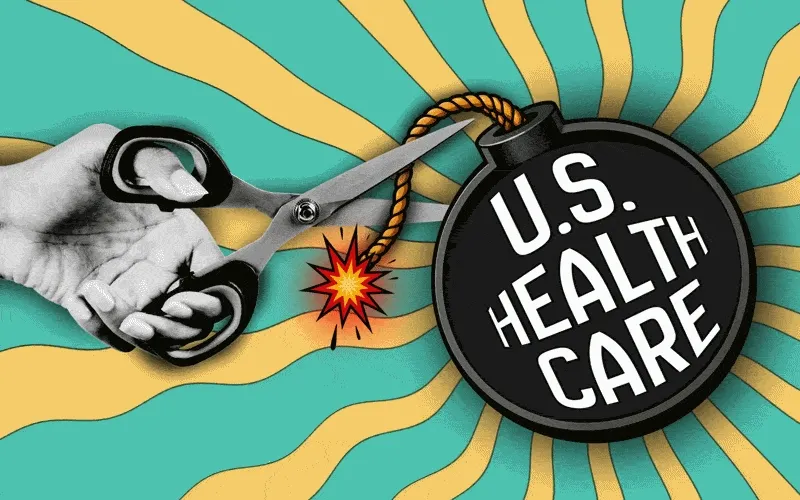
Identifying what’s broken in American health care is easy. The harder part is disarming the ticking time bomb before soaring costs, consolidation and coverage gaps explode into something worse.
I saw an interview with a bomb disposal technician. He made the comment; “Identifying a bomb is easy, disarming it is the hard part.” It made me think about the debate around our current health care problems. It’s easy to point to all the things that are wrong or to throw stones at big insurance companies or Big Pharma.
Even though the finger pointing may be warranted, the harder part is coming up with a solution to this ticking time bomb. If we don’t figure out how to disarm this bomb it’s going to take us all with it when it goes off. I am as guilty as anyone of focusing on the problems we have, so, here is my attempt at some real solutions. I don’t pretend that these five things will solve all our problems, but I think they are a good start. So here we go.
- Pass the Break Up Big Medicine Act. We need to pass this bill right away. Much of our problems with cost and insurance intervention in health care comes from the fact that they have been allowed to create mammoth vertically integrated companies that not only finance health care but also control much of how health care is delivered. These massive health care companies have done nothing to control costs. Their focus is on maximizing profits. Case in point. A recent study showed that UnitedHealth Group pays its own doctors an average of 17% more than independent doctors in the same specialty and market. This is just one example of how this vertical integration is increasing costs to increase profit for UnitedHealth. I could write a whole book on why this much vertical integration creates problems but the long and short of it is, insurance industry vertical integration is like having a for-profit fire department that is also an arsonist. If you are going to be an insurance company then you need to focus on that business and not be allowed to own doctors, PBMs, etc.
- Pass a law that makes the actions performed by insurance company medical directors fall under the legal definition of “practicing medicine”. This would mean that when an insurance company medical director decides that a patient can’t have a study or a specific drug or when they deny a claim as not medically necessary, they are practicing medicine. They would then have all the responsibilities and accountabilities that the treating physician has. They would have to have a valid license in that state. They would have to be practicing in their specialty. They would have to document their decision making in an electronic medical record that belongs to the patient, and they could be sued for malpractice. You know all the same things that the actual treating physician must do. No more hiding behind the shield of “I’m not saying you can’t have it, just that we won’t pay for it.” If this were done it would eliminate most of the delays and care denials that plague our current system.
- Deal with the highly concentrated health insurance marketplace with existing monopoly rules and enforcement. In almost every other industry the Federal Trade Commission protects consumers and makes sure that competition is present by looking at highly concentrated industries. They use a long-standing mathematical measure called the Herfindahl-Hirschman Index (HHI). Under this index any industry with a score higher than 2,500 is considered highly concentrated and as such ripe for review and possible action by the FTC. When it comes to health insurance if you look at the HHI by state you come up with some alarming results. In 2024 there were only 3 states and the District of Columbia that had HHI scores below 2,500. Further, there were eight states with a score of over 7,000. In any other industry those situations would have been reviewed by the FTC long ago. These monopolies should be broken up to increase competition and protect consumers and doctors from this kind of unbalanced market power.
- We need to pass legislation that will create a process for universal clinical coverage policies. The care you receive should not be decided by the company name on your insurance card but rather on your clinical situation and evidence-based coverage guidelines. These guidelines should be approved by a group of clinical experts who are not financially incentivized to deny care. Right now, insurers that have a vested interest in denying expensive treatments decide when something is covered or not covered. We need to change that. Coverage policies should be universal. Doctors shouldn’t be asked to play the game of trying to figure out which drug or which treatment option is covered by each insurance company and rather should be recommending care based on what is best for the patient with the best evidence based medical research available at the time.
- Finally, we need to address one of the biggest travesties in our current health care environment. The fact that the richest country in the world does not have universal coverage for all its citizens should be problem number one. We should be embarrassed that a country of riches has failed and continues to fail such a large portion of our citizens when it comes to health coverage. We should require all insurance companies to sell insurance to anyone who wants to buy it either as an individual or an employer regardless of size. We need to make those premiums community rated with rates that are approved at the state level. We also need to finance or subsidize coverage for small businesses and people who don’t qualify for Medicare or Medicaid. This can be done by giving small businesses tax incentives to provide coverage under their business and to provide subsidies to individuals who are not able to get coverage from their employer and whose income is such that they can’t afford to purchase that coverage themselves. Paying for this universal coverage could be accomplished in several ways including, among other options, a small national sales tax or a small increase in the corporate or high-income tax rate. Again, we live in a country with an annual GDP of over $32 trillion dollars. Paying for universal health coverage for our citizens is not a heavy lift.
These five actions won’t solve all our problems. We still need to put more focus on wellness and prevention. We still have issues with mental health and substance use in this country. We need to work on providing better care and access for rural America.
Yes, there will still be plenty of work to be done even if we enacted each of these suggestions. These five things aren’t a full solution, but they are a very good start. Let’s start disarming this time bomb before it goes off.

