Developing a compelling value proposition for employees

https://mailchi.mp/ff342c47fa9e/the-weekly-gist-july-22-13699925?e=d1e747d2d8
As we’ve been discussing, the COVID pandemic and ensuing economic environment have driven health system job vacancies and attrition rates to all-time highs. Right now, for myriad reasons, many hospital workers are deciding that the financial, emotional, and professional benefits of working for a hospital are outweighed by the toll working in a hospital takes on them personally.

Health systems are responding to this challenge with a wide variety of discrete measures—including hiring and retention bonuses, incentive pay, employee wellbeing initiatives, and expanded professional development opportunities— that target specific groups of employees, but don’t form a long-term solution to workforce instability. 

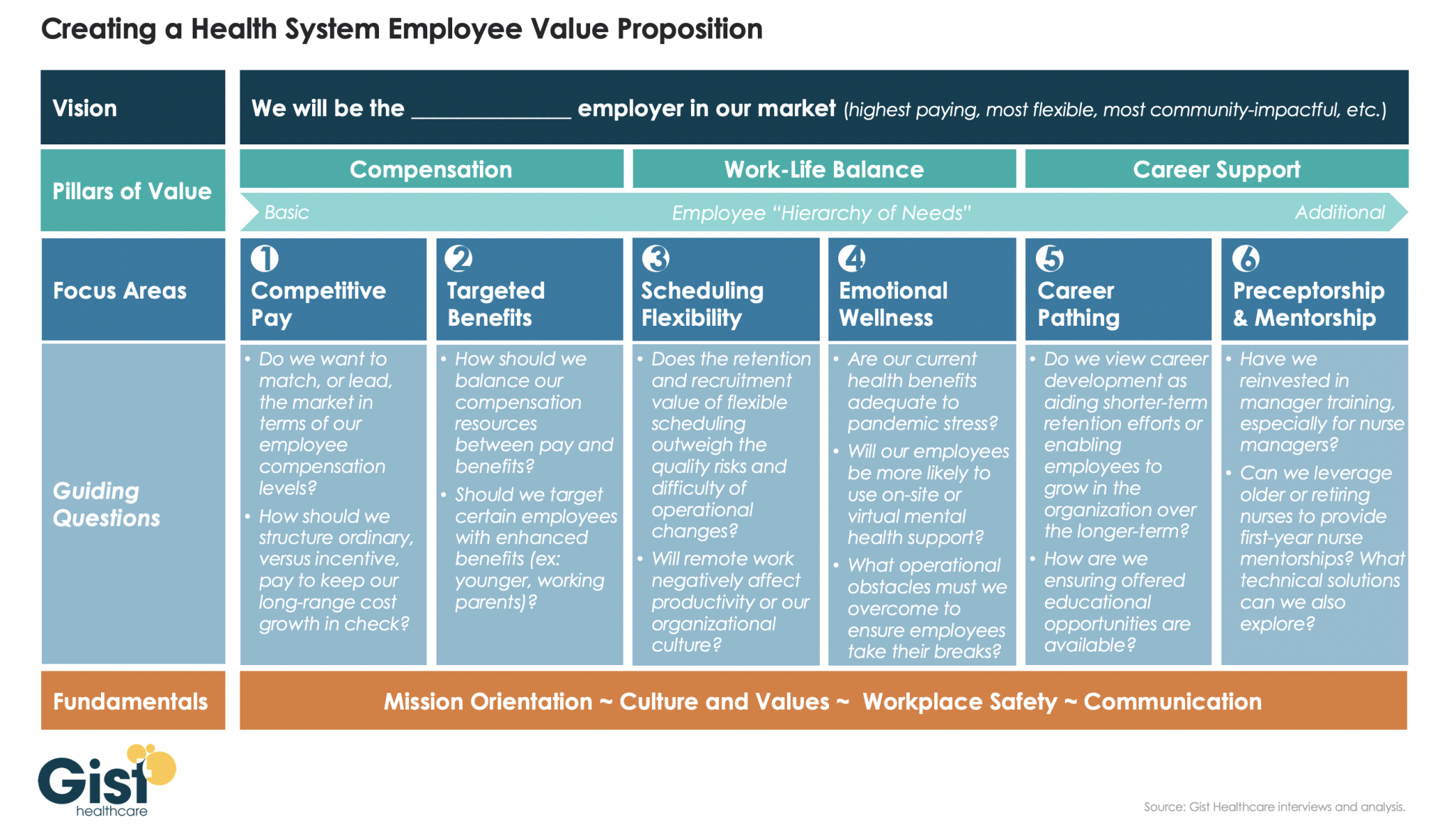
To rebuild a stable and committed workforce, health systems must create, and then communicate, a compelling employee value proposition—a concise statement highlighting why employees should work for them.
 
The graphic above shows what we believe are the key components of a successful employee value proposition, which must have a clear vision and focus on the things most important to employee needs: compensation, work-life balance, and career support. Systems can use the guiding questions listed in each column to craft a value proposition that is differentiated in their local labor market, informed by their level of resources, and undergirded by their own culture and values.
Hospitals face increasing competition for lower-wage workers 

https://mailchi.mp/8e26a23da845/the-weekly-gist-june-17th-2022?e=d1e747d2d8

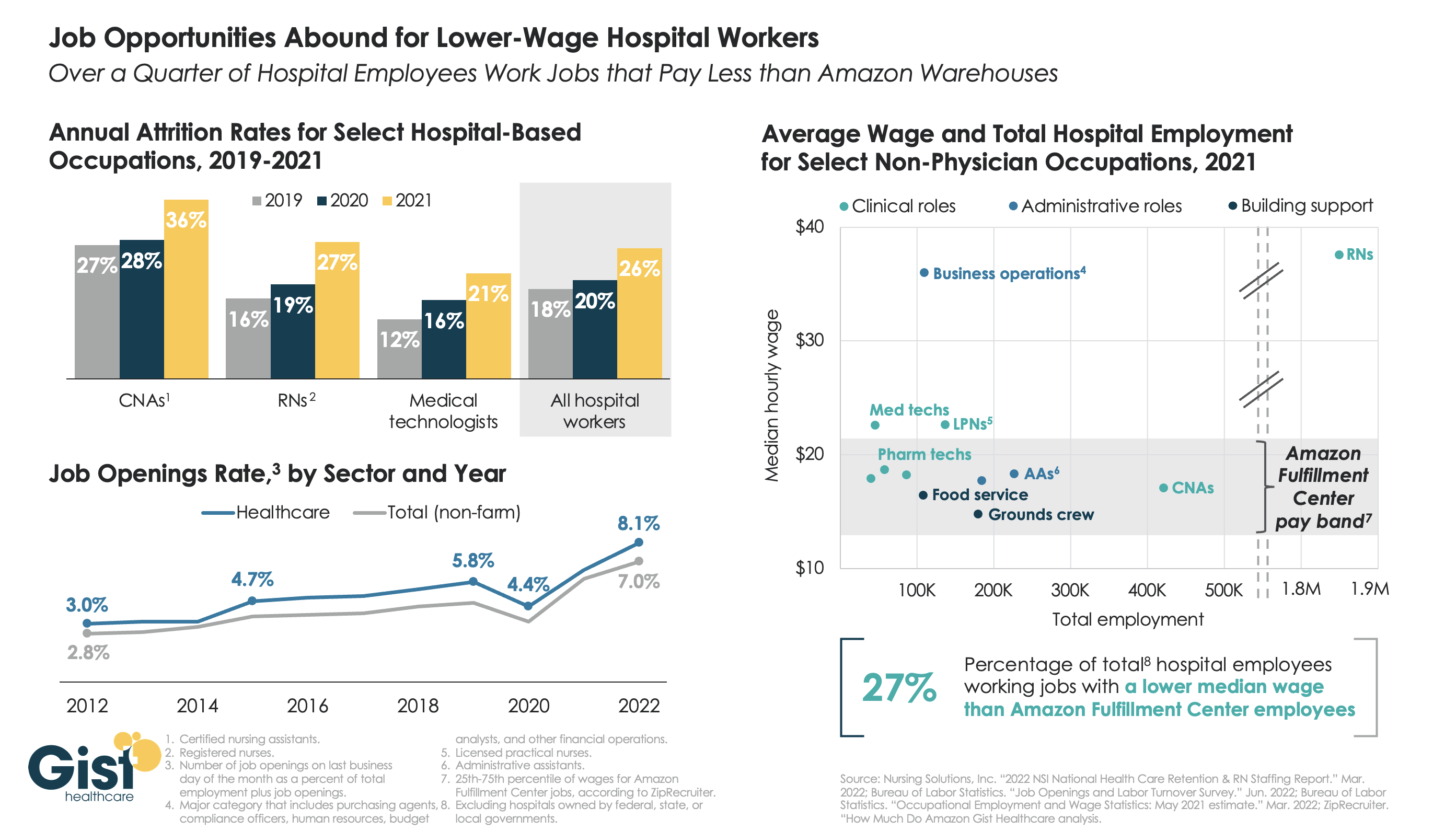
Although the nursing shortage has attracted much attention in recent months, the healthcare workforce crisis is hitting at all levels of the labor force. As the graphic above shows, the attrition rate for all hospital workers in 2021 was eight percentage points higher than in 2019. 

Among clinicians and allied health professionals, certified nursing assistants (CNAs) have the highest turnover levels. Given the demands of the job and relatively low pay, CNA openings have been consistently difficult to fill. But it’s become even harder to hire for the role in today’s labor market as job openings near an all-time high. 

Although labor force participation rates have rebounded to 2019 levels, pandemic-induced economic shifts have led to a boom in lower-wage jobs. In 2021 alone, Amazon opened over 250 new fulfillment centers and other delivery-related work sites. The company is competing directly with hospitals and nursing facilities for the same pool of workers at many of these new sites.

In fact, our analysis shows that more than a quarter of hospital employees currently work in jobs with a lower median wage than Amazon warehouses. Health systems have historically relied on rich benefits packages and strong career ladder opportunities to attract lower-wage employees, but that’s no longer enough—Amazon and other companies have ramped up their benefits, such that they now meet, or even surpass, what many hospitals are providing. 

The time has come for health systems to reevaluate their position in local labor markets, and better define and promote their employee value proposition.