Kids who survive shootings — and their families — face greater health burdens

https://www.axios.com/2023/11/07/gun-violence-children-pain-mental-health
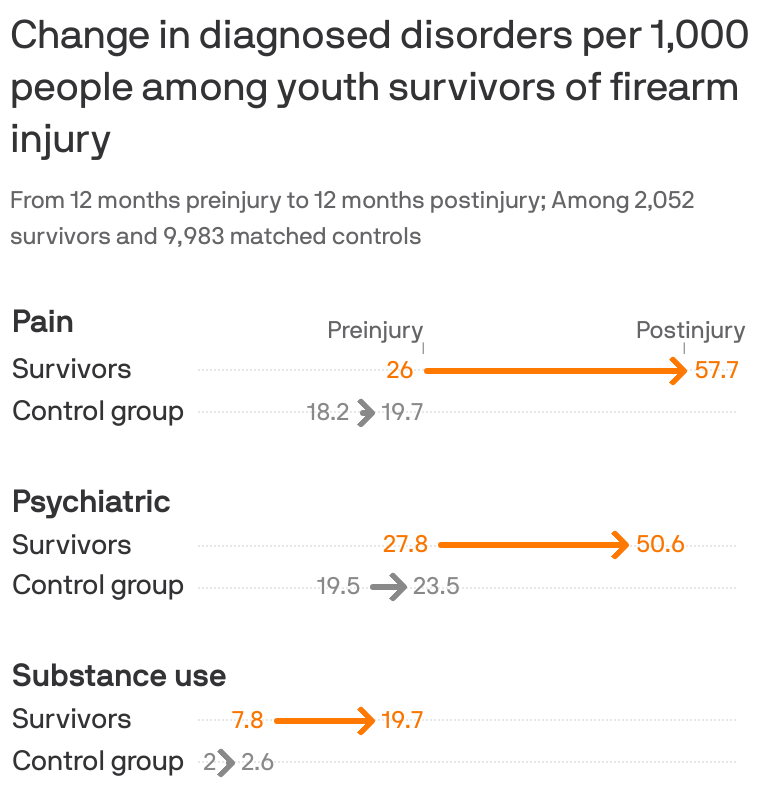
Young survivors of shootings face a litany of physical, psychiatric and substance abuse disorders that can combine to drive up their health costs almost 2,000%, according to new research.

The big picture: 

Guns have become the leading cause of death among kids, but many more survive being shot. Their needs offer a rare and detailed look at the cumulative consequences of gun violence and the burden it places on survivors, their families and the health system.

By the numbers: 

Using a trove of claims data for employer-sponsored insurance, researchers in Health Affairs compared over 2,000 child and adolescent shooting survivors and 6,000 family members with much larger control groups that did not suffer gun injury between 2007-2021.

  • In the year after being shot, survivors had a 117% increase in pain disorders including musculoskeletal pain and headaches compared with the control group, with a 293% increase for those more severely wounded.
  • There was a 68% increase in psychiatric disorders, such as PTSD and mood disorders, with a 321% increase among those with worse injuries.
  • Substance use disorders rose 144% percent — and cases rose regardless of the severity of the injury.
  • Emergency room visits for gun injuries among kids doubled during the pandemic, according to separate research published Monday in Pediatrics.

There is also an impact on families’ mental health and even the types of care they got in the aftermath of a child surviving a shooting, researchers found in the Health Affairs study.

  • Diagnosed psychiatric disorders among mothers and fathers increased by about 30% — and the increases were much larger among parents of children who died.
  • Mothers had a 75% increase in mental health visits, while other routine care like office visits and lab tests declined slightly for themselves and the siblings of survivors.
  • That was consistent with a “crowding out” effect when more acute health care needs arise, researchers said.

What they’re saying: 

“Our study shines light on the substantial effects incurred not just directly by victims and survivors of gun violence, but indirectly by parents and siblings who, we found, often relinquish their own routine health care to the more acute health needs of the family,” senior study author Chana Sacks, co-director of the MGH Gun Violence Prevention Center, said in a statement.

Survivors’ health care costs also soared 17-fold to nearly $35,000 on average over the course of a year. Two-thirds of the cost was in the first month after being shot, while survivors used more health care across the board — including more visits to doctor’s offices, ER trips, imaging and mental health services.

  • Insurers covered the vast majority of the care, but families were on hook for about 5% of the cost.

Between the lines: 

Researchers looked at claims data for workplace health insurance only, so the results don’t include kids without insurance or those enrolled in Medicaid — a major source of coverage, especially for children of color.

Kids killed in gun accidents most often found weapon in the bedroom: CDC

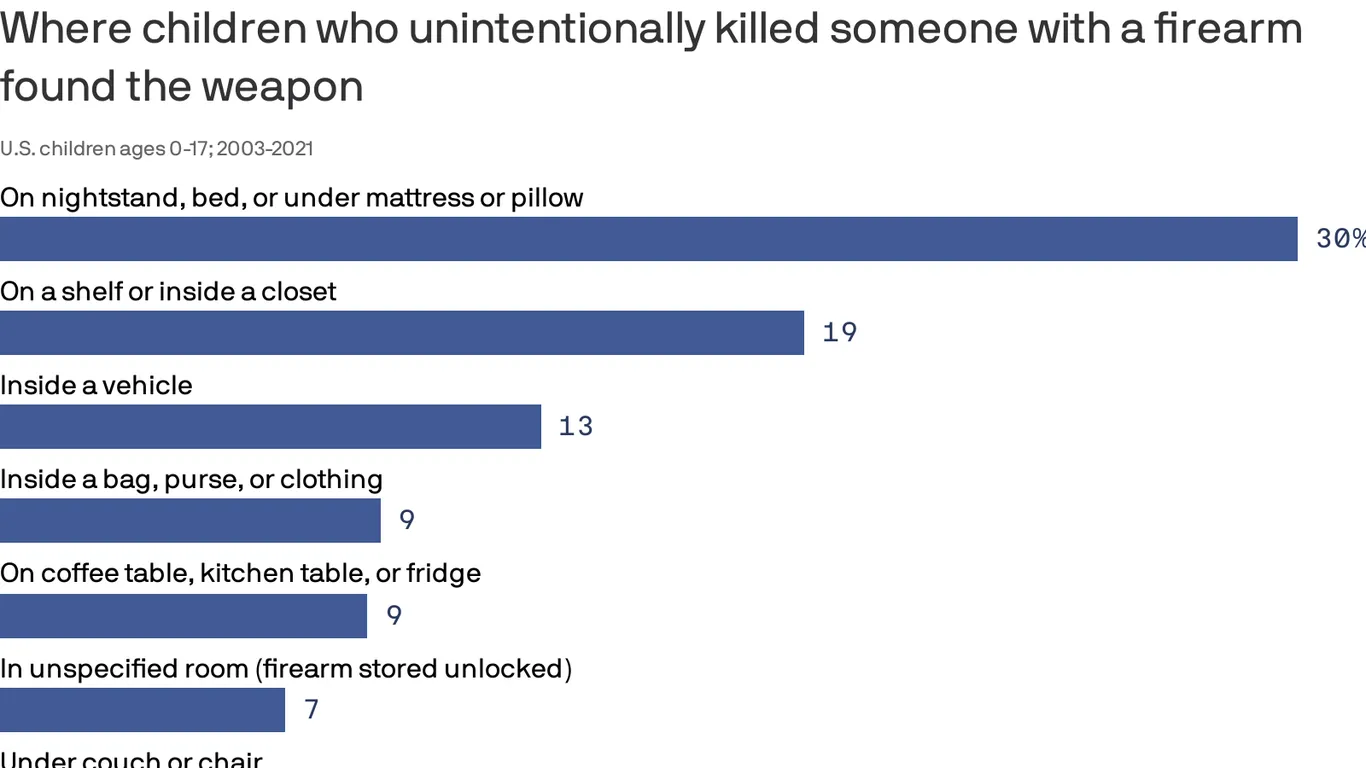
Children and teens involved in unintentional fatal shootings most commonly found the gun inside or on top of a nightstand, under a mattress or pillow, or on top of a bed, according to a new federal study.

Why it matters: 

The data from the Centers for Disease Control and Prevention, which covers nearly 20 years of deadly firearm accidents among America’s youth, demonstrates why putting a gun out of sight or out of reach is not “safe storage,” federal researchers said.

  • It underscores the need for policymakers, health experts and parents to promote safe gun storage, they said.

The big picture: 

Previous research has shown guns are the leading cause of death among kids in the U.S., reaching a record high in 2021.

By the numbers: 

Using data recorded between 2003 and 2021 by the National Violent Death Reporting System, researchers identified more than 1,250 unintentional gun deaths among kids.

  • The vast majority involved guns that were unlocked (76%), and most of those unlocked firearms were also loaded (91%).
  • Two-thirds (67%) of unintentional gun injury deaths among kids occurred when the shooter was playing with the gun or showing it to others.
  • In 30% of deaths, guns were found around nightstands and other sleeping areas.
  • Guns were also most commonly found on top of a shelf or inside a closet (18.6%) or inside a vehicle (12.5%).

Firearm-related Injuries Cost US Healthcare $1B Annually

ttps://medcitynews.com/2023/04/gun-violence-healthcare-costs/?utm_medium=email&_hsmi=255846167&_hsenc=p2ANqtz-_dvFU0DOP4iOPFuqoTdvRwnXBSHTQJaXxK9BOrg5BQ0cQ_7PuWJ_KN4z0KqlHL0yQZCndlLTqNJEKp6soK6s2MU_0Z4w&utm_content=255846167&utm_source=hs_email

In just 2020, deaths from gun violence cost the U.S. healthcare system $290 million, or about $6,400 per patient, according to a report from the Commonwealth Fund. These costs are mostly covered by Medicaid and other government insurance programs.

The U.S. healthcare system sees about 30,000 inpatient hospital stays and 50,000 emergency room visits due to gun violence each year, leading to more than $1 billion in initial medical costs, according to a new analysis.

The Commonwealth Fund published these results last week and relied on three data sources for its analysis: the 2019 Global Burden of Disease study, the Small Arms Survey and the U.S. Government Accountability Office.

Even after leaving the hospital, patients are faced with challenges. A year after a gun injury, medical spending rises about $2,495 per person per month. In addition, those who suffer firearm injuries are more likely to form mental health challenges and substance use disorders.

“The impact of gun violence reaches far beyond the hospital room,” the analysis states.

Firearm-related deaths are increasing, according to the Centers for Disease Control and Prevention. In 2021, almost 49,000 Americans died from firearms, compared to 45,000 in 2020.

Additional findings from the report include:

  • In 2019, the U.S. had a higher rate of firearm deaths than any other country. Its rate of firearm deaths was almost five times as much as France, the second-highest country.
  • Eight times more people in the U.S. died from firearm violence in 2019 compared to Canada, the second-highest country.
  • More people died from self-harm by firearm in the U.S. than any other country in 2019, more than three times higher than France and Switzerland.
  • More women were killed by guns in the U.S. than any other country in 2019.
  • In the U.S., there are 67 million more firearms than people. That difference is higher than the population of the United Kingdom, which has 66.2 million people.
  • In the U.S., 52% of people who are admitted to hospitals for firearm injuries are Black, 29% are White, 14% are Hispanic and 5% are another race or ethnicity. Black Americans account for 50% of firearm injury hospital costs, while White Americans account for 27%, Hispanic Americans account for 17% and other races or ethnicities account for 6%.
  • About 48% of firearm-related inpatient hospital stays are in the American South, while 20% are in the Midwest, 20% are in the West and 12% are in the Northeast. The South accounts for 44% of firearm injury hospital costs, while the West accounts for 26%, the Midwest accounts for 18% and the Northeast accounts for 11%.