


Thought of the Day: On Effective Leadership


Your fences need to be horse-high, pig-tight and bull-strong.
Keep skunks, bankers, and lawyers at a distance.
Forgive your enemies. it messes up their heads.
Do not corner something that you know is meaner than you.
When you wallow with pigs, expect to get dirty.
If you find yourself in a hole, the first thing to do is stop diggin’.
Always drink upstream from the herd.
Lettin’ the cat outta the bag is a whole lot easier than puttin’ it back in.
Life is simpler when you plow around the stump.
Live a good, honorable life. Then when you get older and think back, you’ll enjoy it a second time.

The struggle continues as hospital executives work overtime to return their organizations to necessary profitability, essential competitiveness, and offering an appropriate level of clinical access.
As noted in this blog several months ago, management guru Peter Drucker always maintained that hospitals were the hardest of all American organizations to run successfully. If Drucker were still alive, he would—without question—double down on that observation.
The question must be asked whether historical hospital leadership structures and strategies are still adequate to cope with a fast-changing healthcare industry that features a different level of financial problems, an unrecognizable workforce, and a shape-shifting patient population? This is a leadership question that requires a thoughtful and sophisticated answer.
To paraphrase Albert Einstein, we cannot solve our hospital management problems with the same level of leadership that created them.
So, we are collectively on the hunt for leadership and managerial solutions. The leadership ideas must be different, original, and challenge conventional thinking. Successful healthcare executives these days must be active readers and learners. Winning ideas are everywhere but you need to be both curious and aggressive to find them.
In that regard, let’s turn our curiosity toward the theories and teachings of Coach John Wooden. For our younger readers, John Wooden was the coach of the of the UCLA men’s basketball program from 1948 to 1975. During that time, he won 10 NCAA national championships in 12 years and at one point his teams won 88 games in a row. ESPN’s “Page 2” readers voted him the greatest coach of all time.
But John Wooden wasn’t just a basketball coach; he was a manager, an executive, a teacher, and a philosopher. There was nothing random or laissez-faire about his approach to leadership. Coach Wooden led through a series of principles that he applied with absolute consistency.
Players changed, the opposition changed, and external factors changed, but Coach Wooden’s essential approach to leadership did not vary or change.
The central tenet of Coach Wooden’s leadership philosophy was the somewhat Zen-like principle of “be quick—but don’t hurry.”
At first blush, this organizing principle doesn’t seem to make much sense, especially to the casual reader. John Wooden believed and taught that there were two keys to successful performance, both in sports and otherwise. First, quickness and a sense of urgency was absolutely necessary to winning in a competitive environment. But for Coach Wooden, quickness itself was not sufficient for consistent success. Quickness had to be accompanied by emotional and professional balance in order to achieve team and organizational excellence. So, from Coach Wooden’s perspective, a great athlete or a great executive had to not just move and think quickly, but also had to make sure that he or she was moving to a place of personal balance. Coach Wooden believed that this concept of personal balance was the key to real success at both the team and individual level. To find that place of balance you needed to be quick, but to retain that balance you had to be sure not to hurry. In other words, “be quick—but don’t hurry.”
“Be quick—but don’t hurry” was the central principle of John Wooden’s leadership style but “be quick—but don’t hurry” was also the platform on which an entire management and leadership theory was built. This led to other key Wooden tenets including:
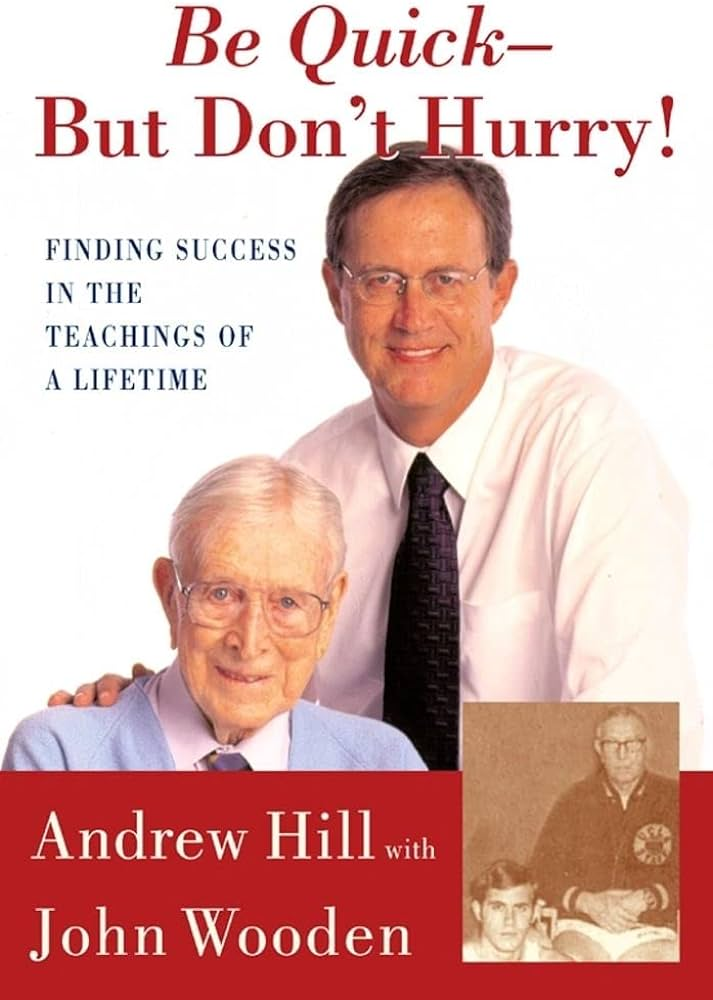
This blog covers just a few of Coach Wooden’s many approaches to and commentaries on management and leadership. But the above observations are a useful start. It is important to disclose that this blog post was guided by and drew quotes from an excellent book, Be Quick—But Don’t Hurry: Finding Success in the Teachings of a Lifetime, which was written by Andrew Hill (a former UCLA player) with the assistance of John Wooden. The book was published by Simon & Schuster in 2001 but as readers can easily see, the book by Messrs. Hill and Wooden remains absolutely relevant today. The book is a short read but will prove to be a good use of your time and your curiosity.
Learn and be smart. Those are the key attributes for today’s healthcare executives. Yesterday’s executive techniques are no longer getting the job done. Hospital leaders must be better in order to deal with the long list of obstacles that are preventing hospital success. Coach Wooden invented a unique roadmap to executive learning and leadership. That Wooden roadmap is definitely “old school,” but that roadmap and its attendant theories and methods are absolutely worth your attention.


Your fences need to be horse-high, pig-tight and bull-strong.
Keep skunks and bankers at a distance.
Life is simpler when you plow around the stump.
A bumble bee is considerably faster than a John Deere tractor.
Words that soak into your ears are whispered… not yelled.
Meanness doesn’t just happen overnight.
Forgive your enemies; it messes up their heads.
Do not corner something that you know is meaner than you.
It doesn’t take a very big person to carry a grudge.
You cannot unsay a cruel word.
Every path has a few puddles.
When you wallow with pigs, expect to get dirty.
The best sermons are lived, not preached.
Most of the stuff people worry about ain’t never gonna happen anyway.
Don’t judge folks by their relatives.
Remember that silence is sometimes the best answer.
Live a good, honorable life… then when you get older and think back, you’ll enjoy it a second time.
Don’t interfere with somethin’ that ain’t bothering you none.
Timing has a lot to do with the outcome of a Rain dance.
If you find yourself in a hole, the first thing to do is stop digging.
Sometimes you get, and sometimes you get got.
The biggest troublemaker you’ll probably ever have to deal with watches you from the mirror every mornin’.
Always drink upstream from the herd.
Good judgment comes from experience and a lotta that comes from bad judgment.
Lettin’ the cat outta the bag is a whole lot easier than puttin’ it back in.
If you get to thinkin’ you’re a person of some influence, try orderin’ somebody else’s dog around..
Live simply. Love generously. Care deeply. Speak kindly. Leave the rest to God.
Don’t pick a fight with an old man. If he is too old to fight, he’ll just kill you.
Most times, it just gets down to common sense.
 HENRY KOTULA