Consumers are paying less for ACA plans, even as premiums continue to rise

https://www.fiercehealthcare.com/payer/consumer-satisfaction-exchange-enrollment-up-but-premiums-continue-to-rise?mkt_tok=eyJpIjoiWlRReU4yTXdZelF5TUdJMyIsInQiOiJqbDN6cndBd1YwOHFvQkV3NGNvXC9xVWh3bVpNYzJ0djZyaXJOakFGaU5nQWdETG0wWE1nWDhTck5XK2JIVTZkanFidU85clo2akpIT0VvXC9MWjFjOExsUm5kUEpRZk9IQ0tYNWFQeGJaQmhJMWNTdnkweFBtTGRJME1KNzJvaTRFIn0%3D&mrkid=959610

Healthcare.gov site on computer

The Centers for Medicare & Medicaid Services (CMS) proclaimed its 2018 open enrollment period a success, citing relatively stable enrollment on reduced costs of outreach and a tightened enrollment period.

The agency’s final report on 2018 enrollment data provides insight on the 11.8 million individuals who enrolled or renewed coverage through the exchanges in 2018. That number includes approximately 8.7 million who signed up through HealthCare.gov, where the average premium rose 30% from $476 last year to $621 this year. A solid majority of consumers opted for the middle-tier silver plans, with 29% choosing bronze plans and only 7% purchasing gold plans.

CMS Administrator Seema Verma lauded the agency’s efforts on Twitter, but pointed to the 30% jump in premiums as an indication that “more affordable options are needed,” particularly for those that don’t qualify for tax credits.

Despite delivering the most successful consumer experience to date, Americans continue to experience skyrocketing premiums and limited choice on http://Healthcare.gov .

Despite higher premiums, consumers that qualified for the tax credit actually saw a 16% decline in their final cost, with average monthly costs dropping from $106 in 2017 to $89 in 2018.

“The reduction in price that consumers paid was staggering,” Josh Peck, co-founder of Get America Covered and former chief medical officer of Healthcare.gov under President Barack Obama, told FierceHealthcare.

“To be totally honest, enrollment would have been far higher had they tried,” he added.

While the total number of enrollees dipped slightly year over year, they remained relatively stable given the shortened time frame rolled out by the Trump administration. Verma also pointed to consumer satisfaction scores of 90%, up from 85% last year, as proof the agency had met its primary goal of ensuring “a seamless experience” for consumers.

Critics, however, lashed out at CMS for doing little to educate the public about open enrollment options.

Lori Lodes@loril

Really weird (and gobsmacking) to see @SeemaCMS take credit for 11.8 million people signing up for health care when she refused to do anything to educate people about Open Enrollent. https://twitter.com/SeemaCMS/status/981250136344088576 

The agency also touted the cost effectiveness of the enrollment period, after CMS slashed its advertising spending from approximately $11 per enrollee last year to just over $1 per enrollee in 2018. Those cuts spurred increased advertising dollars from private insurers in an attempt to make up the gap.

The majority of consumers using the exchanges continues to rely on premium subsidies. The age mix among consumers trended older, as enrollees aged 55 and over ticked up two percentage points to 29%, while the share of those aged 18-34 declined slightly.

Final Exchange Enrollment Report also shows most consumers on the Exchanges relied on premium subsidies. Approximately 83% of consumers nationwide had their premiums reduced by tax credits.

In a statement, Verma said she was pleased with the rise in customer satisfaction, but expressed concerns about the future. “Even with the success of this year’s open enrollment, the individual market continues to see premiums rise and choices diminish,” she said.


ACA marketplace enrollment has beat expectations

Even with final numbers not yet in from several states, it’s fair to say that ACA marketplace enrollment has beat expectations.


https://www.kff.org/health-reform/state-indicator/marketplace-enrollment-2014-2017/?activeTab=graph&currentTimeframe=0&startTimeframe=4&selectedDistributions=number-of-individuals-who-selected-a-marketplace-plan&selectedRows=%7B%22wrapups%22:%7B%22united-states%22:%7B%7D%7D%7D&sortModel=%7B%22colId%22:%22Location%22,%22sort%22:%22asc%22%7D


Despite Compressed Sign-Up Period, ACA Enrollment Nearly Matches Last Year’s

https://khn.org/news/despite-compressed-sign-up-period-aca-enrollment-nearly-matches-last-years/

A day after President Donald Trump said the Affordable Care Act “has been repealed,” officials reported that 8.8 million Americans have signed up for coverage on the federal insurance exchange in 2018 — nearly reaching 2017’s number in half the sign-up time.

That total is far from complete. Enrollment is still open in parts of seven states, including Florida and Texas, that use the federal healthcare.gov exchange but were affected by hurricanes earlier this year. The numbers released Thursday by the Department of Health and Human Services also did not include those who signed up between midnight Dec. 15 and 3 a.m. ET on Dec. 16, the final deadline for 2018 coverage, as well as those who could not finish enrolling before the deadline and left their phone number for a call back.

And enrollment has not yet closed in 11 states — including California and New York — plus Washington, D.C., that run their own insurance exchanges. Those states are expected to add several million more enrollees.

The robust numbers for sign-ups on the federal exchange — 96 percent of last year’s total — surprised both supporters and opponents of the health law, who almost universally thought the numbers would be lower. Not only was the sign-up period reduced by half, but the Trump administration dramatically cut funding for advertising and enrollment aid. Republicans in Congress spent much of the year trying to repeal and replace the law, while Trump repeatedly declared the health law dead, leading to widespread confusion.

On the other hand, a Trump decision aimed at hurting the exchanges may have backfired. When he canceled federal subsidies to help insurers offer discounts to their lowest-income customers, it produced some surprising bargains for those who qualify for federal premium help. That may have boosted enrollment.

“Enrollment defied expectations and the Trump administration’s efforts to undermine it,” said Lori Lodes, a former Obama administration health official who joined with other Obama alumni to try to promote enrollment in the absence of federal outreach efforts. “The demand for affordable coverage speaks volumes — proving, yet again, the staying power of the marketplaces.”

“The ACA is not repealed and not going away,” tweeted Andy Slavitt, who oversaw the ACA under President Barack Obama.

The tax bill passed by Congress this week repeals the fines for those who fail to obtain health coverage, but those fines do not go away until 2019. Still, that has added to the confusion for 2018 coverage.

And it remains unclear whether Congress will make another attempt to repeal the law in 2018.

“I think we’ll probably move on to other issues,” Senate Majority Leader Mitch McConnell (R-Ky.) said in an interview Friday with NPR.


The individual market will thrive in the long run

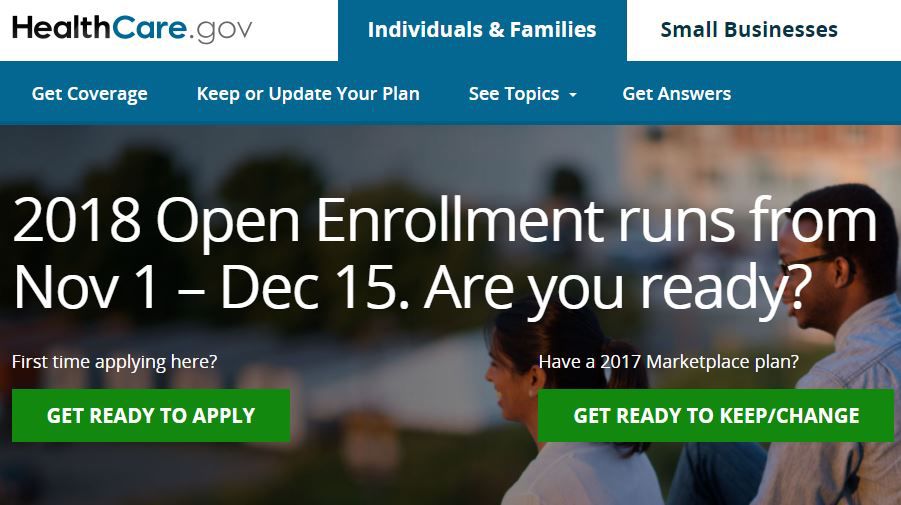
Image result for healthcare.gov 2018 open enrollment

Not since the first year of the Affordable Care Act has there been so much uncertainty at the start of an open enrollment period. How many Americans will sign up for health coverage? As experts weigh the uncertain impact of the Trump administration’s last-minute policy moves, estimates from the Congressional Budget Office and Urban Institute range from nearly one million fewer Americans with coverage to at least 600,000 more.
As co-founders of Oscar Health, an insurance startup that will be signing up Americans for individual plans across six states this year, we anticipate the Trump administration’s actions will simultaneously aid and undermine enrollment, thanks to the mixed impact of its political and policy changes.
The bottom line: It will be hard — after four years where tens of millions of Americans have gained access to health insurance — for the administration to erase the virtues of an individual market where consumers choose their health plan and no one is discriminated against based on health status. In fact, we project that Oscar will enroll significantly higher membership across our six states this year.

Here’s why we believe the administration’s actions will both help and hurt enrollment:

  • Plans will be more affordable for millions of Americans due to the seesaw impact of cuts to cost-sharing reduction subsidies, which will actually increase subsidies for many low-income consumers. And for the first time, the IRS will be aggressively enforcing the individual mandate.
  • On the other hand, the administration’s cuts to outreach and sporadic lip service to repealing the ACA do nothing to stanch growing confusion among shoppers.
The biggest threat to a strong open enrollment period is consumer confusion. That’s why our outreach this year, themed “Get Covered,” is so focused on educating Americans on the importance of health insurance. We were the first to launch our open enrollment ads six weeks ago. And when HealthCare.gov is down for maintenance every Sunday, Oscar will be up — consumers in our states will be able to get subsidized coverage on our website.
The big picture: Our optimism about the individual market, both this year and beyond, stems from our conviction that the near-term regulatory turbulence will pass and that the individual market will thrive in the long run.
That’s because health care costs are spiraling out of control across the board, even for Americans who get coverage through their jobs. This year, premium contributions for workers increased by 8.2%, while the employer’s share increased hardly at all: 1.4%.
But Americans see the full sticker price of care in the individual market alone. To ensure that consumers who are paying out of their own pockets can still afford coverage, it’s actually the insurers and providers in the individual market who are working hardest to control costs.
The details: Indeed, we are seeing signs that sustainable strategies to keep health care costs down for all Americans are being accelerated and proven out in the individual market.
  • Our health care system, for example, must move away from expensive emergency room visits and embrace virtual care. Prices to treat many of the same exact conditions in emergency rooms — where half of all care is delivered in the U.S. — can be orders of magnitude higher than telemedicine. In the first year of the ACA, Oscar introduced the first health insurance plan in the country with free, 24/7 access to telemedicine — and today, one in four Oscar members use it.
  • The individual market has also accelerated the shift away from big hospital networks in health insurance plans that drive prices up for all Americans. Narrow networks — which most ACA plans have — can result in lower premiums for consumers without impacting their quality of care.
  • The true innovation unlocked by the smaller networks, however, is one of integration by design. By making the insurer and hospital more dependent on each other, we can finally begin to remove the friction between your doctor and insurer to result in better, more coordinated care. For example, more than one third of all first-time doctor visits for our members are routed through our Oscar app and Concierge teams, to doctors that we partner with.
  • Hospitals are now looking to become your insurance company, too. Indeed, the Cleveland Clinic, a world-renowned hospital, is offering its own jointly-run plan with Oscar next year — in the individual market.
What’s next: There is no doubt that the individual market under the ACA has stumbled out of the gate, and is in need of some fixes. But America has seen rocky private insurance markets recover before.
Between 1998 and 2002, the number of private Medicare+Choice plans — what are now known as Medicare Advantage plans — was cut in half, to less than 150. After a legislative fix in 2003, the market recovered and matured, and seniors this year will have over 3,000 Medicare Advantage plans to choose from.
We’re confident the same can and will happen with the individual market.