Congress, Industry Hit Reset After Obamacare Repeal Fails

http://www.rollcall.com/news/policy/congress-industry-hit-reset-health-law-repeal-fails?bt_alias=eyJ1c2VySWQiOiAiNjllMWYzZjMtOWY1Mi00OTE5LTk1MjktNDczNDA4OWFlOTBjIn0%3D&utm_source=weekendreads&utm_campaign=newsletters&utm_medium=email

Image result for reset button

House Republicans appeared divided and frustrated Friday morning about their next steps on health care legislation, hours after their Senate colleagues fell short of passing a scaled-back repeal.

House Republicans attending a conference meeting Friday morning described a disappointed mood hanging over them as Speaker Paul D. Ryan of Wisconsin read lyrics from the song “The Wreck of the Edmund Fitzgerald.” The ballad, by Gordon Lightfoot, is about a Great Lakes shipwreck that the song suggests could have been avoided if the crew had decided to keep sailing through a storm.

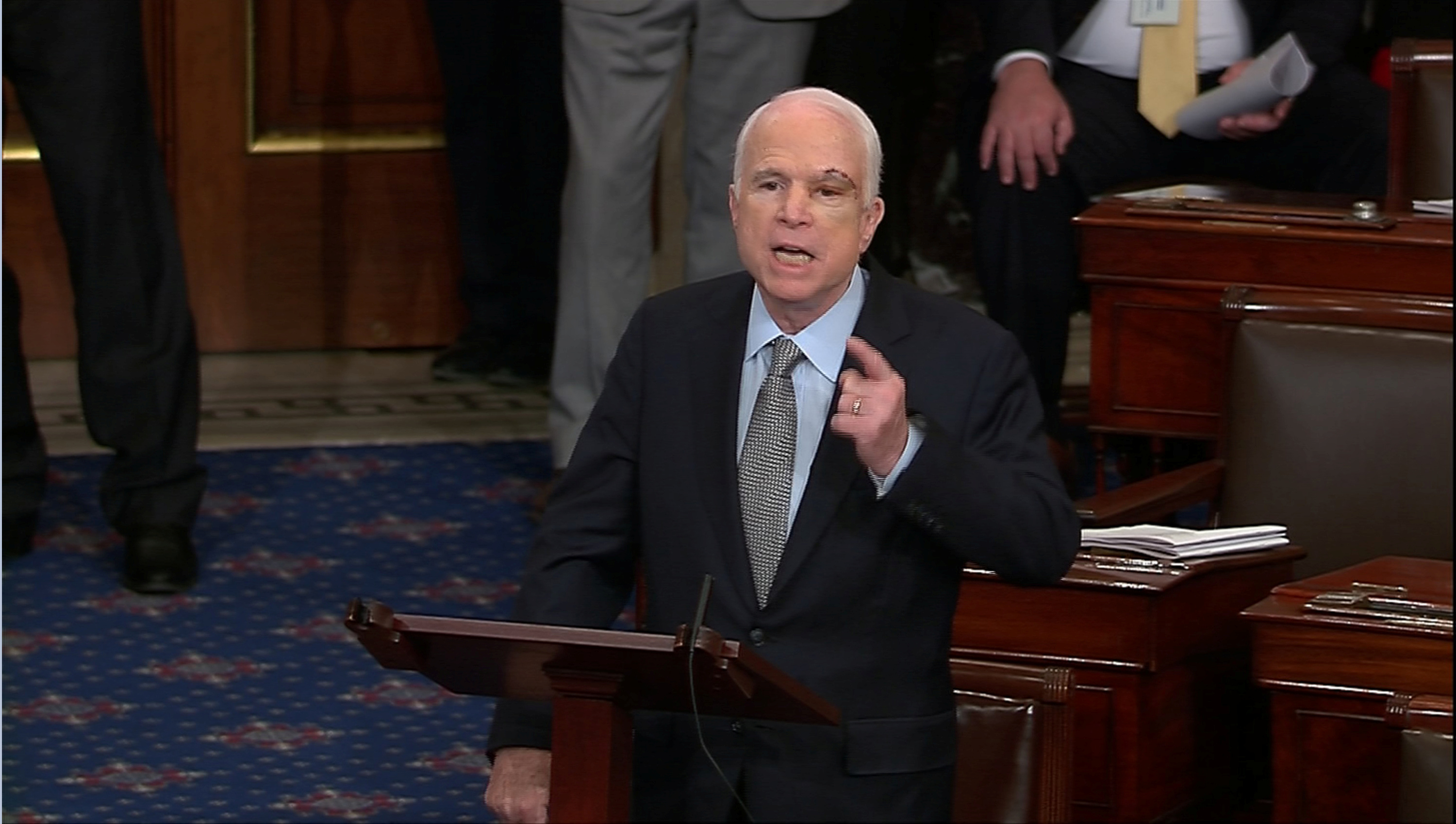
Earlier Friday morning, GOP Sens. Susan Collins of Maine, Lisa Murkowski of Alaska and John McCain of Arizona had voted against a “skinny repeal” amendment, forcing Majority Leader Mitch McConnell, R-Ky., to pull the bill from the Senate floor.

Some House Republicans appeared ready Friday to move on to a tax overhaul and fiscal issues, while others insisted the health care effort could be revived.

Those who were optimistic that work on health care could continue differed about the shape it would take. While moderates such as Reps. Charlie Dent, R-Pa., and Leonard Lance, R-N.J., stressed the importance of working with Democrats, more conservative members advocated continuing a Republican-only approach.

Rep. Mark Meadows, leader of the conservative House Freedom Caucus, thought the Senate would keep working out its differences. “I’m still optimistic we’ll have another motion to proceed and put something on the president’s desk,” he said. “The reconciliation process is not dead.”

Some House members vented about their frustrations with the Senate’s inability to come together on a repeal.

“It’s a huge disappointment,” said Rep. Richard Hudson, R-N.C. “How dare these senators not deliver on the promise we all made, that they all campaigned on? They can’t stop now.”

Republican Study Committee Chairman Mark Walker, R-N.C., suggested there should be some kind of consequences.

“Senate guys are part of our team so we can’t be out saying this or whatever, but there’s still a lot of frustration that exists,” Walker told reporters. “And I think at some point, accountability is not out of order for our Senate companions.”

‘More work to do’

But other Republicans suggested the need to move on to other health care priorities with the hope that aspects of repeal could be addressed at the same time.

A number of health care insurers have abandoned marketplaces in several states, citing the uncertainty in Washington as a major factor.

“We’ve got more work to do going forward, clearly, to rescue these markets,” said Rep. Greg Walden, R-Ore., chairman of the Energy and Commerce Committee.

Walden noted that a variety of legislative efforts could be vehicles for aspects of repeal legislation, including an expected renewal of expiring funding for the children’s health insurance program or reauthorization of community health centers. He thought that a repeal of the Independent Payment Advisory Board, a controversial commission the 2010 health care law called for but which has never been established, could still have traction in Congress. He noted the importance of paying the law’s cost-sharing reductions, which the Trump administration controls and insurers say are critical.

Walden did not rule out working with Democrats.

Any pieces of health care legislation also will be targets for industry groups who were disappointed along with Republicans last night. JC Scott, chief advocacy officer for the medical device trade group  Advanced Medical Technology Association, said the group is examining the calendar to see where a repeal of the medical device tax might fit in, noting that members on both sides of the aisle support the repeal.

The trade group America’s Health Insurance Plans, which has stayed largely neutral during the repeal debate, said it will continue to work with both parties going forward.

Tax legislation

Ryan indicated in a statement that the House is moving on to a tax overhaul and urged the Senate not to give up on changing the health care law.

“We have so much work still to do, and the House will continue to focus on issues that are important to the American people,” he said in a statement. “At the top of that list is cutting taxes for middle class families and fixing our broken tax code. I’m glad that members will now take time to hear directly from those they represent and make the case for historic tax reform that we intend to pursue in the fall.”

But doing tax legislation without completing a health care bill first will be tricky, Rep. Trent Franks, R-Ariz., acknowledged.The health care bill would have repealed taxes, leaving fewer tax changes to be addressed in the tax bill.

“Obamacare was the biggest tax increase in the history of the human family,” he said. “We have to deal with that so we have a baseline to deal with the tax code. I’m afraid at this point we’re going to have to work around that, because I’m not sure there’s going to be time.”

Given the outcome on in the Senate, it seems unlikely that any health care repeal legislation could pass the Senate. Hours before the vote Thursday, McCain told reporters he would not vote for the bill, but then backtracked.

“I never voted for a bill that I didn’t want to become law,” he said.

McConnell indicated he thought Democrats would face a political pushback on their health care policy ideas.

“It’s time for our friends on the other side to tell us what they have in mind,” he said in a speech after the vote. “And we’ll see how the American people feel about their ideas.”

GOP Senators Should ‘Demand’ New Health Care Vote, Trump Says

http://www.rollcall.com/news/politics/donald-trump-health-vote-tweet?bt_alias=eyJ1c2VySWQiOiAiNjllMWYzZjMtOWY1Mi00OTE5LTk1MjktNDczNDA4OWFlOTBjIn0%3D&utm_medium=email&utm_source=weekendreads&utm_campaign=newsletters

Image result for beating a dead horse

President Donald Trump spent a grey and sometimes rainy Saturday at the White House on a Twitter binge, firing off a late-afternoon tweet instructing Republican senators to demand another vote on a measure that would repeal and replace the 2010 health care law.

In the morning, the president threatened lawmakers’ health insurance and attacked members of his own party, saying they “look like fools” because they cannot pass major bills.

Trump had some different advice for Republican senators later in the day, amid talk from both sides of the Senate chamber about working through the relevant committees to craft a possible bipartisan health care overhaul: Don’t be quitters. Try again.

“Unless the Republican Senators are total quitters, Repeal & Replace is not dead! Demand another vote before voting on any other bill!” the president tweeted.

Unless the Republican Senators are total quitters, Repeal & Replace is not dead! Demand another vote before voting on any other bill!

A bill that would have partially done that, but mostly would have set up a conference with the House, failed in the wee hours of Friday morning when Arizona Sen. John McCain shocked the political world by joining fellow Republican Sens. Susan Collins of Maine and Lisa Murkowski of Alaska in voting against a Republican “skinny” repeal bill.

Trump’s tweet was yet another new stance from him on just what he wants the next step to be on health care.

On Friday, during a speech to law enforcement officials in New York, the president — in a rambling address about a wide range of things on his mind — suggested McCain’s dramatic vote would clear the path to an idea he has long seemed to favor over all others.

“I said from the beginning, ‘Let Obamacare implode and then do it.’ I turned out to be right,” Trump said Friday.

But just over 24 hours later, the president once again appeared to have changed his mind.

Trump has been visiting his golf club in nearby Sterling, Virginia, on most weekends that he is in Washington. Saturday’s rainy weather and unseasonably cool temperatures kept him at the executive mansion, but apparently with his phone handy.

Meet the Women Senators Who Helped Stop the Health Care Bill

http://time.com/4877922/health-care-vote-senate-skinny-repeal-murkowski-collins/?utm_content=buffer1684e&utm_medium=social&utm_source=facebook.com&utm_campaign=buffer

Image result for Meet the Women Senators Who Helped Stop the Health Care Bill

Sen. John McCain of Arizona’s vote against the “skinny repeal” of Obamacare may have been the most dramatic, but the objections of Republican Sens. Lisa Murkowski of Alaska and Susan Collins of Maine had already put the bill’s fate in jeopardy.

The Senate’s Republican women, including Sen. Shelley Moore Capito of West Virginia, had been left out of the initial drafting process and derailed the Majority Leader’s mid-July effort to repeal Obamacare in order to replace it further down the road.

While Capito ultimately voted for the bill, Murkowski and Collins held firm on Friday morning and, along with McCain, joined with Democrats to kill the bill.

Here’s who they are.

Sen. Lisa Murkowski

Lisa Murkowski has been a U.S. Senator since 2002, when she was appointed to finish out her father Frank’s term when he was elected governor of the state. She ran for the seat in 2004 and won, but in 2010 she lost the GOP primary to a Tea Party challenger. But ultimately, Murkowski beat both the Tea Party and Democratic candidates and became the first successful write-in candidate since South Carolina’s Strom Thurmond in 1954. She won reelection in 2016.

Murkowski has been wary of the process to replace the Affordable Care Act since it began. She has said she could not support a bill that did not expand coverage and left costs high, but was largely concerned with the approach to Medicaid. She was also against including cuts to Planned Parenthood in a repeal measure. According to the Alaska Dispatch News, a quarter of Alaskans receive health coverage via the entitlement program. In July, Murkowski said that while some Alaskans had told her that she should “stick with the president,” most wanted her to put her state’s citizens first. “Almost without exception, it was, ‘Please Lisa. Protect Alaska’s interests,” the Dispatch News reports she said. “Help us with ensuring that the most vulnerable are cared for, and that when it comes to the access issues that we face, the costs that we face, that you can help us address these.'”

Murkowski vocalized her displeasure with the secretive Obamacare repeal process in late June, telling an Independent Journal Review reporter that she had not seen a draft of the bill because she is “not a reporter and I’m not a lobbyist.” She, along with Sens. Collins and Capito of West Virginia, later came out against Majority Leader Mitch McConnell’s plan to immediately repeal the Affordable Care Act, but hold off on replacing it, effectively killing that effort.

Her opposition to the health care plan made her a target of President Donald Trump, who tweeted that she had “really let the Republicans, and our country, down” when she voted against a motion that led to the Friday morning vote. The administration also reportedly called Murkowski and Alaska Sen. Dan Sullivan threatening that there would be consequences over her position on the repeal.

Sen. Susan Collins

Susan Collins, of Maine, was first elected to the U.S. Senate in 1996 and was last reelected in 2014. She will be up for reelection again in 2020, though she is said to be seriously considering a run for governor of Maine. It would be her second time vying for the governorship—she lost to independent Sen. Angus King in 1994.

Collins has said she could not support the Obamacare repeal because of the impact it would have had on Americans seeking coverage. “I can’t support a bill that will greatly increase premiums for our older Americans,” Collins told MSNBC in June. “I cannot support a bill that is going to result in tens of millions of people losing their health insurance.”

The Maine Republican was also dismayed by the deep cuts to Medicaid that had been proposed under the repeal legislation and the impact it would have on vulnerable citizens including disabled children and poor seniors.”We should not be making fundamental changes in a vital safety net program that’s been on the books for 50 years … without evaluating what the consequences will be,” she said on CNN‘s State of the Union.

In a lengthy statement issued Friday, Collins explained the many reasons why she voted against the measures, including her opposition to proposals that would have stripped funding from Planned Parenthood. “Let me be clear that this is not about abortion,” she said. This is about interfering with the ability of a woman to choose the health care provider who is right for her. This harmful provision should have no place in legislation that purports to be about restoring patient choices and freedom.

Like Murkowski, Collins faced threats as a result of her position on the repeal. The Associated Press reported Texas Rep. Blake Farenthold complained about the opposition the repeal effort had faced from “some female Senators from the northeast.” During a radio interview, he reportedly said, “if it was a guy from south Texas, I might ask him to step outside and settle this Aaron Burr-style.”

She was later caught on a hot mic discussing the threat, with a Senate colleague telling her he thinks she could “beat the s–t” out of the Representative. “Well, he’s huge,” she said in response. “And he — I don’t mean to be unkind, but he’s so unattractive it’s unbelievable.”

After the health care bill failure, what’s next for Congress and the Affordable Care Act?

http://www.politifact.com/truth-o-meter/article/2017/jul/28/after-health-care-bill-failure-whats-next/

Image result for what's next

In a dramatic, late-night vote, the Senate narrowly rejected an effort to repeal portions of the Affordable Care Act. Does that mean the effort to repeal and replace the law — a cornerstone of the Republican agenda for seven years — is over?

Where Senate Majority Leader Mitch McConnell, R-Ky., is concerned, it’s foolish to write off any possibility, said Josh Ryan, a political scientist at Utah State University.

“Every time we thought it was over, he thought of a different legislative maneuver and, except for one shocking vote by Sen. John McCain, it would have worked,” Ryan said. “I don’t think it’s likely, but I wouldn’t count McConnell out just yet.”

That said, key senators have not given early indications that they plan to pursue that approach, and experts, including Ryan, agreed that there are likelier scenarios than a full repeal-and-replace bill.

What are the possible options?

• Do nothing and wait for health markets to deteriorate enough that lawmakers are pressured to act.

“Congress and the administration could do as little as possible to help support the marketplaces, or even take active steps to destabilize them, such as not funding cost-sharing reductions or not actively enforcing the individual mandate,” said Christine Eibner, a senior economist at the RAND Corp. “They could then attempt to pass a bill hoping that — if the marketplaces are in dire straits, more senators will be willing to vote to repeal and replace.”

Eibner noted that President Donald Trump seems to be advocating for this approach on Twitter, where he wrote “let ObamaCare implode, then deal!”

• Look for common ground where a bipartisan approach could work.

Senate Minority Leader Charles Schumer, D-N.Y., said after the vote that he is open to working with the Republicans on a plan.

“Nobody has said Obamacare is perfect. Nobody has said our health care system doesn’t need fixing. The problem was when they started, when they tried to just pull the rug out from under the existing health care system,” Schumer said at a July 28 press conference. “So, change it, improve it, but don’t just take a knife and try to destroy it and put nothing in its place. And so, we can work together.”

What areas might a bipartisan approach address?

Joseph R. Antos, a health policy specialist at the conservative American Enterprise Institute, said he doesn’t see much likelihood of changes beyond well-established political and financial boundaries. “Don’t look for any significant changes from what is now in place,” he said. “Any attempt to do more will only reopen the fresh political wounds on both sides.”

Here are some areas that might fit this description.

• Shore up cost-sharing reductions under the Affordable Care Act.

Insurers are on the hook for these subsidies, which are given to eligible Affordable Care Act enrollees, regardless of whether the federal government reimburses them. But they have been a bone of contention between Republicans and Democrats, leading to uncertainty about whether the federal spigot will remain on.

“The single reason most insurers cite for withdrawing from marketplaces, or for requesting higher premiums to continue participating in marketplaces, is the uncertainty over whether the federal government will reimburse them for cost-sharing subsidies,” said Linda Blumberg, who studies health care policy at the Urban Institute.

There is evidence that both parties could find common ground here, Antos said. A two-year extension of payments was in the Senate Republican health care proposal known as BCRA.

• Add a reinsurance program.

Reinsurance helps protect private, non-group insurers so they can pay off unusually high claims from their enrollees, thus enabling them to stay in business. Reinsurance was part of the Affordable Care Act for its first three years but no longer is.

Blumberg said making reinsurance a permanent part of the law could bring down premiums and help insurer confidence and participation.

Reinsurance could be funded either through direct public support or through a tax levied on insurers, which was the method used during the first few years of the Affordable Care Act, Eibner said. She added that Alaska recently reduced premiums through a state-funded reinsurance program.

• Find a way to lower premiums for young, healthy Americans.

There is widespread agreement that, if more young and healthy people were to join the marketplaces, premiums would fall. Eibner suggested a few options for doing that. Congress could allow insurers to charge older people five times as much as younger people, rather than three times as much, or it could enhance tax credits for young people, she said.

• Do more to encourage the use of catastrophic coverage.

Such plans don’t kick in until an enrollee has a very expensive condition. The downside is that if someone signs up for these plans and gets seriously ill, they would have to pay a significant amount from their own pocket. The upside is that premiums would be lower, and it might open new opportunities for insurers in certain markets.

Currently, such plans are only available in the Affordable Care Act marketplaces for younger adults and individuals who can demonstrate financial need. But one of the provisions pursued by Senate Republicans would have widened access to these plans. “It’s possible that this provision could be revived as part of bipartisan legislation,” Eibner said.

Graham, Trump discuss alternate ObamaCare repeal bill

Graham, Trump discuss alternate ObamaCare repeal bill

Image result for block grant medicaid

Sen. Lindsey Graham (R-S.C.) met with President Trump Friday at the White House about the senator’s ObamaCare replacement proposal.

The meeting comes as some Republicans are pushing to keep alive their effort to repeal and replace ObamaCare despite the failed vote in the Senate early Friday morning.

Graham has pitched his bill as a better alternative to ObamaCare than GOP leaders’ plans. His measure, also backed by Sen. Bill Cassidy (R-La.), would convert money currently being spent on providing ObamaCare coverage into a block grant to states. States could then choose how to spend the funds.

“I had a great meeting with the President and know he remains fully committed to repealing and replacing Obamacare,” Graham said in a statement Friday afternoon.

“President Trump was optimistic about the Graham-Cassidy-Heller proposal. I will continue to work with President Trump and his team to move the idea forward.”

Graham has also spoken with House Freedom Caucus Chairman Mark Meadows (R-N.C.) about the idea, Graham spokesman Kevin Bishop said.

Meadows is also pushing to keep alive the repeal effort and said he had been talking to multiple senators.

“I just think that we’ve got to regroup and continue to stay involved and find something that has 51 votes in the Senate that we can make work,” Meadows told reporters Friday.

Continued efforts to replace the healthcare law face a steep path, though. Senate Majority Leader Mitch McConnell (R-Ky.) said after the failed vote early Friday on a slimmed-down repeal bill that “it is time to move on.”

Republicans have been unable to find 51 votes to pass a plan through the Senate. Other Republicans have started talking about a bipartisan approach.

Graham has expressed hope that Democrats could sign on to his proposal, but so far none have.

Liberal experts have criticized his plan. The Center on Budget and Policy Priorities wrote that the proposal would lead to “drastic cuts” in both Medicaid and subsidies for private insurance, because the amount of the block grants to states would be below ObamaCare spending levels.

Obamacare Repeal Defeat Staves Off Cuts to Preventive Health Program

https://morningconsult.com/2017/07/28/obamacare-repeal-defeat-staves-off-cuts-preventative-health-program/

Defeat of Senate Republicans’ Obamacare repeal bill spares — for now — a program that has become a primary source of funding for state efforts to prevent chronic illnesses, such as heart ailments and diabetes, and the spread of infectious diseases.

The Affordable Care Act’s Prevention and Public Health Fund was likely to be eliminated as part of Senate Republicans’ repeal strategy. Nearly all Obamacare repeal plans proposed in Congress would quash the fund, including the “skinny repeal” that lost 49-51 in the early hours Friday.

Republican lawmakers have cited it as a quintessential example of a government slush fund since Obamacare’s enactment in 2010. And with the mandatory funding stream on the chopping block in the Republican-controlled Congress, public health advocates were worried about a massive shortfall in funding for crucial public health programs in the near future.

Following the collapse of the skinny repeal, the PPHF appears safer than it did before. But the latest setback in the Senate by no means spells the end of a seven-year campaign to repeal former President Barack Obama’s signature domestic achievement. Republicans have made repealing the PPHF a top priority, citing instances in which funding has gone to questionable causes.

Public health advocates warn that eliminating the fund could cripple the nation’s ability to respond to disease outbreaks, and hamper chronic disease prevention efforts. PPHF funding provides nearly $1 billion in state grants annually.

“Over the next five years alone, states stand to lose over $3 billion in funding they rely on to prevent chronic disease, halt the spread of infections and epidemics, and invest in the community resources that support health and equity,” several advocacy groups — including the American Public Health Association, the Prevention Institute, the Public Health Institute, the Society of Public Health Education and Trust for America’s Health — said Thursday in a joint statement.

Most states wouldn’t be able to take on more of the funding burden for their public health prevention programs if the federal grants are eliminated, said Michael Fraser, executive director of the Association of State and Territorial Health Officials, a nonprofit that represents U.S. public health agencies nationwide.

“The potential elimination is really going to force health departments to make some really tough decisions,” Fraser said in a phone interview Wednesday. “Many states are facing significant budget deficits and they have to balance their budgets.”

The PPHF also makes up about 12 percent of the Centers for Disease Control and Prevention budget.

If the fund is repealed, one program that could see a big spending cut is the CDC’s Section 317 Immunization Program, which pays for vaccines and funds outbreak and surveillance efforts for infectious diseases. The program received about $600 million in funding for fiscal year 2017, with nearly $325 million of that coming from the PPHF.

“If you cut PPHF, it’s currently about half of immunization funding so that is just very scary,” Claire Hannan, executive director of the Association of Immunization Managers, said Wednesday in a phone interview. “You would have to take funding from somewhere else and I don’t know, in this environment, where you can take funding from.”

In the current fiscal year, the PPHF is also providing $126 million in anti-smoking efforts, $73 million in heart disease and stroke prevention efforts and $72 million for diabetes prevention.

If Republicans eventually succeed in undoing the ACA, Congress could fill the funding hole created by the repeal of the PPHF by appropriating more discretionary spending. Yet it is likely that the public health programs would still see a cut. There would also be more uncertainty going forward because those programs would no longer have a mandatory funding source.

Some senior Republicans have advocated against reducing funding for the CDC. Earlier this year, Rep. Tom Cole, who chairs the House Appropriations subcommittee on health, pushed back against the Trump administration’s proposed spending cuts to the CDC and the National Institutes of Health.

“These two [agencies] in particular are every bit as important for the national defense and the national security of the American people as the Pentagon is because, frankly, you’re much more likely to die in a pandemic than you are a terrorist attack,” the Oklahoma Republican said at a hearing in March.

The House Republicans’ Obamacare replacement would authorize more than $100 billion in grants to states that could then be used to address a variety of health care issues, including public health prevention. Advocates, though, believe states would be far more likely to use the funds to help prop up their individual insurance markets, and to limit out-of-pocket costs for people who would no longer be eligible for Medicaid.

“Prevention always seems to be the least of the fires you have to put out,” Hannan said.

White House Pushes ‘Implode’ Plan Amid Talk of Bipartisan Health Bill

http://www.rollcall.com/news/white-house-health-care-implode

Image result for building implosion

Amid pleas from Republicans and Democrats for the parties to begin work on a bipartisan health care bill, President Donald Trump and White House officials on Friday doubled down on his call to put off any action until Barack Obama’s 2010 law fails.

Ailing Arizona Republican Sen. John McCain shocked senators from both parties early Friday morning when he voted against a GOP leadership-crafted measure that amounted only to a partial repeal of the Affordable Care Act. Back in Washington after a brain tumor diagnosis, McCain made clear his vote was a shove for the entire Senate to get back to “regular order” — meaning hearings and floor debate — on health care and every other issue.

Following McCain’s dramatic vote on the Senate floor, several senators reported that Health, Education, Labor and Pensions Chairman Lamar Alexander of Tennessee is planning for just that. And Senate Minority Leader Charles E. Schumer, D-N.Y., said he saw Alexander and the committee’s ranking Democrat, Patty Murray of Washington, already talking in the wee hours of Friday morning.

“Now Republicans have a choice to make,” Murray said. “They can continue to try to bring Trumpcare back just to score political points and give special interests a massive tax break, or they can engage in the open, transparent, bipartisan process that many Democrats and Republicans agree is the right way to actually make our health care system work better for the people we serve.”

The list of committees that could begin health care-related work also includes the Homeland Security and Governmental Affairs panel. Its chairman, Ron Johnson of Wisconsin, at times has been very critical of the Senate GOP leaders’ process — which included no committee work and various bills crafted behind closed doors — despite his vote in favor of the so-called “skinny” repeal amendment.

“In the coming weeks, my committee will hold hearings to lay out the realities of our health care system, and I am committed to working with anyone who is serious about addressing these issues,” Johnson said in a statement that appeared to extend and olive branch to Democrats. “Americans deserve far better than their elected officials have delivered to this point.”

GOP Speaker Paul D. Ryan of Wisconsin reacted to the party’s failed Senate vote by putting the health care onus on the shoulders of his Senate colleagues, urging them to “continue working toward a real solution that keeps our promise.” The House, he said Friday, having passed a health overhaul measure, will move on to issues like taxes.

But there is no guarantee Senate Republicans and Democrats, long ideologically divided on the details of health care, can find enough common ground to craft a bill — or that Ryan would bring it to a vote.

“I can’t speculate about a bill that doesn’t exist,” a Ryan aide said Friday when asked if the speaker put a Senate-passed bipartisan health bill on the floor.

And the White House, the person whose opinion matters most, Trump, appears just fine with both chambers moving on to crafting a sweeping tax overhaul push.

White House officials initially were uncharacteristically quiet following the Senate failure. There was no paper statement issued signaling the president’s preferred next move on an issue that was central to his 2016 campaign message. But Trump weighed in during the wee hours of Friday morning — and endorsed only one path for addressing health care.

“As I said from the beginning, let ObamaCare implode, then deal,” Trump tweeted at 2:25 a.m. Friday. He then ended the tweet with what seemed like a guarantee: “Watch!”

Likely to the chagrin of Republican and Democratic lawmakers, a White House official early Friday afternoon said the president’s tweet represents the administration’s preferred path ahead on health care.

“I’d stick with the tweet,” the White House official told Roll Call, adding a more nuanced description could be coming at some point. (One had not been provided by the time this article was published, however.)

About an hour later, Trump doubled down on his call during remarks in New York state.

“I said from the beginning, ‘Let Obamacare implode and then do it.’ I turned out to be right,” Trump said.

Trump may find some allies on Capitol Hill on the path to a possible implosion.

“I believe it may take Obamacare’s collapse before the parties are willing to work together in a bipartisan manner. The collapse and replace of Obamacare may prove to be the most effective path forward,” Sen. Lindsey Graham, R-S.C., said in May. On Thursday evening, Graham reiterated that stance, saying he would rather “get out of the way” and let the 2010 law fail rather than pass a flawed GOP replacement.

Over an hour after Trump said he was “right” about his implode-and-repair idea, the White House official sent an emailed statement saying the administration “will continue to fight to repeal and replace the Obamacare disaster and to ensure all Americans have access to affordable healthcare, making good on an unwavering promise to the American people.”

“President Trump and his administration will not rest until he can sign a bill that fulfills the shared promise to repeal and replace Obamacare,” the official added after Trump spoke.

That statement, notably, applies to the implode-and-repair scenario of which the president is so fond.

Pitching a scenario under which GOP lawmakers and the White House would stand by and let the 2010 law to continue sputtering — forcing Democrats to beg him to cut a deal to fix it — has been a steady drumbeat for Trump. And, just like early Friday morning, the president always brings it up without being prompted — suggesting that has been his Plan A even as Senate Republican leaders struggled to find one of their own.

For months, and especially since the Senate took up the health overhaul baton in early May, Trump has bounced from one preferred approach to another. And after McCain sent ripple waves across the political world, the president again pitched allowing Obama’s law to, as he often puts it, “fail.”

The president has more than one way to nudge Obama’s law toward failure: Trump could opt to stop paying subsidies to insurance companies; he can order agencies to cease enforcing its requirement for most Americans to obtain health insurance; and he could undermine its markets by stopping all federally financed advertising urging folks to enroll under the law.

But lawmakers, at least before the smoke cleared and the sun rose Friday morning, seemed willing to try a new approach. The first real action may come in connection with the looming reauthorization of the children’s health insurance program.

While many Republicans were not in a mood to discuss next steps on health care policy as they left the Capitol in the middle of the night, Sen. Bill Cassidy of Louisiana was an exception.

Cassidy spoke to reporters outside the Capitol at about 2:30 a.m. Friday, and with Democratic senators and other supporters of the 2010 health law cheering across the lawn, he was already talking about the CHIP legislation as a vehicle for interim changes.

“Insurers will continue to leave markets. People will continue to get quotes they cannot afford, and as folks celebrate in the background, they will be bitter because they will feel like they’ve lost an opportunity for something better,” Cassidy said. “Procedurally, CHIP reauthorization will come up, so perhaps there’s some things that can be done”

Three Docs Weigh in On ACA Repeal Failure

https://www.medpagetoday.com/Washington-Watch/repeal-and-replace/66962?xid=nl_mpt_DHE_2017-07-29&eun=g885344d0r&pos=0

Image result for Three Docs Weigh in On ACA Repeal Failure

Following Republicans’ many attempts to kill the Affordable Care Act this week, culminating in last night’s surprising failure of a “skinny” repeal billMedPage Today asked physicians outside the Beltway how they and their patients have been reacting to the drama.

“I think people sort of feel that the whole system is just an angry mess,” said Fred N. Pelzman, MD, of Weill Cornell Internal Medicine Associates in New York City, and weekly blogger for MedPage Today.

In Manhattan, he sees patients of all kinds.

Throughout this process of “dredging up” different repeal bills, instead of patients being relieved that one or another didn’t pass, “there’s a lot of throwing up their hands,” he told MedPage Today in a phone call.

Even those patient who don’t like the Affordable Care Act felt this wasn’t a good process, Pelzman added.

For his own perspective, Pelzman believes that the ACA was a good start but the country should move towards Medicare-for-all (or “god forbid, socialized medicine,” he joked), but he acknowledged that it may not be realistic right now.

“My hope for the future of the healthcare system in this country is that we figure out what that baseline of access and preventive and chronic care that every member of society should have is, and then if people want some platinum policy and want to pay more for this or that, I think the private insurers would be more than happy to provide that.”

“This country needs a safety net that is a little less exclusive … You should be able to get the care you need and if you want to see the world’s greatest heart surgeon, you figure that out.”

“Why should someone who has a child with leukemia … worry that they’re going to have to give up food or their house in order to get their child treatment?” he asked.

“When you hear people like [Sen. John] McCain standing up and saying it’s time to stop making it all what the Democrats want or what the Republicans want, it’s got to be what the people who sent us to Washington want, I think that’s the right message.”

Self-Described Conservative

Daniel Edney, MD, an internist in Vicksburg, Miss., who characterizes his political views as “left of the Tea Party but to the right of most moderates in Washington,” said he isn’t against repealing the ACA as long it can be replaced with something better.

“In the absence of seeing something better, I personally am in favor of fixing what we have,” he said.

He was disappointed that Mississippi’s governor chose not to expand Medicaid.

“If any state in the union needed Medicaid expansion it was Mississippi,” Edney said, adding that it was “absolutely foolish” to give up $2 billion in funding over a political statement.

However, the governor did say he would accept funding through a block grant, an idea that Edney is not opposed to. “It’s not about ideologies, it’s about doing the right thing to help our folks,” he said.

The ideal is “to make healthcare decisions as local as possible,” Edney said.

He’s not hopeful about the prospects of a bipartisan agreement. However, “currently the leadership in Mississippi has a good relationship with the administration,” he said. “Maybe things will improve for us whether there’s a repeal and replace or not.”

Single-Payer Advocate

“People have healthcare and they need healthcare. To take it away from them, that’s just cruel,” said Pamella Gronemeyer, MD, of SEMC Pathology in Highland, Ill., and co-president of her state’s chapter of Physicians for a National Health Program.

Gronemeyer said she fell asleep watching the debate last night but woke up on time to catch the vote.

“I was glad that John McCain voted no and killed it,” she said. “The majority of people I know supported the ACA and did not want it to be repealed.”

“I realize it was a ‘skinny repeal’ but once you get rid of those mandates, it will help break the system,” Gronemeyer added.

The biggest concern Gronemeyer had with repeal was its impact on the critical access hospitals in her state.

“Without the ACA those hospitals are going to close and the rural areas are going to suffer. It’s going to take people an hour or an hour-and-a-half to get to the hospital,” she said.

She also worried about repeal’s impact on Medicaid, noting that southern Illinois has been struggling economically and many people now rely on Medicaid.

Looking ahead, Gronemeyer said, “I’d like to go to single payer … but they keep telling me its not going to happen.”

So, she’s prepared to compromise for the moment.

“We need to fix the ACA. We need to make the markets more competitive, make the premium more affordable” and ensure that deductibles are within reach.

Ever-courageous John McCain returns to D.C., battling both cancer and malignant politics

https://www.brookings.edu/blog/fixgov/2017/07/27/ever-courageous-john-mccain-returns-to-d-c-battling-both-cancer-and-malignant-politics/?utm_campaign=Brookings%20Brief&utm_source=hs_email&utm_medium=email&utm_content=54757954

Image result for Ever-courageous John McCain returns to D.C., battling both cancer and malignant politics

John McCain returned to Washington, D.C., bravely fighting two tumors. One is the malignancy caused by the glioblastoma cancer in his brain. The other is health-care reform, a political tumor that is crippling the Republican Party.

In a Senate floor speech that will long be remembered, McCain, an Arizona Republican and the party’s 2008 presidential nominee, pleaded with his fellow Republicans to reconsider their strategy. Instead of ramming through an ill-conceived, hastily assembled, and entirely partisan health-care bill with hardly any deliberation, the Senate should let committees hold hearings and work across party lines to craft a balanced reform with support from both sides. You know: legislate.

McCain was right. Moreover, most of his Senate Republican colleagues understand he is right. Most of them know their approach to health care is something akin to group suicide.

They know, for example, that the various Senate bills to “repeal and replace” Obamacare, like the version passed by the House, are unworkable. The bills are masses of contradictions, hopelessly trapped between imperatives to deregulate markets and cut costs while also maintaining coverage and affordability. If adopted, the proposals would crater private insurance markets and drop millions from the insurance rolls. If such poorly designed proposals managed to be enacted into law, Congress would spend the next five or ten years desperately trying to patch them.

McCain’s colleagues also know that reforming a sixth of the economy by scribbling a plan on the back of an envelope, and then rushing it to enactment with barely time to read it, is an absurd way to legislate. Writing devilishly complicated laws without transparency, and without input from most of the affected parties, and without expert testimony, and without the involvement of most members of the Senate cannot possibly produce good results.

Senate Republicans also know that if their hasty reform got enacted, it would kill them politically. The Republican repeal/replace proposals are massively unpopular with the public. If the proposals became law, tens of millions of Americans would lose access to health insurance as markets imploded and options disappeared. Those affected would include millions of working-class voters who provided the Republican swing vote in 2016. Angered, they could easily swing back.

Senate Republicans know, too, that the public is running out of patience with health-care half measures and improvisations. Single-payer insurance is waiting in the wings. Republicans who imagine they can leave Obamacare to implode overlook that the current debate may well be conservatives’ last opportunity to save private health insurance. Failure to make the health system work will cause a backlash toward what Republicans fear most, socialized medicine.Something else Senate Republicans know: President Trump will throw them under the bus. He has already called the House bill, which he ostensibly supported, “mean.” He will encourage the Senate to pass something unpopular, sign it, and then brassily campaign against it. The tweets practically write themselves. “Nasty congressional health plan hurts our working class. Sad! Only I can fix it!”

And guess what? Trump, who has expressed support for single-payer on multiple occasions, would be fine with that. If single-payer looked like a political win, he would gladly sign it.

To avoid multiple disasters, Republicans have only one hope. Exchange “repeal and replace” for “retain and repair.” Do as McCain advises: attempt to write serious, bipartisan legislation.

The political price would be high. If they agreed to negotiate at all, the Democrats would demand explicit repudiation of the “repeal” mantra. They would insist on keeping Medicaid whole and keeping today’s Obamacare population insured. Even if the Senate passed a strong bipartisan bill, the House might kill it. The conservative-entertainment complex, of course, would be rageful and vengeful.

A bitter pill, no doubt. But the alternatives are poison pills. And, lest we forget, there is one other reason to consider McCain’s advice. It could improve the country’s unstable and unsatisfactory health-care system.

Back in the late 2000s, when Obamacare was cobbled together by the Democrats, the country missed an opportunity. In the 2008 presidential campaign, the health-reform proposals of Democrat Barack Obama and Republican John McCain had complimentary strengths. If only we could have stapled them together, we would have had a pretty darn good system. Regulations would have moved the country toward universal coverage, tax credits would have helped people buy insurance through private markets, and market reforms would have reduced distortions that drive costs up and transparency down.

What was true then is probably still true: bipartisan reform not only would enjoy more durable public support, it might actually work.

So listen, Republicans, to John McCain. “See if we can pass something that will be imperfect, full of compromises, and not very pleasing to implacable partisans on either side, but that might provide workable solutions to problems Americans are struggling with today.” His prescription offers the best hope of treating the Republicans’ health-care malignancy.

Republicans learn the limits of reconciliation with failed ACA repeal

https://www.brookings.edu/blog/fixgov/2017/07/28/limits-of-reconciliation-and-failed-aca-repeal/?utm_campaign=Brookings%20Brief&utm_source=hs_email&utm_medium=email&utm_content=54757954

Image result for senate

With late night drama not often seen on the Senate floor, Republicans’ latest attempts to pass a bill repealing the Affordable Care Act failed last night, thanks in part to a divide the party’s congressional leaders, especially in the Senate, could simply not bridge.

In Congress, we expect that the majority party’s choices about what to work on and how to work on it will be guided, in large part, by their desire to maintain and grow their majority in the future. As the process went on over the past several months, it became increasingly clear that, for the current GOP leadership, what they thought was best for the party’s collective fortunes was adopting something that they could credibly claim “repeals Obamacare.” After all, doing so has been one of their central campaign promises since the law was adopted in 2010—and what helped account for some of their electoral success since that time. The content of the narrow bill to which Senate Republicans retreated in an attempt to keep the process moving reflects this priority, in that it contained symbolic provisions that would be easy for voters to understand as “Obamacare repeal” should the bill have ultimately become law. Chief among these provisions was the repeal of the requirement that individuals purchase health insurance, known as the individual mandate. This provision is among the law’s best known and the change in the Senate bill would have been easy for voters to understand. Under Obamacare, they were required to do something; under the Republican bill, they would not have been.

At the end of the day, however, individual Senate Republicans concluded that even if leaders had judged that “repealing Obamacare” was in the best interests of the party collectively, they could not support the different proposals drafted to actually get there. This was perhaps most true of Senators Susan Collins (R-Maine) and Lisa Murkowski (R-Alaska), who opposed beginning debate and all three alternative proposals considered this week. There were also, however, 11 other senators who voted no on at least one of the alternatives offered this week. While some of those votes may have been strategic, as members knew that the proposal would not ultimately be enacted, they do help illustrate the persistent divides within the Republican Party about the best way to proceed on health policy. In an era of high party polarization and a well-sorted electorate, this kind of cross-pressuring, where what’s good for the party is not necessarily good for the individual member, is less common than it once was. But as the experience of the last few months suggests, those situations can still and do arise.

While the choice by Republicans to pursue their collective goal of “repealing Obamacare” through the fast-track budget reconciliation process meant that Senate Majority Leader Mitch McConnell (R-Ky.) only needed to find 50 votes, it also constrained his task in important ways. The rules of the budget process, including the Byrd Rule, place restrictions on the content of reconciliation bills and amendments to them. While it can be difficult to know exactly how these rules shape a particular piece of legislation, one consequence of them is that leadership does not necessarily have as much room to maneuver in terms of deal-making as they might have on other bills. What’s more, by turning to a process that did not require the support of any Democrats to move forward, Republicans could not rely on the opposition of the other party as a useful foil while they sought to build a winning coalition. Instead, all attention was focused on the party’s internal conflicts and inability to reach agreement—a task made harder by the presence of a same-party president without the policy expertise or interest to help broker the necessary deals. Special legislative procedures that prevent filibusters, in sum, can help majority parties get legislative wins, but only if the party agrees internally on the policy particulars of what that win should look like.

As an agenda item, health care generally and Obamacare specifically aren’t going anywhere any time soon. The Children’s Health Insurance Program, which covered about 9 million children in 2016, needs to be reauthorized by the end of September, and uncertainty about the continued payment of certain subsidies for some Obamacare enrollees on the individual marketplace remains. But with a range of other major issues needing action in the coming weeks—including spending bills and the debt ceiling—Republicans appear ready to move on from their legislative pursuit of their biggest collective goal of recent years.