Hospitals irate after Eli Lilly follows through on 340B ultimatum

https://www.healthcaredive.com/news/eli-lilly-halts-340b-discounts-hospitals-irate-hrsa/823370

Listen to the article5 min

Dive Brief:

  • Hospitals are urging the government to intercede after Eli Lilly followed through with a controversial plan to halt drug discounts to providers that didn’t comply with the drugmakers’ paperwork requirements.
  • Lilly cut off select hospitals’ 340B savings on Thursday, according to multiple hospital lobbies. The drugmaker argues it’s a necessary step to ensure hospitals aren’t double dipping on discounts in federal programs.
  • But hospitals slammed the move as illegal, and a thinly veiled attempt to boost Lilly’s profits that will undermine access to care for U.S. patients. The American Hospital Association and the lobby 340B Health called on federal regulators to overturn the policy.

Dive Insight:

In January, Lilly said it would begin requiring providers to submit claims data for all of its drugs dispensed in 340B, but the drugmaker didn’t start enforcing the policy until earlier this month.

It was a “crucial step” to root out 340B fraud and abuse that Lilly took “reluctantly,” after a small group of well-resourced hospitals refused to voluntarily comply, the company said in a letter to the Health Resources and Services Administration, the HHS agency that oversees 340B.

Lilly declined to name hospitals that refused to share the data. But on Thursday, the drugmaker followed through on its ultimatum, cutting off 340B pricing for noncompliant facilities, according to the AHA and 340B Health.

It’s a major loss for affected hospitals, which now have to purchase eligible Lilly drugs at wholesale prices instead of getting them at a 20% to 50% discount. That goes directly against the intent of 340B, which was established in the early 1990s to help cash-strapped providers afford pricey prescription drugs, according to the hospital lobbies.

And it’s a policy that Lilly doesn’t have the authority to enact, given that the 340B statute doesn’t allow drugmakers to make discounts conditional on hospitals sharing the data that Lilly wants, they said.

Lilly says that its data submission policy is consistent with decades of guidance from regulators allowing manufacturers to request information to prevent drug diversion and duplicate discounts.

But “we believe Lilly’s actions violate the law and are an unprecedented attempt to rewrite the 340B rules without congressional approval,” said Maureen Testoni, the president and CEO of 340B Health, which represents more than 1,600 hospitals participating in the drug discount program.

A big concern for hospitals is that other drugmakers will enact similar policies if regulators fail to oppose Lilly’s policy. Novo Nordisk is already implementing its own data sharing requirements. 

“HRSA and HHS cannot continue to stand by while Eli Lilly and others rewrite the rules for their own benefit and skirt their obligations,” said Rick Pollack, the president and CEO of the AHA.

Hospitals and drugmakers have found themselves arguing the fine points of 340B statute before, after a number of major drugmakers tried to overhaul how 340B discounts were paid.

Historically, pharmaceutical companies have issued 340B savings as upfront discounts. But in 2024, a cadre of developers — including Lilly — said they would instead require hospitals to pay full price for 340B drugs and then divvy out savings in the form of rebates later on, after they verified the medications were eligibile for 340B.

Drug companies argued the move was necessary to ensure that hospitals weren’t gaming 340B in order to inflate their discounts. But no such programs went into effect, after federal judges agreed with HRSA and the hospital industry that Congress didn’t give drugmakers the authority to tweak 340B’s payment structure on their own.

HRSA declined to comment on the record about Lilly’s new policy and whether regulators planned to intercede.

But under the Trump administration, the agency has proved more open to reinterpreting the status quo in 340B. HRSA planned to pilot a rebate program in 340B, but scrapped the idea in February after hospitals sued to block it.

Spats over 340B between hospitals and drugmakers are nothing new. But the disagreements have increased in scope and intensity in recent years as 340B has grown exponentially, lending more heft to arguments from pharmaceutical companies, lawmakers and health policy experts critical of the program that it’s spiraling out of control.

Roughly 3,000 hospitals benefit from discounted drugs under the program, which accounted for a record $66.3 billion in purchases in 2023, according to government data. That’s up more than 50% from $43.9 billion just two years prior.

Much of that snowballing growth is fueled by hospitals acquiring clinics, contracting with more pharmacies and prescribing higher cost drugs in order to inflate their discounts in the program, according to the Congressional Budget Office. Lawmakers have highlighted issues with 340B in congressional hearings, including how 340B statute doesn’t put any parameters around what providers have to do with the savings or require them to report that information.
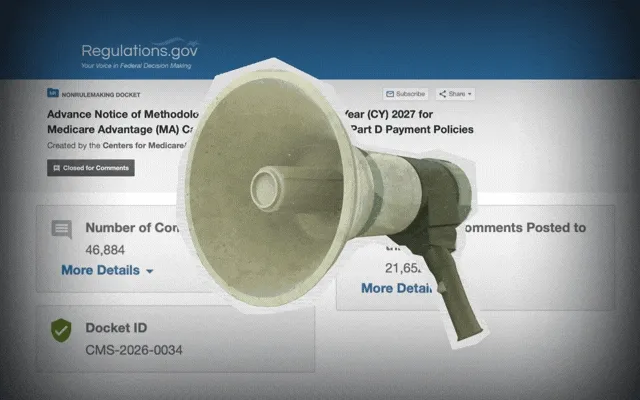
The Insurance Industry’s Old Trick: Flooding the Zone

Nearly 47,000 comments hit regulators. Most weren’t written by seniors — they were engineered by insurers and their front groups.

When the federal government opened a public comment period earlier this year on Medicare Advantage payment rates for 2027, which were far lower than what private health insurers had expected from the Trump administration, something remarkable happened. Comments poured in at a record-breaking pace — nearly 47,000 in all, an all-time high for a Medicare rate notice.

Regulators took notice. A senior CMS official, perhaps trying to lighten the mood, joked that the flood of input might be “another innovation related to AI.”

It was a good line. But the reality was less amusing.

According to an analysis earlier this month by KFF Health News, about 82% of the more than 16,400 publicly available comments were identical to a letter that appeared on the website of a secretive advocacy group called Medicare Advantage Majority — a “dark money” organization that does not reveal its funders, other than to say it is “dedicated to protecting and strengthening Medicare Advantage” and is “powered by hundreds of thousands of local advocates nationwide.”

The letter warned that without higher reimbursements, seniors would face higher costs and fewer benefits. It was signed by thousands of people who almost certainly believed they were speaking for themselves. They were speaking for the industry.

The extent of the deception ran deeper than form letters. KFF Health News found at least one case that illustrates the tactic’s recklessness. Corenia Branham, a 90-year-old widow and cancer survivor in West Virginia, said she never submitted any comment to CMS — yet four form letters appeared online under her name. Branham, who isn’t even on Medicare Advantage, was unambiguous about her views: “I wouldn’t recommend it to nobody.” A spokesperson for Medicare Advantage Majority claimed she had responded to an ad on Facebook. Whether she understood that doing so would put her name on federal regulatory comments is another matter entirely.

Alongside the comment flood, insurers and MA associations funded research, launched ads, rounded up signatures, and met with government officials, submitting a barrage of comments arguing the proposed rule would be disastrous for payers and the seniors they serve. The Better Medicare Alliance, backed by the nation’s largest health insurers, led the charge. So did AHIP, the industry’s primary lobbying group. (And don’t believe for a minute that Medicare Advantage Majority wasn’t funded by the industry, too. In my old career in the insurance business I used to work with Washington propaganda shops to help set up front groups like that.)

The advertising blitz was impossible to miss if you spent any time in Washington. If you visited Washington’s Union Station in recent months and checked the monitor listing train departure times, you would be hard pressed to miss the large electronic billboards around them from an organization called the Coalition for Medicare Choices, another front group, featuring worried-looking seniors warning against cuts to Medicare Advantage. Despite billing itself as a grassroots organization, the Coalition for Medicare Choices was founded out of the same offices as AHIP. The Better Medicare Alliance — whose membership includes UnitedHealth, Humana, and Aetna — ran its own paid media campaign. The group spent over $13.5 million on ads, while yet another dark-money group added $2 million more.

What looked like a nationwide groundswell of concerned seniors was, in large part, a carefully coordinated pressure campaign designed to move our tax dollars — tens of billions of them – to insurance conglomerates that operate private Medicare Advantage plans.

This playbook is not new. It has a name: astroturfing. The term was coined in 1985 by Texas Senator Lloyd Bentsen, who described a “mountain of cards and letters” sent to his office demanding his support for a bill favorable to the insurance industry. “A fellow from Texas can tell the difference between grass roots and AstroTurf,” Bentsen famously said. “This is generated mail.”

Forty years later, the insurance industry is still running the same play — only now with the tools of the internet, AI-assisted drafting, Facebook ads, and front groups bearing names designed to sound like patient advocates.

I know this tactic well. I helped write the playbook.

For years, as a senior executive at one of the country’s largest health insurers, I watched — and participated in — campaigns that manufactured the appearance of public support for industry-friendly policies. The goal was always the same: to make regulators and lawmakers believe that ordinary Americans were rising up in defense of private insurance, when in fact it was the industry pulling the strings. We called it grassroots outreach. It was anything but.

Shooting the Messenger: The Campaign to Discredit MedPAC

Flooding the CMS comment docket with form letters was only one front in the industry’s pressure campaign. Another target was the independent agency whose numbers made the strongest case for reform: the Medicare Payment Advisory Commission, better known as MedPAC.

MedPAC is a nonpartisan congressional advisory body with no financial stake in the outcome of Medicare policy. As we reported earlier, MedPAC’s January 2026 status report estimated that Medicare Advantage overpayments are projected to be $76 billion — or 14% more — above what spending would be in traditional Medicare for the same beneficiaries this year. That finding was politically inconvenient for the industry, so the industry set about undermining it.

The Wall Street Journal published an op-ed calling MedPAC’s methodology into question, with the editorial board going so far as to call for MedPAC to be defunded. Industry-backed lobbying groups like the Better Medicare Alliance and the Healthcare Leadership Council – an outfit formed by Humana founder David Jones and other top industry executives in the late 1980s to shape federal policy – amplified the editorial and supported legislation that would dictate how MedPAC’s staff can conduct research.