Payer merger impact on provider reimbursement

http://managedhealthcareexecutive.modernmedicine.com/managed-healthcare-executive/news/payer-merger-impact-provider-reimbursement?cfcache=true

Merger Ahead

Though recent payer mergers will have a big impact on the industry, it’s doubtful that impact will be related to provider reimbursement. SafaviThat’s according to Kaveh Safavi, senior managing director for consulting firm Accenture’s global healthcare business.

Safavi says the goal behind the payer mergers is to reduce the cost of doing business, not to reduce reimbursement. Insurance is a highly regulated business, and payers are trying to remain profitable and sustainable over time, he says.

“The profit margin for payers is typically 5%. If they’re going to plan for the future, payers have to lower the cost of doing business. By merging, these payers can become more competitive and keep their administrative costs low.”
Democratic Senators Ask Justice Department to Block Insurance Megamergers

http://www.nytimes.com/reuters/2016/06/22/us/politics/22reuters-usa-congress-insurance.html?utm_campaign=KHN%3A+Daily+Health+Policy+Report&utm_source=hs_email&utm_medium=email&utm_content=30930741&_hsenc=p2ANqtz-8v2_Vwj9YHKv6ikVvPVR3IjX0h53Ob9kFNoU_axW-6tBflSgUelzmdB9-b3Mwe8kW1RU0v85qamUHIL7MsBMqe0U_sYQ&_hsmi=30930741&_r=0

Health Insurance Mega Mergers

Seven Democratic senators urged the U.S. Justice Department on Wednesday to block two mergers of major health insurance companies, saying that the proposed deals would mean higher premiums and lower-quality healthcare for consumers.

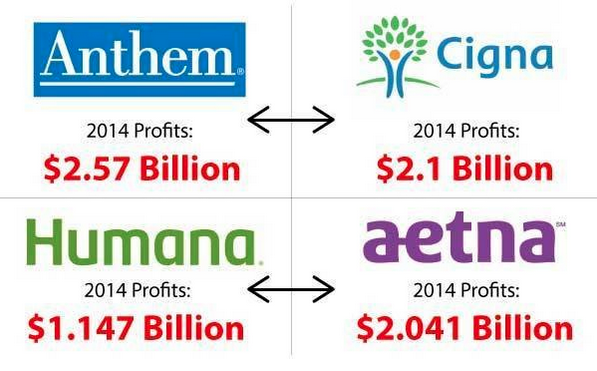
The department is reviewing Aetna Inc’s $33 billion plan to buy Humana Inc and Anthem Inc’s $48 billion proposal to buy Cigna Corp. If approved, the deals, both of which were announced last July, would reduce the number of national health insurance carriers from five to three.

Healthcare mergers and acquisitions in 2015: Running list

http://www.healthcarefinancenews.com/slideshow/healthcare-mergers-and-acquisitions-2015-running-list

Lazy Image


Healthcare mergers and acquisitions in 2016: Running list

http://www.healthcarefinancenews.com/slideshow/healthcare-mergers-and-acquisitions-2016-running-list

Lazy Image


Advanced Analytics: A Triple Win for Payers

http://www.healthcarefinancenews.com/sponsored/advanced-analytics-triple-win-payers

Virtually every organization working in healthcare – payers, hospitals, physicians, and employer group health plans – must do more with fewer resources. That’s especially true for payers.

The Affordable Care Act may have created what Gartner Research estimates to be a $33 billion opportunity for payers in the form of new individual customers, but it also generated new demands. For starters, payers are now held to a higher standard for administrative spend. The ACA’s Medical Loss Ratio (MLR) provisions require payers to spend at least 80 percent and 85 percent of premium dollars, for individuals/small groups and large employer group health plans respectively, on medical care and quality activities or issue a rebate to customers. As intended, this limits profits, salaries and broker commissions and administrative spend on business activities such as customer service, network and product development, and information technology.

In many markets, premium pressures have increased. As the result of the ACA and healthcare exchanges, there is a much higher level of transparency about individual and small group premiums, often leading to price competition. Large employer group health plans too have more options, including contracting directly with provider groups, all of which translates to premium challenges for most payers.

The next stage in health reform

http://www.brookings.edu/blogs/health360/posts/2016/05/26-next-stage-health-reform-aaron?utm_campaign=Brookings+Brief&utm_source=hs_email&utm_medium=email&utm_content=30041023&_hsenc=p2ANqtz-_AGn4Thn8Inuyc_igk7tSjtVMCb-JaqXsYBkb7NQyhEedpzf3Z1b_iYA3tbVpbHWqABocRNpikaooKtyt-j38BLbyOQA&_hsmi=30041023

health-care-reform-logo-001

Health reform (aka Obamacare) is entering a new stage. The recent announcement by United Health Care that it will stop selling insurance to individuals and families through most health insurance exchanges marks the transition. In the next stage, federal and state policy makers must decide how to use broad regulatory powers they have under the Affordable Care Act (ACA) to stabilize, expand, and diversify risk pools, improve local market competition, encourage insurers to compete on product quality rather than premium alone, and promote effective risk management. In addition, insurance companies must master rate setting, plan design, and network management and effectively manage the health risk of their enrollees in order to stay profitable, and consumers must learn how to choose and use the best plan for their circumstances.

Payer Consolidation Expected to Roll on Over Next Decade

http://www.healthleadersmedia.com/health-plans/payer-consolidation-expected-roll-over-next-decade?spMailingID=8976156&spUserID=MTMyMzQyMDQxMTkyS0&spJobID=922552058&spReportId=OTIyNTUyMDU4S0

Health Insurer Consolidation

Senior-level healthcare industry stakeholders believe that consolidation in the payer space is likely to continue over the next ten years—and not to the benefit of consumers.

ACEP files federal lawsuit over out-of-network underpayments

http://www.healthcaredive.com/news/acep-files-federal-lawsuit-over-out-of-network-underpayments/419465/

The American College of Emergency Physicians has filed suit against HHS over a provision in the Affordable Care Act health law they say lets insurers get away with underpayments for out-of-network emergency care, Modern Healthcare reported.

Hedge fund’s healthcare retreat signals industry uncertainty

http://www.healthcaredive.com/news/hedge-funds-healthcare-retreat-signals-industry-uncertainty/419445/

NYC hedge fund Glenview Capital Management, headed by Larry Robbins, has pulled back sharply on its healthcare investments despite its usual emphasis on the industry, Modern Healthcare reported. The hedge fund overall reduced its shares in 11 of 16 healthcare companies during the first quarter, including Aetna, Anthem, Cigna and Humana, which await uncertain state and federal regulatory approval for mergers.

Merge ahead: Healthcare deals adapting as industry evolves

http://www.healthcaredive.com/news/merge-ahead-healthcare-deals-adapting-as-industry-evolves/418868/

There’s little doubt healthcare consolidation will continue as demand increases and the population ages. However, it remains to be seen whether the potential cost savings trickles down to consumers.