

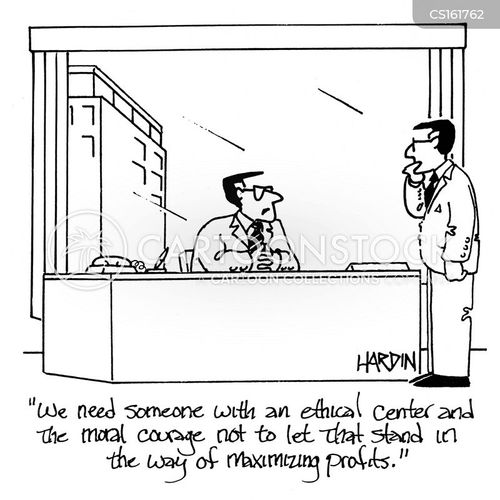
Cartoon – Modern Moral Courage
As usual, the answer is a clear “No” and “Yes,” and resolving the question raises much deeper issues than one executive’s personal culpability. The answer depends on what definition of capitalism one deems appropriate. As the European economist André Sapir has noted, there are actually four distinct brands of capitalism in the Western economy, of which the version practiced in the United States and some other Anglo-Saxon countries—sometimes also referred to as “savage capitalism”—is but one.
The clearest version of raw Anglo Saxon capitalism, and one quoted widely to this day, was offered by the late Nobel Laureate economist Milton Friedman in his classic book “Capitalism and Freedom.” There he proposed that the one and only social obligation to society that the CEO of an investor-owned, for-profit company is “to maximize its profits while engaging in ‘open and free competition without deception and fraud.’” (Quoted in Thomas Carson’s “Friedman’s Theory of Corporate Social Responsibility.”) On that view, any corporate action that is legal is ipso facto ethical.
Ms. Bresch can argue that with her aggressive pricing policy on EpiPen she was merely owning up to this doctrine of Anglo-Saxon capitalism. Her board of directors may or may not have known about that policy with regard to this particular product, one of many the company sells. Here Ms. Bresch also can point out that she is in good company in the drug industry. Many drug companies beyond the poster-boys for what is now decried as “price gouging”—Valeant Pharmaceuticals International and Turing Pharmaceuticals—have adopted raw Anglo-Saxon capitalism as the intellectual foundation for their pricing policies by steadily raising prices on long existing drugs, year after year, or even quarter after quarter.
 HENRY KOTULA