The Great Flattening

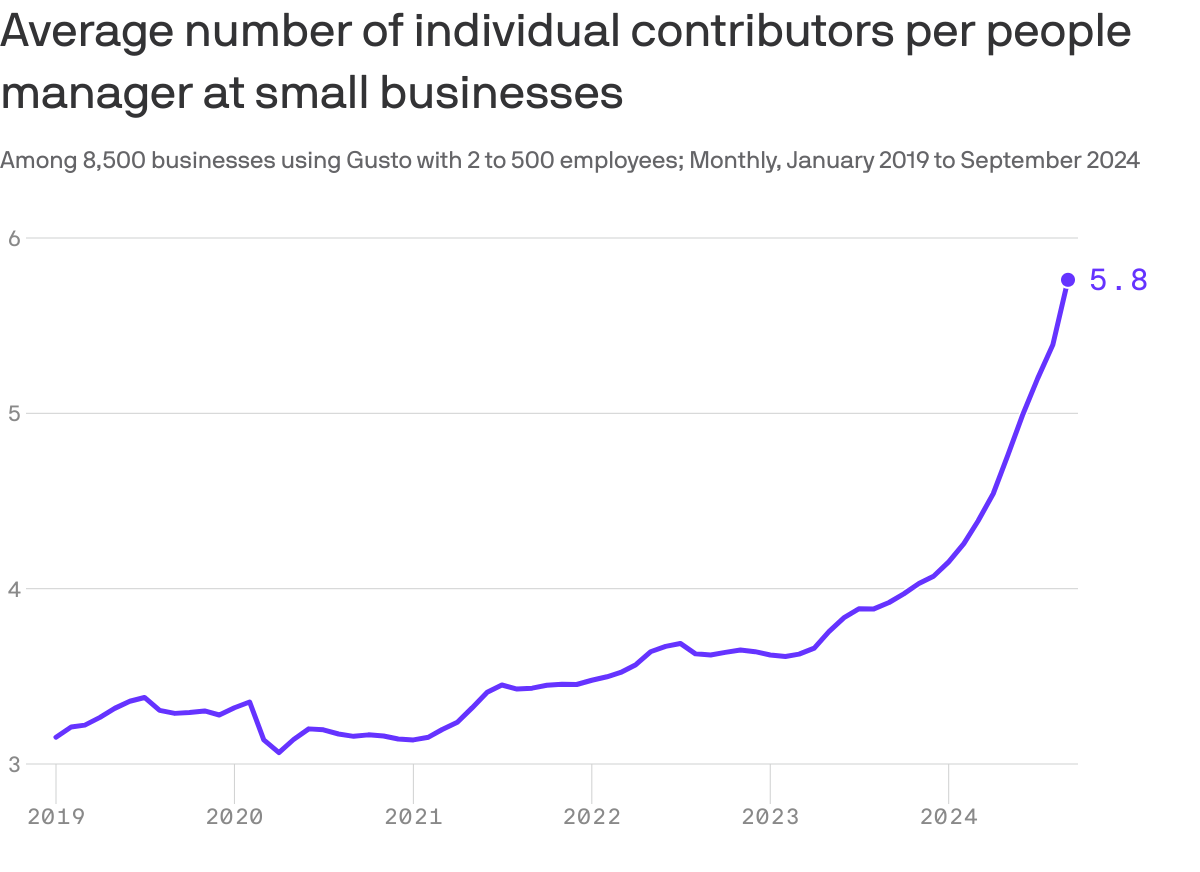
This chart may explain why your boss is taking longer to get back to you lately: They’ve got more underlings to watch over, Axios’ Emily Peck writes from a new analysis.

  • Why it matters: Middle managers — i.e., bosses who have bosses — were already quietly going extinct, and now AI may be hastening the process.

By the numbers: 

People managers now oversee about twice as many workers as just five years ago.

  • There are now nearly six individual contributors per manager at the 8,500 small businesses analyzed in a report by Gusto, which handles payroll for small and medium-sized employers.
  • That’s up from a little over three in 2019.

🎨 The big picture: 

Big Tech has been shedding middle managers for the past few years, a process that’s been dubbed the Great Flattening.

  • Reducing management layers is one of Microsoft’s stated goals in laying off thousands of workers this year as it ramps up its AI strategy.
  • Amazon CEO Andy Jassy last year announced an effort to reduce managers (memo).

Do nurses quit their jobs, or their managers? 

https://mailchi.mp/cfd0577540a3/the-weekly-gist-november-11-2022?e=d1e747d2d8

There’s an old trope among human resources leaders that people don’t quit companies, they quit managers. There’s certainly truth to it. If an employee has a difficult or inattentive boss, they are at much greater risk of leaving for another opportunity. But a “bad” manager is not always someone lacking in the skills necessary to engage employees; sometimes the problem is that their own roles are structured in ways that make it nearly impossible to succeed. 

We’ve recently heard stories from leaders at several health systems describing the untenable management scope for many of their mid-level nursing leaders. It’s common to hear that nurse managers have dozens of direct reports, and a few systems reported that some of their managers have well over a hundred individuals reporting to them. With that scope, it’s impossible to develop relationships with everyone on the team, much less be able to customize roles, or provide tailored feedback and support. 

For younger workers, the manager relationship is critical for engagement, skill development, and building loyalty. 

Given today’s intense margin pressures, it’s tempting to cut clinical managers and increase the span of control for those who remain—but underinvestment here is short-sighted, and will surely exacerbate challenges maintaining critical capacity in the near-term, as well as building the foundation for future growth.