Even Democrats prefer more moderate “Medicare for All”

https://www.axios.com/even-democrats-prefer-more-moderate-medicare-for-all-2fc79e20-70e7-47f1-890d-711ef0adeb92.html

Image result for Even Democrats prefer more moderate "Medicare for All"

Allowing people to buy into Medicare is more popular than establishing a single-payer health care system — including among Democrats, according to a recent Navigator poll.

Why it matters: Bernie Sanders made “Medicare for All” a popular concept, but even its supporters have different ideas about what it entails. And more moderate versions have the upper hand.

Between the lines: Most people don’t have a nuanced understanding of health policy, and even within the same poll, different ways of describing the same policy yielded different results.

By the numbers: Even a majority of Republicans said that they would support a Medicare buy-in, when given a choice between that or single-payer.

  • In another section of the poll, though, a 40% plurality of Republicans said “expanding Medicare” was a bad idea, and 59% said that “Medicare for anyone who wants it” is a bad idea.

Yes, but: A version of Medicare for All that eliminates private insurance is still supported by a majority of both Democrats and independents.

  • 78% of Democrats said a “universal health care system” is a good idea, 76% said that a “‘Medicare for All’ program” is a good idea, and 52% said that a “single payer health care system” is a good idea.

What they’re saying: Polling aside, I think Medicare for All is what the American people want and need,” Sanders said in a brief interview.

  • “I think the vision of a simple, seamless system of health care where you have the care that you need, your loved ones have the care that they need…is very, very appealing. Many ideas are being presented for how do we get to that,” said Sen. Jeff Merkley, who has a Medicare buy-in proposal.

The bottom line: There’s plenty of opportunity to sway the health care debate, but moderate Democrats seem to have the most popular ideas right now.


Healthcare Reform: “150 million Americans won’t give up their private health insurance to get Medicare for all.” Really?

Healthcare Reform: “150 million Americans won’t give up their private health insurance to get Medicare for all.” Really?

Former Representative Jim Delaney (D-Md) threw down the gauntlet to the left-leaning attendees at the California Democratic convention on June 2 by challenging Medicare-for-all.

”The problem with Medicare for all, it’s actually really simple, is that it makes private insurance illegal. And 150 million Americans have private insurance, and 70% of them like it according to polling. So if we want to actually create universal health care, we’re never going to do it by trying to get 150 million Americans to give up what they want.”

The crowd booed at first, but then gave him a respectful hearing. Pundit George Will and commentator Charlie Sykes think Delaney has a good point politically. But let’s look at Delaney’s claim through the apolitical lens of this blog.

1. Why Did Delaney make this claim?

Two reasons:  He wanted to move the debate over U.S. healthcare from sound bites to substance. And Rep. Delaney wanted to distinguish himself from the rest of the pack of Democrat Presidential contenders and position himself as a moderate on this and other issues.

2. Does Medicare-for-all mean making private health insurance illegal?

Clearly for Sen. Bernie Sanders the answer is yes. But not for any of the other Democrat Presidential candidates, at least not right away.  Some like Mayor Pete Buttigieg and entrepreneur Andrew Yang contemplate a gradual path, eventually leading to a single public payer. In Yang’s case, he expects that public health insurance will eventually out-compete private insurance, not that it will be outlawed. Others like Senators Cory Booker and Amy Klobuchar, Governors Hickenlooper and Inslee, and Rep. Eric Swalwell contemplate using public insurance, alongside private insurance, as the means to get to universal coverage, more like “Medicare for all who want it.”  This month’s Kaiser Family Foundation poll found that 55% do not perceive that Medicare-for-all would mean abolishing private insurance.

3. How many Democratic candidates advocate Medicare-for-all?

Of the 24 Democrats who have announced their candidacy (25, if you count former Sen. Mike Gravel), 13 advocate some version of Medicare-for-all, but 10 prefer some other approach to achieve universal coverage. Former Vice-President Joe Biden has not put forward a clear position yet. (Sen. Gravel supports universal healthcare “like Medicare.”)

4. What about Republicans?

Many Republicans, including the President himself, have at times given lip service to universal healthcare coverage. Most of them also advocate “protecting” Medicare, in some cases by scaling it back and limiting it. However, the President and Senate Republicans are once again pledging to “repeal and replace Obamacare” with a new plan, touted as “phenomenal” (though no details so far). At first the new plan was promised “in a very short period of time,” then “in next 2 months,” and now most recently “after the 2020 election.” For them, opposition to Medicare-for-all is a political matter of faith, not just a strategy for preserving private health insurance for those who want it.

5. How many Americans have private health insurance?

Private employer-based insurance covered 181 million Americans in 2017. According to the Census Bureau the full 2017 breakdown is:

  • Any insurance at least part-year           295 million
    • Employer-based, private              181 million
    • Direct purchased, private              52 million
    • Government                                  122 million

(Note: Some individuals had more than one type of insurance during year)

  • Uninsured entire year                              29 million

6. Are Americans satisfied with their own private employer-based healthcare insurance?

Americans currently rate the “coverage” (69%) and “quality” (80%) for their own individual health plans as “good” or “excellent,” according to a December 2018 Gallup poll.

7. How does this compare with Medicare satisfaction statistics?

For Medicare recipients the ratings for “coverage” (88%) and “quality” (88%) are even better, in the same poll.

8. Do Americans see any downside to having employer-based healthcare insurance?

Many Americans feel locked into their current jobs lest they lose health benefits. This is especially so if they have chronic pre-existing conditions. Fear of losing coverage subtly puts them at the mercy of the employer for wages and work conditions. In addition, employees are shouldering a larger share of premiums and copays with each passing year.  A Rand study showed that in the first decade of the 2000s, workers gains in productivity were offset by higher healthcare costs, holding their take-home wages flat.  Increasingly, employees are switching to plans with high deductibles and less doctor choice.

Americans also express dissatisfaction with the wider system, even if they are satisfied with their own plans.  They rate “coverage” at 34% and “quality” at 55% nationally.

Americans polled by Gallup are especially dissatisfied with costs. Only 58% are satisfied with cost of their own plan, while a low 20% are satisfied with overall cost in the national system.

9. Who are other stakeholders in the healthcare debate besides employees with employer-based insurance?

All Americans have a stake in healthcare reform.  But here are some stakeholder sub-groups with special issues:

  • small business
  • big business
  • federal, state and local government employers
  • healthcare insurers
  • healthcare systems
  • healthcare professionals
  • other healthcare suppliers (of equipment, drugs, software, subcontractors)
  • healthcare academia.

The uninsured are special stakeholders, as well.

10. Which of these stakeholders have the most to lose with Medicare-for-all?

In the first instance, healthcare insurers would be most directly affected. On closer look, I predict that several functions would not change much at all under a single-payer. There would still be enrollments, benefits management, claims processing, chronic disease management, contract negotiation, and customer service. These functions would continue, either in the form of subcontracts with government payers or in the form of direct government employment. Meanwhile, some would say that insurance companies have abdicated their job of true risk management, and have simply become pass-throughs for local health system monopolies and oligopolies. Under Medicare-for-all administrative complexities would be simplified, and inflated profits and salaries would be constrained, with resultant cost savings for the overall system

11. Which of these stakeholders have the most to gain with Medicare-for-all?

Big business and public sector employers probably have the most to gain from Medicare-for-all or other healthcare reform.  In 1991, Sam Walton famously railed to his managers, “These people are skinnin’ us alive not just here in Bentonville but everywhere else, too….They’re charging us five and six times what they ought to charge us….So we need to work on a program where we’ve got hospitals and doctors…saving our customers money and our employees money.” Walmart and others like Bezos, Buffet and Dimon’s innovative Haven healthcare management enterprise are taking matters into their own hands out of frustration with traditional insurance’s inability to control healthcare costs and deliver value.

Small businesses also stand to gain much from jettisoning healthcare costs and administrative burdens under a single payer system. Small businesses feel a disproportionate brunt of current high healthcare costs.  For them, a single sick employee can jack up their experience-rating. Tracking payments and maintaining regulatory compliance saps valuable administrative time. For these reasons, just 29 percent of small businesses with fewer than 50 employees provided group health insurance in 2016.  Many dropped insurance for their employees and referred them to the public exchanges instead.

12. Is Medicare-for-all the end goal for its supporters, or only the means to a further goal?

Democrat candidates base their arguments for Medicare-for-all, or for their alternative approaches, primarily on achieving universal coverage. This is a worthy goal in itself. Having healthcare insurance has been linked to quality of life, life expectancy, worker productivity, and financial security.

But this blog has argued that an even more critical goal is constraining costs. Climbing healthcare costs are consuming an ever-greater share of the GDPdiverting resources from other worthy projects, and stressing household, corporate and public budgets.

This blog, thus, sees single payer as a means to the end of leveraging cost containment.

 13. If Medicare-for-all in some form would give government the ability to finally constrain costs, who would be the biggest losers?

Clearly, potentially the biggest losers would be the healthcare industry, from front-line workers to professionals to health system CEOs.  However, many could shift into higher-value healthcare activities. Others could transition to equivalent jobs in other service industries. True, a few might need to accept cuts in their bloated incomes. Since healthcare currently comprises almost one-fifth of all economic activity, these transitions should be done slowly. Leaders should do some industrial policy planning to facilitate changes and mitigate disruptions. Having said that, we should keep in mind that healthcare professionals are generally well educated, motivated, adaptable and resourceful, thus able to successfully navigate change.

Conclusion

Rep. Delaney asks a good question:  Whether Americans with current employer-based health insurance would trade it for Medicare-for-all.  Would they recognize that Medicare gets better quality and coverage ratings than private insurance? Would they view changing to Medicare-for-all as a fair bargain to achieve universal access for all? Do they think that single-payer would give the government leverage to finally constrain costs?  Do they recognize that the total cost of healthcare – whether in the form of out-of-pocket payments, paycheck deductions, or new “$30 trillion” healthcare taxes  – comes out of their wallets, one way or another?

On the other hand, could a larger public insurer (Medicare-for-all-who-want-it) gain sufficient reach and clout to tame the healthcare tapeworm without a Sanders-style single payer system?  This blog will tackle that question in another post.

Now, take action.


Nurse viewpoint: Modern healthcare system prioritizes profits over care quality

https://www.beckershospitalreview.com/quality/nurse-viewpoint-modern-healthcare-system-prioritizes-profits-over-care-quality.html

The American healthcare system benefits companies, hospital systems and administrators over patients and providers, wrote Theresa Brown, PhD, BSN, RN, in an op-ed for CNN.

 Five highlights from Dr. Brown’s opinion piece:

1. Providers work in an environment of “scarcity,” whereas CEOs, pharmaceutical companies and hospital systems live in “a world of plenty.”

2. Dr. Brown cites her own experience at a teaching hospital in the University of Pittsburgh Medical Center system, where she says nurses who requested more life-saving devices were told to do “more with less,” despite the hospital system’s multibillion-dollar revenues.

3. Dr. Brown writes nurses at the teaching hospital also faced staff shortages, which have been shown to negatively affect patient health outcomes.

4. In contrast, 14 pharmaceutical companies made profits of at least $1 billion in 2018. Yet Dr. Brown argues that vilifying such companies misinterprets the problem, which is the long line separating cash-strapped hospital floors from the large profits that benefit systems, companies and administrators over patients.

5. Dr. Brown supports Medicare for All, writing that it is a critical measure for the 66 percent of American households that say they must choose between purchasing food and healthcare.


A Large Employer ‘Frames’ The ‘Medicare For All’ Debate

https://www.healthleadersmedia.com/finance/large-employer-frames-medicare-all-debate

As health costs continue to grow, straining employer budgets and slowing wage growth, the business community is beginning to take the option more seriously.


KEY TAKEAWAYS

More than 156 million Americans get employer-paid healthcare, making it by far the single-largest form of coverage.

Medicare-for-all supports say the health system overall would see savings from a coordinated effort to lower prices and administrative costs and eliminate insurance company profits.

While large business lobbying groups strongly oppose Medicare for all, the resolve of many in the business community — especially among smaller firms — may be shifting.

Walk into a big-box retailer such as Walmart or Michaels and you’re likely to see MCS Industries’ picture frames, decorative mirrors or kitschy wall décor.

Adjacent to a dairy farm a few miles west of downtown Easton, MCS is the nation’s largest maker of such household products. But MCS doesn’t actually make anything here anymore. It has moved its manufacturing operations to Mexico and China, with the last manufacturing jobs departing this city along the Delaware River in 2005. MCS now has about 175 U.S. employees and 600 people overseas.

“We were going to lose the business because we were no longer competitive,” CEO Richard Master explained. And one of the biggest impediments to keeping labor costs in line, he said, has been the increasing expense of health coverage in the United States.

Today, he’s at the vanguard of a small but growing group of business executives who are lining up to support a “Medicare for All” national health program. He argues not that healthcare is a human right, but that covering everyone with a government plan and decoupling healthcare coverage from the workplace would benefit entrepreneurship.

In February, Master stood with Rep. Pramila Jayapal (D-Wash.) outside the Capitol after she introduced her Medicare for All bill. “This bill removes an albatross from the neck of American business, puts more money in consumer products and will boost our economy,” he said.

As health costs continue to grow, straining employer budgets and slowing wage growth, others in the business community are beginning to take the option more seriously.

While the influential U.S. Chamber of Commerce and other large business lobbying groups strongly oppose increased government involvement in healthcare, the resolve of many in the business community — especially among smaller firms — may be shifting.

“There is growing momentum among employers supporting single-payer,” said Dan Geiger, co-director of the Business Alliance for a Healthy California, which has sought to generate business support for a universal healthcare program in California. About 300 mostly small employers have signed on.

“Businesses are really angry about the system, and there is a lot of frustration with its rising costs and dysfunction,” he said.

Geiger acknowledged the effort still lacks support from any Fortune 500 company CEOs. He said large businesses are hesitant to get involved in this political debate and many don’t want to lose the ability to attract workers with generous health benefits. “There is also a lingering distrust of the government, and they think they can offer coverage better than the government,” he said.

In addition, some in the business community are hesitant to sign on to Medicare for All with many details missing, such as how much it would increase taxes, said Ellen Kelsay, chief strategy officer for the National Business Group on Health, a leading business group focused on health benefits.

Democrats Propel the Debate

For decades, a government-run health plan was considered too radical an idea for serious consideration. But Medicare for All has been garnering more political support in recent months, especially after a progressive wave helped Democrats take control of the House this year. Several 2020 Democratic presidential candidates, including Sens. Bernie Sanders and Elizabeth Warren, strongly back it.

The labor unions and consumer groups that have long endorsed a single-payer health system hope that the embrace of it by employers such as Master marks another turning point for the movement.

Supporters of the concept say the health system overall would see savings from a coordinated effort to bring down prices and the elimination of many administrative costs or insurance company profits.

“It’s critical for our success to engage employers, particularly because our current system is hurting employers almost as much as it is patients,” said Melinda St. Louis, campaign director of Medicare for All at Public Citizen, a consumer-rights group based in Washington.

Master, a former Washington lawyer, worked on Democratic Sen. George McGovern’s presidential campaign before returning to Pennsylvania in 1973 to take over his father’s company, which made rigid paper boxes. In 1980, he founded MCS, which pioneered the popular front-loading picture frame and steamless fog-free mirrors for bathrooms. The company has grown into a $250 million corporation.

Master frequently travels to Washington and around the country to talk to business leaders as he seeks to build political support for a single-payer health system.

In the past four years, he has produced several documentary videos on the topic. In 2018, he formed the Business Initiative for Health Policy, a nonprofit group of business leaders, economists and health policy experts trying to explain the financial benefits of a single-payer system.

Dan Wolf, CEO of Cape Air, a Hyannis, Mass.-based regional airline that employs 800 people calls himself “a free market guy.” But he also supports Medicare for All. He said Master helps turn the political argument over single-payer into a practical one.

“It’s about good business sense and about caring for his employees and their well-being,” he said, adding that employers should no longer be straddled with the cost and complexity of healthcare.

“It makes no more sense for an airline to understand health policy for the bulk of its workers than for a health facility to have to supply all the air transportation for its employees,” he said.

Employers are also an important voice in the debate because 156 million Americans get employer-paid healthcare, making it by far the single-largest form of coverage.

Master said his company has tried various methods to control costs with little success, including high deductibles, narrow networks of providers and wellness plans that emphasize preventive medicine.

Insurers who are supposed to negotiate lower rates from hospitals and doctors have failed, he added, and too many premium dollars go to covering administrative costs. Only by having the federal government set rates can the United States control costs of drugs, hospitals and other health services, he said.

“Insurance companies are not watching the store and don’t have incentives to hold down costs in the current system,” he said.

Glad The Boss Is Trying To Make A Difference

What’s left of MCS in Pennsylvania is a spacious corporate office building housing administrative staff, designers and a giant distribution center piled high with carton boxes from floor to ceiling.

MCS pays an average of $1,260 per month for each employee’s healthcare, up from $716 in 2009, the company said. In recent years, the company has reduced out-of-pocket costs for employees by covering most of their deductibles.

Medicare for All would require several new taxes to raise money, but Master said such a plan would mean savings for his company and employees.

MCS employees largely support Master’s attempt to fix the health system even if they are not all on board with a Medicare for All approach, according to interviews with several workers in Easton.

“I think it’s a good idea,” said Faith Wildrick, a shipper at MCS who has worked for the company 26 years. “If the other countries are doing it and it is working for them, why can’t it work for us?”

Wildrick said that even with insurance her family struggles with health costs as her husband, Bill, a former MCS employee, deals with liver disease and needs many diagnostic tests and prescription medications. Their annual deductible has swung from $4,000 several years ago to $500 this year as the company has worked to lower employees’ out-of-pocket costs.

“I’m really glad someone is fighting for this and trying to make a difference,” said Wildrick.

Jessica Ehrhardt, the human resources manager at MCS, said the effort to reduce employees’ out-of-pocket health costs means the company must pay higher health costs. That results in less money for salary increases and other benefits, she added.

Asked about Medicare for All, Ehrhardt said, “It’s a drastic solution, but something needs to happen.”

For too long, Master said, the push for a single-payer health system has been about ideology.

“The movement has been about making healthcare a human right and that we have a right to universal healthcare,” he said. “What I am saying is this is prudent for our economy and am trying to make the business and economic case.”


“This is prudent for our economy and am trying to make the business and economic case.”


Democrats Yet To Successfully Explain Medicare For All

https://www.forbes.com/sites/brucejapsen/2019/05/26/from-bernie-to-warren-democrats-yet-to-successfully-explain-medicare-for-all/#3e8b63126daf


Kaiser Family Foundation Medicare For All briefing on national public healthcare plan approaches introduced in Congress (May 21, 2019).

Even with two dozen Democrats running for President and most touting an expansion of Medicare benefits to everybody, the public is still unclear how a national single payer health plan like “Medicare for All” will benefit them.

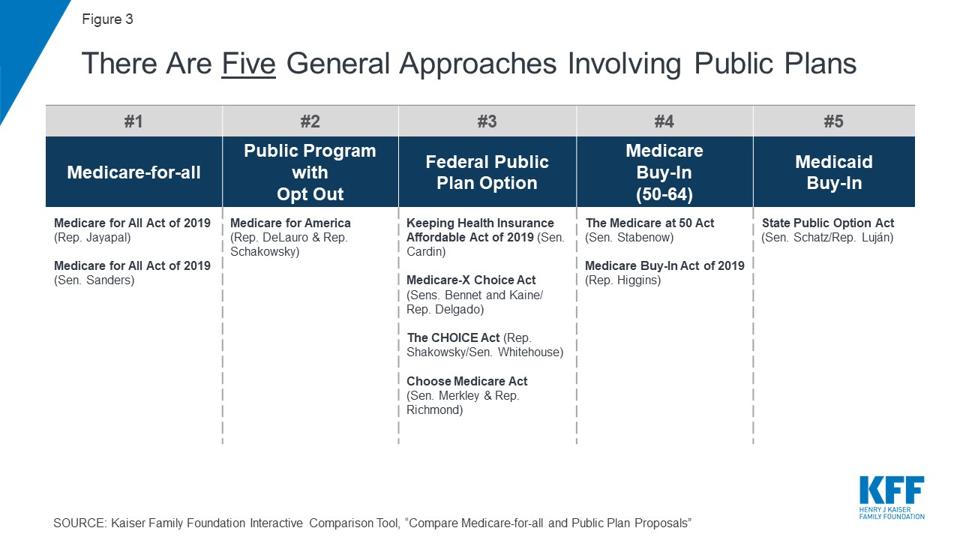
A briefing from experts at the nonpartisan Kaiser Family Foundation for health reporters last week revealed there are five general approaches to expanding coverage involving public plans.

Within those approaches are 10 national plans introduced in Congress that include everything from a single payer version of Medicare for All that would uproot private coverage to a “public program with an opt out” that would be offered along side commercial coverage. Other plans would allow Americans to buy into Medicare as young as 50 years old or buy into Medicaid coverage for the poor.

But no matter the effort to expand health insurance coverage, much is to be done to educate the public at large even as single payer supporters like Sens. Bernie Sanders, Elizabeth Warren and Kamala Harris push Medicare for All on the campaign trail.

“Our polling shows some Americans are unaware of how the implementation of a national health plan could impact them,” said Mollyann Brodie, Kaiser’s senior vice president and executive director, public opinion and survey research. “For example, many people (55%) falsely assume that would be able to keep their current health insurance under a single-payer plan.”

Democrats on the campaign trail hoping to challenge President Donald Trump should Republicans nominate him to run for re-election in 2020 see rising support for a national health plan that would make the government the only insurance carrier.

Kaiser data shows 56% favor a national health plan “in which all Americans would get their insurance from a single government plan.” Just 40% favored such a national health plan 20 years ago, Kaiser data shows.

“Our polls have shown a modest increase in support for the idea of a national health plan,” Kaiser’s Medicare for All presentation showed. Some of these health insurance expansions would be single payer versions of “Medicare for All’ like that proposed by Sanders in the U.S. Senate and Rep. Pramila Jayapal (D-Washington) in the U.S. House of Representatives that would uproot private coverage and replace it with government run Medicare.

Other public approaches would involve a “public program with an opt out” known as Medicare for America or a “Medicare Buy in” like that proposed by Sen. Debbie Stabenow (D-Michigan). Other public plans would involve a so-called “federal public plan option” that would be offered along side commercial coverage on a government exchange and there are also Medicaid buy-in proposals being floated in a number of states.

Politically, the lack of knowledge of Medicare for All and public option proposals offers opportunities for both Democrats who favor Medicare for All and Republicans who want to derail a government expansion of health benefits, particular an approach that would essentially replace much of the private system.

“As the public learns more about the implications of each of these proposals, support may increase or decrease,” Kaiser’s Brodie said.


Who is blocking ‘Medicare for All’?

Who is blocking ‘Medicare for All’?

Who is blocking 'Medicare for All'?

Decades of corporate-friendly politics and policy have decimated communities throughout the country. Centrist Democrats who have chosen corporate profits over people’s needs have aided and abetted this decimation. People are hungry for big ideas to improve their lives and to change the rules that serve only to make the rich richer.

Nowhere is this hunger more apparent than in the demand for improved “Medicare for All”. During a hearing at the House Budget Committee this week it was also apparent that the center-right and their wealthy donors won’t go down without a fight when it comes to health care. 

With guns-a-blazing, they are out to block an incredibly successful and popular program: Medicare, from being improved, expanded and provided to everyone.

Yet polling shows that across party lines,majority of Americans are in favor of Medicare for All. And why not? Right now, nearly 30 million people in this country are uninsured; 40 million can’t afford health-care co-pays and deductibles and 45,000 die annually as a result of not having access to health care.

Those reaping the excessive profits from our illnesses and injuries are in a panic. They’re laying all their chips on the table to make sure Medicare for All never becomes reality. It would mean the end of private insurance companies that profit mightily off the most costly and least effective health-care system in the industrialized world.

So, to continue to rake in their profits, they’ve created the Partnership for America’s Health Care Future, a partnership of corporate hospitals, insurance and drug companies. They must have a lot to lose: last year alone, the group spent $143 million developing attack ads and launching fear campaigns to kill Medicare for All.

It’s time to admit it, while nearly every modern country in the world provides quality, accessible health care for free or very inexpensively to their citizens, the United States stands alone in its willingness to let corporations suck the last pennies out of sick or injured people.

Well, the jig is up. Decades under a corporate-run private health insurance system have proven that we can’t rely on profiteers to provide access to quality health care. We need a publicly held system that is accountable to the people who rely on it. We are able to do so and save trillions of dollars over the next decade.

Medicare for All would reduce national health-care spending by anywhere between $2 trillion to $10 trillion over ten years. Research shows that countries with single-payer systems spend much less on drugs.

Yet opponents continue to decry the “costs” of Medicare for All. They will continue to focus on the cost to taxpayers, conveniently avoiding the truth that already we pay excessive health care costs through insurance premiums, co-pays and deductibles.

Americans suffer from poor health outcomes because they can’t afford to see a doctor until their illness becomes catastrophic. Many weigh the choice between financial ruin and life-saving medicines and treatment. In one of the richest countries in the world that is nothing short of shameful.

The U.S. is a country with abundant resources and more than enough wealth to go around. It’s time to share the wealth in America. It’s a new day and it starts with Medicare for All. Buckle up — because the fight is just beginning.


The Health 202: Large employers don’t want Medicare-for-all

https://www.washingtonpost.com/news/powerpost/paloma/the-health-202/2019/05/20/the-health-202-large-employers-don-t-want-medicare-for-all/5ce1aa38a7a0a435cff8c0d4/?utm_term=.47900c042418

Medicare-for-all advocates argue enacting their plan would lift a heavy burden off employers to provide their workers with health-care coverage, which is the way 180 million Americans get their insurance.

But large employers are just fine with being the suppliers of insurance and don’t want to give up that role, according to an association that represents them.

Overwhelmingly they would like to continue doing it,” Jim Klein, president of the American Benefits Council, told me. “They think they’re doing a good job.”

The American Benefits Council — which represents the country’s largest employers including Walmart, ExxonMobil and Apple — hasn’t joined the large industry coalition of insurers, pharmaceutical makers and hospitals who are vigorously fighting every iteration of Medicare-for-all proposals coming from Capitol Hill (we’ve written about that partnership here).

But its leaders are plenty skeptical of the prospect of a single-payer system, stressing it would upend the way most people in the United States get their coverage and potentially subject employers to big new taxes so the government could pay for the whole thing.

“I think they’re very concerned about sort of a blank check which the government would be filling in the blank, in terms of cost,” Klein said of his members.

The future of employer-sponsored coverage is one of the stickiest questions raised by the Medicare-for-all debate. The shortcomings — and merits — of the system got a lot of airtime during last month’s Medicare-for-all hearing at the House Rules Committee and probably will be part of the debate at a similar hearing House Budget Chairman John Yarmuth (D-Ky.) has scheduled for Wednesday.

Just look at how some of the Democrats running for president have recently danced around the issue.

Sens. Cory Booker (D-N.J.) and Kamala Harris (D-Calif.) are co-sponsors of the latest Medicare-for-all bill from Sen. Bernie Sanders (I-Vt.), which would upend the country’s health insurance system, replacing virtually all private plans with a generous set of benefits provided by the federal government. But both candidates have tried to take a softer stance on what would happen to workplace coverage.

—“I stand by supporting Medicare-for-all, but I’m also that pragmatist that, when I’m chief executive of the country … I’m going to find the immediate things that we can do,” Booker told CNN’s Jake Tapper this month.

“Because I’m telling you right now, we’re not going to pull health insurance from 150 million Americans who have private insurance who like their insurance — my union friends, brothers and sisters, who have negotiated for their health insurance,” Booker added.

—Sen. Kamala Harris (D-Calif.) told Tapper last week “that’s not what I meant” when he asked her to clarify previous comments in which she said she supports eliminating the private insurance industry.

“I support Medicare-for-all but I really do need to clear up what happened on that stage,” Harris said. “It was in the context of saying let’s get rid of all the bureaucracy.”

— Yarmuth poured cold water on the idea of Medicare-for-all being law anytime soon, despite the hearing he’s holding on the issue this week.

“A lot of people, I think, co-sponsored Pramila’s bill for the same reason they co-sponsored H.R. 676; it was the metaphor for Medicare-for-all,” Yarmuth told my colleague Dave Weigel last week. Yarmuth was referring to the House bill proposed by Rep. Pramila Jayapal (D-Wash.).

“Now, people have seen some of the details and said, ‘Okay, we need to look at this.’ There doesn’t seem to be much of a sense of urgency because it’s not going anywhere,” Yarmuth added.

Rep. Donna Shalala (D-Fla.), former Health and Human Services secretary under President Bill Clinton, is also a Medicare-for-all skeptic:

Perhaps these Democrats recall President Barack Obama’s infamous “if you like it, you can keep it,” pledge, where Obama learned the hard way what happens when people lose insurance they wanted to keep. Obama repeatedly promised people they could retain coverage they liked under his 2010 Affordable Care Act. When around 4 million people got notices their plans were being canceled — because they weren’t ACA-compliant — the administration came under heavy fire. The website PolitiFact dubbed Obama’s promise its “Lie of the Year” in 2013.

Yet employer-sponsored plans are still far from perfect. In fact, many health policy wonks have said many of the problems with health insurance in the United States stem from people getting it through the workplace instead of shopping for it on their own.

Costs are a big problem for both employers and their workers. For years, employers have grappled with rapid health-care cost inflation, resulting in higher monthly premiums and annual deductibles. Last year, health benefits for the average employee at a large company cost more than $13,000, according to a Mercer survey of employer-sponsored plans.

In response, employers have trended toward high-deductible plans or asked their workers to contribute more to their monthly premiums. Some have also invested in workplace wellness programs, in hopes of creating a healthier, lower-cost workforce.

“It puts a huge burden on employers,” House Rules Committee Chairman James McGovern (D-Mass.) said at his committee’s Medicare-for-all hearing.

Then there’s the issue of portability — the problem created when people change jobs and are forced to also change their health plan. This can be especially costly for those with chronic health conditions, who can’t afford any gaps in coverage and may find themselves having to satisfy an annual deductible for the second time in one year.

Yet to those enmeshed in the system, such as large employers, overhauling the whole thing is a daunting prospect. While health-care costs continue to rise, employers are more fearful of having to help fund the expensive single-payer system proposed in the Sanders and Jayapal bills.

Sanders argues his Medicare-for-all plan would be net cheaper for employers. He has proposed charging them either 75 percent of what they’re paying for each of their employees enrolling in Medicare-for-all or a 7.5 percent payroll tax, whichever is higher.

This would result in a net savings for employers, Sanders argues. Large employers don’t appear convinced.

Klein said the council isn’t necessarily opposed to expanding Medicare to more people — and stresses that its members are deeply interested in reining in cost growth.

But he said employers don’t want a health insurance overhaul, arguing they spend more than $4 on health benefits for every dollar the government loses by exempting the benefits from taxes.

“Our employers are not calling for Uncle Sam,” he said.