Even the most seasoned patients are no match for the Medical Insurance Industrial Complex

https://www.kevinmd.com/blog/2019/05/even-the-most-seasoned-patients-are-no-match-for-the-medical-insurance-industrial-complex.html

Image result for Medical Insurance Industrial Complex

“Does my insurance cover this?”

I cannot calculate how often a patient poses this inquiry to me assuming wrongly that I have expertise in the insurance and reimbursement aspects of medicine. If I — a gastroenterologist — do not even know how much a colonoscopy costs, it is unlikely that I can speak with authority to a patient’s general insurance coverage issues.

Of course, patients assume that we physicians have an expansive expertise of the medical universe, both in the business and the practice of medicine. Often, friends and acquaintances will informally present a medical issue for my consideration that is wildly beyond my limited specialty knowledge, and yet they expect an informed opinion. “Hey, aren’t you a doctor?” Yes, I am, but if you think a gastroenterologist — a colonoscopy crusader — can advise you on your upcoming hip surgery, psoriasis treatment retinal detachment, or cardiac rehab, think again.

And, I likely know more about psoriasis treatment than I do about the enigma of insurance coverage. I have to check with our billing expert to understand my own medical coverage, and I’m in the business. And, at the risk of appearing as a simpleton to my erudite readers, I cannot aver that I fully grasp the meaning of the EOB (explanation of benefits) forms that I receive for my own care that purport to explain exactly where my insurance company responsibilities end and mine begin.

Imagine for a moment that you are an actual physician as you counsel a patient who is sent to you for a screening colonoscopy. (To assist you in this role play, a screening colonoscopy means there are no symptoms or any other abnormalities that would justify the procedure. A screening study is done on patients who are entirely well as a preventive medicine exercise. In contrast, if a patient has a symptom, such as pain or bleeding, then the colonoscopy is considered diagnostic and not screening.) You advise your 50-year-old patient that his screening colonoscopy will be fully covered by insurance. The patient is happy.

However, during the screening colonoscopy, a polyp is discovered and removed. Indeed, removing polyps is the mission of the procedure. However, polyp removal automatically changes the procedure from screening to diagnostic. And, guess what? Now, the procedure may not be free and the patient may be subject to copays or diving into his deductible. When the patient receives his EOB, and properly decodes it, he is no longer happy. Then, our office is likely to receive a phone call.

This is but one example of the Medical Insurance Industrial Complex. Even our most seasoned patients are no match against this machine. It’s not a fair fight. They make the rules, change them at will and serve as the referees. And, if the insurance company ruling doesn’t fall your way, relax, you can certainly appeal. This process is about as pleasurable as undergoing a rigid sigmoidoscopy. The appeals process is not for the faint of heart. You must have the patience of Job, the fortitude of a Navy SEAL, accept rejection gracefully, welcome irrationality, regard a dropped phone connection as an amusing event and have several consecutive hours available typically at times most inconvenient for you. On reflection, perhaps the sigmoidoscopy is the more pleasant option.



The Retailization of Healthcare

https://www.modernhealthcare.com/care-delivery/report-retail-clinics-have-what-patients-healthcare-execs-want?utm_source=newsletter&utm_medium=email&utm_campaign=newsletter_axiosvitals&stream=top

Health clinics are coming soon to a retail storefront near you, Modern Healthcare reports, citing reports from several consulting firms.

By the numbers: The number of health care tenants in retail spaces has risen 47% over the past 3 years, and could double by 2022.

  • “It’s the Walmart or Kmart that went out of business,” Greg Hagood, senior managing director with SOLIC Capital, told Modern Healthcare. “You pull right up. The parking is easy. The patient is likely to come more often.”

Everybody involved seems to like this idea. And it’s not just pharmacies and walk-in clinics. Complex specialties like oncology are also looking to storefronts.

  • Empty retail space is an attractive option for clinical practices that have gotten frustrated with the high overhead costs on hospital campuses. And a storefront is a good branding opportunity.
  • Landlords like medical tenants, too — they generally have good credit and sign longer leases than traditional retailers would.

The big question: Will this trend help lower health care spending, by shifting care out of expensive hospital settings? Or will it increase them by driving more utilization, the way retail space was designed to do?


Federal Reserve Report on the Economic Well Being of U.S. Holdholds in 2018

Click to access 2018-report-economic-well-being-us-households-201905.pdf

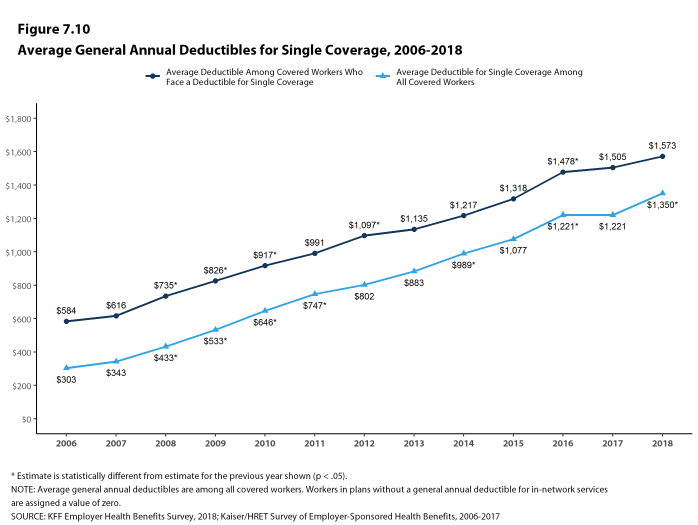
2018 Employer Health Benefits Survey – Section 7: Employee Cost Sharing

Figure 7.10: Average General Annual Deductibles for Single Coverage, 2006-2018

Shot: Almost 40% of Americans would struggle to handle a surprise expense of $400, according to a new Federal Reserve report.

Chaser: The average deductible today among all workers is more than $1,300, according to the Kaiser Family Foundation.


GOP Needs a Health Care Plan, Not an Immigration Plan

https://www.realclearpolitics.com/articles/2019/05/20/gop_needs_a_health_care_plan_not_an_immigration_plan_140372.html?utm_source=morning-scan&utm_medium=email&utm_campaign=mailchimp-newsletter&utm_source=RC+Health+Morning+Scan&utm_campaign=85626cbe0d-MAILCHIMP_RSS_EMAIL_CAMPAIGN&utm_medium=email&utm_term=0_b4baf6b587-85626cbe0d-84752421

Image result for health policy

On Thursday, President Trump unveiled his proposal for shifting the United States to a merit-based program for admitting future immigrants. The plan, which offers meaningful change and deserves serious consideration, is a non-starter politically, given that it does nothing to address the question of the Dreamers, or the millions of other immigrants already in the country illegally. Democrats, as expected, quickly condemned the president’s plan.

Trump isn’t wrong to highlight immigration. A broad-based restructuring of our immigration system is a laudable goal, and we do have a crisis on our southern border – as some Democrats now begrudgingly admit.

So immigration, legal and illegal, is an important issue, particularly to the president’s political base. The problem is that it’s not the most important issue for a most Americans, including many Republicans. It’s not even close. On the issue that is considered the most important – health care –Trump and the Republican Party have no plan at all.

Last week our polling firm, RealClear Opinion Research, released a new survey showing that health care is far and away the most important issue to Americans. At 36%, it was 10 percentage points above the number two issue – the economy – and more than 21 points ahead immigration, which ranked as the number three issue at 15%. (Education and the environment were tied at 11%, and foreign policy ranked last at just 3%.)

Attitudes about our current health care system were even more striking. Although 72% of registered voters rated their own health care as “excellent” or “good,” just 4% said the system was working for all Americans well enough that it needs no significant changes, while 28% think the current system is broken and needs to be replaced.  The vast majority (68%) is somewhere in the middle, viewing the current system either positively or negatively but agreeing that it is in need of improvements.

RealClear Opinion Research pollster John Della Volpe described the findings this way: “Significant proportions of Democrats, Republicans, and Independents agree that the current system needs substantial reform. The debate will be where to start, and how dramatic the correction.”

Democrats are already having that debate. Every single one of the 23 candidates running for the party’s nomination has embraced some form of reform, from expanding Obamacare or advocating “Medicare for All” to calling for a government-run single-payer system.

Meanwhile Trump and the GOP are standing on the sidelines. Nearly two months ago, Trump’s Justice Department came out in support of a Texas district court ruling striking down all of Obamacare. At the same time, the president took to Twitter (where else?) to declare that “the Republican Party will become ‘The Party of Healthcare!'”

Trump claimed that “the Republicans are developing a really great healthcare plan with far lower premiums (cost) & deductibles than Obamacare,” further promising that a “vote will be taken right after the Election when Republicans hold the Senate & win…”

After Republicans complained Trump had caught them off guard, on April 3 the president tweeted, “I was never planning a vote prior to the 2020 Election on the wonderful HealthCare package that some very talented people are now developing for me & the Republican Party. It will be on full display during the Election as a much better & less expensive alternative to ObamaCare…”

Since then, crickets. The thumping the GOP took in the House in 2018 should have been a wake-up call given the prominent role health care played in sending Republicans down to defeat. According to exit polls, 41% of voters in 2018 said health care was the most important issue facing the country, with immigration and the economy running a distant second and third place at 23% and 22%, respectively. More than two-thirds of voters said the health care system needed “major changes.”

Notice how closely those numbers mirror our new findings from RealClear Opinion Research. Six months after Republicans lost the House, voters’ opinions about the importance of health care and the need for reform haven’t budged. If  the president and his party don’t come up with a viable plan to address voters’ concerns, they may find it’s “déjà vu all over again” in 2020.