

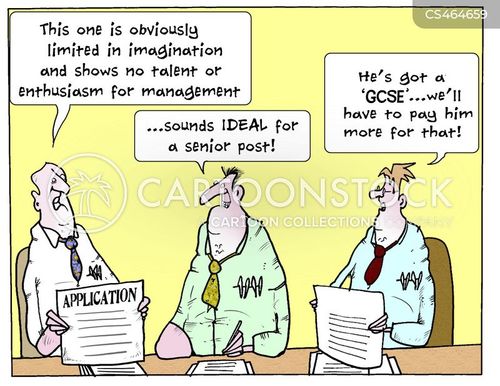
Cartoon – Sounds Ideal for a Senior Post

https://www.healthleadersmedia.com/strategy/ceo-kevin-spiegel-leaves-erlanger-amid-physicians-rancor

The top executive of Erlanger Health System, based in Chattanooga, Tennessee, has left the organization after months of smoldering conflict with some of the nonprofit’s physicians.
President and CEO Kevin Spiegel’s departure was immediate, according to a statement released Wednesday by board chairman Mike Griffin, who offered his well-wishes to the departing leader.
Spiegel, who had been on the job more than six years, reportedly said his separation from the organization was a mutual decision.
“We’re still working out the details, and hopefully that’ll be complete by the board meeting in two weeks,” Spiegel told the Times Free Press‘ Elizabeth Fite. “This is a great hospital, and it’s a great organization, and it’s only going to do better and better things.”
Erlanger’s board is expected to pick Spiegel’s successor in two weeks, at its regularly scheduled board meeting, according to Griffin’s statement.
Spiegel’s exit comes less than two weeks after the board held a special public meeting to talk about physicians’ concerns and criticism of Erlanger’s senior leadership team.
Spiegel is the third high-ranking Erlanger executive to leave since Fite reported in June on a letter from the Medical Executive Committee explaining its reasons for a unanimous vote of “no confidence” in the current executive leadership team. The other two were Executive Vice President and Chief Operating Officer Rob Brooks and Vice President of Patient Safety and Quality Pam Gordon.
Spiegel has been credited with leading Erlanger out of choppy financial waters, but he has also been caught up in a number of controversies, as the Times Free Press reported.



Next time you recruit someone amazing to your business, only to have that person leave for a bigger opportunity elsewhere, think about Nick Saban.
Saban, the head football coach at the University of Alabama, is considered one of the greatest college coaches of all time. His teams have won six national championships — five at Alabama and one at Louisiana State University — tied with another Alabama coaching legend, Bear Bryant, for most in college football history.
Now, he’s getting credit for a statistic that might seem a mixed blessing, but one that great leaders will recognize as a compliment: Saban’s teams endure (or maybe “enjoy”) near-constant churn among his assistant coaches. As the Wall Street Journal pointed out on Sunday, not a single on-field assistant coach from Alabama’s national championship victory in 2017 remains on the team today.
Thirty-eight assistants have moved on since 2007. Most of them leave for jobs with higher profiles or more responsibility elsewhere. Last year, USA Today calculated that there were 15 former Saban assistants in head coaching jobs in either the NFL or college football. Add another to that list: Michael Locksley left Alabama earlier this year to become the head coach at the University of Maryland.
As a head coach, and a coaching recruiter, Saban says he’s only interested in assistants that he believes will be very successful — making it unsurprising to him that they’re later recruited away from him.
“I think if you look at most of the coming and going, it’s people getting better jobs,” he told the Journal. “I actually look for people who have goals and aspirations, who are hard workers and very committed to what they do. So people sometimes favor hiring guys that have been in this program.”
The constant churn arguably drives innovation, too. New assistant coaches have the chance to advocate for new strategies. That makes it harder for opposing teams to predict what Alabama will do on the field.
There’s a saying: Good leaders attract followers; great leaders create more leaders.
If that’s true, then count Saban as a leader with an example worth learning from, no matter what your business or calling may be. Feel better about losing your top people when it happens. It’s inevitable if you’re a great leader.

https://www.healthcareitnews.com/news/healthcare-workforce-development-new-strategies-new-demands

As hospitals and ambulatory sites grapple with the challenges of quality improvement, value-based care, cybersecurity and more, the size and shape of the workforce is changing as technology and imperatives evolve.
The healthcare workforce is evolving, often by necessity, thanks to the same gravitational forces that are affecting the rest of the industry and the economy at large: technological advances, competitive market forces, shifting imperatives that demand new skill sets, challenges with job satisfaction and burnout.
Whether they’re C-suite leaders, physicians, nurses, IT staff, data scientists, case managers, security pros or revenue cycle, billing and accounting experts, hospitals and health systems large and small are facing an array of challenges when it comes to finding the right people to fit the right roles.
There’s a lot that needs doing in healthcare these days, after all – managing the clinical and operational demands of value-based reimbursement, caring for a growing aging population with a shrinking number of doctors and nurses, fighting the good fight against relentless cybersecurity threats – and finding the right employees to do it all is more important than ever.
During July, Healthcare IT News and our sister publication, Healthcare Finance, will explore how hospitals and health systems are managing these challenges – optimizing their workforces and positioning skilled leaders to help drive long-term strategic success in those areas and others.
The recent 2019 HIMSS U.S. Leadership and Workforce Survey polled 232 health information and technology leaders from acute and ambulatory providers nationwide to gain some insights about the challenges they’re prioritizing and the organizational structures they’re putting in place to deal with them.
Surprisingly or not, “hospitals and non-acute providers appear to have very different strategies regarding information and technology leadership and workers,” according to the report.
For instance, inpatient sites are much more able to prioritize the hiring of skilled C-suite execs to guide strategic initiatives. But “the absence of information and technology leaders in non-acute organizations is unsettling as it becomes more challenging to advance capabilities in settings without strong executive champions.”
Likewise, hospitals and practices also differ substantially when it comes to more rank-and-file employees. The larger inpatient sites “tend to operate environments with fairly extensive opportunities, whereas non-acute providers tend to deal with static workforce demands,” according to HIMSS. “The culture that can result from these different settings is something healthcare leaders should take into consideration when developing a staffing strategy.”
And health system hiring strategies are indeed shifting as providers face an array of challenges that need skilled and forward-thinking workers to help solve them. The HIMSS report listed the top 10 of these as:
The big hurdle, however, is that many “hospitals are continuing to be negatively impacted by staffing challenges,” according to the study. “The negative impacts on providers resulting from paused/scaled back projects are significant enough to at least warrant an exploratory consideration,” said HIMSS researchers.
A look at the numbers tells one story: When it comes to workforce vacancy barely one-third 36% of providers polled by HIMSS say they’re fully staffed – while more than half (52%) said they have open positions (12% didn’t answer or weren’t sure).
Indeed, there’s plenty of hiring to be done for health systems trying to tackle some of the biggest ongoing strategic challenges.
Even though the size in provider workforces since 2018 increased for 38% of the providers in this year’s survey – it stayed the same for 37% and decreased for just 14% – the projection for 2020 is a further expected hiring boost at 34% of providers (compared with a status quo for 42% and a contraction at just 9%).
Still, there’s nuance when one considers the differences between inpatient versus ambulatory organizations. While both are more likely to increase their workforces than to decrease them in 2020 (37% and 12% percent of hospitals, respectively, and 26% and 1% of outpatient sites), far more non-acute organizations expect their staff sizes to stand pat than hospitals (51 percent, compared with 38%).
“The variances in staffing growth trajectories evidenced in the two provider groups … has the potential to produce exceedingly different workplace cultures; a fast-paced environment in hospitals and a fairly stable setting in non-acute organizations,” according to the HIMSS report. “If true, then it is very possible these settings attract health IT workers with remarkably different needs/wants. Provider organizations looking to stabilize their workforce should take these factors into consideration when developing staff recruitment, retention and development strategies.”
Over the course of this month, Healthcare IT News and Healthcare Finance will be exploring the many challenges related to staffing and workforce, across many facets of healthcare in the U.S.
We’ll examine the industry’s labor force spend (the percentage of total budgets may surprise you), and look at how how AI, telehealth and consumerism can help change that equation. We’ll learn how to attract top C-suite talent and combat clinician burnout. We’ll explore the benefits of apprenticeship programs, and see the strategies some hospitals are using to deal with labor shortages. And much more.
So, as your healthcare organization looks to the fiscal year or remaining calendar year ahead, be sure to check back at HITN and HF during July to learn from thought leaders and industry peers – about the best way to put the best people in the best position to help meet your strategic goals.

Average total cash compensation for health system executives rose 6.5% from 2018 to 2019, extending a consistent rise in executive pay that governance experts do not expect to slow.
Annual and long-term performance-based incentives have driven pay hikes of 4% to 7% each of the last four years, according to Modern Healthcare’s annual Executive Compensation Survey. Health systems’ ongoing expansions coupled with a highly competitive executive market will continue to drive up their base salaries and bonuses, experts said. But this dynamic is drawing ire from rank-and-file employees who aren’t happy with their pay and from consumers who are spending more on their care. It is also spurring new legislation.
Nevertheless, with baby boomers retiring in large numbers and demand soaring, the pay hikes aren’t going away anytime soon. “Healthcare organizations are becoming more complex and leadership skills are evolving,” which often translates to higher pay, said Bruce Greenblatt, a managing principal at SullivanCotter, the compensation consulting firm that has supplied data for Modern Healthcare’s annual surveys since 2003.
Providers look to select metrics and targets that will shape their organization for years to come. In doing so, they toe a delicate line ensuring their bonuses are attainable to keep executives engaged while not making them out of reach and damaging morale.
With more pay based on performance, there’s greater risk of poor program design, said Steve Sullivan, a managing director at executive compensation consulting firm Pearl Meyer. If you make a mistake, there is a lot of money on the line, he said.
“You don’t want to have giveaways and you don’t want to have plans so egregiously hard that they never have payouts because executives will disengage from the program,” Sullivan said. “You have to strike a balance between responsible compensation and something that is motivating and incenting.”
Health system executives’ average base salaries increased 4.2% and ticked up even higher among organizations with more than $3 billion in revenue based in high-cost cities, according to Modern Healthcare’s 39th Executive Compensation Survey, made up of data aggregated from 1,149 hospitals and 401 health systems. System CEOs earned an average total cash compensation of $1.4 million in 2019, a 6.3% increase.
Executives who saw the highest total cash compensation hikes of 6.6% up to 13.3% were business development officers, administrative officers, internal audit executives, chief financial officers, planning executives, reimbursement executives, chief nursing officers, chief human resources officers and chief operating officers.
Incentives are typically tiered with a minimum threshold, a target and a stretch goal. They are often based on quality, safety and patient experience as well as financial performance. They may be related to ambulatory market share, employee and patient engagement, facilitating access to capital, bolstering physician alignment, inking successful joint partnerships and mergers, emergency department wait times and utilization, population health, shared risk, readmissions, hospital-acquired infections and length of stay, among other metrics.
The types of incentives offered are heavily dependent on the provider and the market. Some hospitals and health systems have stuck to the more traditional financial and market-share-based measurements, while more progressive organizations are targeting outcomes.
The bonuses differ based on short- and long-term goals, the latter becoming more prominent in recent years as boards and compensation committees emphasize the entire organization’s performance. Sometimes there is a trigger, such as operating margin, where executives miss out on all bonuses if it isn’t reached. For instance, Mercy Health, which is now Bon Secours Mercy Health, did not pay executives an incentive in 2016 since the system did not reach its incentive thresholds, the Cincinnati-based Catholic health system said.
“You want to make sure everyone is rolling in the right direction,” said Tom Giella, chairman of healthcare services for executive recruiter Korn Ferry. “You want to do what is right for the system, not an individual hospital or inpatient versus outpatient. It creates an incentive for everyone to work together.”
But even if the baseline isn’t reached, there typically isn’t a penalty, experts said. It will only lower their earning potential. “In some industries there can be a negative adjustment,” Sullivan said. “I haven’t seen that in healthcare. In healthcare, if there is a modifier it is going to be positive.”
Nearly half of larger health systems surveyed report using long-term incentive plans.
Dignity Health said a “substantial portion” of executive compensation is linked to organizational performance related to key clinical-quality and patient-satisfaction measures as well as community health investments and financial performance. Similarly, Kaiser Permanente said a third to half of pay is based on performance, linked to membership growth, expenses, operating income, and clinical and service quality improvements. Bon Secours Mercy said each of its employees are rewarded under the same incentive program, which includes quality, growth, financial and community benefit targets.
More providers are using deferred compensation programs, which can amount to hefty payouts at the end of an executive’s tenure.
In a related Modern Healthcare analysis of more than 2,000 not-for-profit hospitals, the 25 highest-paid not-for-profit health system executives received a combined 33.2% increase in total compensation in 2017, as their compensation rose to $197.9 million from $148.6 million in 2016.
The pay increases have spawned rallies and protests from more than 1,000 employees at Beaumont Health and Providence St. Joseph Health, both of which had chief executives in the top 25. Beaumont and Providence said in prepared statements that their CEO pay are not outliers compared to their peers.
California policymakers introduced a bill, recently passed by a state Senate subcommittee, that aims to boost not-for-profit health systems’ public disclosure requirements for executives’ deferred compensation.
“What surprises people I think as compensation becomes very generous because it is a competitive market, some think a hospital administrator shouldn’t expect to make more than the average physician,” said Paul Keckley, an industry consultant and managing editor of the Keckley Report. “Those days are long gone.”
Executives’ pay along with their respective C-suites are growing as health systems expand. New C-suite positions in 2019 included reimbursement executive, communications executive, academic affairs executive and operations executive, according to SullivanCotter’s data.
Physician leaders continue to be in high demand as providers look to influence clinical delivery redesign, population heath activities and quality improvement, said Tom Pavlik, a managing principal at SullivanCotter. Administrative roles in finance, consumer experience, IT, marketing and human resources are being filled by healthcare industry outsiders, he said.
“There is a lot of change as organizations are realigning to be operationally efficient and integrate clinical care delivery,” Pavlik said.
Among hospital executives, average base salaries rose 3.7% for hospitals that exceeded $300 million in revenue compared to 3.2% for smaller facilities. System-owned hospitals saw slightly lower base salary hikes than independent ones.
Average total compensation increased 5.3%, while CEOs of independent hospitals took home the highest raises at 9.2%, followed by chief financial officers of independent hospitals (6.5%), chief operating officers of system-owned hospitals (5.8%) and chief financial officers of system-owned hospitals (5.3%). Independent hospital CEOs earned an average of $758,300.
Providers rely on third-party consultants for accurate portrayals of market-based compensation reports that inform their compensation structures. But some of Pearl Meyer’s prospective clients are concerned about how their current adviser is interpreting the market, Sullivan said.
“With all the M&A, you have to create larger peer groups to generate a bigger sample,” he said.
This is a relatively new dynamic as the number of megasystems have swelled, Giella said.
“There is a war for talent and a big demand as systems have amalgamated so quickly,” he said. “They are getting through these growing pains where they have never dealt with this scale before, so it’s hard to look at historical trends. It’s very fluid so it’s hard to tell if you are paying someone fair compensation.”
One of Keckley’s regional health system clients told him that they are trying to figure out the most efficient and lean model.
“When I asked him what is keeping him awake, he said, ‘I want to be sure we are market-focused and that we are not just busy moving the deck chairs around.’ ”
DATA: Executive Compensation: 2019
 HENRY KOTULA