‘Skinny’ Obamacare repeal still lacks votes to pass

http://www.politico.com/story/2017/07/26/obamacare-repeal-republicans-minimum-240982

Related image

A bare-bones plan picks up some key GOP support, but centrists and conservatives are skeptical.

Even a bare-bones repeal of Obamacare is no sure thing in the Senate.

A handful of key Republican senators who had spurned earlier overtures from GOP leadership endorsed the latest plan to gut Obamacare’s individual and employer coverage mandates and its medical device tax. But several centrists said they’re undecided on the so-called skinny repeal, leaving the GOP in limbo through at least the end of the week.

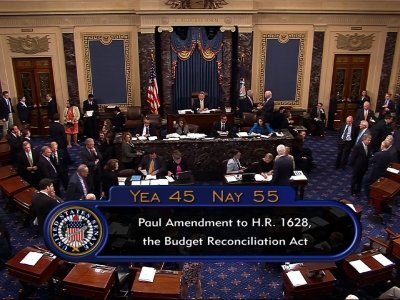
Jockeying on the scaled-back approach came as the Senate rejected a straight repeal of Obamacare in a 45-55 vote Wednesday. The night before, senators turned aside a comprehensive replacement plan that had been crafted by Senate Majority Leader Mitch McConnell. The roll calls were the latest reminders that GOP leaders’ best hope at this point is just to get something — anything — through the chamber with a bare majority and into a conference with the House.

“Sure. There’s plenty we agree on,” said Senate Majority Whip John Cornyn (R-Texas) late Wednesday when asked whether he can get 50 votes. One challenge for GOP leaders is “trying to explain the concept that we need to do it this way, as opposed to solving all the problems in a Senate bill now.”

Cornyn said broader negotiations on Medicaid reforms and other divisive issues would likely re-emerge in bicameral negotiations with the House. But some Republicans are worried that those talks would revive efforts to wind down a Medicaid expansion that’s benefited their states.

Centrist GOP Sens. Rob Portman of Ohio and Shelley Moore Capito of West Virginia were undecided on the so-called skinny repeal Wednesday. Another Republican from an expansion state, Sen. Dean Heller of Nevada indicated he would back it.

“We’ll see at the end of the day what’s in it, but overall I think I’d support it,” Heller said. He said slashing Obamacare’s Medicaid expansion or its growth rate should be a nonstarter.

Conservatives could be another matter.

“I don’t like it,” Sen. David Perdue of Georgia said of the process. “Because I don’t know where we end up. This whole [health care system] holds together or falls apart in totality. We’ve got a system that is collapsing.”

South Carolina Sen. Lindsey Graham on Tuesday called the possibility of a skeletal plan a “political punt,” but it may be able to clear the narrowly divided chamber. Graham said he would vote for the slimmed-down plan only if House and Senate lawmakers use it to go to conference and come up with a fuller replacement.

Sen. Jeff Flake of Arizona also indicated that he could get on board with the skinny option.

“In Arizona, you have 200,000 people who were paying the [Obamacare insurance mandate] fine and can’t afford insurance,” Flake told reporters. “We gotta have relief to those who, one: can’t find affordable insurance so they have to pay the fine; and, two: even those that can afford to pay the premium, generally can’t afford to utilize the coverage because the deductibles are so high.”

Whether Sen. Mike Lee of Utah can back a trimmed-down proposal “depends how skinny it is,” a spokesman said. But Sen. Rand Paul of Kentucky signaled he could live with the minimalist approach.

“I’ve always said I will vote for any permutation of repeal. Obviously, I want as much as I can get, but I’ll vote for whatever the consensus can be. It’s what I’ve been saying for months: Start on what you can agree on,” Paul said in an interview Wednesday. “Starting small and getting bigger is a good strategy.”

That would leave out the divisive issues of cuts to Medicaid spending and efforts to create a new tax credit system for the individual markets. Republicans can afford to lose just two votes to pass whatever they come up with in the end.

Many Republicans are in the dark about the emerging proposal. And aides said senators were still focused on amendment votes, floor tactics and the chaotic atmosphere, making it difficult to tell what can clinch 50 votes.

“I don’t know what would be in the skinny repeal,” said Sen. Susan Collins of Maine. “Until I see what’s in it, I’m not ruling it out because I don’t know what it would be.”

The Senate also rejected on Wednesday an attempt to send their repeal effort to congressional committees for several days.

Republicans need a score on any proposal from the Congressional Budget Office to vote at a 50-vote threshold. They are aiming for a vote on Friday on their final plan after the unlimited amendment process known as vote-a-rama, which is expected to begin sometime Thursday.

In the final bill, Republicans could try to add more elements than repealing the mandates and device tax, but that could complicate efforts to get a quick CBO score.

“Look for victories where we should find them. In my opinion, the victory will always include: individual mandate repeal, employer mandate repeal and [eliminating] the medical device tax,” said South Carolina Sen. Tim Scott. “If we can add to it, we should … as much as you can repeal, let’s get it done.”

The CBO has scored those three pieces of the proposal in the past and could deliver an analysis of the “skinny repeal” more speedily than of a more wide-ranging effort, GOP senators said. Still, Republicans will have to add additional Obamacare provisions to the bill to meet minimum savings requirements required under reconciliation, the budget mechanism that allows for a bare majority instead of 60-vote threshold.

Republicans are likely to cut the Prevention and Public Health Fund, for instance. The goal would be to increase the bill’s scope enough to meet Senate savings targets without losing political support, according to Republican sources. They may be able to do so because slashing the mandates means millions would drop insurance coverage — and the subsidies that come with it.

In the end, Senate leaders would want the House to either take up their bill or go to conference and hammer out a compromise that can pass both chambers.

“I can’t imagine at the end of the process that we haven’t agreed on something,” said Sen. Roy Blunt (R-Mo.). “And all we have to do is agree on something that keeps this going.”

But conservatives are wary of a House-Senate negotiation.

“I would [be in] favor if we have a skinny repeal, just sending it over to the House and seeing if they can pass it rather than going to conference,” Paul said. “Conference committee to me means Big Government Republicans are going to start sticking in those spending proposals.”

Running out of options to overhaul Obamacare, Senate Republicans ponder a ‘skinny’ repeal

http://www.latimes.com/politics/la-na-pol-senate-healthcare-20170726-story.html

Image result for the skinny

nable to agree on a path forward to repealing the Affordable Care ActSenateRepublicans are reluctantly coalescing around what may be the last idea standing: a dramatically scaled-down bill that would leave most of the 2010 law in place.

The so-called skinny repeal is still a work in progress, but one version being floated would repeal only three Obamacare provisions — a medical device tax and the mandates that individuals buy health insurance and that large employers offer it.

That’s far cry from the years-long GOP promise to gut the law, also known as Obamacare. But the face-saving strategy, which could come to a vote as soon as Thursday, would at least allow senators to say they acted on something.

It could also trigger a conference committee with House lawmakers to reconcile the Senate bill with the more sweeping House repeal legislation, giving lawmakers another shot at reaching agreement.

“I’ve got to think about moving things along to get to conference to hopefully get a good product,” said Sen. Charles E. Grassley (R-Iowa), who viewed the skinny alternative as a step toward something more comprehensive.

On Wednesday, GOP senators spent another frustrating and fruitless day debating and rejecting possible approaches.

After voting down their leaders’ most comprehensive overhaul plan a day earlier, Republicans rejected another long-standing GOP idea on Wednesday: to simply repeal most of Obamacare.

The amendment from Sen. Rand Paul (R-Ky.) mirrored a bill from conservatives that passed in 2015 but was vetoed by President Obama. Paul’s measure would have repealed the Affordable Care Act by 2020, theoretically providing time to devise a replacement law.

President Trump has at various times pushed the repeal-only idea, which was seen as the most straightforward approach amid disagreement within the party.

But Paul’s proposal failed to reach the 50 votes needed for passage, despite Republicans’ 52-seat Senate majority. Seven Republicans joined all Democrats in the 55-45 no vote.

That followed the late Tuesday rejection of GOP leaders’ Better Care Reconciliation Act, which had been bolstered with provisions to attract support from conservatives who want full repeal and centrists who worry about cuts to Medicaid.

Nine Republican senators voted against that idea.

“Clearly it has proven to be quite challenging to get 50 Republicans on board with one solution,” said Sen. John Thune (R-S.D.). “It’s been trying to move pieces around that would get everybody kind of comfortable and find a good landing spot. We just haven’t quite gotten there yet.”

Senators braced for an expected all-night session Thursday to consider about 100 amendments from Republicans and Democrats. None are likely to gain traction.

Even the skinny repeal is no sure thing, and leaders Wednesday were assessing what provisions could be cobbled together to win majority support.

A few GOP senators who have been hardest to satisfy voiced interest Wednesday in the scaled-down plan, including Sens. Rand Paul of Kentucky and Dean Heller of Nevada. Sens. Rob Portman of Ohio and Mike Lee of Utah also said they would review it.

For some, even a limited repeal would provide GOP senators an opportunity to pass a bill, declare victory and move on to other issues like tax reform.

Others hope to continue the fight if the legislation moves to a conference to be reconciled with the House bill.

Several Republican senators seemed open to that route, hoping to adjust the final bill in the negotiations to come. But whatever is agreed to in conference would still have to be approved by both the House and Senate.

Paul took the opposite stand. He said he could consider a limited repeal, but was worried that once negotiations with the House began, the legislation would be changed in ways he would not support.

It is highly possible that the House and Senate will not be able to resolve their differences, since they remain far apart on their approaches.

Rep. Mark Meadows (R-N.C.), chairman of the House Freedom Caucus and a key broker of the House-passed bill, said the skinny version had “zero” chance in that chamber.

Even so, some predict that House Republicans may be pressured to approve whatever skinny version ultimately passes the Senate, even if it is less ambitious than what Republicans once envisioned.

Meanwhile, many outside groups have voiced concerns about elements of the skinny plan, particularly if it repeals the individual mandate.

Though that mandate is unpopular with consumers, removing it could cause chaos in the insurance markets.

Without some kind of penalty, many healthy Americans would not get insurance until they were sick. That would push up health insurance costs, causing what people in the business call a death spiral.

The nonpartisan Congressional Budget Office estimated two years ago that repealing the mandates would increase the ranks of the uninsured by as many as 15 million, mostly people voluntarily dropping their coverage. It also estimated that premiums would increase by 20%.

On Wednesday, the skinny plan drew criticism from several leading healthcare groups, including the American Medical Assn., the nation’s largest physicians’ organization and the Blue Cross Blue Shield Assn., a health insurance trade group.

“A system that allows people to purchase coverage only when they need it drives up costs for everyone,” the insurance group warned in a statement.

GOP eyes narrow bill to advance goal on Obamacare repeal

https://apnews.com/a3286ef6fca74cac93fac360ad76f3d4/GOP-eyes-narrow-bill-to-advance-goal-on-%22Obamacare%22-repeal


They couldn’t pass a repeal of “Obamacare,” or find the votes for a White House-backed replacement. So now Senate Republicans are lowering their sights and trying to unite behind a so-called “skinny repeal” that would merely undo just a few of the most unpopular elements of Barack Obama’s law.

The “skinny bill” is an admittedly lowest-common-denominator approach, and it may not even have the votes to pass, either. But as Republicans search for how to keep their years-long effort to repeal and replace “Obamacare” alive, they’re coming to believe that the “skinny bill” may be the only option left.

“It still keeps it in play,” said Sen. Steve Daines of Montana. “It’s threading a needle at the moment, trying to get 51 in the United States Senate.”

President Donald Trump urged lawmakers on in a tweet Thursday morning: “Come on Republican Senators, you can do it on Healthcare. After 7 years, this is your chance to shine! Don’t let the American people down!”

The Senate strategy emerged after Republicans barely succeeded earlier this week in opening debate on health legislation in the narrowly divided Senate, winning the procedural vote to do so thanks only to Vice President Mike Pence breaking a 50-50 tie.

Hours of debate followed, as well a few amendment votes that starkly revealed Republicans’ divisions. On Tuesday, on a 57-43 vote with nine GOP defections, the Senate rejected a wide-ranging proposal by Majority Leader Mitch McConnell to erase and replace much of the Affordable Care Act. Then on Wednesday, a straightforward repeal measure failed 55-45 with seven Republicans joining Democrats in voting “no,” even though nearly identical legislation had passed Congress two years earlier.

At that time, Obama was in the White House and vetoed the repeal bill. But now, with Trump sitting in the Oval Office and itching to sign it, Republican senators demonstrated they didn’t have the stomach to go through with passing a measure that would end insurance coverage for more than 30 million Americans over a decade, according to the Congressional Budget Office.

In the wake of those two telling votes Republican senators have few options left, and that’s led them to look to the “skinny repeal.” The measure has not been finalized, but senators say it could eliminate Obamacare’s two mandates — for individuals to carry insurance and for employers to offer it — along with an unpopular tax on medical devices, and perhaps contain a few other provisions.

The purpose of passing such legislation would be to get something, anything, out of the Senate, so that talks could begin with House Republicans who passed their own more comprehensive repeal-and-replace bill in early May. The House and Senate bills would need to be reconciled by a “conference committee” into one final piece of legislation that both chambers would have to pass again.

“We’ve got to move it along and get it to conference,” said Sen. Chuck Grassley, R-Iowa.

A few GOP aides suggested that perhaps the House would pass the Senate’s “skinny bill” as-is, which would allow Republicans to claim at least a partial victory and move on to other issues. With tax legislation and other priorities waiting in the wings, Republicans are eager to move along after spending the first six months of Trump’s presidency trying unsuccessfully, so far, to fulfill their years of promises to repeal and replace “Obamacare.”

However the House might be unwilling to agree to the “skinny bill” as-is. Conservatives were already ruling that out.

“There would not be enough votes to pass it and send it to the president,” said Rep. Mark Meadows of North Carolina, head of the conservative Freedom Caucus. “But to use it as a vehicle to continue negotiations is certainly welcomed.”

The behind-the-scenes maneuvering came as the Senate moved through 20 hours of debate on repeal legislation, with Democrats unanimously opposed to the GOP efforts. Under the complex rules governing how the legislation is being considered, the debate will culminate at some point Thursday afternoon or evening in a bizarre exercise called a “vote-a-rama” during which unlimited amendments can be offered by all sides in rapid succession.

The vote-a-rama will likely last into the wee hours of Friday morning, or until “people get tired,” said Sen. John Cornyn, R-Texas.

And by the time it’s over, Republicans hope they will have found something, anything, that can get enough votes to pass.

“I think it is quite likely we will be here much of the night, if not all night,” said Sen. Ted Cruz, R-Texas. “And at the end of it hopefully we’ll have a bill that can bring us together.”

States Have Tried Versions Of ‘Skinny Repeal.’ It Didn’t Go Well.

States Have Tried Versions Of ‘Skinny Repeal.’ It Didn’t Go Well.

Betting that thin is in — and might be the only way forward — Senate Republicans are eyeing a “skinny repeal” that rolls back an unpopular portion of the federal health law. But experts warn that the idea has been tried before, and with little success.

Senators are reportedly considering a narrow bill that would eliminate the Affordable Care Act’s “individual mandate,” which assesses a tax on Americans who don’t have insurance, along with penalties for employers with 50 or more workers who fail to offer health coverage.

Details aren’t clear, but it appears that — at least initially — the rest of the 2010 health law would remain, including the rule that says insurers must cover people with preexisting medical problems.

“We need an outcome, and if a so-called skinny repeal is the first step, that’s a good first step,” said Sen. Thom Tillis (R-N.C.).

Based on published reports, several Republican senators, including Dean Heller of Nevada and Jeff Flake of Arizona, appear to back this approach. It is, at least for now, being viewed as a step along the way to Republican health reform.

“I think that most people would understand that what you’re really voting on is trying to keep the conversation alive,” said Sen. Bob Corker, R-Tenn. “It’s not the policy itself … it’s about trying to create a bigger discussion about repeal between the House and Senate.”

But what if, during these strange legislative times, the skinny repeal were passed by the Senate and then became law? States’ experiences with insurance market reforms and rollbacks highlight the possible trouble spots.

Considering The Parallels

By the late 1990s, states such as Washington, Kentucky and Massachusetts felt a backlash from the coverage requirement rules they previously put on the individual market. When some of the rules were repealed, “things went badly,” said Mark Hall, director of the health law and policy program at Wake Forest University.

Premiums rose and insurers fled, leaving consumers who buy their own coverage, because they don’t get it through their jobs, with fewer choices and higher prices.

That’s because — like the Senate plan — the states generally kept popular parts of their laws, including protections for people with preexisting conditions. At the same time, they didn’t include mandates that consumers carry coverage.

That goes to a basic concept about any kind insurance: People who don’t file claims in any given year subsidize those who do. Also, those healthy people are less likely to sign up, insurers said, leaving them with only the more costly policyholders.

Bottomline: Insurers end up “less willing to participate in the market,” said Hall.

It’s not an exact comparison, though, he added, because the current federal health law offers something most states did not: significant subsidies to help some people buy coverage, which could blunt the effect of not having a mandate.

During the debate that led to passage of the federal ACA, insurers flat-out said the plan would fail without an individual mandate. On Wednesday, the Blue Cross Blue Shield Association weighed in again, saying that if there is no longer a coverage requirement, there should be “strong incentives for people to obtain health insurance and keep it year-round.”

About 6.5 million Americans reported owing penalties for not having coverage in 2015.

Polls consistently show, though, that the individual mandate is unpopular with the public. Indeed, when asked about nine provisions in the ACA, registered voters in a recent Politico/Morning Consult poll said they want the Senate to keep eight, rejecting only the individual mandate.

Even though the mandate’s penalty is often criticized as not strong enough, removing it would still affect the individual market.

“Insurers would react conservatively and increase rates substantially to cover their risk,” said insurance industry consultant Robert Laszewski.

That’s what happened after Washington state lawmakers rolled back rules in 1995 legislation. Insurers requested significant rate increases, which were then rejected by the state’s insurance commissioner. By 1998, the state’s largest insurer — Premera Blue Cross — said it was losing so much money that it would stop selling new individual policies, “precipitating a sense of crisis,” according to a study published in 2000 in the Journal of Health Politics, Policy and Law.

“When one pulled out, the others followed,” said current Washington Insurance Commissioner Mike Kreidler, who was then a regional director in the federal department of Health and Human Services.

The state’s individual market was volatile and difficult for years after. Insurers did come back, but won a concession: For a time, the insurance commissioner lost the power to reject rate increases. Kreidler, first elected in 2000, won the authority back.

Predicting the effect of removing the individual mandate is difficult, although he expects the impact would be modest, at least initially. Subsidies that help people purchase insurance coverage — if they remain as they are under current law — could help blunt the impact. But if those subsidies are reduced — or other changes are made that further drive healthy people out of the market — the impact could be greater.

“Few markets can go bad on you as fast as a health insurance market,” said Kreidler.

As for employers, dropping the requirement that those with 50 or more workers offer health insurance or face a financial penalty could mean some workers would lose coverage, but their jobs might be more secure, said Joe Antos, at the American Enterprise Institute.

That’s because the requirement meant that some smaller firms didn’t hire people or give workers more than 30 hours a week — the minimum needed under the ACA to be considered a full-time worker who qualified for health insurance.

The individual mandate, he added, may not be as much of a factor in getting people to enroll in coverage as some think because the Trump administration has indicated it might not enforce it anyway — and the penalty amount is far less than most people would have to pay for health insurance.

However, the individual market could be roiled by other factors, Antos said.

“The real impact would come if feds stopped promoting enrollment and did other things to make the exchanges [— the state and federal markets through which insurance is offered —] work more poorly.”

Senate GOP Wins Vote To Debate Health Care, Then Loses Vote On ACA Replacement Bill

http://healthaffairs.org/blog/2017/07/26/senate-gop-wins-vote-to-debate-health-care-then-loses-vote-on-aca-replacement-bill/

Image result for almighty dollar

At around 6 pm on July 26, 2017, the Senate voted on two motions. The first was on a motion by Senator Casey that would have committed the pending legislation (whatever it might be) to the Senate Finance committee to amend it to ensure that Medicaid coverage for the disabled would not be cut. It failed by a 52 to 48 party line vote.

The Senate also voted overwhelmingly not to waive a Byrd Rule objection raised by Senator Sanders against a “sense of the Senate” amendment offered by Senator Heller from Nevada. The amendment stated that the Senate should review Medicaid coverage and the ACA’s Medicaid expansion and prioritize Medicaid coverage for individuals with the greatest medical need, including individuals with disabilities, but that the body should not reduce or eliminate benefits or coverage for individuals currently eligible for Medicaid or discourage states from expanding Medicaid. Senator Heller made a floor speech in support of his amendment praising the Medicaid expansion and describing what it had done for Nevada.

The amendment, however, also recited a familiar litany of charges against the ACA. It called for the repeal of the ACA and its replacement with patient-centered legislation that would “provide access to quality, affordable private health care coverage for Americans and their families by increasing competition, State flexibility, and individual choice” that would also strengthen Medicaid and increase flexibility for states to best meet the needs of their population.

Republicans did not want to vote to lock in the Medicaid expansion and Democrats did not want to vote for the repeal of the rest of the ACA, so they joined forces in blocking a vote on the amendment. But a handful of Republican senators got to go on record as supporting Medicaid. The motion to waive the Byrd rule objection failed 90 to 10.

Dozens of motions to commit have been filed by Democrats as the means of raising objections to the Republicans attempt to repeal the ACA. After the 6 pm votes, however, Senator Schumer, the minority leader, stated that the Democrats would no offer further amendments until the Republicans offered a bill for them to amend. Senator Schumer also reported that the Congressional Budget Office had determined that the “skinny” repeal being discussed would cause 16 million people to become uninsured and raise premiums by 20 percent, although the CBO has not scored actual legislation but rather specifications given them by Democrats as to what they expect skinny repeal might include. Tables released by the CBO later in the evening largely supported the loss of coverage claim, though they did not address premium increases.

The next vote will apparently will be on a “Medicare-for-all” proposal submitted as an amendment by Senator Daines to put the Democrats on the record voting either for or against a single payer system. It is hard for me to imagine the amendment will survive a point of order.

July 26 Update 2: Amendments Galore

Shortly before 4 pm on July 26, 2017, the Senate rejected by a vote of 55 to 45 a motion by Senator Paul to adopt the Obamacare Repeal Reconciliation Act. The ORRA would have repealed key provisions of the ACA, including the individual and employer mandates, the Medicaid expansions and the premium tax credits and cost-sharing reduction payments, and all of the Affordable Care Act taxes.  It would have delayed the repeal of the Medicaid expansion and premium tax credits and cost sharing reductions for two years.

Seven Republicans (Alexander, Collins, Heller, McCain, Moore Capito, Murkowski, and Portman) joined all Democrats in voting against the amendment.  The only Republican now in the Senate who voted against a similar bill in 2015 is Senator Collins, but six more joined her today. In 2015, however, the senators knew President Obama would veto the bill so the vote was symbolic. Moreover, the Republicans now know that having a replacement up for the ACA’s financial assistance provisions in two years is probably a pipe dream.

The Senate Parliamentarian reportedly upheld an objection to provisions in the ORRA that would have banned individual and small business tax credits for health plans that covered abortions. Democrats, however, did not raise a point of order to strike these provisions; thus, the Senate went directly to voting on the Paul amendment itself.

The Senate then proceeded directly to vote on a motion by Senator Donnelly to commit the bill to the Senate Finance Committee to remove provisions that would have cut Medicaid and the Medicaid expansions and shifted costs to the states. The vote failed 48 to 52 on a straight party line vote.

The vote was immediately followed by a motion by Senator Casey to commit to the Finance Committee to remove provisions that would threaten Medicaid for persons with disability.

With both the most recent version of the BCRA and the ORRA defeated, the debate is apparently about the original amendment (267) offered by Senator McConnell to the  House’s American Health Care Act and unspecified amendments to it. Since this amendment was essentially the ORRA, which has now been voted down, the debate is apparently not in fact addressing any specific proposed language. The Senate may end up with a “skinny” bill, repealing only the individual and employer mandate and one or more ACA taxes, but we have many hours of debates, and dozens and dozens of amendments before we get there.

Senator McCain has proposed three amendments—264, 265, and 266—intended to extend the phase-out of Medicaid expansion funding and meliorate the effect of the per capita caps. Senator Whitehouse has proposed amendment 268, dealing with medical bankruptcy protection. Senator Johnson has proposed amendment 272, which would prohibit federal government payments for insurance coverage provided to members of Congress through the exchange, and amendment 273, which would repeal the entire ACA effective January 1, 2020.

Senator Barrasso has proposed amendments 274, which would increase maximum permitted contributions to HSAs, and 275, which would allow separate risk pools for Cruz skinny plans. Senator Kaine and a number of other Democratic Senators have introduced Amendment 276, which would provide federal funding for reinsurance for high-cost cases and for individual market outreach and enrollment. Senator Merkley has introduced at least 100 amendments, and more are on their way.

July 26 Update: Voting Plans

Senate leadership has announced  votes on Amendment 271—essentially the Obamacare Repeal Reconciliation Act—will take place at 3:30 instead of 11:30. The Senate will first vote on whether the amendment is permissible under budget reconciliation rules (presumably because of its abortion and Planned Parenthood restrictions) and then on the amendment itself. The Senate will also at 3:30 vote on Senator Donnelly’s (D IN) motion to commit the legislation to the Senate Finance Committee to amend it to ensure that it imposes no Medicaid cuts and does not shift costs to the states.

Original Post

On July 25, 2017, the United States Senate began its long-awaited debate on repealing the Affordable Care Act. At around 2 in the afternoon, Senate Majority Leader McConnell called up a motion to proceed on consideration of the American Health Care Act, which the House of Representatives had passed on May 4, with a 217 to 213 vote. A motion to proceed on a budget reconciliation bill needs only to pass by a bare majority, but the Republicans hold only 52 of the chamber’s 100 votes, and Republican Senators Collins (ME) and Murkowski (AK) voted against proceeding.

What’s Happened So Far

There was high drama as Senator McCain (R-AZ), who had surgery for a blood clot and was diagnosed with brain cancer the week before, arrived to vote yes. Senator Johnson (R-WI) huddled with Senate leadership for some time before casting a yes vote to bring the tally to 50 to 50, with protesters in the gallery shouting “Kill the bill, don’t kill us” and “Shame” until they were taken away. With the vote evenly divided at 50 to 50, Vice President Pence, the President of the Senate, cast the deciding vote and the motion to proceed succeeded.

After an emotional speech by Senator McCain calling on the Senate to regain its stature as a deliberative body, Speaker McConnell moved to amend the House bill to substitute amendment 267. This was basically the Senate’s Obamacare Repeal Reconciliation Act, which was in turn the repeal and delay bill that was passed by the Senate in 2015 with a few added features, such as the funding of the cost-sharing reduction payments and the ban on tax credits for plans covering most abortions. The abortion coverage ban was crossed out in the version submitted; in addition, in the section defunding Planned Parenthood, the amount of federal and state funds that the organization would have had to receive in fiscal year 2014 to be covered by the funding prohibition was reduced from $350 million to $1 million, apparently to satisfy the Senate Parliamentarian’s concern that the section was written too specifically to cover only one organization.

The Democrats forced the reading of the entire 18-page bill and then made a couple of speeches against it, but at that point Speaker McConnell moved amendment 270 to amendment 267. This was a third version of the Better Care Reconciliation Act (BCRA), incorporating the Cruz (R-TX) amendment to allow the sale of skinny plans. At the prompting of Senator Portman (R-OH), the new BCRA version also included language providing an additional $100 billion over seven years for states to help reduce cost-sharing obligations of low-income consumers, and further permitting states to use Medicaid funds to help low-income individuals with cost-sharing payments.

The Democrats demanded that the 178-page bill be read, a not unreasonable request given the fact that none of them had seen it before, but were willing to end the reading at the request of Senator Enzi (R-WY) after the clerk had read well over 100 pages. At that point debate resumed and several Senators spoke on both sides, including Senators Cruz and Portman.

Senator Murray (D-WA) then raised a point of order, asking that Amendment 270 be stricken for failure to comply with budget reconciliation rules. It is reported that her objection was that the newest BCRA version with the Cruz and Portman amendments had not been scored by the Congressional Budget Office and thus could not be adopted through reconciliation. A number of the provisions of the BCRA, however, had reportedly also been questioned by the Senate Parliamentarian, who suggested they could not be included in reconciliation legislation. It was further reported on July 25, that the Parliamentarian had held two other provisions of the BCRA to be objectionable, including the change in the age rating ratio from one-to-three to one-to-five and the small business association health plan provisions. The budget challenge presumably did not include these provisions, but it was not wholly clear.

Senator Enzi moved to overrule the point of order, a motion that would have needed 60 votes to succeed. In fact, nine Republicans, Senators Collins, Corker, Cotton, Graham, Heller, Lee, Moran, Murkowski, and Paul, joined all 48 Democrats to uphold the point of order 57 to 43.

At that point, Senator Enzi moved to bring Senate Amendment 271 to the floor. This is the ORRA, including language prohibiting tax credits for plans that cover abortions but replacing the $350 million with $1 million for the amount of FY 2014 federal funding an organization meeting certain conditions (read Planned Parenthood) would have had to receive to be barred from funding. A motion to waive budget rule objections to this bill will receive a vote on the morning of July 26. July 26 will also bring a vote on a motion by Senator Donnelly (D-IN) to recommit the bill to the Senate Finance Committee to remove all provisions that would cut Medicaid, end the Medicaid expansion, or shift costs to the states.

What Comes Next?

The repeal and delay ORRA will very likely be voted down — the CBO scored it as causing 32 million people to lose coverage if no replacement were adopted before the repeal went into effect in two years, and no one should reasonably assume that this Congress could adopt and implement a replacement plan in two years.

It is unclear what will come then — perhaps another vote on a stripped down BCRA, or perhaps another bill. There is talk of the Senate ending up with a skinny bill that would simply repeal the individual and employer mandates and the medical device tax. The CBO has already scored pieces of this and it is possible that it would score such legislation as meeting mandatory deficit reduction goals. The bill would then go to conference with the House in secret and be brought back to the Senate floor for a final vote. Who knows what the final bill would do.

As July 26 begins, there are many hours of debate and many votes ahead of us, including votes on points of order to strike provisions that may come before the Senate in various bills for failure to comply with budget reconciliation rules. At the end will come a vote-a-rama, when both parties can offer unlimited amendments with only a minute to debate each amendment. These could include a substitute amendment by Republican leadership completely changing the legislation. The whole show should end by Friday, July 28, and we will see what remains then. Just about the only certainty is that any children who have learned the legislative process through Schoolhouse Rock will be very confused.

The real losers of Republicans’ latest repeal plan

https://www.vox.com/policy-and-politics/2017/7/26/16028584/skinny-repeal-obamacare-losers

Senate Republicans have struggled for months now to find a plan to repeal and replace Obamacare that their 52-member caucus can get behind. Their latest plan, which began taking shape early Tuesday, is to simply repeal the individual mandate and a few other regulations — a strategy since dubbed “skinny repeal.

It would hurt some American health care consumers in a very different way than previous GOP bills would have.

The losers of a skinny repeal bill, should it pass, are the middle-income Americans who purchase coverage on the individual market. Many of the Obamacare enrollees I’ve interviewed in Southeastern Kentucky, an area that predominantly voted for Trump, fall into this category.

Repealing the requirement that all Americans purchase insurance would cause premiums to rise 20 percent, the Congressional Budget Office estimates. The nonpartisan office projected that 15 million fewer Americans would have coverage when it analyzed a bill very similar to skinny repeal in 2015.

“Eliminating the mandate would likely result in lower coverage rates in the individual market and a deterioration of the risk pool,” the American Academy of Actuaries projects. “Premiums would increase as a result.”

This has the potential to wreak havoc on the individual market. Insurance plans would be reticent to sell on a marketplace where they have to offer coverage to all applicants, but healthy people have no requirement or incentive to purchase.

Premiums would likely rise as only the sickest patients continue to purchase coverage. This could put health insurance out of reach for many who would like to buy, but feel the ever-increasing premiums are a bad deal.

Skinny repeal would, somewhat surprisingly, keep the Medicaid program safe. This is a sharp departure from the other Republican health care plans, such as the House-passed American Health Care Act, which cut hundreds of billions of dollars from the program.

The losers of skinny repeal are middle- to even high-income Obamacare enrollees. Some supported Trump. Some didn’t. All would face a less-functional health insurance market should skinny repeal become law.

Skinny repeal hits those who rely on the Obamacare marketplaces

When I think of who skinny repeal disadvantages, I think of someone like Debbie Mills. She’s an Obamacare enrollee who owns a furniture store in Kentucky, and who supported Trump in the 2016 election.

Mills likes her health coverage. This year, she pays a $280 monthly premium for a plan that covers herself, her husband (who was on a waiting list for a liver transplant when we spoke), and her 19-year-old son. She heard the president talk about Affordable Care Act repeal but didn’t think he would actually follow through on taking away health insurance.

Mills has a high enough income that she does not qualify for Medicaid expansion. She is somewhat shielded from premium increases because of her tax credit, which only requires her to spend a certain percentage of her income to purchase a mid-level health plan. Once she kicks in that amount, the federal government pays the rest.

But Mills relies on a functional health insurance market, one where plans want to sell coverage — and skinny repeal makes it a lot harder for a market like that to exist. Health insurance plans are not enthusiastic about selling coverage in a market where only sick people buy coverage.

The result of skinny repeal, then, could be health plans quitting the marketplaces — or premiums rising dramatically. If Mills ever wanted to upgrade to a more robust plan, for example, she would have to pay a good chunk of that premium increase. The subsidies only limit her premium for a mid-level plan (known as a silver plan on the marketplace, which covers 70 percent of an average enrollee’s costs).

Skinny repeal would hit some of Mills’s neighbors in Southeastern Kentucky. This includes Clifford Hoskins, a 62-year-old retired coal miner who buys coverage on the marketplace, or Bobbi Smith, also 62, who owns an antique store and has used her plan for breast cancer treatment. All rely on the marketplace, not Medicaid expansion. So if insurers leave the marketplaces, scared off by the expected exodus of healthy enrollees, they’re going to be left with no options to purchase coverage.

The people who stand to lose a lot in skinny repeal are also people like Juliana Pieknik, a PhD student in Maryland who I interviewed last fall. When we spoke, Pieknik was earning $42,000, which is just slightly too much to qualify for tax credits where she lives.

Pieknik is by no means getting wealthy on a graduate student salary. But her income makes her just slightly too high-earning to qualify for a tax credit to purchase insurance. This means she’s responsible for her entire premium regardless of how much it goes up.

Under skinny repeal, Pieknik could decide to skip coverage and there would be no penalty. But there would be plenty of risk should some kind of medical emergency arise when she didn’t have coverage.

The surprise winners of skinny repeal would be Medicaid enrollees

Medicaid has never been thought to be a program with much political clout. It has a less-connected, lower-income enrollee population than Medicare, which covers the old.

But Medicaid has proved to be a shockingly resilient program throughout the Obamacare repeal and replace process. Notably, moderate Republican senators have vociferously protested cuts to Medicaid — refusing to support the Senate health bill over it, in some cases — while barely speaking about the cuts to subsidies in the individual market.

This has led to the somewhat surprising outcome where the Senate Republican’s latest attempt at repeal is one that doesn’t touch Medicaid at all, but instead focuses its sights on the individual market. It makes changes that will disadvantage higher-income Obamacare enrollees the most, especially those who earn too much to qualify for subsidies, and hurts the lowest-income patients the least.

Skinny repeal would let Medicaid expansion continue untouched in the 30 states that currently participate in program. For a party that has often pushed big cuts to large welfare programs, the “compromise” position in the Senate is one that leaves Medicaid off the table — but one that has clear losers among Obamacare’s higher-income enrollees.

The Senate’s Skinny ACA Repeal Shell Game

https://www.americanprogress.org/issues/healthcare/news/2017/07/26/436740/senates-skinny-aca-repeal-shell-game/

As the Senate continues to hold votes on repeal of the Affordable Care Act (ACA), it appears more and more likely that Senate leadership plans to offer a “skinny” version of ACA repeal as the final version that senators must vote on. This version would reportedly repeal the individual and employer mandates and the medical device tax.

This plan is simply a feigned retreat; the Republican leadership’s end game most certainly includes cutting financial assistance for people buying insurance in the individual market, ending the ACA’s Medicaid expansion, and capping federal support for the remaining Medicaid program. Both the House-passed American Health Care Act (AHCA) and the Senate-introduced Better Care Reconciliation Act (BCRA) include these draconian changes.

If senators fall for this maneuver and pass the skinny ACA repeal bill, a limited number of senior senators and their counterparts in the House of Representatives would then meet in a conference committee, during which they would make changes to the House and Senate-passed versions of the ACA repeal legislation so that both versions are identical. At that point, Republican congressional leaders could execute their plan to re-insert provisions that lower financial assistance, end the Medicaid expansion, and cap support for the program. The version approved by the conference committee would then be voted on by both the House and the Senate, with no opportunity for further changes or amendments. If the bill passes, it would then go to the president for signature into law.

But the skinny repeal bill alone—without the reinsertion of provisions from the AHCA and the BCRA—would still have devastating effects on health insurance coverage if it became law. It would jeopardize consumer choice in the individual market by creating chaos and uncertainty for issuers in the marketplace and increasing premiums.

Based on a Congressional Budget Office (CBO) analysis, the Center for American Progress estimates that the so-called skinny bill would raise premiums $1,238 higher than it would otherwise be under current law. The benchmark premium for a 60-year-old, for example, would be about $2,014 higher in 2018 under mandate repeal. Among states, these increases would be highest in Alaska because of its already-high premium levels.

Consumers who were not subsidized, including those who buy their coverage outside the marketplaces, would pay the full premium increase from mandate repeal. For consumers eligible for subsidies, any 2018 premium increase would largely be mitigated by increased premium tax credits, and therefore borne by taxpayers.

Because insurers must finalize their 2018 rates in just a few weeks, any further changes to the market rules for 2018 could force some to withdraw altogether. The repeal bill poses an even greater risk in states with fewer insurers offering plans in the individual market. In 2017, for example, there was just one insurer offering marketplace plans each county throughout Alaska and Arizona. Many counties in other states, including Colorado, Nevada, Utah, and West Virginia, also have just one insurer. Given the uncertainty created by congressional action on repealing the ACA and the administration’s repeated actions to sabotage the law, insurers remain very nervous about participating in the marketplaces next year. As of July 26, 2017, four counties in Indiana, 14 counties in Nevada, and 22 counties in Ohio were at risk of having no insurer in the marketplace in 2018.

Voting for the skinny repeal bill authorizes Senate Majority Leader Mitch McConnell (R-KY) and other opponents of the ACA to finalize in secret an ACA repeal bill that will harm millions of Americans. Senators should not fall for this political maneuvering.

Methodology

To estimate what average premiums would be next year, we used information on the 2017 average premium and inflated it to 2018 rates. Among states that reported average 2017 premiums to the Centers for Medicare and Medicaid Services, the average was $471 per month, or $5,652 annually. To estimate premiums for a 60-year-old, we started with the U.S. Department of Health and Human Services report on state average benchmark silver plan premiums and then adjusted those averages to reflect premiums for a 60-year-old. Average premium and benchmark premium data were not available for all states.

Under implementation of the ACA, including continued payment of cost-sharing reductions and enforcement of the individual mandate, premium increases next year would reflect mostly increases in medical trend. The consultancy Oliver Wyman predictsthat premiums should rise about 8 to 11 percent in 2018. We used the midpoint of this prediction, 9.5 percent, to estimate 2018 average and benchmark premiums. To apply the CBO’s estimate that premiums would increase by 20 percent relative to current law, we applied that increase to expected 2018 premiums under the ACA implementation. We estimate that without the mandate, the national average marketplace premium would be $7,427 next year, $1,238 higher than it would otherwise be.

Senate debate day 2: A resounding no for Affordable Care Act ‘repeal and delay’

http://www.fiercehealthcare.com/healthcare/senate-debate-day-2-a-resounding-no-for-affordable-care-act-repeal-and-delay?mkt_tok=eyJpIjoiTVRnMU1UVTNORGsxTVdReSIsInQiOiJZV0xxNFBCM3VtMkF3NitxR2tUNCthXC84cnZUdmxMenQyblJVYUNQZFljZmEzN29qV1wvSDhnZVloeFhjdDZONXQwXC9lRFRacHBqeTZZMEcrSDhHQTBMOWNoNnZFZytqUlk4NGs4MUFNU0FPNHh5Z09TT0RpYStqWFdocUdMczFvWCJ9&mrkid=959610&utm_medium=nl&utm_source=internal

Congress

During the second day of debate over plans to replace the Affordable Care Act, the Senate voted down a motion to repeal President Barack Obama’s signature legislation in two years while lawmakers worked on a replacement plan.

The 45-55 vote, originally scheduled for 11:30 a.m., was delayed to 3:30 p.m. following approximately six hours of debate Wednesday on the Senate floor. A majority vote was needed to move forward with the plan.

The repeal-and-delay plan, sponsored by Sen. Rand Paul, R-Ky., was modeled after legislation that both the House and Senate approved in 2015 before it was vetoed by President Obama. It would have kept the ACA in place for two years, after which time it would have removed Medicaid expansion, the individual and employer mandates, marketplace subsidies and the marketplace exchanges, as well as taxes on the wealthy and the healthcare industry, but it kept pre-existing conditions protections. It also included an amendment (PDF) by Sen. Mike Enzi, R-Wyo., which would have banned people from using subsidies to buy insurance plans that cover abortions.

Other amendments up for consideration

The Senate has approximately 12 hours left to debate proposals over the next two days. Shortly after the repeal-and-delay motion failed, they took up a vote on an amendment sponsored by Democrats to send the bill back to committee so that both parties would be able to work together on a replacement plan. That motion failed on a 48-52 vote. The Washington Post reports that senators will likely next take up bills for a “skinny” repeal and the Graham-Cassidy amendment. Hundreds of other amendments could be presented to stall a vote, Business Insider reports.

The “skinny” repeal would roll back the ACA’s individual mandate, the employer mandate and a tax on medical devices. Although they are among the healthcare reform law’s least popular mandates, the American Academy of Actuaries warns that repeal would lead to increased premiums, increased federal government costs for premium subsidies and insurance losses and solvency issues.

The Graham-Cassidy amendment proposes to repeal the individual and employer mandates and medical devices taxes under the ACA and keep requirements for pre-existing conditions. It would also keep the ACA’s taxes on the wealthy but give those funds in the form of block grants to states to administer their own health insurance programs.

Democratic senators, including Senate Minority Leader Chuck Schumer, D-N.Y., warned during the debate Wednesday that the skinny or scaled-back version of repeal is the Republican senators’ attempt to pass some sort of legislation that would lead to a full repeal. “Make no mistake about it,” Schumer said, “the skinny repeal is equal to a full repeal. It’s a Trojan horse designed to get the House and Senate into conference where the hard-right flank of the Republican caucus, the Freedom Caucus, will demand full repeal or something very close to it.”

He likened the idea for a conference with the House to a game of “hot potato” where the Republican leader in the Senate would pass the potato to the House, and the House leader would hand it back to the senate leader. “Neither wants to be responsible for what is inevitable, the demise of TrumpCare,” Schumer said.

But at the beginning of the debate on Wednesday, Senate Majority Leader Mitch McConnell said he expects the Senate to consider many different proposals and ultimately agree on legislation that will effectively end the ACA. “This certainly won’t be easy,” he said; “hardly anything in this process has been. But we know that moving beyond the failures of Obamacare is the right thing to do.”

Why There’s No Substitute for the Individual Mandate

http://www.commonwealthfund.org/publications/blog/2017/jul/no-substitute-for-the-individual-mandate?omnicid=EALERT1248041&mid=henrykotula@yahoo.com

Image result for individual mandate

Republicans seeking to replace the Affordable Care Act (ACA) are finding it difficult to eliminate its individual mandate while maintaining protections for people with preexisting conditions. The mandate has succeeded in keeping young, healthy people in the insurance market. The alternatives under consideration won’t accomplish that and would cause some people harm.

Protections for people with preexisting health conditions can destabilize health insurance markets because these protections encourage people to sign up for coverage only when they need care. The ACA addresses this by requiring those who can afford it to buy insurance even if they’re not sick and imposing a penalty on those who fail to make timely coverage purchases. The mandate has been quite effective because people may or may not believe they will need health insurance, but they can be sure they will have to pay a penalty at tax time if they don’t purchase it.

The ACA’s mandate worked. Although some have argued the law’s penalties are insufficient, the evidence indicates that they did lead young, healthy people who could afford coverage to buy insurance. In 2013, just before implementation of the ACA reforms, the uninsured rate among college-educated men ages 26 to 34—the group most likely to be able to afford coverage but not see it as a priority—was 6.9 percent. By 2015, during the first full year of the mandate, that rate had dropped to 3.8 percent, a decline of 45 percent (Exhibit 1).

Republican proposals would replace the individual mandate with provisions that penalize people who don’t maintain continuous coverage, either by forcing them to pay a premium surcharge when they do sign up for coverage (House plan), or forcing them to wait six months for coverage (Senate plan). These proposals would therefore replace the ACA’s modest but predictable assessment with larger but far-off, uncertain penalties for not buying coverage.

Studies over more than half a century consistently show that in most situations people are more responsive to immediate and certain consequences than they are to far-off, uncertain ones.1 That result is even stronger in the context of our fragmented health care system. For the Republican penalties to encourage continuous coverage, people must believe there’s a good chance they’ll face consequences if they delay purchasing insurance. But in our health care system, they know they probably won’t.

In the individual insurance market, prior to the ACA’s reforms, penalties for delaying insurance were large, far-off, and uncertain—as in the current Republican proposals. Just as in the current Republican proposals, coverage in the nongroup market before the ACA was guaranteed renewable, meaning that once in the market, people could continue to obtain coverage at prices that did not reflect changes in their health status. But before the ACA, when people first entered the nongroup market after being uninsured, insurers could lock out those with health conditions, exclude preexisting conditions, or charge any level of premiums they wanted. Those very costly consequences ought to have provided a strong inducement to avoid breaks in coverage. But the reality is that very few people actually faced those consequences. Over a seven-year period, just 15 percent of those who lost their health insurance coverage ultimately made their way to the individual market (Exhibit 2). Instead, most people who switched coverage eventually moved to employer plans (as policyholders or dependents) or to Medicaid or Medicare, which have few penalties for delaying the purchase of insurance.

This is especially true for young people. Not only are these “young invincibles” less likely to believe they need health coverage, they assume that if they do eventually want it, they will be able to get it outside of the individual market. From 2003 to 2009, about 23 percent of those ages 55 to 63 with a change in coverage eventually entered the individual market. Just 12 percent of those ages 25 to 34 did so. Most young adults who had been uninsured eventually gained coverage through an employer plan. That’s a big reason why the large, but far-off and uncertain, penalties in the pre-ACA market were never enough to encourage many young, healthy people to sign up for individual coverage—and why the ACA mandate, by contrast, prompted so many of them to sign up.

The Republican penalties are not just likely to be ineffective in encouraging people to make timely insurance purchases. As with any arbitrary penalty, their burden would disproportionately fall on some people. Before the ACA, some unlucky people who lost coverage assumed they’d regain it through a job or public program, but guessed wrong. While uninsured, they became ill or got injured. Some may then have paid exceptionally high premiums for individual coverage, many went without care, and still others paid their health care costs out of pocket. In that last group were nearly 150,000 people who became uninsured each year and incurred more than $20,000 in out-of-pocket medical expenses; 20,000 of them incurred over $50,000 in expenses. That’s a hefty price to pay for an unlucky choice.

The Republican proposals to replace the individual mandate with large but uncertain penalties would leave us in the worst of both worlds: high prices for those who do participate in the market and hefty punishments for those who are unlucky. The proposals won’t persuade young, healthy people to enter, and help to stabilize, the individual market. And they will leave some unlucky people who gambled wrong, held off buying coverage, and got sick to face exorbitant costs.


Which health-care plans the Senate is voting on (and who to watch) – The Devils in the Details

https://www.washingtonpost.com/graphics/2017/politics/health-care-senate-amendment-votes/?_hsenc=p2ANqtz-9dWlaC8TtZzkZPj6QCpBHm1Tyb397C6DlKWalIJoa9zuOb40kntqoSSZfy9SzbZdkgNo_-N7Mx-yHItRglqD2QPbFT4A&_hsmi=54638652&utm_campaign=KHN%3A%20First%20Edition&utm_content=54638652&utm_medium=email&utm_source=hs_email&utm_term=.1cc57d27b7d8

Image result for devils in the details

Senate Republicans opened debate on their health-care bill on Tuesday, but the devil’s in the details.

The Senate is considering a series of amendments to the House’s health-care bill. But don’t let the name fool you; many of these amendments would actually replace the entire House bill with an alternative plan. If the amended bill does pass, it will either be reconciled with the House bill in a conference committee or return to the House for an up-or-down vote.

Here are some of the most significant amendments we expect to come up: