California insurance commissioner urges Department of Justice to block CVS Health, Aetna merger

https://www.healthcarefinancenews.com/news/california-insurance-commissioner-urges-department-justice-block-cvs-health-aetna-merger?mkt_tok=eyJpIjoiWXpNMVltTm1OVGswTlRGbSIsInQiOiJjXC82T2s4Yms2K2RuSXhJYlpoMTd4OFRWSkVnd0pXXC9PN1wvaVBKT1dEdFI2OStpcVhWVkVzaUlPOU9maklhZG5lYlFSOGNSQ2dvTmtSTm1reE56U0JsbFEzdzJ6dmpOXC95V3RySUtmbExTbmhtUENrRDZ6REw4VisybWhwSExMVVwvIn0%3D

The merger would increase market concentration in the PBM space and put other insurers at a competitive disadvantage, Dave Jones says.

The proposed $69 billion merger between CVS Health and Aetna hit a snag on Wednesday when the California insurance commissioner urged the Department of Justice to block the deal.

California Insurance Commissioner Dave Jones said the proposed merger would have significant anti-competitive impacts on consumers and health insurance markets and would also pose a concern in the Medicare Part D market.

Nationally, Aetna has a 9 percent market share among Part D plans while CVS Health has a 24 percent market share, with even greater overlap in some geographic markets. Economic evidence suggests that increasing the market concentration and reducing competition for Part D plans will likely result in higher premiums, Jones said.

California is the largest insurance market in the U.S., according to Jones. Insurers collect $310 billion annually in premiums from individuals and businesses in the state.

“Mergers which decrease competition are not in the interest of Californians,” Jones said in the August 1 letter to Attorney General Jeff Sessions and Assistant Attorney General Makan Delrahim.

In 2016, Jones also vetoed the proposed Anthem/Cigna and Aetna/ Humana mergers that were both blocked by federal regulators.

Jones did approve of Centene’s plan to acquire Health Net, a deal that also received federal approval.

Those mergers would have combined competitors in the same industry, while CVS has dominant market power as a supplier.

Post merger, CVS would have less incentive to keep down the cost of prescription drugs for insurers competing with Aetna, Jones said. Insurers would have difficulty using CVS’s pharmacy benefit manager, CVS-Caremark.

CVS currently provides PBM services to 94 million plan beneficiaries nationally, of which 22 million are Aetna subscribers.

The merger would increase market concentration in the PBM market, eliminate Aetna as a potential entrant in that market and put other insurers at a competitive disadvantage, he said.

Many of the largest PBM competitors are also owned by health insurers, such as OptumRx, which is part of UnitedHealthcare, and Cigna, which has initiated a merger with Express Scripts.

“The PBM market’s lack of competition and the merger of CVS-Aetna is likely to put other insurers that do not own a PBM at a disadvantage,” Jones said.

The merger would not benefit consumers and it would also harm independent pharmacies, he said.

The California Department of Insurance does not have direct approval authority over the proposed acquisition because the transaction does not involve a California insurance company. It does involve Aetna subsidiary, Aetna Life Insurance Company, which is licensed by the state.

The proposed merger was announced in December. The deal has been going through the regulatory process.



California attorney general sues Sutter Health for anticompetitive practices

https://www.fiercehealthcare.com/regulatory/california-ag-sues-sutter-health-for-anticompetitive-practices?mkt_tok=eyJpIjoiTkdNMU56bGxOVGRpWlRRMyIsInQiOiJOQmExNkliUVBkRFNHMGRBUFZiRG5MazRJVHJxQjFvRTl3NjVNV0pxeDlHc0dyVEhBS01HRjlcL1ZLaXFcL3hpOHVzVkxtdEpZb1BPYTc3SE82VnN3U05nejlNNEVOWUhhY2h2NThFdUluTjY1SU5zUkgxZEExRTFTemI5a3dSNkZJIn0%3D&mrkid=959610

Gavel

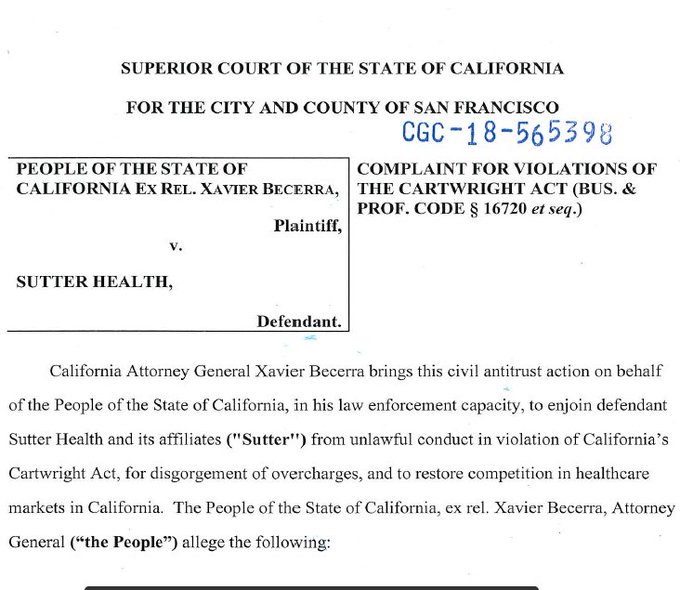
California’s attorney general has filed a lawsuit against Sutter Health, the largest system in the northern part of the state, claiming the organization’s anticompetitive practices have driven up healthcare prices throughout the region

The charges in the lawsuit (PDF) are “not new to Sutter,” AG Xavier Becerra said at a press conference Friday afternoon. The filing follows a statewide investigation into healthcare costs that revealed wide price disparities between the northern and southern parts of the state.

“Sutter Health is throwing its weight around in the healthcare market, engaging in illegal, anticompetitive pricing that hurts California families,” Becerra said in an announcement. “Big business should not be able to throttle competition at the expense of patients.”

Sutter was able to jack up prices for care at its facilities in several ways, according to the lawsuit:

  • Forcing insurance companies to negotiate with it in an “all-or-nothing” systemwide fashion
  • Blocking payers from offering patients low-cost health plan options
  • Charging extremely high rates for out-of-network visits
  • Limiting price transparency

Karen Garner, a spokesperson for Sutter, said in a statement emailed to FierceHealthcare that the system is “aware that a complaint was filed, but we have not seen it at this time, so we cannot comment on specific claims.”

Garner said that data from the state’s Office of Statewide Health Planning and Development show lower prices at Sutter Health facilities compared to other providers operating in Northern California. Sutter has also kept rate increases for its health plan in “low single digits since 2012,” she said.

“It’s also important to note that healthy competition and choice exists across Northern California,” Garner said. “There are 15 major hospital systems and 142 hospitals in Northern California, including Kaiser Permanente, Dignity, Adventist, Tenet, UC and more. And health plans can elect to include or exclude parts of the Sutter Health system from their networks, and health plans have been doing so for many years.”

Multiple California employers and labor unions have taken action against the health system for anticompetitive practices prior to the AG’s involvement. Sutter came under fire late last year after it was revealed that in 2015 it destroyed 192 boxes of documents that these entities sought as evidence, which the system said was a regrettable mistake.

A California judge said there was “no good reason” for Sutter to have destroyed the documents and said the “most generous interpretation” was that the system was “grossly reckless.”

The AG’s lawsuit also alleges that in addition to driving up healthcare costs in Northern California, Sutter’s actions enriched its executives, and fueled acquisitions that led to further consolidation and funding for its own health plan.

Becerra’s office was spurred to act, according to the announcement, following the release earlier this week of a report from the University of California that detailed how much consolidation has impacted healthcare costs in the state, with northern regions especially affected.

The average cost for an inpatient stay in Northern California was $223,278, compared to an average of $131,586 in the southern regions, according to the report (PDF).

Kathleen Foote, senior assistant attorney general in California who heads the antitrust unit, said at the press conference that taking action against Sutter’s practices should lead to increased competition that benefits both price and care quality.

A video of the full press conference is embedded below: