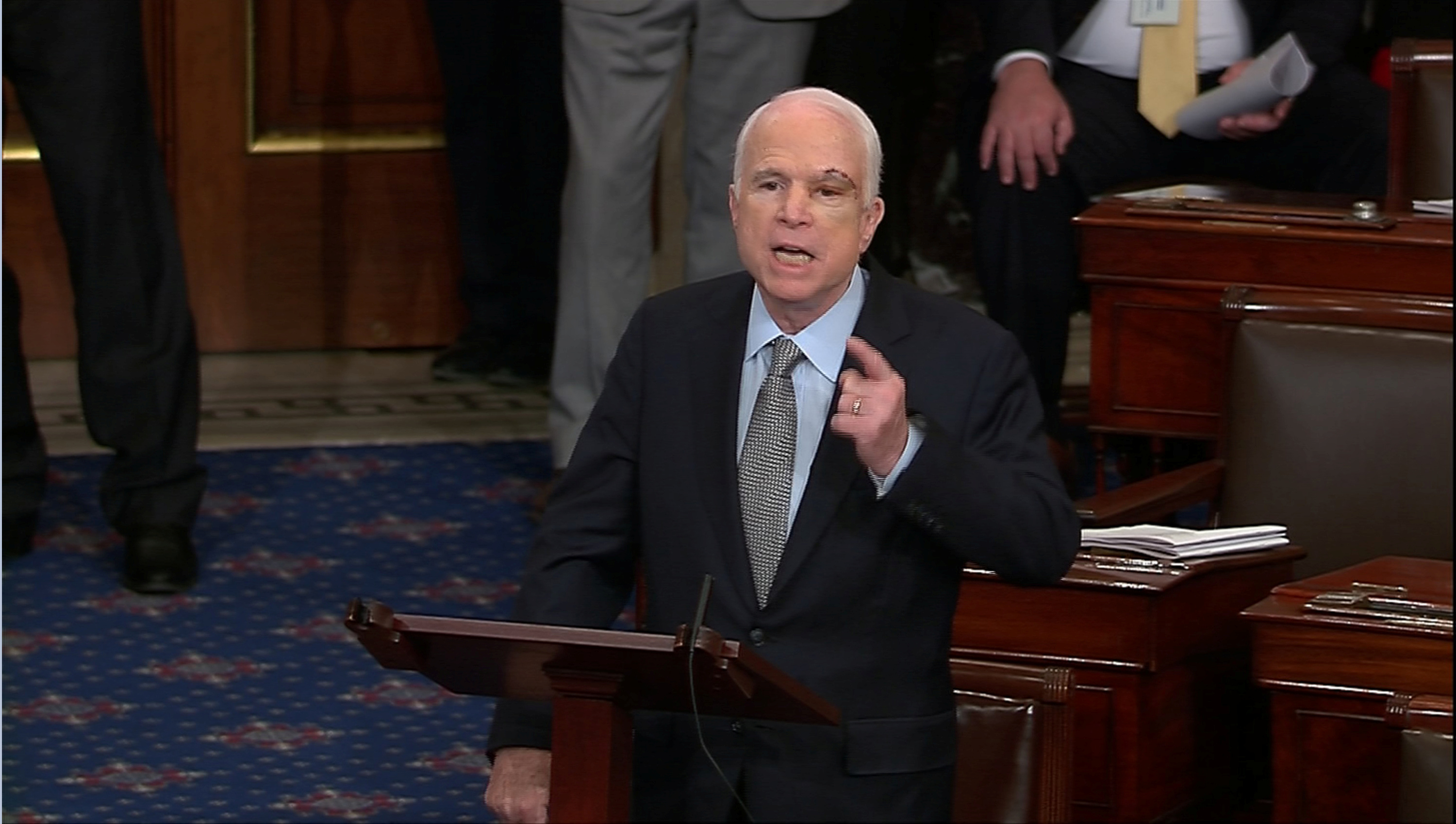
Ever-courageous John McCain returns to D.C., battling both cancer and malignant politics

https://www.brookings.edu/blog/fixgov/2017/07/27/ever-courageous-john-mccain-returns-to-d-c-battling-both-cancer-and-malignant-politics/?utm_campaign=Brookings%20Brief&utm_source=hs_email&utm_medium=email&utm_content=54757954

Image result for Ever-courageous John McCain returns to D.C., battling both cancer and malignant politics

John McCain returned to Washington, D.C., bravely fighting two tumors. One is the malignancy caused by the glioblastoma cancer in his brain. The other is health-care reform, a political tumor that is crippling the Republican Party.

In a Senate floor speech that will long be remembered, McCain, an Arizona Republican and the party’s 2008 presidential nominee, pleaded with his fellow Republicans to reconsider their strategy. Instead of ramming through an ill-conceived, hastily assembled, and entirely partisan health-care bill with hardly any deliberation, the Senate should let committees hold hearings and work across party lines to craft a balanced reform with support from both sides. You know: legislate.

McCain was right. Moreover, most of his Senate Republican colleagues understand he is right. Most of them know their approach to health care is something akin to group suicide.

They know, for example, that the various Senate bills to “repeal and replace” Obamacare, like the version passed by the House, are unworkable. The bills are masses of contradictions, hopelessly trapped between imperatives to deregulate markets and cut costs while also maintaining coverage and affordability. If adopted, the proposals would crater private insurance markets and drop millions from the insurance rolls. If such poorly designed proposals managed to be enacted into law, Congress would spend the next five or ten years desperately trying to patch them.

McCain’s colleagues also know that reforming a sixth of the economy by scribbling a plan on the back of an envelope, and then rushing it to enactment with barely time to read it, is an absurd way to legislate. Writing devilishly complicated laws without transparency, and without input from most of the affected parties, and without expert testimony, and without the involvement of most members of the Senate cannot possibly produce good results.

Senate Republicans also know that if their hasty reform got enacted, it would kill them politically. The Republican repeal/replace proposals are massively unpopular with the public. If the proposals became law, tens of millions of Americans would lose access to health insurance as markets imploded and options disappeared. Those affected would include millions of working-class voters who provided the Republican swing vote in 2016. Angered, they could easily swing back.

Senate Republicans know, too, that the public is running out of patience with health-care half measures and improvisations. Single-payer insurance is waiting in the wings. Republicans who imagine they can leave Obamacare to implode overlook that the current debate may well be conservatives’ last opportunity to save private health insurance. Failure to make the health system work will cause a backlash toward what Republicans fear most, socialized medicine.Something else Senate Republicans know: President Trump will throw them under the bus. He has already called the House bill, which he ostensibly supported, “mean.” He will encourage the Senate to pass something unpopular, sign it, and then brassily campaign against it. The tweets practically write themselves. “Nasty congressional health plan hurts our working class. Sad! Only I can fix it!”

And guess what? Trump, who has expressed support for single-payer on multiple occasions, would be fine with that. If single-payer looked like a political win, he would gladly sign it.

To avoid multiple disasters, Republicans have only one hope. Exchange “repeal and replace” for “retain and repair.” Do as McCain advises: attempt to write serious, bipartisan legislation.

The political price would be high. If they agreed to negotiate at all, the Democrats would demand explicit repudiation of the “repeal” mantra. They would insist on keeping Medicaid whole and keeping today’s Obamacare population insured. Even if the Senate passed a strong bipartisan bill, the House might kill it. The conservative-entertainment complex, of course, would be rageful and vengeful.

A bitter pill, no doubt. But the alternatives are poison pills. And, lest we forget, there is one other reason to consider McCain’s advice. It could improve the country’s unstable and unsatisfactory health-care system.

Back in the late 2000s, when Obamacare was cobbled together by the Democrats, the country missed an opportunity. In the 2008 presidential campaign, the health-reform proposals of Democrat Barack Obama and Republican John McCain had complimentary strengths. If only we could have stapled them together, we would have had a pretty darn good system. Regulations would have moved the country toward universal coverage, tax credits would have helped people buy insurance through private markets, and market reforms would have reduced distortions that drive costs up and transparency down.

What was true then is probably still true: bipartisan reform not only would enjoy more durable public support, it might actually work.

So listen, Republicans, to John McCain. “See if we can pass something that will be imperfect, full of compromises, and not very pleasing to implacable partisans on either side, but that might provide workable solutions to problems Americans are struggling with today.” His prescription offers the best hope of treating the Republicans’ health-care malignancy.

Venrock Partner offers take on Senate health bill debate and how ACA can be fixed (Q&A)

Venrock Partner offers take on Senate health bill debate and how ACA can be fixed (Q&A)

Image result for bipartisanship

Before he joined venture capital firm Venrock and became a partner investing in healthcare startups, Dr. Bob Kocher served as special assistant to President Obama for healthcare and economic policy from 2009 to 2010 and played a role in the development of the Affordable Care Act. Given another rollercoaster week for ACA repeal and replace machinations in the Senate, we thought it would be helpful to check in with Kocher to get his perspective. Kocher responded to questions in a couple of emails. What follows is a lightly edited Q&A.

What do you make of Trump’s comment this week: “We’re not going to own it. I’m not going to own it. I can tell you the Republicans are not going to own it. We’ll let Obamacare fail, and then the Democrats are going to come to us.”

Trump is responsible for the performance and premiums of State Exchanges.  The regulations that Trump enacts governing the individual insurance market, the day-to-day operations of HHS’ insurance exchanges, and efforts to reduce political uncertainty around policies like funding cost-sharing rebates, enforcing the employer and individual mandates, and extending reinsurance all have enormous effects on the premiums.  Also, HHS has a great deal of latitude on how to design the purchasing experience and can make it harder or easier for individuals and brokers trying to help people buy insurance.  How Trump chooses to oversee the Affordable Care Act could easily have a larger impact on premium growth than underlying medical trend.

What aspects of the Affordable Care Act need to be fixed at this point?

The ACA is working well in most places and premiums under the ACA have grown more slowly than prior to the ACA.  Moreover, premiums today are almost exactly what the Congressional Budget Office predicted.  To make the ACA work even better, and to reduce future premiums, five things should be done:

  1. The Trump Administration should enforce the individual and employer mandates
  2. The Trump administration should commit to funding cost sharing rebates (failure to fund these will lead to 10 percent to 15 percent increases in premiums)
  3. Ask Congress to reinstate the risk-corridor funding, that Marco Rubio removed, like we do for Medicare Advantage
  4. Ask Congress to extend and make permanent reinsurance funding like we do for Medicare Advantage
  5. Require plans to bid on large regions or entire states to create larger risk pools and more plan options in less populated counties.

How do you expect the healthcare reform debate to unfold from here?

I think Republicans will find it politically advantageous to move on to other agenda items and work with Democrats to enact these five policies as part of the end-of-year flurry of must-pass government funding bills.   

What aspects of the healthcare reform debate are getting overlooked or missed that you think are important? 

The fundamental problem is that healthcare costs too much. Premiums under the Republican health care plans are forecast to go up even faster than the ACA.  Premiums today are already over $17,000 per year for a family.  That is simply unaffordable.  We need to redesign healthcare to be lower cost.  We know that healthcare can be delivered at lower costs since groups like Kaiser, Geisinger, Group Health, ChenMed, Healthcare Partners, and CareMore have delivered care that is about 30 percent lower cost with great outcomes done this for years.  We need policy makers to argue more about how to create incentives to drive down cost and less about what cost sharing should be for individuals.

Has the healthcare debate on Capitol Hill shown that the shift to value-based care is at risk or can overcome the current uncertainty?

I think the shift towards payment models that reward better outcomes at lower cost is certain. The legislation that drives this change is MACRA and it is not being debated.  MACRA passed Congress with bipartisan support and Secretary Price committed to enact it faithfully during his confirmation hearing.

Does the Senate’s lack of success (so far) with the ACA repeal and replace effort say more about the GOP and the members of this party, the ACA or the divisiveness of the healthcare debate in general?

I think that most Americans think the ACA is working.  Having access to high quality insurance with subsidies to make care more affordable is valued by Americans.  The thought that they would suddenly have to pay both more out of pocket when they go to the doctor with higher deductibles, pay higher annual premiums, and have plans that cover fewer conditions is scary. The rhetoric of “repeal and replace” may have sounded good politically but it is sure unattractive when you consider the reality.

You noted in an editorial you wrote for The Wall Street Journal last year that one thing you got wrong about Obamacare was how the change in the delivery of healthcare would and should happen:

“I believed then that the consolidation of doctors into larger physician groups was inevitable and desirable under the ACA….What I know now, though, is that having every provider in health care “owned” by a single organization is more likely to be a barrier to better care.

Is there anything that can be done to improve this situation through amendments to ACA?

While we anticipated ongoing consolidation of healthcare providers into larger systems, we thought that these systems would also embrace the new payment models the ACA launched.  These new models reward coordination of care that can be made easier through scale and being part of a single organization that can do everything from primary care and hospital care to rehab and hospice.  In reality, these larger systems have discovered that they have the market power to say no to health plans trying to get them to take part in new payment models and to raise prices.  We now need to do more work on creating local market competition and price pressure.

What are the chances that after the repeal effort fails, that a truly bipartisan effort may emerge to deal with areas of the U.S., where the healthcare exchanges are not working well because too few insurers are participating?
I think there can be bipartisan support for solutions to make Exchanges work better and to lower premiums for consumers. Just like Democrats and Republicans have come together to fund reinsurance, risk corridors, and reduce uncertainty for private health plans in Medicare Advantage and Medicare Part D, fortunately, these same solutions will work again for Exchanges. I think we can achieve bipartisan support to bolster the ACA and that Republicans will have the desire to do these things soon.

Health care fight shows Washington at its worst

http://www.sfchronicle.com/opinion/article/Health-care-fight-shows-Washington-at-its-worst-11303602.php?utm_campaign=CHL%3A%20Daily%20Edition&utm_source=hs_email&utm_medium=email&utm_content=54498266&_hsenc=p2ANqtz-8nW1z8XGp1RyWaBRZo1HR_YwqOWFq8gREqh7wzXohioPQ2kx3SMz2vwu8CMs2xJr1f1w3UqB1IbqGUtwIJvTN98D4mjA&_hsmi=54498266

The fight over repealing and replacing Obamacare was more about partisan politics than protecting consumers. Photo: Joe Raedle, Getty Images

The story of health care policy this week, this month and for the last decade (at least) has been a tale of partisan folly. But fear not, this isn’t another earnest pundit’s lament for the vital center to emerge, phoenix-like, to form a governing coalition of moderates in both parties. That’s not my bag.

After all, I have always argued that bipartisanship is overrated.

Bipartisan support often means unthinking support (as the founders could have told you). Partisans may be annoying from time to time, but they also can be relied upon to point out the shortcomings of what the other side is doing. When partisan criticism is missing, it might be a sign that politicians in both parties are helping themselves, not the country. Or, it might mean they’re pandering to the passions of the public and press rather than doing the hard work of thinking things through.

So you’ll get no warm and fuzzy pleading for moderates to scrub clean the word “compromise” so that it’s no longer a dirty word in Washington. Others can make the case for that. And besides, that argument misses the essence of this spectacular failure. Honest partisanship isn’t the problem, bipartisan dishonesty is.

Both parties have become defined by their lies and their refusal to accept reality. It’s a problem bigger than health care, but health care is probably the best illustration of it.

For seven years Republicans campaigned to repeal Obamacare. We now know that for many of those politicians, that pledge was a sales pitch that expired after the sale — i.e., the election — was final.

But before liberal readers pull a muscle nodding their heads: The Democrats aren’t any better. Obamacare itself was lied into passage. “You can keep your plan!” “You can keep your doctor!” “Your premiums won’t go up!” These were lies. If those promises were remotely true, Obamacare wouldn’t be the mess it is.

But these aren’t even the lies I have in mind.

The Republican “repeal and replace” bills debated for the last six months did not in fact repeal Obamacare. They kept most of its regulations intact — particularly the popular ones. The GOP did seek to repeal and reform the Medicaid expansion under Obamacare, but that’s not the same thing as repealing Obamacare.

Yet Republicans insisted it was a repeal because they wanted to claim that they fulfilled their repeal pledge. Actually fulfilling the substance of the pledge was a low-order priority. Heroically winning the talking point: This was their brass ring.

So, too, for the White House. Donald Trump just wanted a win. He has made it abundantly clear that he would sign anything the Republicans sent him — up to and possibly including the head of Alfredo Garcia if someone had written “Obamacare: Repealed” on the poor chap’s forehead. Trump has shown zero preference for any specific policy or approach during these debates. He just wants the bragging rights.

And that is the one thing Democrats are most determined to deny him. The Democrats know that Obamacare has been an albatross for their party. They often acknowledge, through gritted teeth, that the law needs a substantial overhaul.

More important, they also know that the GOP wasn’t pushing an actual repeal. But they couldn’t tolerate for a moment the idea that the Republicans would get to claim it was repeal. So the one thing both sides could agree upon was that this was a zero-sum war over repealing Obamacare — when it wasn’t.

This was all about bogus gasconade and rodomontade for Republicans and insecure rhetorical wagon-circling around Barack Obama’s “legacy” for Democrats. If Trump and the GOP agreed to abandon “repeal,” as Senate Minority Leader Chuck Schumer wants, one can only wonder how much replacing of Obamacare Schumer would allow the GOP to get away with.

Likewise, if Democrats could somehow give Republicans the ability to say they repealed Obamacare, many Republican senators — and certainly Trump — would probably be happy to leave the bulk of it intact.

It is this fact that makes the polarized, tribal climate in Washington so frustrating. I like partisan fights when those fights are about something real. The Medicaid fight was at least about something real. But most of this nonsense is a battle of liars trying to protect past lies in the hope of being able to make new lies seem just plausible enough for the liars to keep repeating them.

As repeal and replace falters, more say GOP should abandon repeal plan

http://www.cnn.com/2017/07/20/politics/health-care-poll-abandon-repeal-replace/index.html?lipi=urn%3Ali%3Apage%3Ad_flagship3_feed%3BUMCVso0rSd6nYA7sO0FoTg%3D%3D

Image result for As repeal and replace falters, more say GOP should abandon repeal plan

A new CNN poll conducted by SSRS finds a growing share of Americans want to see the GOP abandon its effort to repeal and replace the 2010 health care law known as Obamacare, as majorities across party lines want congressional Republicans to aim for a bill with bipartisan support.

Overall, 35% in the poll say they’d like President Donald Trump and the Republicans in Congress to give up their plans for repealing and replacing Obamacare, up from 23% who said the same in a March survey.
A majority still favor some form of repeal (34% would prefer repeal with replacement at the same time, and 18% favor repeal regardless of whether the law is replaced at the same time). The share in favor of repeal without replacement has held roughly steady since March; it remains the least popular option.
But public preferences are shifting away from repealing the law and enacting replacements concurrently (down from 59% in March), and more now say they’re unsure how they want Republican leaders to proceed (13% say so in the new poll).
Increases in support for abandoning repeal have come largely among groups that aren’t central to the GOP’s base: Younger adults, non-whites and those with lower incomes have become notably more supportive of leaving the ACA as is.
On the growing uncertainty, the percentage of respondents in a poll who say they don’t know how they feel about an issue is often related more to the methodology and administration of the survey than to real uncertainty about an issue, however, given the real-life uncertainty about the Senate’s plan to replace the ACA while the poll was in the field, in this case, it’s possible there’s been a meaningful increase in unknown feelings about the law itself.
The poll also finds that with several failed efforts at repealing and replacing the bill in the rear view mirror, about half think it’s likely the President and Republicans in Congress will ultimately be able to reach a deal to repeal and replace Obamacare. That’s down from 58% who felt it was likely in an April CNN/ORC survey, but remains above the share who say it’s unlikely the ACA will be repealed and replaced (41%).
Republicans themselves remain optimistic that their party’s leaders in the White House and Congress will be able to come together to achieve this long-standing goal, 78% say it’s very or somewhat likely to happen, but less than half of independents or Democrats agree.
Overall, almost eight in 10 in the new poll say they’d like Republicans in Congress to try to work with Democrats to pass a health care bill that has bipartisan support (77% say so). Just 12% favor continuing to try to pass a bill that only has GOP backing. Even among Republicans, only about a quarter favor an approach that only has the backing of Republican lawmakers.
Interviewing for the CNN poll conducted by SSRS was completed July 14-18 among a random national sample of 1,019 adults. The survey included 405 respondents reached on landline telephones and 614 reached on cellphones. The margin of sampling error for the full sample is plus or minus 3.7 percentage points.


The BCRA is dead, but don’t take your eye off Capitol Hill

http://www.healthcaredive.com/news/the-bcra-is-dead-but-dont-take-your-eye-off-capitol-hill/447356/

Image result for keeping an eye on

The healthcare industry may have dodged a bullet, but this week’s legislative stumbles for the GOP don’t mean healthcare is off the table for Congress. Here’s what to watch.

Republicans Now Have 3 Options for Dealing With Health Care

https://www.thefiscaltimes.com/2017/07/18/GOP-Health-Care-Failures-Leave-3-Paths-Open-None-Them-Very-Appealing

Image result for three paths

Badly wounded and humiliated by the latest turn of events, President Trump and Senate Majority Leader Mitch McConnell (R-KY) are blaming Democrats and a few disloyal Republicans who helped block action on the Senate GOP’s star-crossed plan to repeal and replace the Affordable Care Act.

In the aftermath of the devastating announcement late Monday by two conservative Republicans, Sens. Mike Lee of Utah and Jerry Moran of Kansas, that they were joining with Sens. Rand Paul of Kentucky and Susan Collins of Maine in opposing the bill, Trump and McConnell apparently are choosing retribution over statesmanship.

Related: The GOP Senate Health Bill Just Died as Two More Senators Say No

Unable to muster at least 50 of the 52 Senate Republicans to support the legislation – the bare majority they would need under budget reconciliation to pass the bill without a single Democratic vote and Vice President Pence casting the tie-breaking vote –the president and majority leader are vowing to press for action in the coming days to outright repeal the ACA while giving Congress two years in which to concoct a replacement plan.

But already there are indications that this Hail Mary pass approach will fail as well, with moderate Republicans pushing back.

Congressional Republicans and the Trump administration have argued for months that Obamacare, with its soaring premiums and diminished insurance choices, is in a death spiral and that Congress must save Americans from the ill effects of the 2010 legislation. But for all the problems of a program that has provided coverage to more than 20 million people, including expansion of Medicaid, the Congressional Budget Office (CBO) and other individual analysts say that the Obamacare markets have remained relatively stable, while polls show that voters much prefer to hang onto Obamacare than take their chances with the Republican approach.

McConnell, whose reputation as a shrewd deal maker has taken a beating in recent days, insisted Monday night and again today in a floor speech that the Republican-controlled Senate and House already approved a “repeal and delay” bill in early 2015 that President Obama vetoed, and that the two chambers could replicate that vote in the coming days.

Related: Why Trump Can’t Sell Health Care Reform – and the Price He’ll Pay for It

“Our Democratic friends have spoken a lot recently about wanting bipartisan solutions,” McConnell said. “This legislation will provide the opportunity for senators of all parties to engage with a fresh start and a new beginning for the American people.”

The president told reporters at the White House today that he wants to “let Obamacare fail” and then have the Democrats and GOP leader to “fix it.” He blamed the Democrats for putting the Republicans in an impossible position to pass comprehensive legislation and insisted that voters would ultimately hold the Democrats responsible. “I’m not going to own it,” he declared.

But in passing the repeal and delay legislation two years ago, the Republicans weren’t shooting with live ammunition: The bill was largely campaign messaging by the GOP, and everyone knew that Obama would prevent it from taking effect. Republicans blithely ignored the warning of the Congressional Budget Office (CBO) that the bill, if enacted, would result in havoc in the individual insurance market, skyrocketing premiums and out of pocket costs, and the loss of coverage for 32 million Americans by 2026.

Related: There’s a Nasty Surprise Hidden in the Fine Print of the GOP Health Care Bill

Trump’s and McConnell’s assertion that Democrats would have little choice but to join forces with the Republicans and negotiate a bipartisan compromise on replacement legislation if Obamacare were given a death sentence effective two years from now is fanciful at best. Senate Minority Leader Chuck Schumer (D-NY) says the Democrats are open for talks now on a wide range of measures to strengthen the existing law and bring down costs, but only if the Republicans abandon their insistence on repealing Obamacare.

“Make no mistake about it, passing repeal without a replacement would be a disaster,” Schumer said in a floor speech today. “Our health care system would implode, millions would lose coverage, coverage for millions more would be diminished, our health care system would be in such a deep hole that repair would be nearly impossible.”

While Republican prospects of making good on a seven-year promise to dismantle the Affordable Care Act appear next to zero at this point, the political situation remains fluid, with the outcome still very much in doubt. Here are three possible scenarios in the coming days and weeks: 

Repeal and delay: Like just about everything else connected with the Senate health care deliberations, the decision to go for repeal without replacing Obamacare was made in haste by McConnell and Trump after Lee and Moran jointly announced their opposition to the Better Healthcare Reconciliation Act.

Related: GOP Health Plan Hits Another Wall and McConnell Once Again Postpones a Vote

McConnell, 75, has few peers as a legislative strategist, and he is inclined to make split second decisions, as he did in declaring that the Senate wouldn’t consider a replacement for the late Supreme Court justice Antonin Scalia until after the 2016 presidential election, in hopes that a Republican president would make the choice.

Rather than allowing for a day or two of contemplation and consultation on how to proceed, McConnell announced that he intended to hold a vote in the coming days to take up the House-passed version of the Republican health care plan. He would seek passage of an amendment that would strip out many of the new GOP policies but eliminate major portions of Obamacare, including Medicaid expansion, insurance subsidies and fines for individuals and employers who failed to adhere to the law’s mandates.

But McConnell is likely to have as much trouble pushing through this backup approach as winning majority support for the health care reform legislation he almost single-handedly drafted.

Collins, a leading moderate in the party, denounced the approach and promised to vote against it this week or next when it is brought up. “I think [passage] would create great anxiety for individuals who rely on the ACA, I believe it would cause insurance markets to go into turmoil, and I don’t think it is the right way to proceed,” Collins told reporters today.

Related: Last Chance for the Senate GOP Health Plan: Let the Arm Twisting Begin

What’s more, moderate Sens. Shelley Moore Capito of West Virginia and Lisa Murkowski of Alaska told reporters that they too would oppose a repeal and delay approach, bringing to three the number of Republicans opposed to McConnell’s tactics and enough to stop them in their tracks. 

A bipartisan deal: Feelings about health care reform are running high on both sides of the aisle, and Republican disdain of Democrats for refusing to assist in rewriting the law is matched by Democrats’ contempt for McConnell in totally shutting them out of the backroom deliberations. For those who still believe that Obama and the Democrats passed the ACA without trying to make the bill a bipartisan effort, read this piece in The Atlantic, which shows how McConnell urged Senate to stonewall any cooperation with the Obama administration.

McConnell said recently that if the Republicans couldn’t agree among themselves on legislation to supplant the ACA, they would have no choice but to seek a limited bipartisan deal with the Democrats to buttress the nation’s insurance marketplaces. Schumer has repeatedly said that he was open to talks with the Republicans over the future of Obamacare, provided they abandoned their demand for outright repeal of the law and massive cuts in Medicaid for 70 million poor and disabled people,

“We’re ready to sit down right now” and negotiate “if Republicans abandon cuts to Medicaid, abandon huge tax breaks for the wealthy and agree to go through the regular order, through the committees, with hearings, onto the floor, with time for amendments,” Schumer said in a floor speech. “That’s how we perfect legislation here. That’s how it’s been done for nearly 200 years…. Almost inevitably when you try to draft something behind closed doors and not vet it with the public, it becomes a failure – in this case, a disaster.”

Related: The Lesson of the GOP Health Care Collapse: Make America Simpler Again

Should the two sides eventually get to the bargaining table, the Democrats are likely to press for a handful of other requirements, including the guarantee of a continuous flow of federal cost-sharing subsidies to enable insurers to lower premium costs for low-income consumers, a resumption of reinsurance or “rate corridor” measures that protect the insurance industry from unexpected massive losses, and some steps to rein in the cost of prescription drugs.

Robert Laszewski, a health care consultant, wrote to his clients today, “The fact is that there is no common ground that could garner more than a handful of Republicans willing to save Obamacare. Such an effort would almost certainly now take 60 votes and would require the cooperation of the Republican leadership in both houses willing to let some of their caucus give the Democrats an enormous victory.”

Status Quo and stumbling along: A third possibility is that dysfunction in Congress and a lack of leadership from President Trump could result in a prolonged state of the current status quo. That would present its own problems because the ACA needs serious repair in order to bring premiums and deductibles down to more manageable levels.

Related: Everything You Need to Know About Your Health Savings Account (HAS)

The cutoff of some subsidy payments to insurers and the Trump administration’s purposefully vague statements about whether it intends to keep paying others has created the sort of uncertainty that either pushes insurers out of markets they would otherwise serve or forces them to raise premiums to compensate for additional risk.

A continuation of the status quo could help Republicans sell their narrative of a failed Obamacare if it drives more insurers away, but it’s unclear that it would bring lawmakers closer to a viable alternative to the ACA.


Fixing Our Most Pressing Health Insurance Problems: A Bipartisan Path Forward

http://www.commonwealthfund.org/publications/blog/2017/jul/fixing-health-insurance-problems-bipartisan-approach?omnicid=EALERT1244206&mid=henrykotula@yahoo.com

With Senate Republicans mired in seemingly intractable disagreements about how to proceed with health reform—which may very well not be resolved by the latest Senate draft bill, Majority Leader Mitch McConnell suggested on July 6 that a bipartisan short-term fix may be needed for the problems of the individual health insurance market. In fact, opinion polling reveals wide public support for bipartisan health reform. And bipartisanship in health policy is not a fantasy—both the 2015 Medicare Access and CHIP Reauthorization Act (MACRA) and the 2016 21st Century Cures Act passed with wide bipartisan majorities.

How could a bipartisan solution happen? First, it must focus on the individual market, where we face an immediate crisis. Long-term changes to the employer-sponsored coverage market and the Medicare and Medicaid programs, which together cover the vast majority of Americans, can be debated, but nothing needs to change right now. Moreover, sharp ideological divisions between Republicans and Democrats (and within both parties) as to the path forward with respect to public programs and the employer market make short-term consensus unlikely.

Second, we need solutions that can be implemented immediately through existing programs. We do not have time to extensively rewrite federal regulations or implement state-based systems for providing premium and cost-sharing assistance to address pressing problems facing us now.

And third, we may need to accept short-term increases in federal spending to get us through the immediate difficulties, as we have when our country has faced other crises. In the long term, we must cut health care spending growth generally. But in the short term, simply shifting the burdens to individuals who will lose insurance coverage or face much higher deductibles and premiums is not acceptable.

The immediate problem that needs to be addressed is that it appears that individual market coverage will not be available in 40 counties in Nevada, Ohio, and Indiana for 2018. An additional 1,300 counties, representing about one-quarter of marketplace enrollees, may have only one insurer next year. The number of “bare” or single-insurer counties changes from week to week, and these numbers may improve, but it is also possible that more counties will lose insurers by 2018. Moreover, some individual market insurers are requesting double-digit premium increases for 2018 for the second year in a row.

The cause of this crisis is no secret. Insurers and insurance regulators have repeatedly pointed to the regulatory uncertainty driving insurer withdrawals and premium increases. In particular, confusing signals from the administration as to whether it will reimburse insurers for the cost-sharing reductions they are required to offer low-income consumers under the Affordable Care Act (ACA) and enforce the individual mandate has left insurers very nervous about the individual market’s future. Decreased exchange enrollment and a fear of a less healthy risk pool also have insurers feeling insecure.

What can be done? First, Congress should immediately enact a mandatory appropriation to cover the cost-sharing reduction reimbursements through 2020. Not only the major insurer trade organizations, but also the National Association of Insurance Commissioners, the National Governors Association, and the United States Chamber of Commerce have identified this as an urgent necessity. Because the cost of this initiative is already included in the budget baseline, the appropriation would not even have budget consequences.

Second, Congress should ensure coverage for bare counties. The Federal Employees Health Benefits Program (FEHBP) offers private insurance coverage from multiple insurers in every county in the nation. For 2018 and 2019 only, the largest two FEHBP insurers in any county should be required as a condition of continued participation in the program to offer at least one silver-level plan though the federal exchange in all counties that would otherwise be without coverage. These plans should be eligible for premium tax credits and could otherwise charge actuarially appropriate premiums.

Third, Congress should appropriate the short-term premium stabilization funding included in the Senate’s Better Care Reconciliation Act (BCRA), providing $50 billion in reinsurance funds directly to insurers over the next four years. Reinsurance payments of $15 billion for 2018 and 2019 could significantly reduce individual market premiums for those years, as reinsurance did in the first three years of the ACA.

Fourth, Congress should reinstitute the ACA’s risk corridor program for 2018 and 2019 for any county with fewer than two insurers. The Republican’s 2003 Medicare Modernization Act included a risk corridor program to share risk with insurers that experienced unanticipated losses. It remains in place today. Congress essentially defunded the ACA’s risk corridor program in 2015, causing insurers to experience huge losses and driving some to insolvency. The program should be reinstated and funded for 2018 and 2019. Congress should also suspend the ACA’s health insurer tax for insurers that offer individual market coverage in bare and single-insurer counties.

Fifth, Congress should leave the individual mandate in place until it can devise a credible replacement. The House-passed American Health Care Act would impose a 30 percent premium surcharge on people who failed to maintain continuous coverage or allow states to permit insurers to charge higher premiums to such enrollees with preexisting conditions. The Congressional Budget Office (CBO) determined that these penalties would discourage healthy consumers from enrolling, and that allowing health status underwriting would destabilize the market. The CBO also concluded that the Senate’s solution of a six-month lockout period for consumers who lacked continuous coverage would be ineffective. The ACA’s individual mandate penalty is too small, was phased in too slowly, and has not been adequately enforced, but for the time being it is all we have to encourage healthy people to enroll in coverage. Until someone comes up with a better solution, it should be left in place.

Sixth, Congress should rework the premium tax credit formula for 2018 through 2020 to allow younger enrollees to claim more generous tax credits. The BCRA would do this, but would reduce tax credits for older people, discouraging healthy boomers from enrolling. In the short term at least, insurers need all the healthy enrollees they can get, regardless of age.

Finally, every consumer should be able to fully deduct the payments they make to purchase individual market premiums (i.e., not the costs covered by premium tax credits). Self-employed individuals are already allowed to do this. Senate Republicans are reportedly considering legislation that would allow individuals to pay premiums through tax-subsidized health savings accounts, but why require a consumer to go to the trouble of establishing an account and paying associated fees when they could simply pay premiums tax free?

As Senator McConnell has acknowledged, bipartisan action may be needed to address our most pressing problems in the health insurance market. Practical solutions are available. Congress should adopt them immediately and by consensus, and then debate the longer-term future of our health care system.


Poll: Americans see healthcare as most important issue

https://origin-nyi.thehill.com/policy/healthcare/342336-poll-americans-see-healthcare-as-most-important-issue

Image result for Healthcare Poll

Americans view healthcare as the most important issue facing the country but are doubtful Congress will pass legislation that will lower premiums and cover more people, according to a Bloomberg poll released Monday.

With the GOP push to repeal and replace ObamaCare serving as the poll’s backdrop, 35 percent of Americans surveyed indicated healthcare was their top issue, more than twice as many as any other option. The other leading issues included unemployment and jobs (13 percent), terrorism (11 percent), immigration (10 percent) and climate change (also 10 percent).

A majority, 64 percent, disapproves of how President Trump is handling healthcare, compared to 28 percent approving.

Senate Majority Leader Mitch McConnell (R-Ky.) has delayed a vote on healthcare legislation that leadership hoped would be this week, as Sen. John McCain (R-Ariz.) recovers from an unexpected surgery. Without McCain, Republican leadership didn’t have enough votes to begin debate on the bill because Sens. Rand Paul (R-Ky.) and Susan Collins (R-Maine) said they would vote against a motion to proceed.

About 60 percent of those surveyed believe it’s unrealistic legislation will pass in the next several years that both lowers premiums and leads to more people with health coverage.

Conservative lawmakers have consistently pushed for a bill lowering health insurance premiums. A provision from Sen. Ted Cruz (R-Texas) that was added to the revised version of the GOP plan lets insurers sell plans that don’t comply with ObamaCare’s coverage regulations as long as they also sell a plan that does.

But the measure has received pushback from healthcare experts and insurers. In a strongly worded letter sent Friday, America’s Health Insurance Plans — the major insurance trade group — and the Blue Cross Blue Shield Association warned that it is “simply unworkable in any form and would undermine protections for those with pre-existing medical conditions, increase premiums and lead to widespread terminations of coverage for people currently enrolled in the individual market.”

Bloomberg surveyed approximately 1,000 people over the phone from July 8 to July 12. The poll has a margin of error of plus or minus 3.1 percent.


The Un-Democratic Process Behind Trumpcare

https://www.theatlantic.com/politics/archive/2017/07/the-disturbing-process-behind-trumpcare/533850/

http://www.realclearhealth.com/2017/07/18/the_un-democratic_process_behind_trumpcare_276901.html?utm_source=morning-scan&utm_medium=email&utm_campaign=mailchimp-newsletter&utm_source=RC+Health+Morning+Scan&utm_campaign=114c8c7a9a-MAILCHIMP_RSS_EMAIL_CAMPAIGN&utm_medium=email&utm_term=0_b4baf6b587-114c8c7a9a-84752421

Image result for The Un-Democratic Process Behind Trumpcare

Since I came to Washington in 1969, I have been immersed in Congress and its policy process. I have seen many instances of unpopular bills considered and at times enacted. I have seen many instances of bills put together behind closed doors. I have seen bills enacted and repealed after a public backlash. I have seen embarrassing mistakes in bills, and lots of intended consequences.

But I have never seen a process like the one Senate Majority Leader Mitch McConnell is using in the Senate with his so-called Better Care Reconciliation Act, BCRA, to presumably repeal and replace the Affordable Care Act; nor have I seen lawmakers responding to the bill, and their own constituents, this way.

Let’s take a brief look at a couple of Congress’s greatest hits: one unpopular bill and one crafted in private. Perhaps the most notorious in terms of unpopularity was the aptly named Medicare Catastrophic Act of 1988, which was substantially repealed just a year later after an intense backlash from a group of more affluent seniors upset that their costs would go up. The visual imprinted in many minds was hundreds of enraged elderly chasing Illinois Representative Dan Rostenkowski down a street in Chicago as he sought refuge in his car after a rancorous town meeting.

Sure sounds like a parallel to today. But consider: The 1988 act was an open and thoroughly  bipartisan effort to fulfil one of Ronald Reagan’s promises, to protect seniors against financial disaster; it actually provided a substantial set of benefits for poorer seniors, but because it was financed entirely within Medicare, it included additional taxes on wealthier seniors, many of whom already had some of the benefits in the bill through their supplemental insurance. There was a lot of debate over the elements in the bill during its deliberations, but no real controversy at its passage. But after its enactment, the more well-to-do seniors, inflamed by a distorted attack by a rival group to AARP, reacted to the costs without considering the benefits, leading Congress the next year to repeal most of it. The repeal of its prescription drug benefit triggered another controversial law, President George W. Bush’s Medicare Part D, in 2003.

What about bills crafted in private? Take a look at the two-year spending deal reached in 2013 by House Budget Chair Paul Ryan, a Republican, and Senate Budget Chair Patty Murray, a Democrat. Many of the details were in fact worked out in private sessions between the two and their staffs. The deal averted a draconian sequester for both defense and domestic spending that neither side wanted. And they worked out a series of tradeoffs, avoiding the worst kinds of pain, keeping the government open, and adding a bit more to deficit reduction along the way, while also finding a two-year deal to keep the same crisis from emerging the next year.

To be sure, this was not a deal that followed the regular order of open conference committee deliberations. But it was a process that House and Senate leaders of both political parties endorsed. And it was one where at every step along the way, Murray and Ryan reported back to their party leaders, and their caucus members, what was going on. It was, especially for the time, a commendable effort to find bipartisan consensus. Which it did.

Now let’s look at BCRA. It started, of course, with McConnell bypassing the committees that deal with health policy, both Finance and Health, Education, Pensions, and Labor (HELP) by handpicking 13 Republican senators—all middle-aged and elderly white men—to work in complete privacy to draft the bill. Besides women like Senators Susan Collins and Lisa Murkowski, McConnell also left off Senator Bill Cassidy of Louisiana, a physician with deeper knowledge of health policy than nearly all of the 13 chosen. The gang of 13 kept their vow of omerta, leaving even their Republican colleagues at sea during their sessions. And of course, McConnell brushed aside peremptorily any notion that Democrats would be brought into deliberations, or consulted.

Nor were the groups representing those on the front lines of health policy and delivery, including doctors, hospitals, insurers, nurses, those with debilitating diseases, and more, consulted or included. One of the more striking, and embarrassing, moments came when McConnell—who had overcome polio as a child—refused to meet with the March of Dimes, the non-profit founded in the New Deal era to combat the disease.

The bill that emerged was, of course, a catastrophe. It was not a carefully constructed health-policy bill, but basically a vehicle to give ginormous tax cuts to the wealthiest among us, financed by almost $800 billion in cuts from Medicaid, while also adding immensely to the health-care costs of poor and older Americans. The CBO score was devastating. And despite repeated vows to vote before the July 4 recess, McConnell had to take the bill back to the drawing board. Over the recess, we saw another remarkable phenomenon. Senators who went back home, ostensibly to meet and communicate with their constituents, instead mostly behaved as if they were in witness protection programs—doing everything they could to avoid town meetings or any gatherings with voters, or in some cases to hold meetings only with a pre-selected group to keep out those who would be hurt by the health bill.

The next iteration of the McConnell bill made a concession to Senator Ted Cruz to nail down votes from the radical members of the Senate GOP that health experts said would blow up insurance markets. It pared down some of the tax cuts, primarily to give McConnell a $200 billion-plus slush fund to lure recalcitrant Republican senators; he promptly threw in $42 billion more for opioid treatment to corral Senators Rob Portman of Ohio and Shelly Moore Capito of West Virginia, and tossed billions more to Alaska to nail down Senator Lisa Murkowski.

But despite adding $172 billion to stabilize insurance markets, the bill kept all the provisions to blow up Medicaid, dealing victims of the opioid disaster a much larger blow than the additional $42 billion, continued to defund Planned Parenthood, and drew sustained condemnation for every major health industry group, every major health policy analyst, a slew of governors including Republicans like John Kasich of Ohio and Brian Sandoval of Nevada. And the approval of the bill with the public stood at 38 percent in a Kaiser poll, lower than any piece of significant legislation I can ever recall.

Compounding all this, McConnell was intent on moving the bill before a new CBO score, even pushing to substitute a number from the Department of Health and Human Services. Along the way, to build support among wavering senators, administration officials led by HHS Secretary Price and Vice President Pence offered reassurances and statements that were simply false—so much so that Republican Ohio Governor John Kasich actually called out his own vice president.

By every past standard, and every logical standard of behavior in a representative democracy, this bill should be dead. It is not. Why not?

Republicans have no easy way out of a box canyon on health policy of their own making.

Eight years ago, when the Affordable Care Act was in its gestation period, then Republican Whip Eric Cantor said the GOP alternative to it was “weeks away.” It turned out to be 400 weeks. After ACA was enacted, we saw not a Republican alternative but 60-plus votes to repeal with a promise to replace. A week ago, when asked why Senate Republicans had to scramble to slap this plan together, Senator Pat Toomey of Pennsylvania said it was because none of them had expected Donald Trump to win. Think about that: Toomey was admitting that Republicans saw no need to come up with their own health plan in a  Clinton presidency; they could just continue to work to sabotage Obamacare and take more votes to repeal without any replacement to be judged by the same standards as other bills.

There was another element to the box canyon. The ACA was fundamentally built on the Republican alternative to Clintoncare in 1993-94, as crafted by Charles Grassley, Orrin Hatch, the late John Chafee and the former Senator David Durenberger. Their alternative had competition for private insurers on regulated exchanges, and an individual mandate to buy insurance to broaden the risk pool and get rid of the burden of pre-existing conditions. When Republicans in 2009 decided not to cooperate with Democrats in Congress, but to unite in full-throated opposition to any plan that emerged, and then to work actively to delegitimize whatever passed, they created a big dilemma. Call Obamacare the worst thing since slavery, as Ben Carson did, vote over and over to repeal it root and branch—and you can’t then turn around and adopt its framework. That left  no workable framework.

Of course there is a workable alternative: join with Democrats and fix the problems in Obamacare, stabilizing insurance markets, expanding Medicaid in the states that have failed to do so, finding ways to make the individual mandate work better to expand the risk pool more. But after a decade of success inflaming tribal warfare, that is not a path McConnell and Ryan are willing to take.

Republicans had no real interest in actually fixing the health-care system. This bill is far more a delivery system for tax cuts for the rich, paid for by cutting Medicaid.

Those tax cuts are the number one priority for conservatives in and out of Congress. But this could become a twofer. Conservatives have hated Medicaid ever since it was created in 1965. As Medicaid expanded to become the vehicle to pay for long-term care for the elderly along with care for the disabled and mentally ill, it became a huge government program. When Medicaid expansion became a core vehicle in Obamacare for giving health insurance to the poor, it became larger yet. So Republicans in Congress seized the moment to do something they have been unable to do in more than five decades—cut the program dramatically and shift the burden for the cuts largely to states. Doing so meant freeing up hundreds of billions of dollars that could then be used to pay for the first wave of deep tax cuts aimed especially at the richest among us. Indeed, the first BCRA iteration provided a boon for the 400 richest Americans that was large enough to pay for the Medicaid benefits of 725,000 Americans.

The tax-cut drive, however, was made much more complicated by budget rules. To get big tax cuts, Republicans have to avoid a Senate filibuster by Democrats; that means finding a vehicle that can bypass the 60-vote hurdle. Enter budget reconciliation. But reconciliation poses major hurdles to passing things that blow up deficits and debt. And reconciliation must be preceded by a budget resolution with instructions on what can be reconciled. ACA repeal was included in the budget last year—but not separate tax cuts. Those will require a new budget resolution and a second reconciliation bill. If Republicans can get a big part of their tax cuts done now, and paid for, it will make the second tax-cut bill much easier to craft within the rules.

Republicans don’t fear the backlash from a bill that will hurt lots of people, including their own voters.

Some think the simple fact of acting, and getting a policy victory, will help. Others may actually believe that the bill will work—hard as that is to believe. But the ideological view that cutting government magically brings freedom and prosperity and good health is strong among many Republicans in Congress. Nonetheless, the more rational or pragmatic ones know that this bill will hurt a lot of people, with a heavier concentration among the white working-class voters that are a mainstay of the current GOP. So why no fear? For one thing, the large tax cuts for the ultra-rich may guarantee that the web of billionaires contributing huge sums to 501(c)4s and other entities to help elect Republicans will double down. In the special election in Georgia’s sixth district, Democrat Jon Ossoff collected a mind-boggling sum for his campaign from small donors; if Karen Handel had not been able to match that with a flood of independent ads financed by big money, we might have seen a different outcome.

For another, with Justice Neil Gorsuch on the Supreme Court instead of Merrick Garland, states under GOP control and possibly even Congress will pass more and more draconian voter suppression laws (New Hampshire just joined the ranks) that will get a much more favorable treatment down the road. They will be aided by Trump’s outrageous new commission on voting, co-chaired by the king of voter suppression, Kris Kobach and including an all-star list of other voter suppressors, which is already intimidating voters. Money and voter suppression laws could well enable Republicans, even if this disaster of a bill passes, to keep control of both houses at least until 2020—and during that time, they can do even more to tilt the campaign finance system and narrow the electorate to their advantage.

Put it all together, and what emerges is a truly disturbing picture of a failed legislative process built on a deep distortion of representative democracy. A thoroughly partisan, ill-conceived and ill-considered bill, slapped together without the input of experts or stakeholders, done not to improve the health care system but to aid plutocrats, crafted in a fashion that will hurt millions and millions of Americans, by lawmakers doing whatever they can to avoid interacting with their own constituents. Dismaying, even despicable. And worse is that so many senators who should know better, and many who do know better, will actually vote for the monstrosity—and give this illegitimate process their imprimatur.