Data Note: Variation in Per Enrollee Medicaid Spending Across States

Data Note: Variation in Per Enrollee Medicaid Spending Across States

Image result for Medicaid Spending

President Trump and other GOP leaders have called for fundamental changes in the structure and financing of Medicaid along with repeal of the Affordable Care Act (ACA). The GOP has proposed transitioning Medicaid from its current structure that provides an entitlement to coverage and provides states guaranteed federal matching dollars with no pre-set limit to a block grant or per capita cap. A block grant would limit all federal Medicaid spending and per capita cap could limit federal funding per enrollee. To understand per capita cap proposals, it is helpful to understand variation in per enrollee spending and per enrollee spending growth across states and enrollment groups.  A per capita cap policy could lock in historic variation.  A more detailed analysis of per enrollee spending can be found in this brief. This data note uses interactive maps and tables to show variation in per enrollee spending and spending growth by state and eligibility group.

How Medicaid Helps Your State

http://www.commonwealthfund.org/interactives-and-data/infographics/2017/feb/how-medicaid-helps-your-state

Image result for How Medicaid Helps Your State

As of the November 2016 open enrollment period, Medicaid and the Children’s Health Insurance Program have added a total of 16.4 million beneficiaries nationally since the Affordable Care Act’s (ACA) coverage expansions went into effect. Moreover, billions of dollars in federal funding for health care have flowed into states.

Both a repeal of the ACA’s Medicaid expansion and alternative approaches to funding, such as block grants, are now under discussion. These changes may result in less federal funds for states to spend on Medicaid, and lead to reduced access to care, reduced payments to health care providers, and job losses.

Click on a state in the map below to view a state Medicaid fact sheet, or browse by state alphabetically below the map.

GOP Medicaid Block Grants Cut Costs … and Care

http://www.realclearhealth.com/articles/2017/02/20/gop_medicaid_block_grants_cut_costs__and_care_110453.html?utm_source=RealClearHealth+Morning+Scan&utm_campaign=43886a5bc1-EMAIL_CAMPAIGN_2017_02_20&utm_medium=email&utm_term=0_b4baf6b587-43886a5bc1-84752421

Image result for GOP Medicaid Block Grants Cut Costs … and Care

Most people have heard the aphorism, “if it sounds too good to be true, it probably is.” Referring to the GOP’s cure for Medicaid, “If it sounds too good to be true, it might be true; but guaranteed, it won’t be good.”

A Feb. 6, 2017 report on Medicaid makes this point perfectly. The GOP commissioned a study by Avalere Health, a health care consulting group, to assess the fiscal impact of federal block grants to state Medicaid programs. They evaluated two funding approaches: a lump sum to be negotiated and a per capita, i.e., per enrollee, formula.

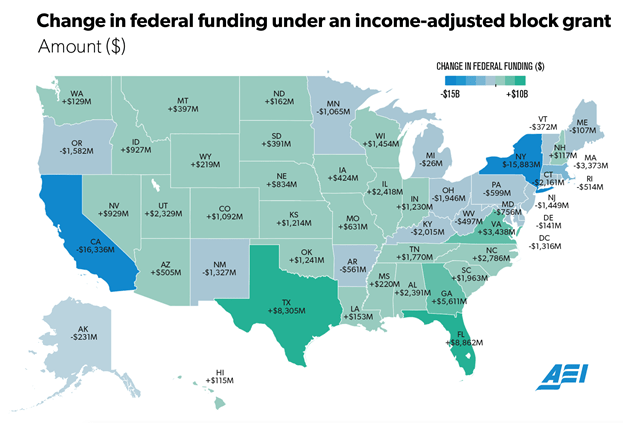
Their study showed that block grants could save Washington between $110 billion and $150 billion over five years depending on which formula was used. Roughly half the states would get a small increase in their federal contribution and half would get less, sometimes a lot less. The biggest loser, Arizona Medicaid, would receive 62 percent less than it is currently receiving from Washington.

With the present Medicaid state-federal matching scheme, the more a state spends, the more money it gets from Washington. This produces a classic perverse incentive: rewarding the outcome you don’t want. We want states to reduce spending, yet Washington rewards them—with federal dollars—when they spend more! With a block grant, this perverse incentive goes away. This is a good thing.

Medicaid block grants could save $110-150 billion and would eliminate the perverse incentive. Sounds like a great idea. It makes wonderful sound bytes, and the GOP seems to want to run with it.

There is just one teeny, tiny problem with block grants as proposed: no health care.

http://thehill.com/policy/healthcare/320286-kasich-house-gop-medicaid-plan-very-bad-idea

Kasich: House GOP Medicaid plan ‘very bad idea’

Kasich: House GOP Medicaid plan 'very bad idea'

Republican Ohio Gov. John Kasich on Sunday criticized the House Republicans’ plan to phase out ObamaCare’s expansion of Medicaid.

“I’m in Munich, but I understand that there was an initial effort by House Republicans to, for example, phase out Medicaid expansion, which means phasing out coverage,” Kasich said on CNN’s “State of the Union.” “That is a very, very bad idea, because we cannot turn our back on the most vulnerable. We can give them the coverage, reform the program, save some money and make sure that we live in a country where people are going to say, ‘At least somebody is looking out for me.’”

An outline of an ObamaCare replacement plan put forward by House Republicans on Thursday called for phasing out the Medicaid expansion by lowering the federal share of the cost back down to its traditional level, meaning that states would have to pour more of their own money into the program if they wanted to keep the expansion, a tall order.


GOP Considers Medicaid Reforms for Reconciliation Bill

https://morningconsult.com/2017/02/14/gop-considers-medicaid-reforms-reconciliation-bill/

Image result for Medicaid Reforms for Reconciliation Bill

House Republicans are weighing specific reforms to Medicaid that could be included in a reconciliation measure to overhaul the Affordable Care Act.

How to deal with the federal expansion of Medicaid under the ACA is one of the main unanswered questions as Congress works to overhaul Obamacare — one that has exposed divisions between the House’s most conservative members and GOP lawmakers from states that chose to expand the federal program for low-income Americans.

Rep. Brett Guthrie (R-Ky.), the vice chairman of the Energy and Commerce Health Subcommittee, said Tuesday that lawmakers are considering what types of reforms — specifically shifting to per capita allotments or allowing states to choose block grants — could be included in a House reconciliation bill to repeal the ACA.

“We’re going to deal with Medicaid reform in reconciliation, is kind of what was discussed. There’s no details yet,” Guthrie told reporters Tuesday after a House GOP conference meeting. Guthrie led a working group focused on Medicaid reforms in the last Congress.

Rep. Michael Burgess (R-Texas), who chairs the health subcommittee, told reporters Medicaid reform would be a discussion all week. House Majority Whip Steve Scalise’s office held a listening session Tuesday afternoon with members on Medicaid, and other committees are also gathering feedback. House Republicans are expecting to learn more information about health reform in a Thursday conference meeting focused on Obamacare.

House Speaker Paul Ryan attended the GOP senators’ policy lunch on Tuesday, and told attendees that appropriators and the authorizing committees are working out Medicaid reforms, Sen. Marco Rubio (R-Fla.) said.

In the House, proposals to transition to per capita allotment or block grants were included in the House GOP’s “Better Way” agenda, rolled out last year.

How Would Republican Plans for Medicaid Block Grants Actually Work?

How Would Republican Plans for Medicaid Block Grants Actually Work?

Image result for How Would Republican Plans for Medicaid Block Grants Actually Work?

There are only so many ways to cut Medicaid spending.

You can reduce the number of people covered. You can reduce the benefit coverage. You can also pay less for those benefits and get doctors and hospitals to accept less in reimbursement. Or you can ask beneficiaries to pay more.

None of those are attractive options, which is why Medicaid reform is so hard. Medicaid already reimburses providers at lower rates than other insurance programs. How do you reduce the number of beneficiaries when the vast majority of people covered are poor children, poor pregnant women, the disabled, and poor older people? Which of those would you cut?

Reducing benefit coverage has always been difficult because most of the spending has been on the disabled and poor older people, who need a lot of care. Beneficiaries don’t have much disposable income, so asking them to pick up more of the bill is almost impossible.

That doesn’t mean that states haven’t tried. As I’ve discussed in past columns, a number are attempting to increase cost sharing. But this isn’t really a solution because it doesn’t change overall spending much at all.

Part of the challenge lies in the way Medicaid was set up in the first place. The federal government picks up between 50 percent and 100 percent (depending on the population and the per-person income) of whatever it costs to provide health care to a state’s population. Many, if not most, Republican plans would like to change that.

They are pushing for what many refer to as a block grant program. The federal government would give a set amount of money to each state for Medicaid; it would be up to the states to spend it however they like. These block grants could be set based on overall past state needs or based on the number of beneficiaries in the state, referred to as a “per capita” block grant. Some per-capita block grants function more like “ceilings” than outright grants, allowing the state to be paid at normal Medicaid rates, but with a maximum each state could get based on the per-capita calculation.

Everything You Need to Know About Block Grants: The Heart of GOP’s Medicaid Plans

http://www.realclearhealth.com/articles/2017/01/24/everything_you_need_to_know_about_block_grants_the_heart_of_gops_medicaid_plans_110404.html

Image result for block grant medicaid

President Donald Trump’s administration made explicit this weekend its commitment to an old GOP strategy for managing Medicaid, the federal-state insurance plan that covers low-income people — turning control of the program to states and capping what the federal government spends on it each year.

It’s called “block granting.” Right now, Medicaid, which was expanded under the 2010 health reform to insure more people, covers almost 75 million adults and children. Because it is an entitlement, everyone who qualifies is guaranteed coverage and states and the federal government combine funds to cover the costs. Conservatives have long argued the program would be more efficient if states got a lump sum from the federal government and then managed the program as they saw fit. But others say that would mean less funding for the program —eventually translating into greater challenges in getting care for low-income people.

Block granting Medicaid is a centerpiece of health proposals supported by House Speaker Paul Ryan and Rep. Tom Price, Trump’s nominee to run the Department of Health and Human Services. This weekend, Trump adviser Kellyanne Conway emphasized the strategy as key to the administration’s health policy.

But what would this look like, and why is it so controversial? Let’s break down how this policy could play out, and its implications — both for government spending and for accessing care.

Q: How would a block grant work?


Medicaid Reform: The Elephant in the Room

http://www.realclearhealth.com/articles/2017/01/04/medicaid_reform_the_elephant_in_the_room_110358.html

While headlines fixate on the future of the Affordable Care Act’s health insurance exchanges, a more consequential fight is brewing over the future of Medicaid. Proposed reforms would affect tens of millions of Americans and state governments across the country. Previous attempts have failed, however, and longstanding roadblocks may sink this administration’s efforts as well.

With over 70 million enrollees, Medicaid covers more Americans than any other insurer.   Responsibility for funding the program – which accounts for nearly 20 percent of all healthcare spending – is shared between states and the federal government. At a minimum, the federal government covers 50 percent of costs, with that share rising to nearly 75 percent in the poorest states and more than 90 percent for those covered through ACA Medicaid expansions. This amounts to nearly $350 billion in federal funding per year.

Importantly, this money is allocated in an open-ended manner. As states increase the generosity of their Medicaid programs, the federal government is obliged to pay its portion of the higher costs.

During his campaign, Donald Trump joined a long list of Republican lawmakers who argue that this gives states the wrong incentives. Because the federal government covers at least half of each dollar spent, they argue, states may take less care to weed out inappropriate and inefficient spending as they otherwise would.

To eliminate this open-ended feature, Trump’s plan calls for federal money to be allocated in fixed lump sum payments known as block grants.

First proposed in 1981 by President Reagan, block granting of Medicaid hardly represents a novel policy option. Why then has the current system endured, and what does this portend for the resistance Trump’s efforts may encounter?

To understand, consider the most basic decision for any block grant policy: How should each state’s grant be initially determined?

Why hospitals really don’t want to go back to pre-Obamacare days

https://www.axios.com/why-hospitals-really-dont-want-to-go-back-to-pre-obamacare-days-2162243137.html

Image result for pre-Obamacare hospitals

Hospital executives know that if Obamacare is repealed and not replaced, the ranks of the uninsured will swell, and they will still be required to treat those patients.

That’s why they’re hit especially hard these days by the uncertainty over what will happen and when, as Republicans try to figure out how they want to get rid of the law. The biggest concerns for hospital executives: losing Medicaid payments, and having more privately insured patients who can’t pay their bills because of high out-of-pocket costs. Hospitals were just getting relief from uncompensated care, and don’t want those costs to rise again.

The primary concern: It’s not the potential loss of patients with private Obamacare insurance that worries hospitals the most. It’s the loss of patients with Medicaid coverage.

Even though state Medicaid programs pay hospitals less than Medicare or private insurers, it’s still been better than nothing. That’s why state hospital associations have aggressively lobbied for Medicaid expansion in Republican states that haven’t embraced it.

Dennis Dahlen, chief financial officer of Banner Health in Phoenix, recently said there could be “dire consequences” if Medicaid expansion is rolled back and if Republicans move toward Medicaid block grants. That would threaten revenue immediately and lead to more uninsured patients walking into the emergency room.

“Our biggest exposure and biggest concern is Medicaid funding,” Dahlen said. About 13% of Banner’s patient revenue comes from Medicaid.

Today in Obamacare: the big hurdle to block-granting Medicaid — explained by a GOP legislator who wants to do it

http://www.vox.com/2017/2/1/14475974/obamacare-medicaid-block-grants

Image result for medicaid block grants

GOP legislator: Block-granting Medicaid will be “harder” than I thought

Yesterday afternoon, I interviewed Rep. Phil Roe (R-TN), a conservative legislator who co-chairs the GOP Doctors Caucus and authored the Republican Study Committee’s Obamacare replacement plan. We spent most of the time talking about that health care bill, and you can read that full conversation here.

But one of the things Roe told me that surprised me the most was that he has begun to think block-granting Medicaid is going to be much harder than he initially expected. Here was the full answer:

What I thought was going to be easy was I thought Medicaid, we’d just block-grant it to the states. That one actually is going to be a little harder than I thought. The reason is there are states like New York, states that expanded [Medicaid]. How do you cover that 10 or so million people on Medicaid?

Why this is surprising: There is a lot that divides Republicans on health policy right now (what exactly to do about the Affordable Care Act, for example). But if there is one major idea that unites them, it is block grants for Medicaid.