


https://hbr.org/cover-story/2019/03/how-employers-are-fixing-health-care

A 56-year-old man who works at Walmart — we’ll call him Bill — had been suffering from mild neck pain for years. Recently the pain had worsened, and his wife noticed a subtle tremor in his hands. An MRI showed some narrowing of the spinal column along with disc degeneration. A local surgeon explained that Bill’s best option was spine surgery.

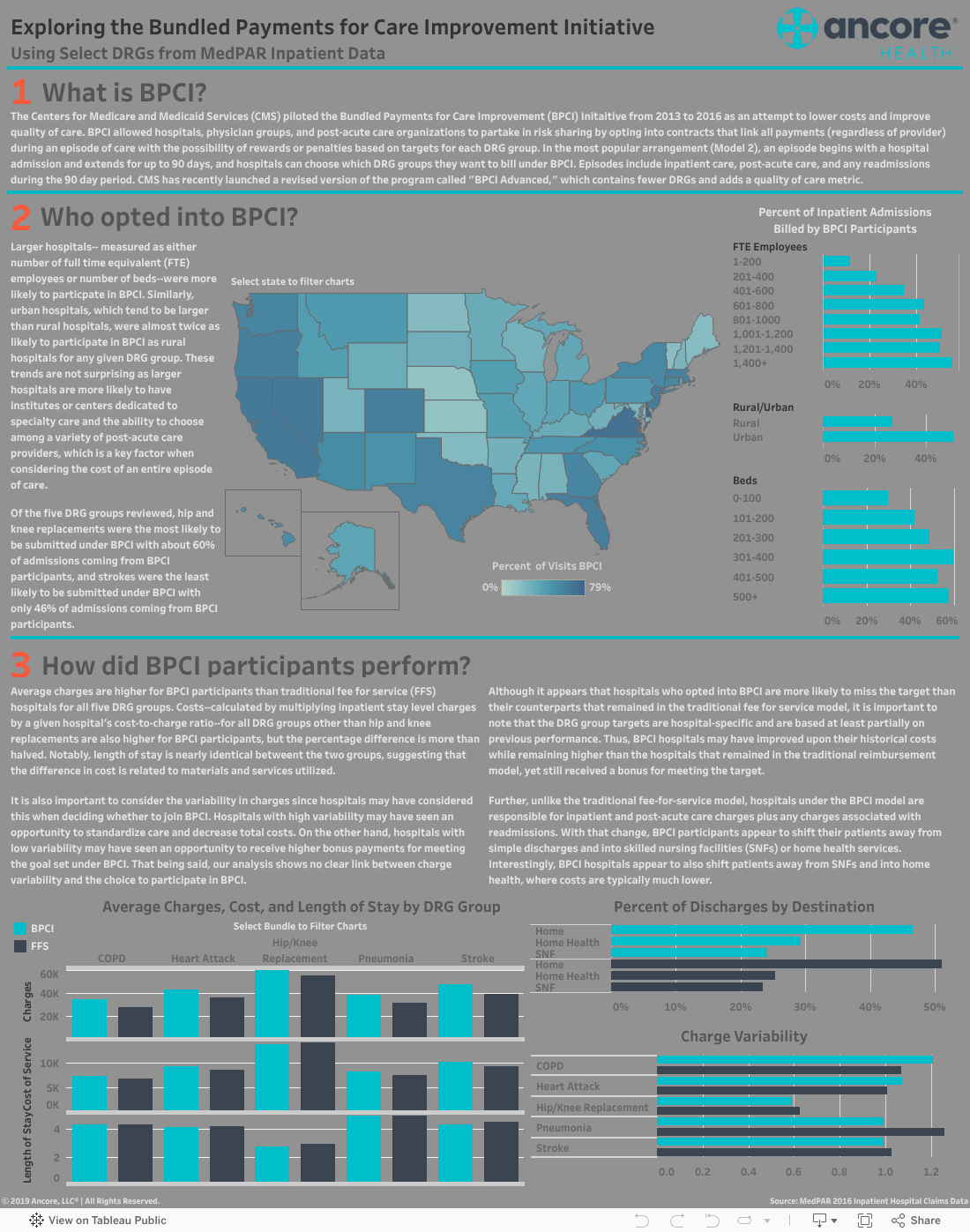
The Centers for Medicare and Medicaid Innovation Center has launched a new voluntary bundled payment model called Bundled Payments for Care Improvement Advanced — which CMS Administrator Seema Verma said is the first Advanced APM.
The current Bundled Payments for Care Improvement Initiative, or BPCI, is scheduled to end on Sept. 30. BPCI Advanced starts on Oct. 1 and runs through Dec. 31, 2023.
The BPCI will qualify as an an advanced alternative payment model under the quality payment program for MACRA. With advanced APMs, providers take financial risk, but can also reap an incentive payment reward.
The model gives incentive payments if all expenditures for an episode of care are under a spending target that factors in quality.
“BPCI Advanced builds on the earlier success of bundled payment models and is an important step in the move away from fee-for-service and towards paying for value,” Verma said.
BPCI Advanced participants may receive payment for performance based on 32 different clinical episodes. The clinical episodes in BPCI Advanced add outpatient episodes to the inpatient episodes that were offered in the previous BPCI model, including percutaneous coronary intervention, cardiac defibrillator, and back and neck except spinal fusion.
Last year, the Centers for Medicare and Medicaid Services cancelled or scaled back on mandatory bundled models for joint replacement, hip fractures and cardiac care, but promised to release new voluntary models.
CMS cancelled the episode payment model and the cardiac rehabilitation incentive payment model, which were scheduled to begin on Jan. 1.
The agency also reduced the number of mandatory geographic areas participating in the comprehensive care for joint replacement model, from 67 to 34. Participants in the 33 remaining areas could take part on a voluntary basis.
In BPCI Advanced, participants will be expected to redesign care delivery to keep Medicare expenditures within a defined budget while maintaining or improving performance on specific quality measures. Participant bear financial risk, have payments tied to quality performance, and are required to use certified electronic health record technology.
Like all models tested by CMS, there will be a formal, independent evaluation to assess the quality of care and changes in spending under the model.
Remedy Partners, which works with providers in the current BPCI program, reported in June 2017 that bundles resulted in a $500 million reduction in the cost of unnecessary medical expense over that past year for more than 1,000 providers. In addition, hospital readmissions decreased by 6.1 percent and a patient’s length of stay at a skilled nursing facility decreased by 6.3 percent, Remedy said.

Reimbursement incentives are crucial in health care. The bottom line is, well, the bottom line. But one reason we still have haven’t got a tight handle on health care costs is that they are too often treated only as an issue of economics, rather than medicine.
The limits of this approach are clear. Health care costs in the United States have been rising much faster than inflation for a long time. When Medicare was created in 1965, for example, the United States was spending about 6 percent of GOP on health care. Today the number is about 18 percent, or $3.4 trillion in 2016.
Much of that rise is, happily, due to life-changing and life-saving breakthroughs in care delivered to more people than ever before. Health care was cheaper before hip and knee replacements became common, for instance, but it was also common in the recent past to see the elderly walk with canes and confined to wheel chairs.
Nevertheless, health care costs remain troubling for the average patient. To develop new approaches to providing better and more affordable care, we can’t look just to economists to devise clever price structures and incentive systems. We must also look to caregivers working in the field. The good news is that this effort is underway. Medical schools and health-care systems around the country are quietly revolutionizing how health care is delivered in ways that are likely to reduce costs by improving care.
To see the difference between reforms advanced by doctors rather than economists consider the widespread concerns regarding the Trump administration’s plan to reconsider “bundled payment” mandates Bundled payments are, on the whole, a good idea that take a traditional economics-first approach. They seek to control costs by setting a single price for all of the care in a particular illness episode. But the Centers for Medicare & Medicaid Services (CMS) recently announced that it will allow many hospitals to opt out of bundled payment mandates for hip and joint replacements and will eliminate forthcoming mandates regarding certain aspects of cardiac care.
This move is certainly worth debate. CMS’s movement toward more voluntary models could allow more flexibility in trying to achieve the larger goals of transparency and cost containment. But, as critics have noted, it may also make it hard to collect enough data to know whether any approach can be effective across the broad spectrum of care.
Missing from this discussion is the broad effort now underway at medical schools across the country to achieve a central aim of bundled payments: having a wide range of health-care providers leave specialized silos and work in teams to provide comprehensive care.
Fostering such collaboration is the aim of the substantial investments universities are making in Inter-Professional Education programs. The University of Kansas, for example, opened an $82 million Health Education Building in July that will provide interdisciplinary training for all three of KU’s medical centers (medicine, nursing, and the health professions).
In 2015, the school I lead launched The Michigan Center for Interprofessional Education to bring faculty together from across a broad range of disciplines — including dentistry, medicine, nursing, pharmacy and social work — to develop and implement new curricula to allow students to collaborate case-based decision making. Our ambitious effort is one of dozens across the nation aimed at training tomorrow’s health-care providers to see themselves as members of teams who must coordinate care to deliver the best care to patients.
The need for such collaboration will only become wider going forward. As technology and the social sciences make their own discoveries, caregivers will increasingly have to understand and interact with highly accomplished engineers, mathematicians, statisticians, chemists, physicists, and computer scientists. As we better understand the influence of culture and lifestyle on health outcomes, the contributions of social workers and psychologist will only increase.
Most patients already know that medicine has become a team sport. Few people today have a single doctor. Many are treated by a group of primary care physicians, specialists, nurses, and pharmacists who must work together. Bringing these health-care professionals together, with their patients — to draw on their various areas of expertise and to identify the best course of treatment — should improve care and reduce costs.
It is still too early to state the full impact of this approach. But early signs are encouraging. Like bundled payments, such shared decision-making has already been shown to reduce costs by putting more options on the table. They also dovetail with efforts to provide patients with a wider range of treatments options, which has also led to cost savings.
These reforms are not being made with an eye toward the bottom line. The incentives driving them are our evolving knowledge about how to improve care. Nevertheless, these medical decisions will pay significant economic dividends.



 HENRY KOTULA