Some Drugmakers Are Canceling Price Hikes – but Not Because of Trump

http://www.thefiscaltimes.com/2018/07/11/Some-Drugmakers-Are-Canceling-Price-Hikes-Not-Because-Trump

Pfizer may have decided to roll back drug price hikes after being criticized by President Trump, but Bloomberg reports that several other large drugmakers are canceling or reducing planned price increases, perhaps in part because of a new California drug pricing transparency law that requires them to provide at least 60 days’ notice of price increases greater than 16 percent during a two-year period.

“In the past three weeks, Novartis AG, Gilead Sciences Inc., Roche Holding AG and Novo Nordisk A/S sent notices to California health plans rescinding or reducing previously announced price hikes on at least 10 drugs,” Bloomberg’s Ben Elgin, Cynthia Koons and Robert Langreth write.

The law is being challenged in court by the industry, but manufacturers have been complying while the case plays out.

Still, one industry analyst tells Bloomberg that the California law won’t actually slow the rate of price hikes. “If what you are trying to do is limit price inflation, this is not the way to go about it,” said Richard Evans, an analyst at investment research firm SSR. “This is not going to change mainstream list price behavior at all.”

Evans says that the drugmakers involved are probably just “throwing up a smokescreen” to hide the details of their price increases from competitors and patients.

Why it matters: These early results from California’s law might look encouraging, but it’s still a far cry from structural reforms that will keep prices in check.


HHS proposes allowing some drug importation, but impact would be limited

HHS proposes allowing some drug importation, but impact would be limited

Money pile and medicine pills representing medical expenses

Nevertheless, the proposed policy could take Martin Shkreli-like practices “out of the ballgame,” expert says.

Regulators could allow importation of certain drugs in an effort to keep prices down, under a proposal from the Department of Health and Human Services.

On Thursday, HHS Secretary Alex Azar requested that Food and Drug Administration Commissioner Scott Gottlieb create a working group to find how to safely import drugs from abroad in cases when their US-made marketed equivalents undergo dramatic price increases.

However, experts said the effect of such a policy on prices – if it passes – will be limited.

Azar pointed to the now infamous example of the toxoplasmosis drug Daraprim, whose price manufacturer Turing Pharmaceuticals increased from $13.50 per pill to $750 in 2015, drawing nationwide scorn for Turing and its CEO, Martin Shkreli. Shkreli was sentenced to seven years in prison in April following his August 2017 conviction on charges of securities fraud and conspiracy. Turing, which has since changed its name to Vyera Pharmaceuticals, is currently losing money, STAT reported, and shareholders will vote Friday on a proposal to change the name again, to Phoenixus.

Several political leaders have proposed allowing importation of drugs. In May, Republican Vermont Gov. Phil Scott signed a bill that would allow importation of drugs from Canada, though HHS must still certify the law. Independent Vermont Sen. Bernie Sanders also introduced a bill in the Senate, S. 469, The Affordable and Safe Prescription Drug Importation Act, that would allow the same, with cosponsorship from several Senate Democrats. The bill would wholesalers, pharmacies and individuals to import a range of medications.

However, the HHS proposal is more narrow, focusing specifically on drugs that have seen significant price increases. Gerard Anderson, professor of health policy and management at Johns Hopkins University, and several colleagues made a similar proposal in a paper published in JAMA in February 2016. Under their proposal, GlaxoSmithKline – the original manufacturer of Daraprim – would be able to import the drug from the United Kingdom, where it sells for less than $1 per tablet. The paper compared the proposal to FDA allowances for importation during shortages of critical medications.

Still, Anderson said in a phone interview that the HHS proposal will not likely have a broader spillover effect on drug prices, but will only affect the specific drugs that are included. “For a very narrow subset of medications, it could take the Martin Shkrelis out of the ballgame because these drugs are very inexpensive in other countries,” he said.

In addition to Turing, other companies that have become notorious for raising drug prices include Shkreli’s prior company, Retrophin, and Valeant Pharmaceuticals. Questcor Pharmaceuticals raised the price of Acthar Gel from $1,650 per vial to $23,269 in 2007, and the price has risen to $38,892 since Questcor’s 2014 acquisition by Mallinckrodt Pharmaceuticals. More recently, larger drug companies have also taken heat for smaller price increases. Pfizer backed down from a plan to raise the prices of about 100 of its medications after criticism from the Trump administration, while Novartis and Merck & Co. have pledged to limit price increases as well.

The government stipulating what constitutes a “dramatic price increase” could create a de facto price ceiling that drugmakers would stay under when changing their prices, said Lev Gerlovin, vice president at Boston-based consultancy Charles River Associates, in a phone interview. It’s hard to assess whether that would have a material effect on the industry, given that the ceiling may be greater than what most manufacturers already tend to do as a matter of course. However, while cautioning that he is not a Washington observer, Gerlovin said likely industry pushback citing patient safety concerns makes the proposal appear unlikely to pass.


4 Regulations That Would Terrify U.S. Drug Companies Ahead Of The 2018 Midterms

https://www.forbes.com/sites/robertpearl/2018/07/16/drug-companies/#72ce13501e41
Image result for High Drug Prices

If you’re a powerful American drug company, then you’ve had a strange couple of months. In that time, you’ve experienced a rainbow of emotions: fear, relief and, now, confusion and anxiety.

The roller-coaster ride, as you recall, began in mid-May when President Trump stood alongside HHS Secretary Alex M. Azar, in the Rose Garden of the White House, in front of a sign reading “Lower Drug Prices for Americans.”

As the president approached the mic, you watched with bated breath, remembering Trump’s campaign promise to drive down prescription drug prices to below a penny on the dollar. You always knew that’d be impossible but, then again, you thought, is anything really impossible?

Things started off poorly that morning. Almost immediately, Trump began denouncing the actions of drug manufacturers who, he said, were contributing to a “broken system.” He then urged all U.S. pharma companies to drop their prices, before deriding pharmacy benefits managers (PBMs) as “middlemen” who are getting “very, very rich” off the same broken system as you.

But when his speech ended, relief washed over you. After all, President Trump made no mention of his previous promise to negotiate lower drug prices for seniors enrolled in Medicare. He didn’t revive his vow to allow the importation of prescription medications, either. He didn’t discuss the popular notion of shortening pharmaceutical patents, nor that idea about requiring drug-companies to justify the price of new medications.

Granted, all these promises would be incredibly difficult to legislate. And, like most drug companies, you know that most of these ideas wouldn’t severely damage your bottom line anyway. But had the president committed to even one of them in his Rose Garden speech, he would have sent a clear message that this is not business as usual.

Instead, you and your colleagues took solace in his words. By late afternoon, the nation’s pharmaceutical, biotech and PBM stocks were up, not down. In the following weeks, drug companies interpreted Trump’s comments the same way drag-racers look at a stop signs—as more of a request than a rule.

Now, in fairness, President Trump and Secretary Azar had no intention of revealing a final, comprehensive set of proposals, rules or regulations on May 11. They set their sights on Tuesday, July 16—the official deadline for interested parties to comment on Secretary Azar’s blueprint Q&A. That’s when the real policy-making is set to begin. And, until early this month, most of the drug industry had been bracing for incremental, not radical, change.

But on July 1, Pfizer learned that it’s not safe to wake a sleeping bear. Thinking they had a clear runway, Pfizer’s corporate executives went ahead and raised list prices on more than 100 prescription drugs.

He followed that Tweet with a phone call and, within 24 hours, Pfizer had rolled back its price increases. Just like that, Trump had the drug industry’s full attention.

It stands as a public relations win for Trump in the lead up to the 2018 midterm elections. With recent polls indicating that 22% to 30% of Americans say healthcare is their top voting issue, Trump and the Republican party are wise to appear tough on rising drug prices (even if Pfizer is merely deferring its price hikes until later in the year).

Uncertainty and confusion, once again, permeate the drug industry. If the polls are even remotely accurate at predicting voter behavior this November, Trump and his cabinet will have good reason to take action.

I personally hope they have the courage to do so.

Unfortunately, the ideas Trump and Azar presented in the Rose Garden won’t be enough. They aren’t going to flatten the rapid rate of drug-price inflation or dramatically impact future price escalation.

So, alongside the administration’s proposed ideas, I offer four alternative policies that could make a real difference:

Leading idea No. 1: Take out the “middlemen”

In his May 11 address, the president went after PBMs, those insurance-company intermediaries between drug manufacturers and patients. At present, consumers know nothing about the prices these intermediaries negotiate or the size of the rebates/kickbacks they keep for themselves. Revenue for PBMs is determined as a percentage of all Rx drugs sold, which means there’s virtually no incentive to drive prices lower or replace the high-margin, brand-name drugs on PBM formularies with new, lower-cost alternatives. Federal legislation could require PBMs to operate transparently and work to lower out-of-pocket costs and drug prices for patients. However, there are way too many “ifs” with this approach to expect major change on the horizon.

A more frightening proposition for drug makers: Imagine if the U.S. government negotiated drug prices for all 55.5 million Medicare patients and made those costs publicly available so that everyone knew what price was fair and reasonable. Nearly all other nations do this. Why not the United States? Besides, Medicare already establishes prices for participating hospitals and doctors. Why not do the same for drug prices?

Leading idea No. 2: Make other nations pay more

Whether it’s NATO spending or wall-building, President Trump expects other nations to pony up for American interests. Most nations have made a habit of saying no. Now, rather than negotiating on behalf of Medicare for lower-cost medications (particularly Part B), the president has encouraged citizens of other countries to pay more for their prescriptions and, thereby, contribute an increased share of funding to drug-company R&D. Health ministers in other nations haven’t made this high priority for their 2019 healthcare agendas. They likely won’t. Even if drug prices were to rise in other countries, would drug manufacturers pass that added revenue on to American patients? Or to their shareholders? History suggests it’s the latter.

A more frightening proposition for drug makers: Require drug companies to document all the R&D dollars they spend in bringing a product to market. Further, force them to quantify and compare their drug’s efficacy to other drugs on the market. If pharmaceutical companies want generous patent protections (for products that often determine whether a patient lives or dies), their pricing can’t be capricious or simply what the market will bear. Prices should relate either to: (a) the cost of the drug’s R&D or (b) the superior clinical effectiveness of the medication.

Leading idea No. 3: Put prices in Rx ads

This is one of the most interesting concepts to come out of Trump and Azar’s blueprint. That’s because such a policy would, at least in theory, make it impossible for drug makers to hide their prices. USDA regulations already require companies to disclose possible side-effects in ads. Imagine if the administration also stipulated that pharmaceutical manufacturers must disclose their prices in ad copy, as well. For now, it’s unclear which costs the drug makers would need to disclose, given that patients and purchasers pay very different amounts for the same medications. Already, drug companies are using coupons and rebates, what critics deem to be clever schemes, to lower the advertised price for patients while simultaneously raising what they charge insurers—who ultimately pass those costs back to purchasers and patients through higher premiums.

A more frightening proposition for drug makers: Limit what U.S. pharmaceutical companies can charge. Period. American drug makers should be required to pay a penalty if they charge Americans more than 120% for the same medication as the 10 wealthiest nations pay on average. It’d be the same thing that happens when baseball teams exceed the salary cap. And when comparable medications exist at lower prices, TV ads would need to disclose that fact to viewers, as well.

Leading idea No. 4: Speed up generic medication approvals

This idea is a step in the right direction. Unfortunately, the president didn’t explain why generics currently undergo such lengthy delays for approval. The biggest hurdle is not government regulations, but drug company tactics. For most patented prescriptions, the generic versions have exactly the same chemical structure, and therefore, the same efficacy. As such, once a generic exists, there’s little or no reason to purchase the more expensive product. Knowing this, makers of the brand-name version use legal maneuvers to extend their patent protections before driving generic competitors out of business with their pricing and marketing leverage.

A more frightening proposition for drug makers: The government needs to change patent laws to protect patients first. Medications fall into two classifications. There are the small-molecule ones that often are available over-the-counter. With these, the generic version’s chemical structure is identical to that of the brand-name version. There also are the biologicals, so named because they are produced by living cells and organisms. Insulin is one example. Increasingly, this latter class of drugs has the highest price. These chemicals are too complex to be copied exactly, which is why the generic equivalents are labeled “biosimilars.” The solution here is to focus on the most expensive, large-molecule biologics first. In so doing, the government should force manufacturers to hand over drug samples to biosimilar companies 18 months before their patents end. This will speed up the development of biosimilars and fast-track the approval of lower-cost (but equally efficacious) medications. For patients with diabetes, this could lower the cost of life-saving insulin by 50% or more. Recent research from Yale shows up to 1 in 4 people with diabetes are injecting less insulin than they should simply because of the cost.

A Realistic Glimpse Into The Future Of Drug Pricing

Today, the pharmaceutical industry enjoys powerful patent protections and, thereby, monopolistic control over pricing. The consequence is that Americans are paying exorbitant prices for patented medications. The simplest solution is to strike a legislative balance that allows (a) drug companies to invent (and invest in) the next generation of breakthrough medication while (b) allowing the American people to afford the medications they need to stay healthy.

For most of the 20th century, the pharmaceutical world stayed within those guardrails. But over the past decade, profits have been way out of line with R&D and investment. The time has come to restore balance and reasonableness, regardless of what the national drug lobby wants.

Later this week, Secretary Azar will receive feedback on the administration’s blueprint and will begin drafting potential cost-cutting regulations. I encourage him and President Trump to use their authority to make drugs more affordable.

I suspect the pharmaceutical industry believes it will be business as usual, despite the campaign rhetoric and another Rose Garden event this coming fall. I hope the Secretary and the president have the courage to prove them wrong. The health of the American people depends on it.


Reducing Drug Prices and Medicare’s Role: ‘It’s Complicated’

https://us5.campaign-archive.com/?u=8ccc385380053ffb629ecef0f&id=fd94cdddf1

Related image

Reducing Drug Prices and Medicare’s Role: ‘It’s Complicated

The White House Rose Garden was in full bloom when President Trump took the podium to announce that his administration was “launching the most sweeping action in history to lower the price of prescription drugs for the American people.”

He said: “It’s been a complicated process, but not too complicated.”

Thing is, it is pretty complicated and made more so by the admittedly tangled web of lobbyists knocking with dogged determination on lawmakers’ doors in pursuit of one thing: higher drug prices.

Their efforts appear to be working. In 2017, they spent almost $280 million in pursuit of their employers’ objectives. Another estimate puts the cost of drug lobbying at $2.3 billion from 2006 to 2016, and it’s clear that the industry also pays substantially to support candidates for both houses of Congress.

The President talked about his announcement being “the most sweeping action in history to lower the price of prescription drugs.” If you remember the presidential campaign, he promised to utilize Medicare’s gorilla purchasing power to negotiate directly to reduce prices. That all sounded very promising.

What Medicare Can and Can’t-Do

Medicare buys more drugs than anyone else, because it has a base of approximately 60 million people over age 65 or younger with certain disabilities, and is the largest single healthcare payer. However, the law actually prevents Medicare from carrying on direct negotiations with pharmaceutical companies. Specifically, it bars the Secretary of the Department of Health and Human Services (HHS) from managing the negotiations. Right now that’s Alex M. Azar II, a former executive with behemoth pharmaceutical company Lilly USA LLC, of Eli Lilly and Co.

Many were chagrined that the “American Patients First” does not, in fact, have any mandate for Medicare to negotiate directly with drug manufacturers. Some have described the situation in general as a gift, with a big bow around it, to America’s drug companies.

To understand why this happened, it helps to understand some of the history. Hearken to 2006, when Congress was in the throes of arguing the federal law around Medicare’s Part D law, the Medicare Modernization Act that became enforced in 2003. It was the most extensive rejuvenation of the program in 38 years.

Lobbyists persuaded lawmakers that if Medicare gained the ability to negotiate, that it would be akin to price control and an affront to the free market. Insurance companies in charge of subsidizing the new coverage were charged with managing drug costs.

Drugs Do Come Cheaper

In contrast, AARP invites us to consider how the Veterans Health Administration (VHA) deftly negotiates drug prices. The proof is in the pricing, as VHA pays 80 percent less for brand names than Medicare Part D. The VHA’s formulary list, that magic roster of medications it covers is a powerful negotiating tool. The relationship between Medicare and Medicaid that exists within the Food and Drug Administration (FDA) means the former two agencies must cover all FDA-approved drugs. That’s in spite of the fact that less expensive and equally effective medications can be bought on the open market.

Maybe you wonder how your fellow Americans feel about all of this. Big surprise: Democrats, Republicans, and independents are all pretty much on the same page. That’s according to a report from the National Academies of Sciences, Engineering, and Medicine. The analysis states emphatically that “finding a way to make prescription medicines — and healthcare at large — more affordable for everyone has become a socioeconomic imperative.”

According to the Henry J. Kaiser Family Foundation, a majority of Democrats (96 percent), Republicans (92 percent), and Independents (92 percent) think that yes, our government should have to negotiate power here.

Maybe Yes, Maybe No

Kaiser’s analysis of this conundrum over the “noninterference clause” is this. Those in favor of having Azar negotiate think this would result in leverage to reduce drug costs, especially around medications with sky-high prices but with no competition. They say private plans just don’t pack enough punch that way.

As expected, those who proclaim “no” shrug and opine that the Secretary simply couldn’t get better deals done. Then there’s the argument that haggling over price would inhibit pharma’s research and development, limiting the opportunities for more and better medications to improve quality of life and save lives.

As Kaiser notes, in addition to allowing the HHS Secretary to make better deals on drugs, another option would be to establish a public Part D plan that works in partnership with private Part D. “The Secretary would establish a formulary for the public Part D plan and negotiate prices for drugs on that formulary.”

There’s also a compromise approach of sorts in the mix that would address those expensive drugs and those that don’t have therapeutic alternatives: The Secretary could negotiate those.

At the end of the day, before Medicare can become the drug price negotiator extraordinaire, the law must be changed, and that’s a big lift. Based upon history, even Republicans are not expected to want to do this, and for sure pharma will recoil. That leaves consumers using Part D watching and waiting for change.

Drug Negotiation Side Effects

Increasing negotiating around Medicare could have ramifications if the President transfers expensive medications from Part B — the first Medicare legislation in 1965 —
to Part D, says The New York Times.

AARP says it’s worried about increasing out-of-pocket charges if this happens. Also, 9 million Medicare members in Part B don’t have Part D, leaving a void as to who will pay medication costs.

The publication asked doctors for their opinions and one responded that one misstep could be “a disaster.” Another worried about Part D drugs’ prices increasing more than Part B’s. Still, other notes protected classes of Part D drugs that must be covered by insurance plans, but in this instance may hamper Part D negotiations.


‘What The Health?’ ACA Under Fire. Again.

https://khn.org/news/podcast-khns-what-the-health-aca-under-fire-again/

Image result for ‘What The Health?’ ACA Under Fire. Again.

Democrats in the Senate are gearing up to fight President Donald Trump’s nominee to the Supreme Court, U.S. Circuit Judge Brett Kavanaugh. They argue he is not only a potential threat to abortion rights, but also to the Affordable Care Act.

Meanwhile, the Trump administration continues its efforts to undermine the workings of the Affordable Care Act. This week, officials announced a freeze on payments to insurers who enroll large numbers of sicker patients, and another cut to the budget for “navigators” who help people understand their insurance options and enroll for coverage.

This week’s panelists for KHN’s “What the Health?” are:

Julie Rovner of Kaiser Health News

Margot Sanger-Katz of The New York Times

Anna Edney of Bloomberg News

Julie Appleby of Kaiser Health News

Among the takeaways from this week’s podcast:

  • One reason Democrats are rallying around the health issue rather than the abortion issue is that there is more unity in their caucus over health than abortion. Also, the two key Republican senators who support abortion rights — Sen. Susan Collins (R-Maine) and Sen. Lisa Murkowski (R-Alaska) — also voted against GOP efforts to repeal the Affordable Care Act last year.
  • The Trump administration’s action on risk-adjustment payments sent yet another signal to insurers that the federal government does not necessarily have their backs and is willing to change the rules along the way.
  • The Trump administration says it wants to cut to payments for navigators because they are not cost-effective. But the navigator money does not come from taxpayers or government sources. It is paid from insurance industry user fees. These funds also go to support ACA advertising — which has also been cut. However, the user fees have not been reduced. In theory, reducing these fees could provide savings that could be passed on to consumers.
  • After being called out on Twitter by Trump, drugmaker Pfizer this week announced it would delay some already-announced price increases on about 100 of its drugs. It is worth noting that the president used his bully pulpit and gained some success. The six-month delay will mean that consumers will not experience an increase in cost at the pharmacy for at least that time period. But it still raises questions.
  • The Trump administration worked to block a World Health Organization resolution to promote breastfeeding. But while this seemed a clear case of promoting the interests of infant formula companies over public health experts, there was pushback from some women who say they are unable to breastfeed and feel stigma when they opt for formula instead. On the other hand, formula can be dangerous in developing countries without easy access to clean water.


The real driver of health care spending

https://commonwealthmagazine.org/opinion/the-real-driver-of-health-care-spending/

An inefficiency gap is boosting costs — and profits

THE HEALTH CARE DEBATES that occurred in Washington over the past year were largely irrelevant to what’s happening in the health care marketplace. Republicans couldn’t repeal the Affordable Care Act but they made some changes that weakened it. Those changes will increase insurance premiums in the individual market but they do nothing to address the most significant trends that are evolving across the system. To understand the important trends, one must look elsewhere.

In March, three researchers from the Harvard T. H. Chan School of Public Health published a study in JAMA analyzing the well-known reality that the United States spends dramatically more on health care than other wealthy countries. They compared the US, where health care consumes 17.8 per cent of gross domestic product, to 10 comparable nations where the mean expenditure is 11.5 percent. Despite spending much less, the other countries provide health insurance to their entire populations and have outcomes equal to or better than ours. The researchers found that this inefficiency gap is primarily driven by two characteristics of the US system: the high cost of pharmaceuticals and inordinate administrative expenses.

The high administrative spending derives in large part from the fact that 55 percent of the people in the US are covered by private health insurers who embed their own billing requirements, expenses, and profit into the system. The next highest country in this regard is Germany, where 10.8 percent of the population is covered by private insurers. In many countries, there are no such middlemen.

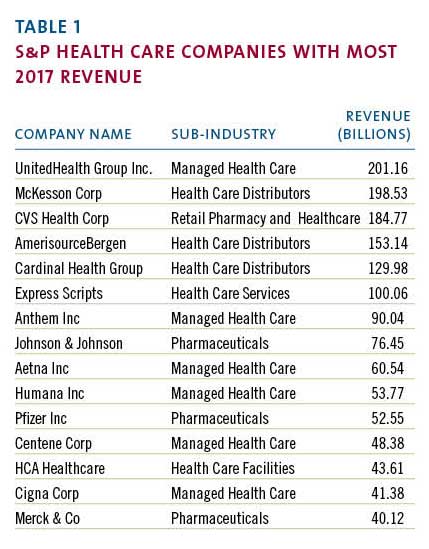
Coincidentally, when the JAMA study was published, the large publicly traded health care companies that dominate the US market had just finished disclosing their 2017 financial results. Examining those results provides additional insight into the economic forces that make our system so expensive and inefficient. The scale of the money involved is sometimes hard to grasp. The largest health care corporations, those included in the S&P 500, had almost $2 trillion in revenue last year. (Table 1)

Most of these enormous companies are engaged in one of two businesses: they’re either selling drugs or they’re selling health insurance. The excess costs reported by the Harvard researchers serve mainly to support the revenue of the companies in those fields.

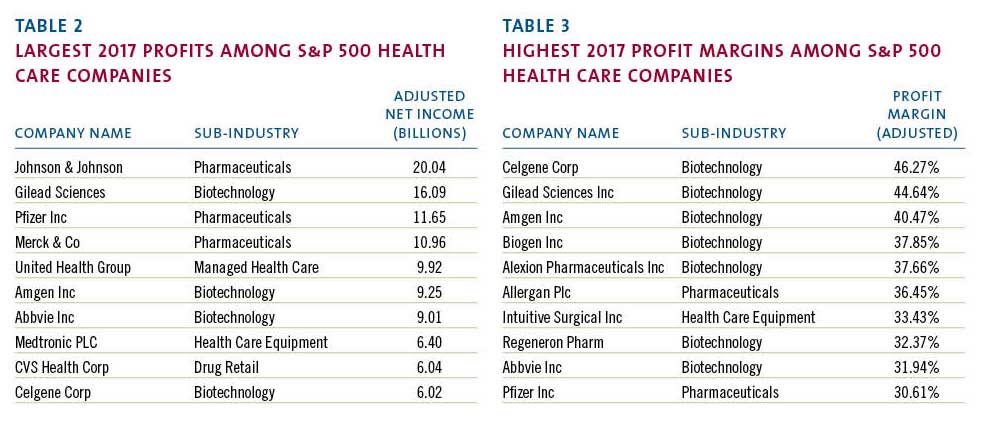
The 2017 reporting of corporate profits was complicated by the passage of the new tax bill. But most companies also reported “adjusted net income,” which shows their normalized profits after accounting for the one-time impact of the tax law. The chart below (Table 2) uses the adjusted numbers to show the largest annual profits among S&P health care companies.

Health insurers such as United Health and retailers such as CVS have enormous revenue and impressive profits but, when profit is measured as a percentage of revenue, they can’t compete with biotech and pharma. The highest relative profitability, using the same reported adjusted results, is in the chart below. (Table 3)

These profit margins show that there are many situations where between a third and a half of every dollar spent on a prescription drug falls to the bottom line of the of the company that made it. This profit derives in large part from the enormous difference in drug prices in the US versus other countries where such prices are more effectively controlled.

The high administrative cost of the US system stems from the large portion of the market dominated by insurance companies looking to maximize their profits.  Notwithstanding many news stories about turmoil in the insurance markets, 2017 was a banner year for the largest health insurers. The big players all had significant increases in annual profitability in 2017.

Note that Humana did not report “adjusted” numbers even though its profit was swollen by unusual events. A major distortion was a huge break-up fee the company received from a failed merger. That accounted for approximately $630 million in after-tax profit. Even discounting that, it was a very good year.

The revenue and profitability of these corporations support the proposition that high pharmaceutical prices and insurance-related administrative costs account for much of the extraordinary expense of our system. US health policy, or the absence thereof, has enabled these businesses annually to drive costs up for the benefit of their bottom line. That effect will continue. Not surprisingly, the big health care companies are developing new strategies to enhance their businesses and drive their profits going forward.

The term now heard often among health care giants is “vertical integration,” which means combining upstream suppliers with downstream buyers to control the flow of business. If this strategy persists, health care delivery will evolve significantly although it is unlikely to become less expensive. The most prominent current example of  vertical integration is the planned $68 billion acquisition of Aetna by CVS.

How would these companies work together? A Wall Street analyst recently described the vision as a way to “identify high risk patients and preemptively get them into a Minute Clinic.” Thus, your health insurer could send you to a local store for diagnosis, treatment, drugs, and anything else you might need from the shelves. This will keep even more of the health care dollar under their control.

Similarly, Cigna is in the process of acquiring Express Scripts, a huge pharmacy benefits manager, for $54 billion, another attempt to bring more services under one roof. The combined company would have annual revenue of $142 billion and, presumably, enough leverage with drug companies to improve profits although not necessarily to lower costs to patients. United Health, a leader of vertical integration, previously bought a pharmacy benefit manager but co-pays and deductibles for its patients have continued to climb. United has aggressively acquired physician practices in recent years and is now in the process of buying DaVita Medical Group, which operates nearly 300 clinics and outpatient surgical centers.

More striking are reports of a potential but unsigned merger of Walmart and Humana, a combined company that would have revenue of $550 billion. Walmart is a large operator of retail pharmacies inside its stores and the logic is similar to the Aetna-CVS deal. Humana, a huge insurer, is separately in the process of acquiring a large home health business from Kindred so this could represent yet another level of vertical integration.

If this course continues, the health care system will evolve quickly, giving fewer and larger companies even more market leverage. Integration of this kind benefits the large corporations that initiate it but there is no evidence it will lead to lower costs, improved access, or enhanced quality. These changes are driven by highly focused corporate financial interests and are occurring without reference to public policy. That’s because there is no coherent public policy to guide these changes.

On May 11, President Trump made a long-awaited speech to reveal what he described as “the most sweeping action in history to lower the price of prescription drugs for the American people.” His typically firebrand language struck at “drug makers, insurance companies, distributors, pharmacy benefit managers, and many others” who contributed to “this incredible abuse.” His attack seemed to target the large public companies that have benefited from the abuse. Unsurprisingly, his speech did not include specifics. His staff then released tepid policy details, which immediately generated a significant upward spike in the biotech stock index as well as the stock prices of other large health care companies. For all the presidential bombast, investors saw Trump’s policy for what it is: indifference to the current path and no threat to high prices.

It is not in the interest of huge profit-making corporations to restrain the overall cost of the US health care system. In fact, their interest is served by driving health care expenditures higher. When combined with the spending analysis provided by researchers, the financial data disclosed by public corporations point to a path that the country must follow to make our system more coherent and less costly. Any progress will require driving down pharmaceutical pricing and reducing administrative costs imposed by middlemen. We are not doing that yet but, ultimately, we must.


‘What The Health?’ Podcast Turns 1. Justice Kennedy Retires. Now What?

https://khn.org/news/podcast-khns-what-the-health-justice-kennedy-retires-now-what/

Image result for ‘What The Health?’ Podcast Turns 1. Justice Kennedy Retires. Now What?

The retirement of Supreme Court Justice Anthony Kennedy has triggered a political earthquake in Washington, as Republicans see a chance to cement a conservative majority and Democrats fear a potential overturn of abortion rights and anti-discrimination laws, and even — possibly — challenges to the Affordable Care Act. Kennedy has been the deciding vote in dozens of cases over his long career on the high court, mostly siding with conservatives but crossing ideological lines often enough that liberals see him as the last bulwark against challenges from the right to many policies.

The Supreme Court made other health news this week, ruling that California cannot require anti-abortion “crisis pregnancy centers” to post signs informing women of their right to an abortion and telling them that financial help is available.

And this is a special week for us. It’s our first anniversary. This week’s panelists for KHN’s “What the Health?” are Julie Rovner of Kaiser Health News, Rebecca Adams of CQ Roll Call, Alice Ollstein of Talking Points Memo and Margot Sanger-Katz of The New York Times.

Among the takeaways from this week’s podcast:

  • Kennedy’s retirement will put all eyes on the Senate, where Republicans have a slim majority but have also changed the rules to allow confirmation with only 51 votes instead of the usual 60.
  • The fight over Kennedy’s replacement is likely to galvanize both Republicans and Democrats, but also put in the hot seat the two Republican female senators who have supported abortion rights — Susan Collins of Maine and Lisa Murkowski of Alaska.
  • This week’s primaries again put the spotlight on Democratic support of single-payer health proposals, as Alexandria Ocasio-Cortez upset the fourth-ranking Democrat in the House in New York and former NAACP head Ben Jealous won the Democratic nomination for governor in Maryland. But while Democrats have made clear that health is their top issue for the coming campaign, they have so far managed to paper over their intraparty differences on incremental versus wholesale change.
  • The California legislature could vote on a measure as soon as Thursday that would gut efforts by municipalities to put in place soda taxes. If it passes, it will mark a change in momentum away from the success of these measures across the country. The soda industry took a page from the tobacco companies in executing this plan.
  • The controversy surrounding the Trump administration’s immigration policy that separates children from their parents at the border continued to be a flashpoint this week. Health and Human Services Secretary Alex Azar was questioned about it on Capitol Hill during a hearing about drug pricing. Congressional Republicans find themselves in a difficult position. Many don’t want to defend the administration, but there doesn’t seem to be an avenue by which to move forward either.