Battle heats up between Stanford Health Care, union over hospital charge initiative

https://www.beckershospitalreview.com/human-capital-and-risk/battle-heats-up-between-stanford-health-care-union-over-care-cost-initiative.html?origin=bhre&utm_source=bhre

Image result for stanford health care


Stanford (Calif.) Health Care and an employees union are disputing over a November ballot initiative to place a 15 percent cap on hospital charges in Palo Alto, Calif., The Stanford Daily reported.

Seven things to know:

1. The ballot initiative, initially filed in May, would place a 15 percent cap on the amount Palo Alto-based hospitals can charge in excess of direct patient care costs. Hospitals, medical clinics and other providers in Palo Alto would have to refund payers for charges exceeding the 15 percent cap within 180 days of each fiscal year.

2. The Service Employees International Union-United Healthcare Workers West sponsored the measure. It represents healthcare workers at Stanford Health Care — which has a main campus in Palo Alto.

3. Stanford University announced its opposition to the measure in a Sept. 28 statement.

The measure “would threaten Stanford Health Care’s ability to provide top-quality healthcare to patients from Palo Alto and across the region,” officials said.

“Such a policy is estimated to reduce Stanford Health Care’s budget by 25 percent, requiring significant cutbacks and the possible closure of many services and programs that are essential to high-quality healthcare in the local area.”

4. Union spokesperson Sean Wherley argued the measure will provide accountability for local healthcare providers and the city, according to the report.

“This is about transparency [and] letting people understand how much [they] are being charged, and why [they] are being charged so much more than the clinic down the street or in the neighboring community,” he told The Stanford Daily. “This is our chance as an organization to get healthcare costs under control.”

5. The union has also taken issue with Stanford Health Care’s profits, but the system said these are necessary resources to maintain its specialists, facilities and community benefit program, and that the system invests all its profit margin.

6. Palo Alto City Council members voted this summer to oppose the measure. According to the report, they attributed the decision to not having adequate bureaucratic infrastructure to regulate healthcare charges from local providers.

7. As of Oct. 3, the political action committee of the union and the opposition committee — Protect Our Local Hospitals and Health Care — had spent a combined $1.8 million on the measure.


Rhode Island hospital workers encouraged to seek jobless benefits during lockout

https://www.beckershospitalreview.com/human-capital-and-risk/rhode-island-hospital-workers-encouraged-to-seek-jobless-benefits-during-lockout.html

Image result for Rhode Island hospital workers encouraged to seek jobless benefits during lockout

United Nurses and Allied Professionals Local 5098, the union representing 2,400 workers at Rhode Island Hospital and Hasbro Children’s Hospital in Providence, is encouraging members to apply for unemployment during a lockout, according to WPRI.

The workers, which include nurses, technicians and therapists, began a three-day strike about 3 p.m. July 23. They were willing to return to work at 3 p.m. July 26. However, Lifespan said it will not allow the workers to return until July 27 because of a commitment to  temporary staff hired during the walkout.

Norman Farias, RN, executive vice president of UNAP Local 5098, told WPRI the union is encouraging workers to apply for unemployment for the 24 hours ending at 3 p.m. July 27 “because this is a day they would be working, and the hospital’s telling them they can’t.”

It is unknown whether workers’ claims will be approved by the Rhode Island Department of Labor and Training.

According to hospital officials, the union was notified about the hospitals’ four-day commitment to temporary staff on July 13.


Labor Unions Will Be Smaller After Supreme Court Decision, but Maybe Not Weaker


Image result for Labor Unions Will Be Smaller After Supreme Court Decision, but Maybe Not Weaker

With the Supreme Court striking down laws that require government workers to pay union fees, one thing is clear: Most public-sector unions in more than 20 states with such laws are going to get smaller and poorer in the coming years.

Though it is difficult to predict with precision, experts and union officials say they could lose 10 percent to one-third of their members, or more, in the states affected, as conservative groups seek to persuade workers to drop out.

The court’s decision is the latest evidence that moves to weaken unions are exacting a major toll. Beyond the dropout campaigns aimed at members, conservatives are bringing lawsuits to retroactively recover fees collected by unions from nonmembers.

In May, President Trump signed three executive orders making it easier to fire government workers and reining in the role of unions representing federal workers.

Dropping out of a union is a more attractive proposition now that workers no longer have to pay a so-called agency fee, typically about 80 percent of union dues, if they choose not to belong to a union. (Those doing so generally account for a small fraction of the workers whom public-sector unions represent.)

In the five years after Michigan passed a law ending mandatory union fees in 2012, the number of active members of the Michigan Education Association dropped by about 25 percent, according to government filings, a much faster attrition rate than before. Its annual receipts fell by more than 10 percent, adjusting for inflation.

Still, the more interesting question is whether the unions, whatever the blow to their ranks and finances, will be substantially weaker.

Union leaders insist that they won’t — that the crisis posed by the case, Janus v. American Federation of State, County and Municipal Employees, has brought more cohesion and energy to their ranks.

“No one wanted this case,” said Randi Weingarten, president of the American Federation of Teachers. “But the gestalt around the country has been to turn an existential threat into an opportunity to engage with our members like never before.”

There are reasons to believe that the claim is not merely desperate bravado.

One parallel to the current development is a 2014 Supreme Court ruling known as Harris v. Quinn, which struck down mandatory union fees for home-based workers who serve private individuals but are paid through government programs like Medicaid.

As of late 2013, the Service Employees International Union represented about 60,000 public-sector home care and child-care workers in Illinois, about 40 percent of whom were union members. (The rest paid agency fees.)

Receipts for the service employees union local representing home-based workers in Illinois dropped significantly in the four years after the decision. But an aggressive membership campaign largely offset the loss of members.

It also built and reinforced personal relationships with members, who could be summoned to make demands of politicians in nearly every legislative district.

“Our members go and meet Sam McCann,” said Keith Kelleher, who until last year was president of the local representing these home-based workers, referring to a Republican state senator. “He says yes most of time because he’s got hundreds of members in his district.”

Public home-based workers in Illinois, a state with a notably anti-union Republican governor, continue to notch victories as a result. Last summer, home care workers won a 48-cent-an-hour wage increase from the state, up from an average wage of $13, in a budget that the legislature passed by overriding the governor’s veto. This spring, home child-care workers won more than a 4 percent raise.

In anticipation of the Janus ruling, major public-sector unions have invested heavily in recent years in reaching out to current members — an effort known as internal organizing — and to prospective members to keep their numbers from dropping precipitously and to create a more activist culture. They plan to continue funding these initiatives even if it requires cutting spending elsewhere.

Mary Kay Henry, the international president of the service employees union, said the union used projections derived from its experience after the Harris decision to cut its budget by 30 percent shortly after Mr. Trump was elected. She said the union, which represents about two million workers, roughly half of them in the public sector, was focusing its spending on recruiting members and mobilizing workers to face down employers and elect pro-labor politicians.

“We intend to prioritize the political and organizing work,” she said.

Government filings show that the union has cut contributions to organizations that it had traditionally supported, including the Children’s Defense Fund, People for the American Way, and the National Immigration Law Center. (The union says it provides nonmonetary support to some of these groups.)

At the same time, the union is investing tens of millions of dollars in a door-to-door canvassing initiative for the midterm elections, intended to turn out people who don’t normally vote.

Lee Saunders, president of the American Federation of State, County and Municipal Employees, said that his union’s two highest priorities going forward would be its internal outreach and helping to organize nonunionized workplaces, and that the union would probably “have to make adjustments” to fund these programs. The union spent more than $15 million during the 2016 campaign cycle supporting political candidates, parties and committees.

Mr. Saunders said the union, which represents over 1.2 million workers, had held one-on-one conversations with nearly 900,000 members since 2013. Among the goals of these conversations, he said, is to inoculate members against campaigns by conservative groups to urge them to quit.

“If someone knocks on their door talking about how you can get out of the union — ‘it would be so easy, you don’t have to pay union dues’ — our folks are prepared to tell them to get the hell off their doorstep,” he said.

Alexander Hertel-Fernandez, a political scientist at Columbia University who studies corporate and conservative efforts to weaken labor, said organized interest groups had traditionally had the greatest impact on elections by educating members about candidates and through on-the-ground canvassing rather than large campaign contributions. “It’s doubly so for unions,” he said, adding that the focus “seems like a wise decision, but the effectiveness has to be weighed against what happens to membership and overall revenues.”

The unions enjoy certain advantages. States like California and New Jersey have tried to ease the blow from Janus pre-emptively by passing legislation that, for example, guarantees public-sector unions access to new hires and their personal contact information to help in recruiting.

There is also a substantial wind at their back: a rising energy on the left during the Trump era. Workers in particular appear more willing to take to the streets and state capitols, including tens of thousands of teachers who walked off their jobs this year in conservative states to protest the underfunding of public education.

When the Supreme Court ruled last month that employment contracts could prohibit workers from bringing class-action lawsuits, activists in states like New York, Vermont and Oregon escalated their efforts to pass so-called private attorneys general legislation, allowing workers to bring cases on the state’s behalf that could benefit all affected workers, the same way litigation by an attorney general would.

“We’ve had many, many folks calling: ‘I heard about this legislation you helped design. How do we make this happen?’” said Deborah Axt, co-executive director of Make the Road New York, an advocacy group pushing the measure. Ms. Axt said the group planned to campaign for the legislation’s enactment this summer.

That kind of energy appears to be benefiting unions. A Gallup poll last summer showed labor’s approval at its highest level since 2003, and unions in West Virginia and several other states where teachers walked off the job this year report gains in members.

“We’ve seen a 13 percent jump in membership because of the walkout,” said Ed Allen, president of the Oklahoma City American Federation of Teachers. “We have over 300 people signed up to work in political campaigns. We’ve never seen those kinds of numbers before.”


California attorney general sues Sutter Health for anticompetitive practices

https://www.fiercehealthcare.com/regulatory/california-ag-sues-sutter-health-for-anticompetitive-practices?mkt_tok=eyJpIjoiTkdNMU56bGxOVGRpWlRRMyIsInQiOiJOQmExNkliUVBkRFNHMGRBUFZiRG5MazRJVHJxQjFvRTl3NjVNV0pxeDlHc0dyVEhBS01HRjlcL1ZLaXFcL3hpOHVzVkxtdEpZb1BPYTc3SE82VnN3U05nejlNNEVOWUhhY2h2NThFdUluTjY1SU5zUkgxZEExRTFTemI5a3dSNkZJIn0%3D&mrkid=959610

Gavel

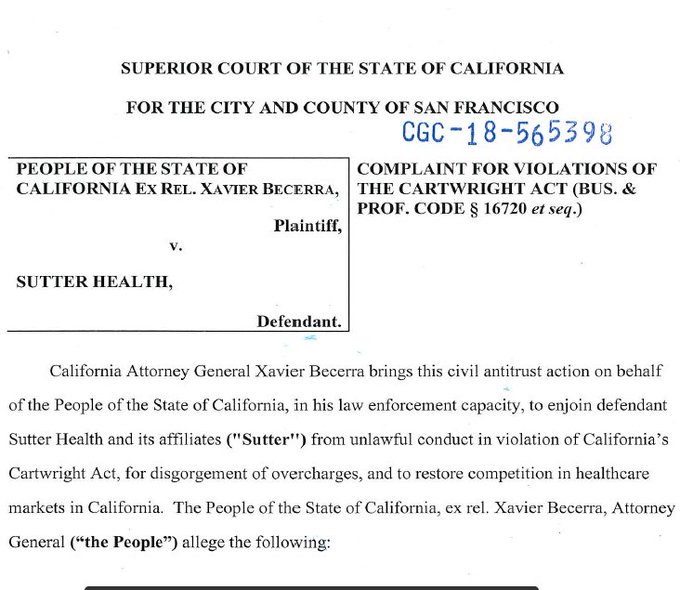
California’s attorney general has filed a lawsuit against Sutter Health, the largest system in the northern part of the state, claiming the organization’s anticompetitive practices have driven up healthcare prices throughout the region

The charges in the lawsuit (PDF) are “not new to Sutter,” AG Xavier Becerra said at a press conference Friday afternoon. The filing follows a statewide investigation into healthcare costs that revealed wide price disparities between the northern and southern parts of the state.

“Sutter Health is throwing its weight around in the healthcare market, engaging in illegal, anticompetitive pricing that hurts California families,” Becerra said in an announcement. “Big business should not be able to throttle competition at the expense of patients.”

Sutter was able to jack up prices for care at its facilities in several ways, according to the lawsuit:

  • Forcing insurance companies to negotiate with it in an “all-or-nothing” systemwide fashion
  • Blocking payers from offering patients low-cost health plan options
  • Charging extremely high rates for out-of-network visits
  • Limiting price transparency

Karen Garner, a spokesperson for Sutter, said in a statement emailed to FierceHealthcare that the system is “aware that a complaint was filed, but we have not seen it at this time, so we cannot comment on specific claims.”

Garner said that data from the state’s Office of Statewide Health Planning and Development show lower prices at Sutter Health facilities compared to other providers operating in Northern California. Sutter has also kept rate increases for its health plan in “low single digits since 2012,” she said.

“It’s also important to note that healthy competition and choice exists across Northern California,” Garner said. “There are 15 major hospital systems and 142 hospitals in Northern California, including Kaiser Permanente, Dignity, Adventist, Tenet, UC and more. And health plans can elect to include or exclude parts of the Sutter Health system from their networks, and health plans have been doing so for many years.”

Multiple California employers and labor unions have taken action against the health system for anticompetitive practices prior to the AG’s involvement. Sutter came under fire late last year after it was revealed that in 2015 it destroyed 192 boxes of documents that these entities sought as evidence, which the system said was a regrettable mistake.

A California judge said there was “no good reason” for Sutter to have destroyed the documents and said the “most generous interpretation” was that the system was “grossly reckless.”

The AG’s lawsuit also alleges that in addition to driving up healthcare costs in Northern California, Sutter’s actions enriched its executives, and fueled acquisitions that led to further consolidation and funding for its own health plan.

Becerra’s office was spurred to act, according to the announcement, following the release earlier this week of a report from the University of California that detailed how much consolidation has impacted healthcare costs in the state, with northern regions especially affected.

The average cost for an inpatient stay in Northern California was $223,278, compared to an average of $131,586 in the southern regions, according to the report (PDF).

Kathleen Foote, senior assistant attorney general in California who heads the antitrust unit, said at the press conference that taking action against Sutter’s practices should lead to increased competition that benefits both price and care quality.

A video of the full press conference is embedded below:


50 Essentia Health workers fired for refusing flu vaccine

https://www.hrdive.com/news/50-essentia-health-workers-fired-for-refusing-flu-vaccine/511593/

Dive Brief:

  • Essentia Health terminated 50 employees for refusing to get the flu vaccination, reports the Star Tribune. Hundreds of other workers agreed to be vaccinated after the Duluth, Minnesota-based healthcare system threatened to fire them if they refused.
  • The new policy requires all employees to get vaccinated to protect patients, Dr. Rajesh Prabhu, Essentia’s chief patient safety officer and an infectious disease specialist, told the Tribune. He said severely ill patients are more susceptible to complications and death from the flu, which is why the need to vaccinate employees is greater.
  • The Tribune says three unions oppose the new policy, which covers 15 hospitals in the system and 75 clinics. The United Steelworkers, which represents some employees, failed to get a court injunction to block the terminations.

The American Hospital Association​ (AHA), along with the National Business Group on Health and the American Academy of Family Physicians, strongly supports vaccinations to prevent the spread of the flu. The AHA backs mandatory patient safety policies that require workers to get flu vaccinations or wear hygienic masks when coming in contact with patients during the flu season.

Statistics from the Centers for Disease Control (CDC) show that less than 45.6% of Americans got flu shots during the 2015 to 2016 flu season. According to the CDC, some people don’t think the flu vaccination is effective, while others don’t think they’ll come down with the flu or think the side effects will be worse than the disease. Other workers might be eligible for a medical or religious exemption.

Employees routinely come to work ill, spreading infections to coworkers. Some 80% of employees came to work sick last year based on findings from Staple Business Advantage’s cold and flu survey. The cost of the flu alone is  $10.4 billion in medical expenses and, for employees, $16.3 billion in lost earnings each year.

Healthcare statistics would seem to support the argument for mandatory flu vaccinations. However, legal considerations come into play. States like New York allow employers to have blanket mandatory flu vaccination policies, but the Equal Employment Opportunity Commission (EEOC) is against mandatory policies. Employers will need to pay attention to local and state law before making any such policies of their own.


Unions must follow through on ballot initiatives to reform healthcare finances

http://www.fiercehealthfinance.com/story/unions-must-follow-through-ballot-initiatives-reform-healthcare-finances/2016-05-31

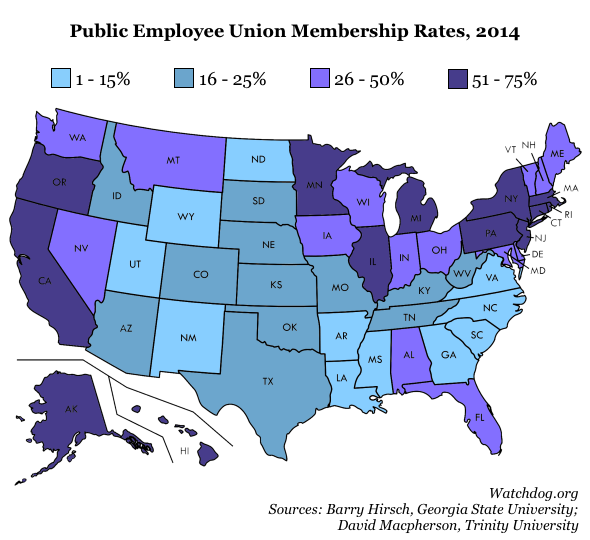
govt-union-membership-by-state

The healthcare industry has been the single most vigorous creator of jobs in the country in recent years. And healthcare has created a range of jobs, from hourly janitorial gigs to middle-class nursing positions to upper-middle class physicians and executives, to CEOs paid millions of dollars a year.

Many of the non-managerial jobs not only pay well, but are unionized. While unions have been slowly worn down and out in the automotive, aerospace and other sectors, they have become quite healthy, if not robust, in healthcare. The California Nurses Association, for example, was key to getting a staffing ratio mandate signed into law and surviving voluminous legal battles about a decade ago. Healthcare labor unions stage walkouts and work slowdowns on an ongoing basis throughout the country these days.

Pension Reform Efforts Move Forward After Harris Issues Summaries

http://www.californiahealthline.org/articles/2015/12/11/pension-reform-efforts-move-forward-after-harris-issues-summaries

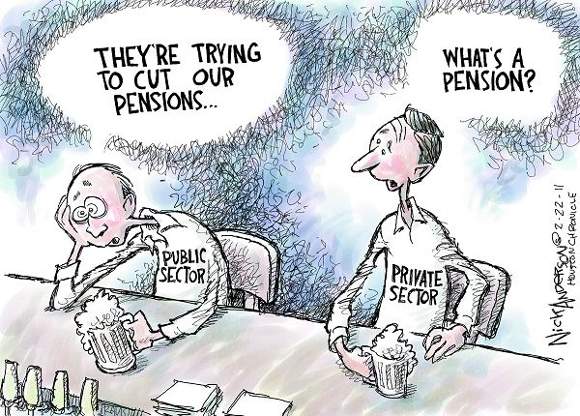
Cartoon Pensions

Hospitals and unions: 31 recent conflicts, agreements

http://www.beckershospitalreview.com/workforce-labor-management/hospitals-and-unions-31-recent-conflicts-agreements.html

Cash Hospital

CFOs may have more leverage over organized labor

http://www.fiercehealthfinance.com/story/cfos-may-have-more-leverage-over-organized-labor/2015-07-01?utm_medium=nl&utm_source=internal

But unions back caps to hospital pay, compulsory financial disclosures