How are hospitals complying with patient medical record requests? Not well, study finds

https://www.beckershospitalreview.com/legal-regulatory-issues/how-are-hospitals-complying-with-patient-medical-record-requests-not-well-study-finds.html

Image result for medical record access

Most hospitals were found to be noncompliant with federal and state regulations when completing patient medical records requests, according to a study published in JAMA Network Open.

Through a simulated patient experience, researchers analyzed 83 U.S. hospitals across 29 states that maintained independent medical records request processes and medical records departments reachable by telephone. The hospitals were among the top 20 hospitals for each of the 16 adult specialties in the 2016-17 U.S. News & World Report Best Hospitals National Rankings.

Under HIPAA, patients have a right to access their protected health information. Federal law requires medical record requests must be fulfilled within 30 days of receipt, in the format the patient requests and for a fair cost to the patient.

Information on records request authorization forms differed from that obtained from patient telephone calls in terms of requestable information, formats of release and costs, according to the researchers. Additionally, 8 percent of hospitals were noncompliant with state requirements for processing times.

On telephone calls, all 83 hospitals said they were able to release entire medical records to patients, but on the forms, fewer than 9 hospitals (11 percent) provided the option of selecting one of the categories of requestable information, such as laboratory test results, medical history and discharge summaries, and only 44 hospitals’ forms (53 percent) gave patients the option to acquire the entire medical record.

There were also differences between the formats hospitals said they could use to release information. On telephone calls, 83 percent of hospitals stated they would allow the patient to pick up their records in person, compared with 48 percent of forms listing this option. Forty-seven percent of hospitals indicated they could email patients their records when patients asked on the telephone calls, while only 33 percent of hospitals’ forms listed email as an option.

The researchers also identified 48 hospitals that charged well above the federal government’s recommendation of $6.50 for electronic records — charging as much as $541.50 for a 200-page record.

“Requesting medical records remains a complicated and burdensome process for patients despite policy efforts and regulation to make medical records more readily available to patients,” the study reads. “As legislation, including the recent 21st Century Cures Act, and government-wide initiatives like MyHealthEData continue to stipulate improvements in patient access to medical records, attention to the most obvious barriers should be paramount.”

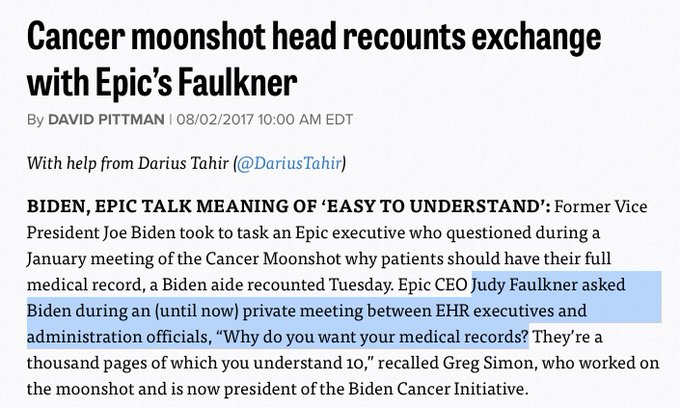


Editor’s Corner—Why the Biden-Faulkner exchange over EHR access touched a nerve

http://www.fiercehealthcare.com/ehr/editor-s-corner-why-biden-faulkner-exchange-over-ehr-access-touched-a-nerve?mkt_tok=eyJpIjoiTWpnMFlUY3dNREExTUdReSIsInQiOiJ4WGdTalwvWk9ZTVFSaXQ0Y2R4OEVqUHFBWFE5NllQc2xHVEl2Z2VYc1d0aTJwUnZwczE5Y1pNVGcxSGFIa2lhZFZaaVRHc0FhSGhwaVRiR3NuNWJRZDhFNW5COTAyRXpQODdJR2VIcDlHTHBcL0RDZ2ZFU2lCSWxyRWNKRTdEdXE3In0%3D&mrkid=959610&utm_medium=nl&utm_source=internal

Joe Biden

It’s hard to say exactly what transpired at that January meeting between then-Vice President Joe Biden and Epic CEO Judy Faulkner.

What we do know is that it triggered a visceral online reaction over the importance of interoperability and access to health data—and even some Twitter threads on the nuances of HIPAA. But that might be more telling about where the industry currently stands and the direction it’s quickly heading.

It began last week when Politico recounted the exchange between Biden and Faulkner as told by the vice president’s aide Greg Simon, who now serves as president of the Biden Cancer Initiative. The short version: Faulkner reportedly asked Biden why he wanted 1,000 pages of medical records to which Biden retorted, “None of your business.”

“It went downhill from there,” Simon said.

The story developed more on Monday, when former White House Chief Technology Officer Aneesh Chopra told CNBC the meeting was cordial and there “was a motivation and desire to work together to improve data access.” An Epic spokesperson told Health IT News that the company “supports patients’ rights to access their entire record,” adding that Biden was “consistently polite and positive” during the meeting.

By then, Twitter had worked itself into a full lather. Many were particularly incensed at Faulkner’s insinuation that that length and complexity of a medical record somehow rendered it useless to patients.

The reactions to Biden’s exchange with Faulkner may say more about the state of health IT than the interaction itself that was either contentious or cordial, depending on who you ask. There’s still a lot of frustration over the amount of money invested in EHR adoption and the fact that interoperability is still a challenging task.

At the same time, the vast majority of the industry is embracing the concept of replacing medical paternalism with patient-centered care, and more healthcare consumers are recognizing the benefits of having all of your health information at your fingertips.

In other words, demand is growing, but healthcare is still short on supply. That might explain the visceral reactions.

This week, Chilmark Research analyst Brian Eastwood argued that the debate over patient access to data revolves more around culture than software, and that’s probably true. Embracing the idea that patients should be able to access their medical record is a basic hurdle before anyone can tackle the technology that can make that happen.

But the heated debate that followed shows how much people across the healthcare industry see this as a core priority. It may not have infiltrated every corner of the ecosystem, but it touched a nerve that was far more basic than the technical minutia of interoperability or data standardization. It’s clear that the broader notion that patient records aren’t just the property of the health system—or even the software vendor—is carving out a substantial role in healthcare’s ongoing transformation. Any insinuation to the contrary is seen as shortsighted.

Clearly, it’s not ubiquitous yet, but there’s a strong undercurrent pushing the industry beyond the question of why patients might want their data and into the how. Perhaps that’s a small measure of progress. – Evan | @DB_Sweeney@FierceHealthIT