House GOP tax cut bill has pluses and pitfalls for healthcare stakeholders

http://www.modernhealthcare.com/article/20171102/NEWS/171109965/house-gop-tax-cut-bill-has-pluses-and-pitfalls-for-healthcare

Image result for money changing hands

Healthcare companies, executives and professionals could enjoy lower business and personal taxes while facing reduced revenue due to Medicare and Medicaid cuts that may be used to pay for the tax reductions, under the House Republican tax reform bill released Thursday.

The 429-page Tax Cuts and Jobs Act—which congressional Republicans hope to pass quickly through the expedited budget reconciliation process with little or no Democratic support—would slash the corporate tax rate from 35% to 20%. That would benefit profitable companies like UnitedHealth Group, HCA and Universal Health Services, according to an analysis by Mizuho Securities.

The tax plan also would sharply raise the income threshold for individuals and families paying the top personal tax rate of 39.6%, to $500,000 for individuals and $1 million for married couples. In addition, it would abolish the alternative minimum tax. Those provisions would reduce personal income taxes for many healthcare executives and professionals.

But at the same time, the bill would cap corporate interest deductions at 30% of earnings before interest, taxes, depreciation and amortization. That could hurt companies carrying large debt loads such as Tenet Healthcare Corp. and Community Health Systems, which declined to comment on the bill.

“For companies that are profitable, the lower corporate tax rate is a powerful generator of cash flow,” said Sheryl Skolnick, managing director at Mizuho. “But for highly levered companies, the interest deduction is quite powerful for them in reducing their tax bill. If that deduction is no longer available, that would be a negative for money-losing companies with little cash flow to begin with.”

Healthcare industry groups will have to consider how the long-term budget impact of the tax cuts will affect broader health policies.

“This is clearly a package that will increase the deficit significantly,” said Matt Fiedler, an economist at the Brookings Institution’s Center on Health Policy. “Ultimately the lower revenues need to be financed by reduced federal spending. Since healthcare programs are a large portion of the budget, this will create pressure for cuts in those programs.”

The release of the House GOP bill Thursday was the first step in what’s likely to be a politically difficult process of passing a bill in the House and reconciling it with a separate Senate GOP tax bill scheduled for release as early as next week. The legislation is likely to come under heavy fire from various industry and consumer groups as well as Democrats as the winners and losers are identified.

But congressional GOP leaders and President Donald Trump believe they can’t afford another legislative failure following the collapse of their efforts to repeal and replace the Affordable Care Act. “We made a promise to deliver tax reform that creates more jobs, fairer taxes, and bigger paychecks,” House Ways and Means Committee Chairman Kevin Brady (R-Texas) said in a written statementaccompany the bill’s release.

Paul Keckley, a veteran industry analyst, said healthcare companies will hold off on making any financial adjustments based on this bill because it’s certain to undergo substantial changes before anything is passed. “With all the darts that will be thrown at this thing, it’s a long way from the finish line,” he said.

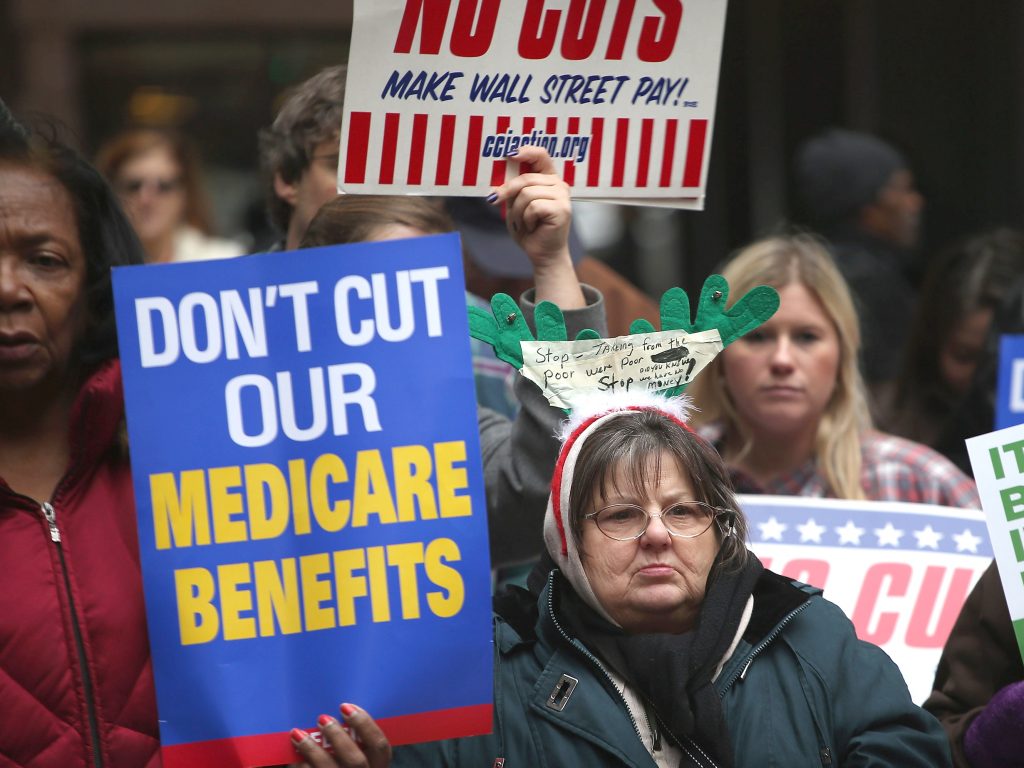
Beyond the immediate tax impact, however, analysts cautioned that healthcare companies should beware of big cuts in Medicare, Medicaid and Affordable Care Act funding that Congress may consider to offset the revenue losses from the bill’s tax cuts. The House and Senate budget resolutions capped the 10-year cost of the tax cut package at $1.5 trillion.

A Democratic analysis of the Senate budget blueprint passed by Republicans last month found that it would cut Medicaid by $1 trillion and Medicare by $473 billion over 10 years.

“This massive tax cut for the rich would add trillions of dollars to the national debt, allowing Republicans to then come after Medicare, Medicaid, Social Security, and other middle-class priorities,” Sen. Patty Murray (D-Wash.) said in a written statement.

“There’s no way you can offset $1.5 trillion in tax cuts without looking at entitlements,” said Anders Gilberg, senior vice president for government affairs at the Medical Group Management Association.

He worried that if congressional Republicans seek to cut Medicare to recoup those revenue losses, that could destabilize the current transition of physicians from fee-for-service to value-based payment. “We’ll be looking at what the offsets are,” he said. “This sounds easy until you have tension between cutting taxes and being accountable for the deficit.”

Skolnick agreed that hospital leaders need to watch out for possible cuts in federal healthcare programs as a way to pay for the tax cuts. “Unless you pay a whole lot of whopping taxes, tax reform will be a net negative for the hospital sector, both for-profit and not-for-profit,” she predicted. “Careful what you wish for, you may get it.”

The American Hospital Association raised objections to two provisions of the bill affecting hospitals. One would stop treating tax-exempt bonds as investment property. The AHA warned that if hospitals’ access to tax-exempt financing is limited or eliminated, they would have a harder time investing in new technologies and renovations.

The other measure would impose a 20% excise tax on executive compensation above $1 million. The AHA said the law already requires a rigorous process for hospital boards to set compensation based on competitive market rates for top talent.

Physician groups were left behind on the bill’s provision reducing tax rates for pass-through entities. Passive owners of S corporations and limited liability corporations — the structures used by many medical groups — would be able to pay just a 25% tax rate rather than the 39.6% top rate for personal income. But medical groups and other professional service firms would not receive that reduced rate unless they were able to show the income was not labor-related.

“I’m disappointed we wouldn’t see a benefit for our members,” said Tina Hogeman, the MGMA’s chief financial officer.

She also worried about the bill’s $500,000 cap on home mortgage interest deductions, down from the current $1 million. “That’s a real problem for our members,” she said. “The average physician has a home that cost more than $500,000.”

A controversial provision of the House GOP bill that affects consumers is the proposed elimination of itemized deductions for high medical expenses, including long-term care costs. That deduction costs the Treasury about $10 billion a year. The AHA opposes ending that deduction.

The Brookings Institution’s Fiedler said that while the deduction isn’t well-targeted to help people with high medical costs, it’s a bad idea to repeal it to help pay for tax cuts for corporations and wealthier Americans.

“It could be sensible policy to repeal the deduction, but here it’s just financing regressive tax cuts,” Fiedler said.

Healthcare industry groups and supporters of the Affordable Care Act were relieved that the House GOP tax bill did not include provisions Republicans were considering to repeal the ACA’s individual mandate or erase the ACA’s taxes on wealthier people’s investment earnings. Those provisions could have undermined the individual insurance market and the financing for the law’s coverage subsidies.

“The bill is most notable for what’s not in there,” Fiedler said.
How GOP Will Still Carve Up Medicare

https://www.forbes.com/sites/johnwasik/2017/07/19/how-gop-will-still-carve-up-medicare/#48a9aa5943f1

Image result for assault on medicare

Now that the GOP’s plan for repealing and replacing Obamacare seems to be in a coma, the party has turned its attention to the 2018 federal budget.

Although specific spending details in the House committee mark-ups are still being hammered out, the GOP is back to its old script.

The GOP has a working blueprint to cut billions out of federal programs and balance the budget without tax increases. And, among other items, it still wants to privatize Medicare.

Speaker of the House Paul Ryan (R-WI). (Photo by Win McNamee/Getty Images)

Medicare covers more than 55 million Americans. Most of them are 65 or older and millions are permanently disabled. It’s the nation’s second-largest government-managed single-payer plan after Medicaid, which covers some 70 million.


While Medicare provides coverage for doctors and hospitals, it also covers prescription drugs if you pay an additional premium. You also have the option to buy into private policies through Medicare Advantage — if you don’t want the fee-for-service part of basic Medicare.

The rehashed House GOP budget blueprint wants to reshape Medicare into more of a Medicare Advantage model, which now covers some 19 million Americans.

What does that mean? Funding for the guaranteed part of Medicare would be shifted into the privatized scheme. You’d receive a fixed stipend or “premium support” to buy a private policy on an exchange.

Buying private plans on an exchange? Where have we heard that before? Oh yes, that was the model for the Affordable Care Act, or Obamacare, which the GOP has spent the last seven yearstrying to repeal. It’s been a staple of House Speaker Paul Ryan’s policy platform for years.

According to the House Budget Committee blueprint:

“The Medicare improvements envisioned in this budget resolution would adopt the popular simplified coverage structure of Medicare Advantage, and allow seniors greater plan choices while reducing costs.

It would resemble the private insurance market, in which the majority of Americans select a single health care plan to cover all their medical needs.”

In theory, having private insurers compete with the government to provide more coverage at a lower cost sounds like a good idea. But is it possible, given the government’s massive economies of scale?

Without generous subsidies, the prospect of insurers offering a better Medicare deal is like the corner grocer trying to compete with Wal-Mart. Moreover, using Medicare Advantage as a model is a horrible idea.

Medicare Advantage insurers have been embroiled in numerous billing scams, according to the non-partisan Center for Public Integrity. The Center, an independent watchdog, has published more than two dozen pieces on this ongoing morass. Here’s a summary of their findings:

“Congress created private Medicare Advantage health plans 11 years ago to help control health care spending on the elderly. But a Center for Public Integrity investigation found that billions of tax dollars are wasted every year through manipulation of a Medicare payment tool called a “risk score.”

The formula is supposed to pay health plans more for sicker patients and less for healthy people, but often it pays too much. The government has for years missed opportunities to corral tens of billions of dollars in overcharges and other billing errors tied to abuse of risk scores.

Meanwhile, the growing power of the Medicare Advantage industry has muzzled many critics in Congress, and turned others into cheerleaders for the program.”

Back to the main story: What House Speaker Paul Ryan and GOP congressional leaders are proposing is to tear down and remold basic Medicare into the troubled Medicare Advantage program, which would be like throwing kerosene on a house fire.

There’s even more of a muddle on how the GOP would calculate how much to give seniors for their yearly stipend to cover private premiums. What if policy costs go up double digits and the stipend doesn’t keep pace with the private market?

Would private insurers offer lower rates to healthier seniors and price less-healthy Americans out of the market? Although basic Medicare would still be available, wouldn’t the money diverted to premium support undermine funding for the traditional Medicare Hospital Trust Fund, which may be insolvent by 2029?

I think there’s a reason why there’s a billboard in Kenosha, Wisconsin — in the heart of Ryan’s Congressional District — that shows Ryan in a robber’s mask. There’s an attempted theft in progress, but older Americans and the disabled will be the victims.

AHCA savings, $487 billion in Medicare cuts remain in House budget proposal

http://www.modernhealthcare.com/article/20170719/NEWS/170719888/ahca-savings-487-billion-in-medicare-cuts-remain-in-house-budget

Image result for medicare cuts

The House Budget Committee on Wednesday agreed to bake in hundreds of billions in Medicaid cuts from its ACA repeal bill to the budget resolution, plus an additional $114 billion in cuts over 10 years.

The committee’s Republicans’ unanimously approved the decision with no Democrats on board. The budget resolution, which is the foundation for passing tax reform in the Senate without Democratic votes, also assumes Medicare will reduce spending by $487 million from 2018 to 2027.

Some of the additional savings would come from imposing a work requirement on Medicaid adult beneficiaries who are younger than 65 and are not on Social Security disability as a condition of eligibility.

The Medicare savings are built on an idea long-favored by Republicans — using vouchers to buy insurance, though Republicans say future beneficiaries will have the option to buy traditional Medicare too. Democrats during Wednesday’s hearing complained that traditional Medicare would cost 25% more than it does now if vouchers come into play.

The Republicans also included savings that would stem from raising the Medicare eligibility age for future beneficiaries who are 51 or younger. Under the proposal, those individuals would not become eligible for full Social Security benefits or Medicare until the age of 67. The Congressional Budget Office has estimated that would reduce Medicare spending by 2% once everyone in the program is covered by the later eligibility age.

The proposal includes a requirement that affluent seniors pay higher premiums, and that people with incomes of $1 million or more pay the full cost of Medicare premiums without any federal subsidy.

Rep. Matt Gaetz, R-Fla., said during the hearing that the proposed changes are based on math rather than Tea Party politics, as some have alleged.

The Republican spending outline also assumes the government will do better at recouping or avoiding improper payments. The proposal said that there was $59.7 billion in improper Medicare payments in in the last fiscal year, and $36.3 billion in improper Medicaid payments. The outline assumes future improper payments will be 50% lower than today’s levels.

Rep. Debbie Wasserman-Schultz, D-Fla., introduced an amendment that would have changed the resolution so that it no longer assumed American Health Care Act changes would be future law, citing the Senate bill’s collapse this week.

But every Republican present on the committee voted against the amendment. “This is the official position of the House on repeal and reform efforts,” said Rep. Bill Johnson, R-Ohio.

The budget resolution also includes a reduction in health spending of $43.9 billion over 10 years, the CBO estimate of how much the malpractice reform bill that passed the House would save.

Ranking Member John Yarmuth, D-Ky., called the budget disgraceful and others called the cuts to Medicare, Medicaid and food stamps draconian, several Republicans worried what it envisions might not come to pass.

“We might fail to achieve savings in mandatory spending,” which includes Medicaid and Medicare, Johnson said, noting that the budget resolution might make it harder to pass tax reform in the Senate.

The first hurdle, however, is for the resolution to pass the entire House of Representatives.