How GOP Will Still Carve Up Medicare

https://www.forbes.com/sites/johnwasik/2017/07/19/how-gop-will-still-carve-up-medicare/#48a9aa5943f1
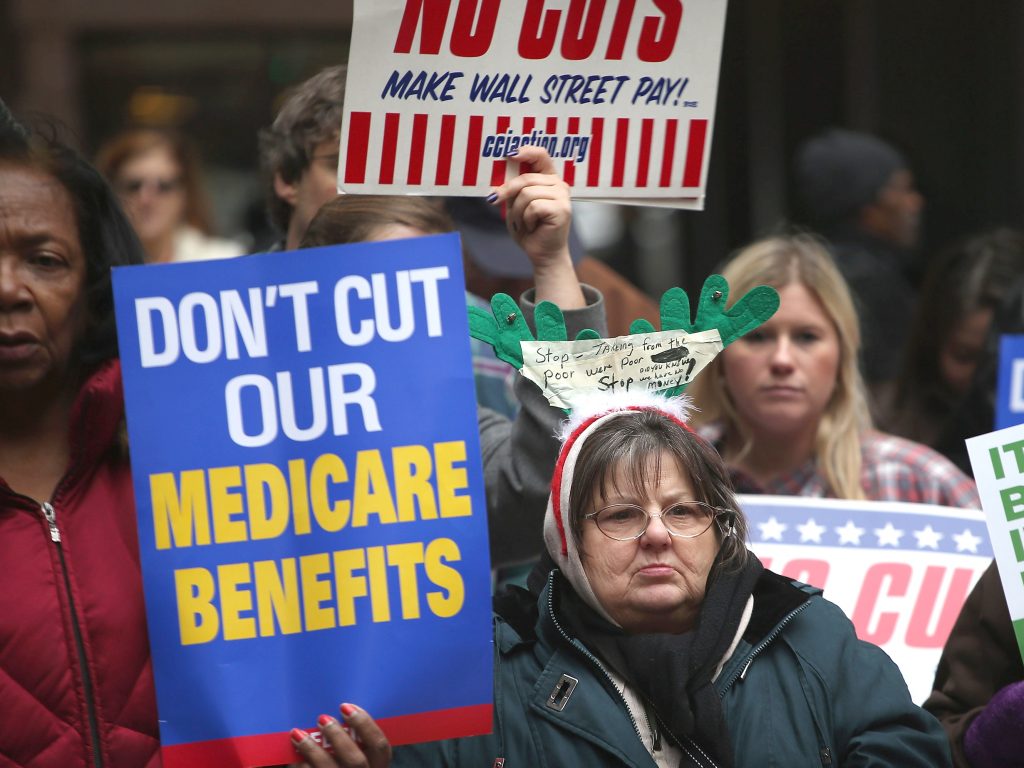
Image result for assault on medicare

Now that the GOP’s plan for repealing and replacing Obamacare seems to be in a coma, the party has turned its attention to the 2018 federal budget.

Although specific spending details in the House committee mark-ups are still being hammered out, the GOP is back to its old script.

The GOP has a working blueprint to cut billions out of federal programs and balance the budget without tax increases. And, among other items, it still wants to privatize Medicare.

Speaker of the House Paul Ryan (R-WI). (Photo by Win McNamee/Getty Images)

Medicare covers more than 55 million Americans. Most of them are 65 or older and millions are permanently disabled. It’s the nation’s second-largest government-managed single-payer plan after Medicaid, which covers some 70 million.


While Medicare provides coverage for doctors and hospitals, it also covers prescription drugs if you pay an additional premium. You also have the option to buy into private policies through Medicare Advantage — if you don’t want the fee-for-service part of basic Medicare.

The rehashed House GOP budget blueprint wants to reshape Medicare into more of a Medicare Advantage model, which now covers some 19 million Americans.

What does that mean? Funding for the guaranteed part of Medicare would be shifted into the privatized scheme. You’d receive a fixed stipend or “premium support” to buy a private policy on an exchange.

Buying private plans on an exchange? Where have we heard that before? Oh yes, that was the model for the Affordable Care Act, or Obamacare, which the GOP has spent the last seven yearstrying to repeal. It’s been a staple of House Speaker Paul Ryan’s policy platform for years.

According to the House Budget Committee blueprint:

“The Medicare improvements envisioned in this budget resolution would adopt the popular simplified coverage structure of Medicare Advantage, and allow seniors greater plan choices while reducing costs.

It would resemble the private insurance market, in which the majority of Americans select a single health care plan to cover all their medical needs.”

In theory, having private insurers compete with the government to provide more coverage at a lower cost sounds like a good idea. But is it possible, given the government’s massive economies of scale?

Without generous subsidies, the prospect of insurers offering a better Medicare deal is like the corner grocer trying to compete with Wal-Mart. Moreover, using Medicare Advantage as a model is a horrible idea.

Medicare Advantage insurers have been embroiled in numerous billing scams, according to the non-partisan Center for Public Integrity. The Center, an independent watchdog, has published more than two dozen pieces on this ongoing morass. Here’s a summary of their findings:

“Congress created private Medicare Advantage health plans 11 years ago to help control health care spending on the elderly. But a Center for Public Integrity investigation found that billions of tax dollars are wasted every year through manipulation of a Medicare payment tool called a “risk score.”

The formula is supposed to pay health plans more for sicker patients and less for healthy people, but often it pays too much. The government has for years missed opportunities to corral tens of billions of dollars in overcharges and other billing errors tied to abuse of risk scores.

Meanwhile, the growing power of the Medicare Advantage industry has muzzled many critics in Congress, and turned others into cheerleaders for the program.”

Back to the main story: What House Speaker Paul Ryan and GOP congressional leaders are proposing is to tear down and remold basic Medicare into the troubled Medicare Advantage program, which would be like throwing kerosene on a house fire.

There’s even more of a muddle on how the GOP would calculate how much to give seniors for their yearly stipend to cover private premiums. What if policy costs go up double digits and the stipend doesn’t keep pace with the private market?

Would private insurers offer lower rates to healthier seniors and price less-healthy Americans out of the market? Although basic Medicare would still be available, wouldn’t the money diverted to premium support undermine funding for the traditional Medicare Hospital Trust Fund, which may be insolvent by 2029?

I think there’s a reason why there’s a billboard in Kenosha, Wisconsin — in the heart of Ryan’s Congressional District — that shows Ryan in a robber’s mask. There’s an attempted theft in progress, but older Americans and the disabled will be the victims.

AHCA savings, $487 billion in Medicare cuts remain in House budget proposal

http://www.modernhealthcare.com/article/20170719/NEWS/170719888/ahca-savings-487-billion-in-medicare-cuts-remain-in-house-budget

Image result for medicare cuts

The House Budget Committee on Wednesday agreed to bake in hundreds of billions in Medicaid cuts from its ACA repeal bill to the budget resolution, plus an additional $114 billion in cuts over 10 years.

The committee’s Republicans’ unanimously approved the decision with no Democrats on board. The budget resolution, which is the foundation for passing tax reform in the Senate without Democratic votes, also assumes Medicare will reduce spending by $487 million from 2018 to 2027.

Some of the additional savings would come from imposing a work requirement on Medicaid adult beneficiaries who are younger than 65 and are not on Social Security disability as a condition of eligibility.

The Medicare savings are built on an idea long-favored by Republicans — using vouchers to buy insurance, though Republicans say future beneficiaries will have the option to buy traditional Medicare too. Democrats during Wednesday’s hearing complained that traditional Medicare would cost 25% more than it does now if vouchers come into play.

The Republicans also included savings that would stem from raising the Medicare eligibility age for future beneficiaries who are 51 or younger. Under the proposal, those individuals would not become eligible for full Social Security benefits or Medicare until the age of 67. The Congressional Budget Office has estimated that would reduce Medicare spending by 2% once everyone in the program is covered by the later eligibility age.

The proposal includes a requirement that affluent seniors pay higher premiums, and that people with incomes of $1 million or more pay the full cost of Medicare premiums without any federal subsidy.

Rep. Matt Gaetz, R-Fla., said during the hearing that the proposed changes are based on math rather than Tea Party politics, as some have alleged.

The Republican spending outline also assumes the government will do better at recouping or avoiding improper payments. The proposal said that there was $59.7 billion in improper Medicare payments in in the last fiscal year, and $36.3 billion in improper Medicaid payments. The outline assumes future improper payments will be 50% lower than today’s levels.

Rep. Debbie Wasserman-Schultz, D-Fla., introduced an amendment that would have changed the resolution so that it no longer assumed American Health Care Act changes would be future law, citing the Senate bill’s collapse this week.

But every Republican present on the committee voted against the amendment. “This is the official position of the House on repeal and reform efforts,” said Rep. Bill Johnson, R-Ohio.

The budget resolution also includes a reduction in health spending of $43.9 billion over 10 years, the CBO estimate of how much the malpractice reform bill that passed the House would save.

Ranking Member John Yarmuth, D-Ky., called the budget disgraceful and others called the cuts to Medicare, Medicaid and food stamps draconian, several Republicans worried what it envisions might not come to pass.

“We might fail to achieve savings in mandatory spending,” which includes Medicaid and Medicare, Johnson said, noting that the budget resolution might make it harder to pass tax reform in the Senate.

The first hurdle, however, is for the resolution to pass the entire House of Representatives.

A Battle to Change Medicare Is Brewing, Whether Trump Wants It or Not

Donald J. Trump once declared that campaigning for “substantial” changes to Medicare would be a political death wish.

But with Election Day behind them, emboldened House Republicans say they will move forward on a years-old effort to shift Medicare away from its open-ended commitment to pay for medical services and toward a fixed government contribution for each beneficiary.

The idea rarely came up during Mr. Trump’s march toward the White House, but a battle over the future of Medicare could roil Washington during his first year in office, whether he wants it or not.

“Let me say unequivocally to you now: I have fought to protect Medicare for this generation and for future generations,” Senator Joe Donnelly of Indiana, a Democrat running for re-election in 2018, said this week in a video message to constituents. “I have opposed efforts to privatize Medicare in the past, and I will oppose any effort to privatize Medicare or turn it into a voucher program in the future.”

For nearly six years, Speaker Paul D. Ryan has championed the new approach, denounced by Democrats as “voucherizing” Medicare. Representative Tom Price of Georgia, the House Budget Committee chairman and a leading candidate to be Mr. Trump’s secretary of health and human services, has also embraced the idea, known as premium support.

And Democrats are relishing the fight and preparing to defend the program, which was created in 1965 as part of Lyndon B. Johnson’s Great Society. They believe that if Mr. Trump chooses to do battle over Medicare, he would squander political capital, as President George W. Bush did with an effort to add private investment accounts to Social Security after his re-election in 2004.

Democrats will “stand firmly and unified” against Mr. Ryan if he tries to “shatter the sacred guarantee that has protected generations of seniors,” said Representative Nancy Pelosi of California, the Democratic leader.

Republicans have pressed for premium support since Mr. Ryan first included it in a budget blueprint in 2011. As he envisions it, Medicare beneficiaries would buy health insurance from one of a number of competing plans. The traditional fee-for-service Medicare program would compete directly with plans offered by private insurers like Humana, UnitedHealth Group and Blue Cross Blue Shield.