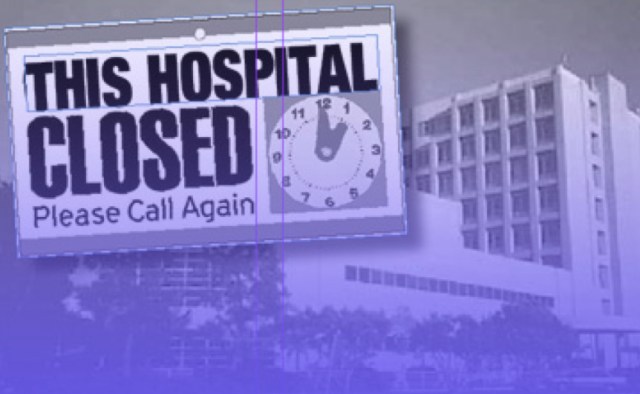
8 hospitals closed so far this year — here’s why

https://www.beckershospitalreview.com/finance/8-hospitals-closed-so-far-this-year-here-s-why.html?origin=cfoe&utm_source=cfoe

Image result for hospital closures

From reimbursement landscape challenges to dwindling patient volumes, many factors lead hospitals to close.

Here are the factors that led eight hospitals to close so far this year:

1. Belmont Community Hospital, a 99-bed hospital in Bellaire, Ohio, closed April 5. Hospital officials cited a decline in patient volume as the reason for the closure. “Utilization of BCH has continued to decline despite efforts to offer varying services at the facility,” the hospital said in a press release. “The decline has place[d] a financial strain on the BCH that cannot be sustained in the long term.”

2. Kentuckiana Medical Center in Clarksville, Ind., closed April 5. The hospital, which opened in 2009, faced financial losses for years and previously filed for Chapter 11 bankruptcy, according to the Louisville Courier Journal.

3. Horton (Kan.) Community Hospital closed March 12. The 25-bed critical access hospital, owned by Kansas City, Mo.-based EmpowerHMS, shut down after struggling to pay utilities and missing payroll for several weeks. The hospital entered Chapter 11 bankruptcy on March 14.

4. Georgiana (Ala.) Medical Center closed March 8. Ivy Creek Healthcare in Georgiana, which owns the hospital, cited growing costs and cuts to reimbursement as the reasons for the closure.

5. Cumberland River Hospital in Celina, Tenn., closed March 1. In January, officials announcedthat the hospital was shutting down due to financial challenges. They said Cumberland River Hospital had experienced significant losses in recent years due to declining reimbursements and lower patient volumes.

6. Harrisburg, Pa.-based UPMC Pinnacle closed its hospital in Lancaster, Pa., on Feb. 28. The health system announced plans in December to close UPMC Pinnacle Lancaster and transition inpatient services to another one of its hospitals located about 7 miles away. In a Feb. 15 news release, UPMC Pinnacle President and CEO Philip Guarneschelli said consolidating inpatient services on one campus would make care more convenient for patients.

7. Oswego (Kan.) Community Hospital and its two affiliated clinics closed Feb. 14. A statement from the board announcing the closure said the hospital, owned by Kansas City, Mo.-based EmpowerHMS, wasn’t bringing in enough revenue to cover payroll and other expenses. After the abrupt closure, the hospital entered Chapter 11 bankruptcy on March 17.

8. Washington County Hospital in Plymouth, N.C., closed Feb. 14 after missing payroll on Feb. 8. The critical access hospital is now working its way through the Chapter 7 bankruptcy process. The hospital is one of several facilities owned by Kansas City, Mo.-based EmpowerHMS that has entered bankruptcy or closed in recent months. The Washington County Board of Commissioners is working with state and federal agencies to investigate the hospital’s financial and operational issues and working to restore medical services as the hospital, according to a Feb. 19 public service announcement on Washington County’s website.


Red October: CMS Details Process for Billions in DSH Cuts

http://www.healthleadersmedia.com/leadership/red-october-cms-details-process-billions-dsh-cuts?spMailingID=11619096&spUserID=MTY3ODg4NTg1MzQ4S0&spJobID=1220267507&spReportId=MTIyMDI2NzUwNwS2#

Image result for disproportionate share hospital payments

With Congressional delays in Medicaid disproportionate share funding cuts set to expire Sept. 30, CMS issues a proposed rule that details billions in reductions that will begin in 2018.

As the Senate tries repeatedly to repeal the Affordable Care Act, so far without success, CMS is moving ahead with detailing how cuts in disproportionate share funding will be administered under a political deal the hospital lobby agreed to in exchange for getting more people covered by health insurance under the ACA.

The first step of the DSH cuts, which were supposed to have been implemented in stair-step fashion beginning in 2014 and running through 2020, had been delayed by Congress until 2018 after hospitals successfully argued that uncompensated care costs weren’t declining as much as expected under the ACA.

The cuts will now begin in 2018 with $2 billion, with $1 billion in cuts added each year until 2024, when DSH payments will be cut by $8 billion. Another $8 billion in cuts is scheduled for 2025.

Cuts will total $43 billion over the eight years.

The proposed rule lays out the DSH Health Reform Methodology (DHRM) that will be used to implement DSH funding reductions by state, in an attempt to target more heavily hospitals that experience the least financial impact from uncompensated care.

The DHRM will incorporate several sources of data to determine the amount by which each state’s DSH funding will be reduced for each year, in an attempt to account for a variety of factors that influence the financial impact of uncompensated care burdens in each state.

The methodology must, according to CMS “impose a smaller percentage reduction on low-DSH states.”

The largest reductions will be imposed on states with the lowest percentage of uninsured during the most recent year data is available, to states that do not target their DSH payments to hospitals with high volumes of Medicaid inpatients and to states that do not target DSH payments to hospitals with high levels of uncompensated care.

Data that will influence the DHRM will include United States Census Bureau Data and Medicaid DSH audit and reporting data submitted by the states.

The proposed rule is open for public comment until August 28.

Medicare proposed changes would cut home health reimbursement

http://www.healthcarefinancenews.com/news/home-health-agencies-concerned-about-cuts-proposed-medicare-payments?mkt_tok=eyJpIjoiTXpOa01qUXhaVGd5TnpkaiIsInQiOiJudFozOHVLS1VVNXZZRE42Y0RmTWdIZHpkOU0yNERUSmlXU0VCMlJDMEFyMmVTUUc4aVwvcXRVc0gzXC9ndUdJVjhHT1drZkkzdDhBVFhHZ3BHVjI1NmhIVHY1RmNXSENVdWtwb3RVVnVtaFNWbXNFdnBzb0JVenRcL1ZuR1p0MW0zRyJ9

Home health agencies could see decreases of $80 million in 2017 and $950 million in 2019.

Home health providers object to the Centers for Medicare and Medicaid Services’ proposed rule that would reduce Medicare payments by 0.4 percent, or $80 million, in 2018, and up to  $950 million in 2019.

The Partnership for Quality Home Healthcare is especially concerned about a groupings model proposal starting in 2019 that  would change the unit of payment from 60-day episodes of care to 30-day periods of care and places patients in payment groups based on how they fit in six clinical categories.

“CMS is proposing a major reform to home health reimbursement without having worked collaboratively with industry partners like the Partnership and we expect to be included in payment reform development going forward,” said Partnership Chairman Keith Myers. “We question whether CMS has the unilateral authority to make such a proposed change without action by Congress.”

CMS said the six clinical groups used to categorize 30-day periods of care are based on the patient’s primary reason for home healthcare.

The new model could result in a $950 million Medicare payment cuts for home health providers in 2019 if it is implemented in a non-budget neutral manner, according to Home Health Care News. If implemented in a partially-budget-neutral manner, it could reduce payments by $480 million, the report said.

CMS is not proposing a revision to the split percentage payment approach in the change to a 30-day period. However, the agency said it is proposing to phase-out of the split percentage payment approach in the future and is soliciting feedback now.

For 2018, Medicare payments to home health agencies would be reduced by 0.4 percent, or $80 million, based on the proposed policies, CMS projects.

The $80 million decrease reflects the effects of a $190 million increase from a 1 percent home health payment update, a $170 million decrease from a -0.97 percent adjustment to the 60-day episode payment rate to account for nominal case-mix growth, and a $100 million decrease due to the sunset of the rural add-on provision.

The Medicare Access and CHIP Reauthorization Act, or MACRA extended until Jan. 1, 2018 the rural add-on, which increased by 3 percent the payment amount otherwise made for home health services in a rural area.

Additionally, the proposed rule for 2018 refines the home health value-based purchasing model. It revises the applicable measure for receiving performance scores for any of the home health consumer assessment of healthcare providers and systems, or HHCAHPS.

The Partnership for Quality Home Health Care said it plans to release an analysis of the proposed payment model and its impacts on home health delivery.

The coalition is concerned that Affordable Care Act directives for high-risk beneficiaries to receive access to home health services would result in disproportionate cuts to provide the care if the payments are implemented as drafted.

Tuesday’s home health rule is among several proposals that reflect a broader strategy by CMS to relieve regulatory burdens for providers, support the patient-doctor relationship in healthcare and promote transparency, flexibility, and innovation in the delivery of care, CMS said.

“CMS is committed to helping patients and their doctors make better decisions about their healthcare choices,” said CMS Administrator Seema Verma. “We’re redesigning the payment system to be more responsive to patients’ needs and to improve outcomes. The new payment system aims to encourage innovation and collaboration and to incentivize home health providers to meet or exceed industry quality standards.”

CMS gives $2.4 billion boost to inpatient hospitals for fiscal year 2018 with final uncompensated care rule

http://www.healthcarefinancenews.com/news/cms-gives-24-billion-boost-inpatient-hospitals-fiscal-year-2018-final-uncompensated-care-rule?mkt_tok=eyJpIjoiTXpOa01qUXhaVGd5TnpkaiIsInQiOiJudFozOHVLS1VVNXZZRE42Y0RmTWdIZHpkOU0yNERUSmlXU0VCMlJDMEFyMmVTUUc4aVwvcXRVc0gzXC9ndUdJVjhHT1drZkkzdDhBVFhHZ3BHVjI1NmhIVHY1RmNXSENVdWtwb3RVVnVtaFNWbXNFdnBzb0JVenRcL1ZuR1p0MW0zRyJ9

Inpatient hospitals will see increase of $800 million over the previous year, but long-term care facilities face $110 million cut in payments.

CMS Final Rule for the 2018 Medicare Inpatient Prospective Payment System will give hospitals an overall $2.4 billion raise in fiscal year 2018, the agency said.

Due to the combination of payment rate increases, other policy changes and adjustments acute care hospitals will see $6.8 billion in payments for uncompensated care, an increase of $800 million over the previous year, CMS said.

Medicare payments to inpatient psychiatric facilities will rise by $45 million, or roughly one percent. However, long-term care hospitals will decrease by $110 million in fiscal year 2018.

The changes will affect 3,330 acute care facilities and roughly 420 long-term care hospitals for discharges happening after October 1, 2017. The new rule incorporates CMS’ finalized proposal to use data from its National Health Expenditure Accounts in its estimate of the rate of uninsurance, which is used in calculating the total amount of uncompensated care payments available.

Long-term care hospitals will be facing a cut. Under the 2018 final rule, CMS projected payments will drop roughly 2.4 percent, or $110 million in FY 2018, which is “due in large part to the continued phase in of the dual payment rate system.” However, this amount is actually smaller than the previously projected cut of 3.75 percent, which was first proposed back in April.

CMS has also finalized its proposal for a one-year regulatory moratorium on the payment reduction threshold for patient admissions for long-term care hospitals in FY 2018 while they continue to evaluate the policy, CMS said.