Advocate Aurora raising minimum wage to $15/hour

https://www.healthcaredive.com/news/advocate-aurora-raising-minimum-wage-to-15hour/543378/

Image result for competitive labor market

Dive Brief:

  • Advocate Aurora Health, a 27-hospital non-profit health system covering Illinois and Wisconsin, announced it will increase its minimum wage to $15 an hour by early 2021. The system plans to make the increase in steps, reaching $13 an hour in the middle of next year and $14 in early 2020.
  • In a message to staff, Kevin Brady, chief human resources office at Advocate Aurora, said the pay raise “aligns with our longstanding commitment to be market competitive and remain a place that attracts and retains top talent.”
  • It’s the latest in a growing list of health systems that are raising minimum wages. Allegheny Health Network and UPMC also set targets of $15 an hour this year.

Dive Insight:

Health systems are making these moves as they struggle to find employees in the competitive job market. Labor costs remain a major issue for hospitals and have led to nursing strikes over the past two years.

A recent Navigant analysis predicted hospitals and health systems will continue to see higher labor costs in the coming years as administrators raise wages to tackle shortages. Total employment compensation for the industry increased 2% in 2017 and 2.3% the previous year, according to the Bureau of Labor Statistics employment cost index.

Many states are also moving forward with minimum wage increases, including some that have increased pay to $15 an hour.

Brady said the health system’s goal is to be a “destination employer where our team members feel valued, have opportunities for growth and connect with our values and purpose-driven culture.” The decision will improve the workplace and, in turn, make patients “feel this is the best place to entrust their health and wellness,” he added.

Brady said the health system is investing in higher pay while still facing shrinking reimbursements and rising pharmaceutical costs. “Continuing to ensure that our team members have access to rewarding jobs with comprehensive benefits, competitive wages and an engaging work environment will not only strengthen our workplace, it will strengthen our marketplace and most importantly, enhance the quality of life in our communities from Green Bay to Bloomington Normal and everywhere in between,” he wrote to staff.

The Downers Grove, Illinois-based health system was created earlier this year with the merger of Advocate Health Care and Aurora Health Care. The system experienced a 20% drop in operating income in the first six months. The decrease was related to added costs connected to the merger and a new EHR.

Healthcare job growth slows; hospitals add 10.6K jobs in June

https://www.beckershospitalreview.com/workforce/healthcare-job-growth-slows-hospitals-add-10-6k-jobs-in-june.html

Image result for Healthcare job growth


Healthcare added 25,200 jobs in June, with hospitals contributing 10,600 to that total, according to the latest jobs report from the U.S. Bureau of Labor Statistics.

This is down from the 28,900 jobs the industry added in May.

Within healthcare, ambulatory healthcare services continued to show employment growth, adding 13,500 jobs last month. Hospitals added 10,600 jobs in June compared to the 6,200 they added in May. Nursing and residential care facilities gained 1,100 jobs last month.

Overall, healthcare has added 309,000 jobs over the year, according to the BLS.

In total, the U.S. added 213,000 jobs in June.


Average hourly, annual wages for NPs by state

https://www.beckershospitalreview.com/compensation-issues/average-hourly-annual-wages-for-nps-by-state.html

Related image

California has the highest annual wage for nurse practitioners in the U.S., with Golden State NPs earning $126,770 a year on average, according to the most recent data from the Bureau of Labor Statistics.

Here is the average hourly and annual wage for NPs in each state, listed in alphabetical order.

Alabama
Hourly: $45.62
Annual Wage: $94,880

Alaska
Hourly: $60.16
Annual Wage: $125,140

Arizona
Hourly: $50.47
Annual Wage: $104,970

Arkansas
Hourly: $45.79
Annual Wage: $95,230

California
Hourly: $60.95
Annual Wage: $126,770

Colorado
Hourly: $53.10
Annual Wage: $110,440

Connecticut
Hourly: $56.97
Annual Wage: $118,500

Delaware
Hourly: $50.66
Annual Wage: $105,380

District of Columbia
Hourly: $52.81
Annual Wage: $109,840

Florida
Hourly: $48.04
Annual Wage: $99,930

Georgia
Hourly: $49.95
Annual Wage: $103,890

Hawaii
Hourly: $58.93
Annual Wage: $122,580

Idaho
Hourly: $49.40
Annual Wage: $102,760

Illinois
Hourly: $49.02
Annual Wage: $101,960

Indiana
Hourly: $48.93
Annual Wage: $101,780

Iowa
Hourly: $50.06
Annual Wage: $104,130

Kansas
Hourly: $47.05
Annual Wage: $97,870

Kentucky
Hourly: $45.89
Annual Wage: $95,450

Louisiana
Hourly: $47.49
Annual Wage: $98,780

Maine 
Hourly: $48.13
Annual Wage: $100,100

Maryland
Hourly: $52.81
Annual Wage: $109,840

Massachusetts
Hourly: $57.76
Annual Wage: $120,140

Michigan
Hourly: $49.16
Annual Wage: $102,250

Minnesota
Hourly: $55.84
Annual Wage: $116,150

Mississippi
Hourly: $51.58
Annual Wage: $107,280

Missouri
Hourly: $46.39
Annual Wage: $96,490

Montana
Hourly: $46.86
Annual Wage: $97,470

Nebraska
Hourly: $48.04
Annual Wage: $99,930

Nevada
Hourly: $50.73
Annual Wage: $105,520

New Hampshire
Hourly: $54.06
Annual Wage: $112,440

New Jersey
Hourly: $56.55
Annual Wage: $117,630

New Mexico
Hourly: $52.56
Annual Wage: $109,330

New York
Hourly: $56.35
Annual Wage: $117,210

North Carolina
Hourly: $51.11
Annual Wage: $106,320

North Dakota
Hourly: $49.75
Annual Wage: $103,470

Ohio
Hourly: $48.90
Annual Wage: $101,710

Oklahoma
Hourly: $45.96
Annual Wage: $95,590

Oregon
Hourly: $54.27
Annual Wage: $112,870

Pennsylvania
Hourly: $47.24
Annual Wage: $98,260

Rhode Island
Hourly: $52.23
Annual Wage: $108,630

South Carolina
Hourly: $46.70
Annual Wage: $97,140

South Dakota
Hourly: $48.09
Annual Wage: $100,030

Tennessee
Hourly: $45.18
Annual Wage: $93,970

Texas
Hourly: $53.53
Annual Wage: $111,330

Utah
Hourly: $48.06
Annual Wage: $99,960

Vermont
Hourly: $49.96
Annual Wage: $103,920

Virginia
Hourly: $49.15
Annual Wage: $102,240

West Virginia
Hourly: $45.67
Annual Wage: $95,000

Washington
Hourly: $55.41
Annual Wage: $115,250

Wisconsin
Hourly: $49
Annual Wage: $101,930

Wyoming
Hourly: $54.48
Annual Wage: $113,310


Healthcare Still Driving Jobs Growth

http://www.healthleadersmedia.com/hr/healthcare-still-driving-jobs-growth?utm_source=edit&utm_medium=ENL&utm_campaign=HLM-Daily-SilverPop_04092018&spMailingID=13278339&spUserID=MTY3ODg4NTg1MzQ4S0&spJobID=1380763774&spReportId=MTM4MDc2Mzc3NAS2

Image result for Healthcare Still Driving Jobs Growth

Ambulatory healthcare and hospitals saw biggest March gains in within the sector.

The latest employment numbers released by the federal government indicate that healthcare remains among the major industry sectors driving jobs growth.

More than 22,000 healthcare jobs were added in March, keeping roughly in line with the average number of healthcare jobs added for each of the past 12 months, according to data released Friday by the Bureau of Labor Statistics (BLS).


Within healthcare, the largest gains were among ambulatory healthcare services (16,000 jobs) and hospitals (10,000 jobs). Nursing and residential care facilities, meanwhile, lost nearly 4,000 jobs in March.

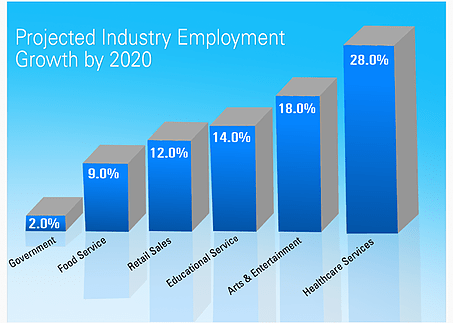
These overall numbers are not surprising. Healthcare occupations were projected to grow by 18%, or 2.4 million jobs, from 2016 to 2026, according to BLS analysis. The strength of the healthcare sector is attributed largely to the aging U.S. population, which drives demand for services.

But this rising demand coincides also with rising healthcare spending, which is projected to grow by 5.5% each year through 2026, outpacing American spending in other sectors.


The unfortunate truth about most health care jobs

https://www.cbsnews.com/news/health-care-jobs-salary-the-unfortunate-truth/

Image result for dream jobs

For Americans seeking career advice, experts often point to health care as an occupation ripe with opportunities. If only the pay were better.

Employment data do, in fact, show the health care industry to be the fastest growing sector in the U.S. A recent analysis by the National Employment Law Project estimates that the number of jobs, mostly tied to hospitals, will rise 21 percent in the decade ending 2024. That contrasts with a projected 7 percent decline in manufacturing.

About 1.4 million manufacturing jobs evaporated during a 16-year period, while health care added 1.3 million, according to the analysis, which focused on 11 industrial states. By 2016, health care had a net 780,000 more workers versus manufacturing in the region, concluded NELP, a labor rights advocacy group. The figures are based on U.S. Labor Department data from its quarterly census of employment and wages.

“There’s been a lot of focus on the industrial Midwest in general because there is so much anxiety,” said Rajesh Nayak, NELP’s director of research and author of the analysis, in an interview. “Contrast that with the growing health care industry, and you start to see opportunities for folks.”

Yet for every higher-paying job held by workers like nurses and doctors, more than six workers such as orderlies, phlebotomists and cooks make less than $15 an hour. Nationwide, 70 percent of hospital service workers make less than $15 an hour, NELP found. In the Midwest, it’s 71 percent.

The NELP study defined Midwest industrial states as Minnesota, Indiana, Missouri, Illinois, Wisconsin, Michigan, Indiana, Ohio, Kentucky, West Virginia and Pennsylvania.

By contrast, unionized hospital workers in Seattle, New York and Oakland had wages higher than $15. Higher wages can help with quality of care, the group said, citing collective bargaining agreement data.

“We can take some of the lessons from factories — folks had decent labor standards. They had a collective bargaining agreement, or just more of a voice in general,” Nayak said. By raising wages, “You start to get to a place where people can pay for a family that looks like the kind of wages that folks were getting in the factory jobs.”

It’s not just hospitals that pay lower hourly wages, a study released this week by the Center for Economic Policy and Research shows hourly wages in outpatient centers either fell or stayed stagnant in the decade ending in 2015. Median hourly wages after inflation is factored in rose 75 cents over the decade, from $23.79 to $24.54, the think tank found. That amounts to a rise of only 3.2 percent over 10 years.

“A hospital’s workforce is its most vital asset,” said Marie Watteau, vice president of media relations with the American Hospital Association, in an e-mailed statement. “From the clinicians to environmental services professionals, all play a role in ensuring that patients receive high quality care.”

The top three fastest-growing health care occupations from 2014 to 2024 are personal care aides, registered nurses and home health aides, according to projections from the Bureau of Labor Statistics. Health care will drive all five of the five fastest growing industries, the NELB analysis found.

In 2015, spending tied to health care made up 17.8 percent of U.S. gross domestic product, a figure that is projected to rise to 19.9 percent by 2025, according to the Centers for Medicare and Medicaid Services.

Women made up 68 percent of hospital workers in Midwest industrial metro areas, while 49 percent were non-white, the NALP analysis found.

On Monday, thousands workers rallied in Chicago, including hospital support workers, focusing on issues including raising the minimum wage to $15 an hour by 2022 from the current $8.25. Illinois Gov. Bruce Rauner vetoed such an increase last month, contending the cost may be too high for some employers.

Even as some cities like Seattle require higher wages, some states, like Missouri, are rolling them back as employers generally complain they can’t afford to pay. Conflicting studies earlier this year differed on how well Seattle’s shift  to a higher minimum wage affected the city’s economy.

Most counties in the U.S. have a cost of living across industries that isn’t covered by minimum wage incomes, according to a recent blog post  from Amy Glasmeier, a professor and co-chair at the Massachusetts Institute of Technology’s economic geography and regional planning Ph. D program.

For instance, in Chicago, a single parent of one child needs to earn $24.67 an hour to meet a definition of living wage, while a person living alone there needs at least $12.33, based on a living-wage calculator  developed by Glasmeier in conjunction with MIT.

Hospitals add $2.8 trillion to US economy, AHA report says

http://www.healthcarefinancenews.com/news/hospitals-add-28-trillion-us-economy-aha-report-says

American Hospital Association estimates that each hospital job supports about two additional jobs.

Hospitals support 16 million total jobs, or one in nine jobs in the United States, according to an annual survey from the American Hospital Association. They also support more than $2.8 trillion in economic activity.

Those numbers don’t reflect direct hospital employment, but rather the “ripple effect” the AHA said hospitals exert across the broader economy. Directly, hospitals employ about 5.7 million people. That’s good enough to make them one of the top sources of private sector jobs, according to the AHA.

The group calculated the ripple effect by factoring in the $852 billion that hospitals spend on goods and services from other businesses. The AHA estimates that each hospital job supports about two additional jobs, and every dollar spent by a hospital supports roughly $2.30 of additional business activity.

According to figures from the Bureau of Labor Statistics, healthcare added more than 35,000 jobs per month in 2016. In 2015, hospitals treated 142 million people in their emergency departments, provided 581 million outpatient visits, performed close to 27 million surgeries and delivered nearly 4 million babies, the AHA said.

The healthcare industry added about 18,300 jobs last month.

Healthcare adds 33,000 jobs in September, though diagnostic labs shed staff

http://www.healthcarefinancenews.com/news/healthcare-adds-33000-jobs-september-though-diagnostic-labs-shed-staff

Healthcare businesses added 33,000 jobs in September, the U.S. Department of Labor’s Bureau of Labor Statistics announced on Friday, as the sector continues to be one of the biggest drivers of American jobs.

Overall, the U.S. economy added 156,000 jobs in the month, and the unemployment rate held at 5 percent.

Ambulatory services added 23,900 jobs in the month while hospitals added 6,900 positions. Only medical and diagnostic laboratories lost jobs in the month, shedding 400.

Overall, healthcare has added 445,000 jobs in the past 12 months. September’s gains more than double the 14,000 jobs the sector added in August.

Here’s the seasonally adjusted breakdown for the healthcare sector. All numbers are in thousands: