Two large nonprofit health systems made headlines earlier this month announcing that they plan to transition, enterprise-wide, from Oracle Cerner to Epic for their electronic health record (EHR) system.
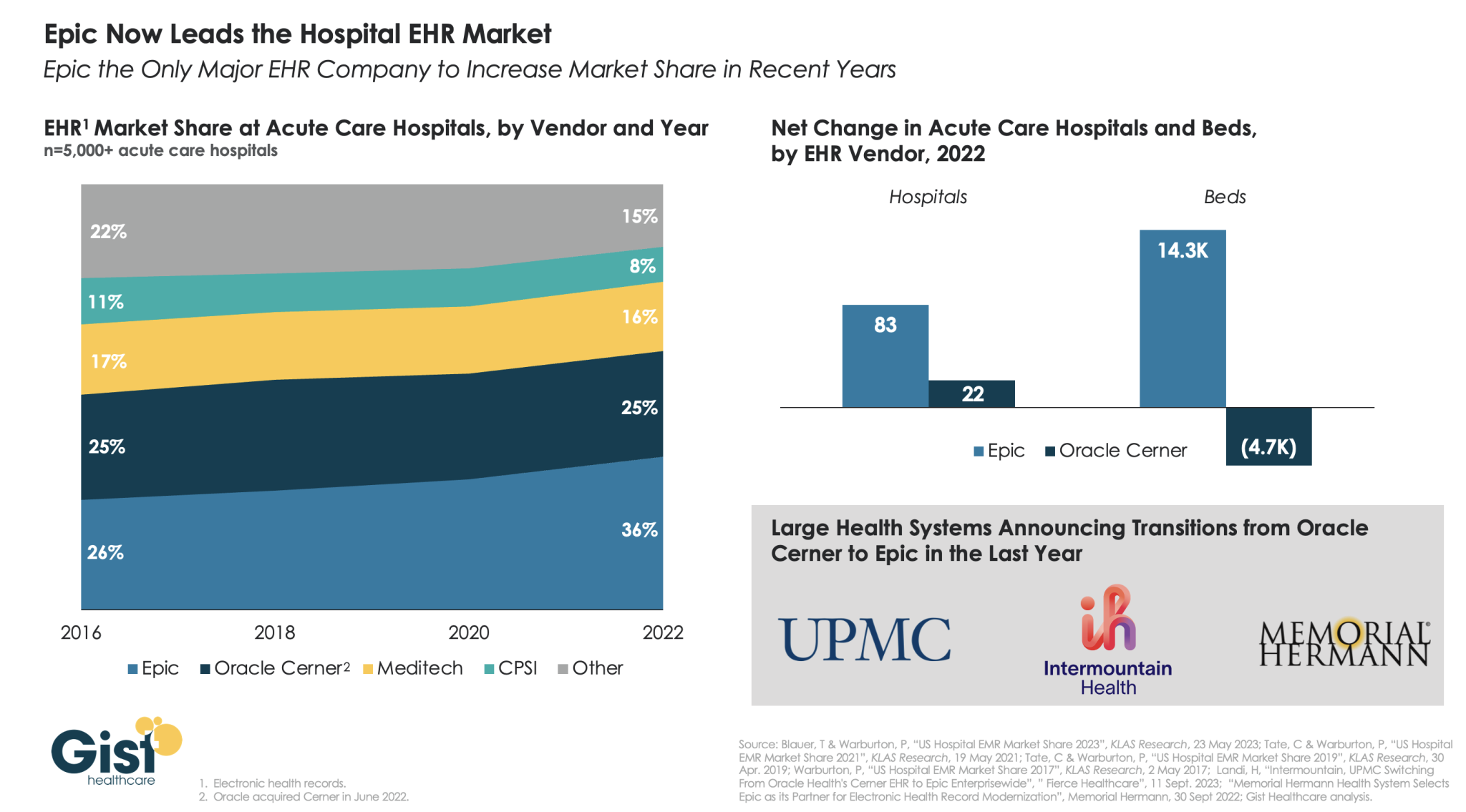
Using data from KLAS Research, the graphic below shows how Epic has emerged in recent years as the leader in the hospital EHR market. From 2016 to 2022, Epic increased its acute care hospital market share from 26 percent to 36 percent, while its main rival, Oracle Cerner, held flat at 25 percent.
Moreover, Epic is gaining popularity among larger health systems,while Oracle Cerner lost almost 5K beds in 2022, despite gaining 22 hospitals, as it trades large systems for smaller hospitals.
Epic’s ability to consolidate multiple archives into a single, more functional platform has made it popular with physicians, whose feedback was cited by Intermountain as a key reason behind the system’s decision to switch.
With three quarters of Americans having an Epic record, the company is leveraging its pole position in aggregating healthcare data as healthcare approaches the cusp of a generative AI boom, recently announcing an expanded partnership with Microsoft focused on integrating AI tools into its EHR system.
Two of the nation’s largest nonprofit health systems, Salt Lake City, UT-based Intermountain Healthcare and Pittsburgh, PA-based UPMC, have recently announced plans to end their electronic health record (EHR) contracts with Oracle Cerner and transition, enterprise-wide, to Epic.
Intermountain, which operates 33 hospitals across seven states, plans to integrate Epic’s EHR into all of its facilities by 2025; its legacy SCL Health hospitals in Colorado and Montana already use Epic.
UPMC, which operates 40 hospitals in three states, has set mid-2026 as the target for consolidating its nine EHRs into a single platform with Epic. It has been using Oracle Cerner in inpatient settings and Epic for ambulatory care.
Both systems cited provider feedback and a desire to simplify patient record-keeping as key reasons behind their decisions to switch.
The Gist: With two more marquee health systems jumping ship for Epic, Oracle Cerner faces a steeper battle to maintain a foothold with health systems and may need to rethink its target market and value proposition.
Cerner initially appealed to large, progressive, value-oriented systems with highly customizable offerings, but over the years the resulting “Franken-Cerner” systems (as one CIO put it) became hard to maintain and scale.
Meanwhile, Epic continues to grow its lead in the domestic EHR market: it now covers roughly half of acute-care beds in the US and holds records on 78 percent of US patients.
Sitting on troves of health data, Epic is also well-positioned to become a leader in the rollout of next-generation healthcare AI, which it has already set in motion through its partnership with Microsoft.
Kansas City, MO-based electronic health record (EHR) company Cerner is now a business unit within Oracle, the Austin, TX-based software behemoth. Oracle, which already sells some software to insurers, hospitals, and public health departments, called Cerner the company’s “anchor asset”, and hopes to use it to expand its healthcare presence. Oracle co-founder and board chair Larry Ellison unveiled lofty plans to create a national health records database, but he didn’t detail how the company would get access to health records from non-Cerner systems, as interoperability standards haven’t been fully implemented.
The Gist: In addition to the challenge of entering the complex EHR and healthcare data market, Oracle now faces the challenge of rebuilding Cerner’s growth, and its clients’ confidence. Cerner lags Epic in terms of hospital market share: Epic holds about a third of the US hospital market, compared to Cerner’s 24 percent. Epic gained an additional 74 hospitals last year, compared to Cerner’s five.
Anecdotally, we know of several long-term Cerner health system clients who are either in the middle of, or planning for, a transition to Epic, which is seen by health system leaders as the superior EMR option. (In the words of one executive, “No CEO ever got fired for choosing Epic.”) If a stronger Cerner product emerges as a result of the acquisition, it could help to stem this tide.
Oracle’s chairman Larry Ellison outlined a bold vision Thursday for the database giant to use the combined tech power of Oracle and Cerner to make access to medical records more seamless.
Days after closing its $28.3 billion acquisition of electronic health record company Cerner, Ellison said Oracle plans to build a national health record database that would pull data from thousands of hospital-centric EHRs.
In a virtual briefing Thursday, Ellison highlighted many long-standing problems with interoperability in healthcare. “Your electronic health data is scattered across a dozen or separate databases. One for every provider you’ve ever visited. This patient data fragmentation and EHR fragmentation causes tremendous problems,” he said.
“We’re going to solve this problem by putting a unified national health records database on top of all of these thousands of separate hospital databases. So we’re building a system where the health records all American citizens’ health records not only exist at the hospital level but also are in a unified national health records database.”
The concept of the national health records database, which would hold anonymized data, Ellison said, is to help doctors and clinicians have faster access to patient records when providing care. Anonymized health data in that national database could also be used to build artificial intelligence models to help diagnose diseases such as cancer.
“Better information is the key to transforming healthcare,” he said. “Better information will allow doctors to deliver better patient outcomes. Better information will allow public health officials to develop much better public health policy and it will fundamentally lower healthcare costs overall.”
Oracle also plans to modernize Cerner’s Millennium EHR platform with updated features such as voice interface, more telehealth capabilities and disease-specific AI models, Ellison said.
He highlighted a partnership between health tech company Ronin, a clinical decision support solution, and MD Anderson to create a disease-specific AI model that monitors cancer patients as they work through their treatments.
“The people at Oracle are not going to be developing these AI models. But our platform, Cerner Millennium, is an open system and allows medical professionals at MD Anderson, who are experts in treating cancer, to add these AI modules to help other doctors treat cancer patients,” Ellison said.
The purchase of Cerner, which marks Oracle’s biggest acquisition, gives the database giant a stronger foothold in healthcare. Ellison said the company’s enterprise resource planning (ERP) and HR software already is widely used in healthcare.
But the company will face the same long-standing barriers to sharing health data that have stymied other interoperability efforts. There also could be pushback from the industry to any effort by a tech giant to build a nationalized health database.
In March 2020, the federal government released rules laying the groundwork to give patients easier access to their digital health records through their smartphones. The regulation, which went into effect in April 2021, requires health IT vendors, providers and health information exchanges to enable patients to access and download their health records with third-party apps. Under the rule, providers can’t inhibit the access, exchange or use of health information unless the data fall within eight exceptions.
Interoperability experts point out there are already efforts underway to create a more unified database of health records, such Cerner competitor Epic’s Cosmos, which is a de-identified patient database combining the company’s EHR data of over 122 million patients.
Former U.K. Prime Minister Tony Blair is backing Ellison’s vision for building a unified health database. Blair, who leads the nonprofit Tony Blair Institute for Global Change, partners with Oracle to use its cloud technology to tackle health issues.
Speaking at the virtual event, Blair said a unified health records system will “empower citizens and provide clinicians and other care providers with immediate access to their health history and treatment without chasing it down from disparate sources.”
David Feinberg, M.D., who took the reins as Cerner CEO just four months before the acquisition was announced in December, said he was excited about the potential for Oracle and Cerner to advance data sharing.
“We’re bringing world-class technology coupled with a deep and long history of understanding how healthcare works. I don’t think anyone’s ever done that,” said Feinberg, now president and CEO of Oracle Cerner.





 HENRY KOTULA