

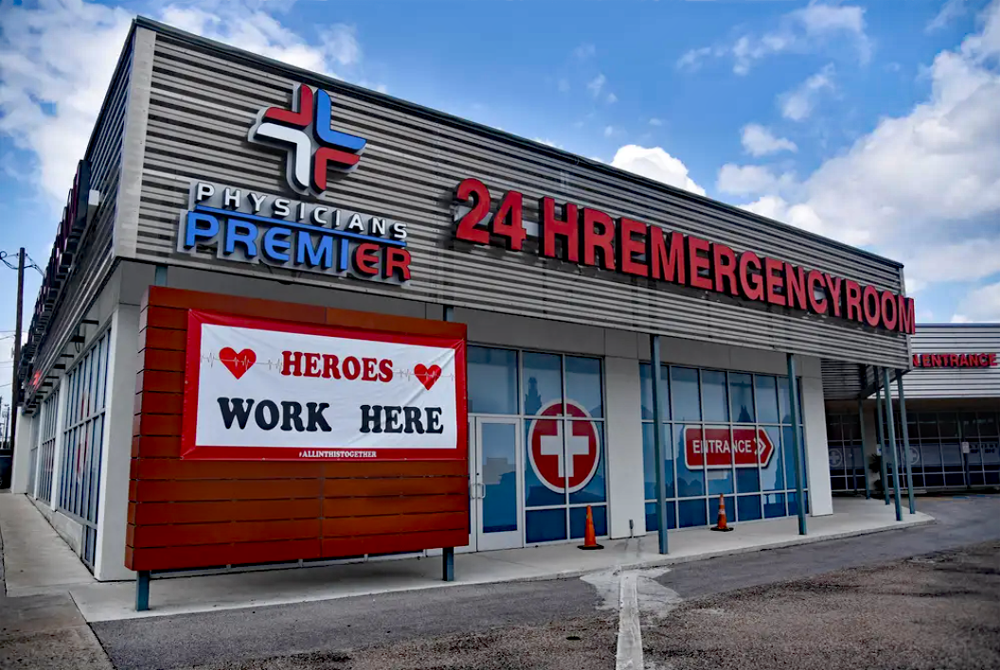
Physicians Premier ER charged Dr. Zachary Sussman’s insurance $10,984 for his COVID-19 antibody test even though Sussman worked for the chain and knows the testing materials only cost about $8. Even more surprising: The insurer paid in full.
When Dr. Zachary Sussman went to Physicians Premier ER in Austin for a COVID-19 antibody test, he assumed he would get a freebie because he was a doctor for the chain. Instead, the free-standing emergency room charged his insurance company an astonishing $10,984 for the visit — and got paid every penny, with no pushback.
The bill left him so dismayed he quit his job. And now, after ProPublica’s questions, the parent company of his insurer said the case is being investigated and could lead to repayment or a referral to law enforcement.
The case is the latest to show how providers have sometimes charged exorbitant prices for visits for simple and inexpensive COVID-19 tests. ProPublica recently reported how a $175 COVID-19 test resulted in charges of $2,479 at a different free-standing ER in Texas. In that situation, the health plan said the payment for the visit would be reduced and the facility said the family would not receive a bill. In Sussman’s case, the insurer paid it all. But those dollars come from people who pay insurance premiums, and health experts say high prices are a major reason why Americans pay so much for health care.
Sussman, a 44-year-old pathologist, was working under contract as a part-time medical director at four of Physicians Premier’s other locations. He said he made $4,000 a month to oversee the antibody tests, which can detect signs of a previous COVID-19 infection. It was a temporary position holding him over between hospital gigs in Austin and New Mexico, where he now lives and works.
In May, before visiting his family in Scottsdale, Arizona, Sussman wanted the test because he had recently had a headache, which can be a symptom of COVID-19. He decided to go to one of his own company’s locations because he was curious to see how the process played out from a patient’s point of view. He knew the materials for each antibody test only amounted to about $8, and it gets read on the spot — similar to an at-home pregnancy test.
He could even do the reading himself. So he assumed Physicians Premier would comp him and administer it on the house. But the staff went ahead and took down his insurance details, while promising him he would not be responsible for any portion of the bill. He had a short-term plan through Golden Rule Insurance Company, which is owned by UnitedHealthcare, the largest insurer in the country. (The insurance was not provided through his work.)
During the brief visit, Sussman said he chatted with the emergency room doctor, whom he didn’t know. He said there was no physical examination. “Never laid a hand on me,” he said. His vitals were checked and his blood was drawn. He tested negative. He said the whole encounter took about 30 minutes.
About a month later, Golden Rule sent Sussman his explanation of benefits for the physician portion of the bill. The charges came to $2,100. Sussman was surprised by the expense but he said he was familiar with the Physicians Premier high-dollar business model, in which the convenience of a free-standing ER with no wait comes at a cost.
“It may as well say Gucci on the outside,” he said of the facility. Physicians Premier says on its website that it bills private insurance plans, but that it is out-of-network with them, meaning it does not have agreed-upon prices. That often leads to higher charges, which then get negotiated down by the insurers, or result in medical bills getting passed on to patients.
Sussman felt more puzzled to see the insurance document say, “Payable at: 100%.” So apparently Golden Rule hadn’t fought for a better deal and had paid more than two grand for a quick, walk-in visit for a test. He was happy not to get hit with a bill, but it also didn’t feel right.
He said he let the issue slide until a few weeks later when a second explanation of benefits arrived from Golden Rule, for the Physicians Premier facility charges. This time, an entity listed as USA Emergency sought $8,884.16. Again, the insurer said, “Payable at: 100%.”
USA Emergency Centers says on its website that it licenses the Physicians Premier ER name for some of its locations.

Now Sussman said he felt spooked. He knew Physicians Premier provided top-notch care and testing on the medical side of things. But somehow his employer had charged his health plan $10,984.16 for a quick visit for a COVID-19 test. And even more troubling to Sussman: Golden Rule paid the whole thing.
Sussman was so shaken he resigned. “I have decided I can no longer ethically provide Medical directorship services to the company,” he wrote in his July 13 resignation email. “If not outright fraudulent, these charges are at least exorbitant and seek to take advantage of payers in the midst of the COVID19 pandemic.”
Sussman agreed to waive his patient privacy so officials from the company could speak to ProPublica. USA Emergency Centers declined interview requests and provided a statement, saying “the allegations are false,” though it did not say which ones.
The statement also said the company “takes all complaints seriously and will continue to work directly with patients to resolve issues pertaining to their emergency room care or bill. …The allegations received pertain to a former contracted employee, and we cannot provide details or further comment at this time.”
Physicians Premier advertises itself as a COVID-19 testing facility on its website, with “results in an hour.” According to the claims submitted by Physicians Premier to Golden Rule, obtained by Sussman, the physician fee and facility fees were coded as emergency room visits of moderate complexity. That would mean his visit included an expanded, problem-focused history and examination. But Sussman said the staff only took down a cursory medical history that took a few minutes related to his possible exposure to COVID-19. And he said no one examined him.
The claims also included codes for a nasal swab coronavirus test. But that test was not performed, Sussman said. The physician’s orders documented in the facility’s medical record also do not mention the nasal swab test. Those charges came to $4,989.
The claims show two charges totaling $1,600 for the antibody test Sussman received. In a spreadsheet available on its website on Friday, Physicians Premier lists a price of $75 for the antibody test.
For comparison, Medicare lists its payment at $42.13 for COVID-19 antibody tests. That’s because Medicare, the government’s insurance plan for the disabled and people over 65, sets prices.
Complicating matters, Texas is the nation’s epicenter for free-standing emergency rooms that are not connected to hospitals. Vivian Ho, an economist at Rice University who studies the facilities, said their business model is based on “trying to mislead the consumer.” They set up in locations where a high proportion of people have health insurance, but they don’t have contracted rates with the insurers, Ho said. They are designed to look like lower-priced urgent care centers or walk-in clinics, Ho said, but charge much higher emergency room rates. (The centers have defended their practices, saying that they clearly identify as emergency rooms and are equipped to handle serious emergencies, and that patients value the convenience.)
The day after he resigned, Sussman texted an acquaintance who works as a doctor at Physicians Premier. The acquaintance said the facility typically only collects a small percentage of what gets billed. “I just don’t want to be part of the game,” Sussman texted to him.
Shelley Safian, a Florida health care coding expert who has written four books on medical coding, reviewed Sussman’s medical records and claims at ProPublica’s request. The records do not document a case of a complex patient that would justify the bills used to code the patient visit, she said. For example, the chief complaint is listed as: “A generic problem (COVID TESTING).” Under “final acuity,” the medical record says, “less urgent.” Under the medical history it says, “NO SYMPTOMS.”
Safian described the charges as “obscene” and said she was shocked the insurer paid them in full. “This is the exact opposite of an employee discount,” she said. “Obviously nobody is minding the store.”
Congress opened the door to profiteering during the pandemic when it passed the CARES Act. The legislation, signed into law in March, says health insurers must pay for out-of-network testing at the cash price a facility posts on its website, or less. But there may be other charges associated with the tests, and insurers generally have tried to avoid making patients pay any portion of costs related to COVID-19 testing or treatment.
The charges for Sussman’s COVID-19 test visit are “ridiculous,” said Niall Brennan, president and CEO of the Health Care Cost Institute, a nonprofit organization that studies health care prices. Brennan wondered whether the CARES Act has made insurers feel legally obligated to cover COVID-19 costs. He called it “well intentioned” public policy that allows for “unscrupulous behavior” by some providers. “Insurance companies and patients are reliant on the good will and honesty of providers,” Brennan said. “But this whole pandemic, combined with the CARES Act provision, seems designed for unscrupulous medical providers to exploit.”
It’s illegal for medical providers to charge for services they did not provide. But ProPublica has previously reported how little insurers, including UnitedHealthcare, do to prevent fraud in their commercial health plans, even though experts estimate it consumes about 10% of all health care costs. For-profit insurance companies don’t want to spend the time and money it takes to hold fraudulent medical providers accountable, former fraud investigators have told ProPublica. Also, the insurance companies want to keep providers in their networks, so they easily cave.
In mid-July, Sussman used the messenger system on Golden Rule’s website to report his concerns about the case. Short-term health plans are typically less expensive because they offer less comprehensive coverage. Sussman said he appreciated that his plan covered the charges, and felt compelled to tell the company what had happened.
That led to a phone conversation with a fraud investigator. They went line by line through the charges and Sussman told him many of the services had not been provided. “His attitude was kind of passive,” Sussman said of the fraud investigator. “There was no indignation. He took in stride, like, ‘Yep, that’s what happens.’” The investigator said he would escalate the case and see if the facility had submitted any other suspect claims. But Sussman never heard back.
Maria Gordon-Shydlo, a spokeswoman for UnitedHealthcare, which owns Golden Rule, would not provide anyone to be interviewed. She said in an emailed statement that the company’s first priority during the pandemic “has been to ensure our members get the care they need and are not billed for COVID testing and treatment. Unfortunately, there are some providers who are trying to take advantage of this and are inappropriately or even fraudulently billing.”
“Golden Rule has put processes in place to address excessive COVID-related billing,” the statement said. “We are currently investigating this matter and, if appropriate, will seek to recoup any overpayment and potentially refer this case to law enforcement.”
Golden Rule’s 100% payment of the charges may simply come down to “incompetence,” said Dr. Eric Bricker, a Texas internist who spent years running a company that advised employers who self-fund their insurance. Insurance companies auto-adjudicate millions of claims on software that may be decades old, said Bricker, who produces videos to help consumers and employers understand health care. If bills are under a certain threshold, like $15,000, they may sail through and get paid without a second look, he said.
UnitedHealth Group reported net earnings of $6.6 billion in the second quarter of 2020. Bricker said the company may be paying bills without questioning them because it doesn’t “want to create any noise” by saying no at a time its own earnings are so high, Bricker said.
Texas has a consumer protection law that’s designed to prevent businesses from exploiting the public during a disaster. The attorney general’s office has received and processed 52 complaints about health care businesses and billing or price gouging related to the pandemic, a spokeswoman from the office said in an email. The agency does not comment on the existence of any investigations, but has not filed any cases related to overpriced COVID-19 tests.
Sussman said he got one voicemail from a billing person at Physicians Premier, saying she wanted to explain the charges, but he did not call back. He said he spoke out about it to ProPublica because he opposes Medicare-for-all health care reform proposals. Bad actors in the profession could cause doctors to lose their privilege to bill and be reimbursed independently, he said. Most physicians are fair with their billing, or even conservative, he said. “If instances like these go unchecked it will provide more ammo for advocates of a single-payer system.”


 HENRY KOTULA