Federal Reserve delivers super-sized half-point rate cut

The Federal Reserve cut its target interest rate Wednesday by an extra-large half-percentage point and projected more rate cuts this year and next, as its period of trying to put brakes on the economy to fight inflation comes to a close.

Why it matters: 

The move lowers borrowing costs for consumers and businesses, as the central bank aims to keep the economy’s expansion going strong amid warning signs on the outlook.

What they’re saying: 

“The labor market is actually in solid condition — and our intention with our policy move today is to keep it there,” Fed chair Jerome Powell told reporters at a press conference on Wednesday.

  • “The U.S. economy is in good shape. It’s growing at a solid pace,” Powell added. “We want to keep it there.”

Zoom in: 

The rate cut reflects the U.S. entering a new phase where the softening job market is the predominant economic risk — rather than elevated inflation.

  • By going with an aggressive half-point cut instead of its more traditional quarter-point adjustment, the Fed moved to get ahead of some evident faltering in the job market.
  • However, new projections imply the Fed will shift toward smaller quarter-point rate cuts from here.
  • The cut also thrusts the Fed into election-year politics, as former President Trump has said the central bank should not ease monetary policy mere weeks before the election. Some Democrats have called for even more aggressive rate cuts.

Driving the news: 

The policy-setting Federal Open Market Committee lowered its target range for the federal funds rate to 4.75%–5%, from the 5.25–5.5% range in place since last July.

  • The central bank also released new projections that anticipated the rate will be cut an additional half-point by December — implying a quarter-point cut at each of its two remaining 2024 meetings.
  • The median Fed officials anticipated their target rate will be down to 3.4% by the end of 2025, which implies four quarter-point rate cuts next year.
  • “Job gains have slowed,” the Fed’s policy statement noted, adding that the committee “has gained greater confidence that inflation is moving sustainably toward 2 percent.”

Of note: 

The Fed policy meeting marked the first dissent from a board member in more than two years. Michelle Bowman, a Trump-appointed governor who focuses on community banking issues, preferred to cut by only a quarter point.

  • Bowman’s dissent is also the first by a member of the Fed’s seven-member Board of Governors — as opposed to a regional Fed bank president — since 2005.
  • Christopher Waller, the other Trump-appointed governor on the board, supported the action.

By the numbers: 

The median official saw inflation for the full year coming in at 2.3%, not far from the Fed’s 2% target. By contrast, in June, officials saw 2.6% inflation this year.

  • They also anticipate slightly higher unemployment. The projections listed a 4.4% unemployment rate in the final quarter of the year. That rate was 4.2% in August, up from 3.7% at the start of the year.
  • However, the Fed officials’ forecasts also imply the jobless rate leveling out at that point and being flat at 4.4% in the final months of 2025.

The bottom line: 

Powell and his colleagues elected to take more aggressive action Wednesday in hopes that it will be enough to forestall any further deterioration in the job market of the sort seen over the last few months — and is betting that the Fed can move to a more gradualist approach from here.

  • Speaking about the larger-than-anticipated rate cut, Powell said he was pleased the Fed made a strong start in lowering interest rates.
  • “The logic of this — both from an economic standpoint and also from a risk management standpoint — was clear,” Powell said.
  • He added: “We’re gonna take it meeting by meeting. … There’s no sense that the committee feels it’s in a rush to do this.”

Two less-obvious ways the Fed made mortgages pricier

The line chart shows the Federal Reserve's holdings of mortgage-backed securities from August 2019 to August 2024, with a steep rise between the spring of 2020 and early 2022, peaking at about $2.7 trillion following by a gradual decline starting in mid-2022. As of August 21, holdings had fallen to $2.31 trillion.

Data: Federal Reserve; Chart: Axios Visuals

The Federal Reserve has pushed mortgage rates higher not just through its much-discussed interest rate policy decisions, but through two less widely understood channels, a new paper argues.

Why it matters: 

Since 2022, high mortgage rates have made homebuying an expensive endeavor for would-be borrowers and created dysfunction in the housing market.

The big picture: 

But mortgage rates have risen substantially higher than justified by the Fed’s rate hikes alone. That’s thanks in part to a double whammy of two other factors:

  1. Quantitative tightening has meant the Fed withdrawing billions from the mortgage market.
  2. Higher rates have led banks to do the same as they have lost deposits, says the paper presented by New York University economist Philipp Schnabl on Saturday at the Kansas City Fed’s annual symposium in Jackson Hole, Wyoming.

How it works: 

As the Fed looked to stimulate the economy at the onset of the pandemic in 2020 and 2021, it began buying mortgage-backed securities (MBS) on massive scale as part of its quantitative easing program, essentially funneling cash to homebuyers. Its stockpile of MBS rose from $1.4 trillion in March 2020 to $2.7 trillion at the peak.

  • Its reversal, part of the Fed’s fight against inflation, has so far drained those holdings by about $400 billion.
  • Meanwhile, in 2021, consumers’ rapid accumulation of pandemic savings swelled bank deposits, and banks — needing to deploy those funds — ramped up their own mortgage lending and purchases of MBS. But as rates rose, deposits reversed as depositors had better options in Treasury bills and money market mutual funds.

The intrigue: 

As the Fed tightened policy to fight inflation starting in 2022, it raised its short-term interest rate target, which also led longer-term Treasury bond yields to rise. But the mortgage rates available to consumers rose by even more.

  • The spread between the 10-year Treasury yield and average consumer mortgage rate was a mere 1.5% in May 2021, but nearly twice as large, 2.9%, in 2023.
  • In other words, homebuyers got hit harder by monetary tightening than the U.S. government. The new paper helps explain why.

What they’re saying: 

“Banks and the Fed bought enormous quantities of mortgages during 2020–21, causing mortgage rates to decline drastically,” write the authors, Itamar Drechsler, Alexi Savov, Schnabl and Dominik Supera.

  • “When monetary policy reversed course, banks and the Fed cut back their mortgage holdings, causing mortgage rates to rise and the mortgage spread to widen,” they write. “Monetary policy thus had an outsized impact on mortgage rates.”

Surprising U.S. economy is powering better global outlook, World Bank says

The global economy is in better shape than it was at the start of the year, thanks largely to the performance of the United States, the World Bank said in its latest forecast Tuesday. But the sunnier outlook could cloud over if major central banks — including the Federal Reserve — keep interest rates at elevated levels.

Global growth is expected to reach an annual rate of 2.6 percent this year, up from a January forecast of 2.4 percent, the bank said. The global economy is drawing closer to a “soft landing” after recent price spikes, with average inflation dropping to a three-year low amid continuing growth, bank economists said.

While Americans’ unhappiness with high prices remains a key vulnerability for President Biden’s reelection bid, the World Bank now expects the U.S. economy to grow at an annual rate of 2.5 percent, nearly a full percentage point higher than it predicted in January.

The United States is the only advanced economy growing significantly faster than the bank anticipated at the start of the year.

“Globally, overall things are better today than they were just four or five months ago,” said Indermit Gill, the World Bank’s chief economist. “A big part of this has to do with the resilience of the U.S. economy.”

The bank credited “U.S. dynamism” with helping stabilize the global economy, despite the highest interest rates in years and wars in Ukraine and the Middle East. Employers added 272,000 jobs in May, topping analysts’ estimates, the Labor Department reported last week.

Expected global growth this year and next, however, will remain below the pre-pandemic average of 3.1 percent. Three out of four developing countries are now expected to grow more slowly than the bank forecast in January, leaving them little hope of narrowing the income gap with richer nations.

Despite their mostly upbeat tone, bank officials warned that central banks including the Fed are likely to move slowly to begin reversing the past two years of interest rate increases. That means global interest rates will remain high, averaging around 4 percent over the next two years, roughly twice the average recorded during the two decades before the pandemic.

Global inflation should ease to 3.5 percent this year, before dropping to 2.9 percent next year. But the decline is proving more gradual than the bank anticipated. And any deterioration that causes monetary authorities to delay cuts in borrowing costs could strip 0.3 percentage points from the forecast growth rates.

“This is a major risk confronting the global economy — interest rates remaining higher for longer and an already weak growth outlook becoming weaker,” Gill said.

Bank officials also flagged global trade — which is on course this year to complete its weakest half-decade since the 1990s — as a concern. Trading nations in 2024 have implemented more than 700 restrictions on merchandise trade and nearly 160 barriers to services trade.

“Trade restrictive measures have skyrocketed. They have more than doubled since the pre-pandemic period,” Gill said.

Rising protectionism risks becoming a drag on the global economy’s already modest pace of growth. Popular support in many countries for tariffs on imported goods and industrial subsidies that favor domestic production could further constrict trade flows that are already under pressure from the U.S.-China rivalry and other geopolitical risks.

“The world might become stuck in the slow lane,” said Ayhan Kose, the bank’s deputy chief economist.

Among those likely to suffer if key interest rates stay higher for longer are the 40 percent of developing countries at risk of a debt crisis. Many borrowed heavily to fund pandemic-related health care and subsequently to cover food and fertilizer bills that soared following the war in Ukraine.

They have little immediate prospect of securing debt relief and now risk losing out on trade gains as larger economies turn inward, Gill said.

What to look for the in the Labor Department’s May jobs report

https://www.cbsnews.com/news/jobs-report-may-inflation-interest-rates/


The US labor market added more jobs than expected in May defying previous signs of a slowdown in the economy.

Data from the Bureau of Labor Statistics released Friday showed the labor market added 272,000 nonfarm payroll jobs in May, significantly more additions than the 180,000 expected by economists.

Meanwhile, the unemployment rate rose to 4% from 3.9% the month prior. May’s job additions came in significantly higher than the 165,000 jobs added in April.

The print highlights the difficulty the Federal Reserve faces in determining when to lower interest rates and how quickly. The economy and labor market has held up overall, and inflation has remained sticky, building the case for holding rates higher for longer. Yet some cracks have emerged, such as signs of inflation pressuring lower income consumers and rising household debt.

“They’re really walking a tight rope here,” Robert Sockin, Citi senior global economist, told Yahoo Finance of the central bank. He noted the longer the Fed holds rates steady, the more cracks could develop in the economy.

Wages, considered an important metric for inflation pressures, increased 4.1% year over year, reversing a downward trend in year-over-year growth from the month prior. On a monthly basis, wages increased 0.4%, an increase from the previous month’s 0.2% gain.

“To see more confidence that inflation could move lower over time, you’d really like to see the wage numbers look a little lower than we’ve seen them today,” Lauren Goodwin, New York Life Investments economist and chief market strategist, told Yahoo Finance.

Also in Friday’s report, the labor force participation rate slipped to 62.5% from 62.7% the month prior. However, participation among prime-age workers, ages 25-54, rose to 83.6%, its highest level in 22 years.

The largest jobs increases in Friday’s report were seen in healthcare, which added 68,000 jobs in. May. Meanwhile, government employment added 43,000 jobs. Leisure and hospitality added 42,000 jobs.

The report comes as the stock market has hit record highs amid a slew of softer-than-expected economic data, which had increased investor confidence that the Federal Reserve could cut interest rates as of September. After Friday’s labor report, that trend reversed with investors pricing in a 53% chance the Fed cuts rates in September, down from a roughly 69% chance seen just a day prior, per the CME FedWatch Tool.

Other data out this week has reflected a still-resilient labor market that’s showing further signs of normalizing to pre-pandemic levels. The latest Job Openings and Labor Turnover Survey (JOLTS), released Tuesday, showed job openings fell in April to their lowest level since February 2021.

Notably, the ratio between the number of job openings and unemployed people returned to 1.2 in May, which is in line with pre-pandemic levels.

Dow Jones Industrial Average hits 40,000 for the 1st time

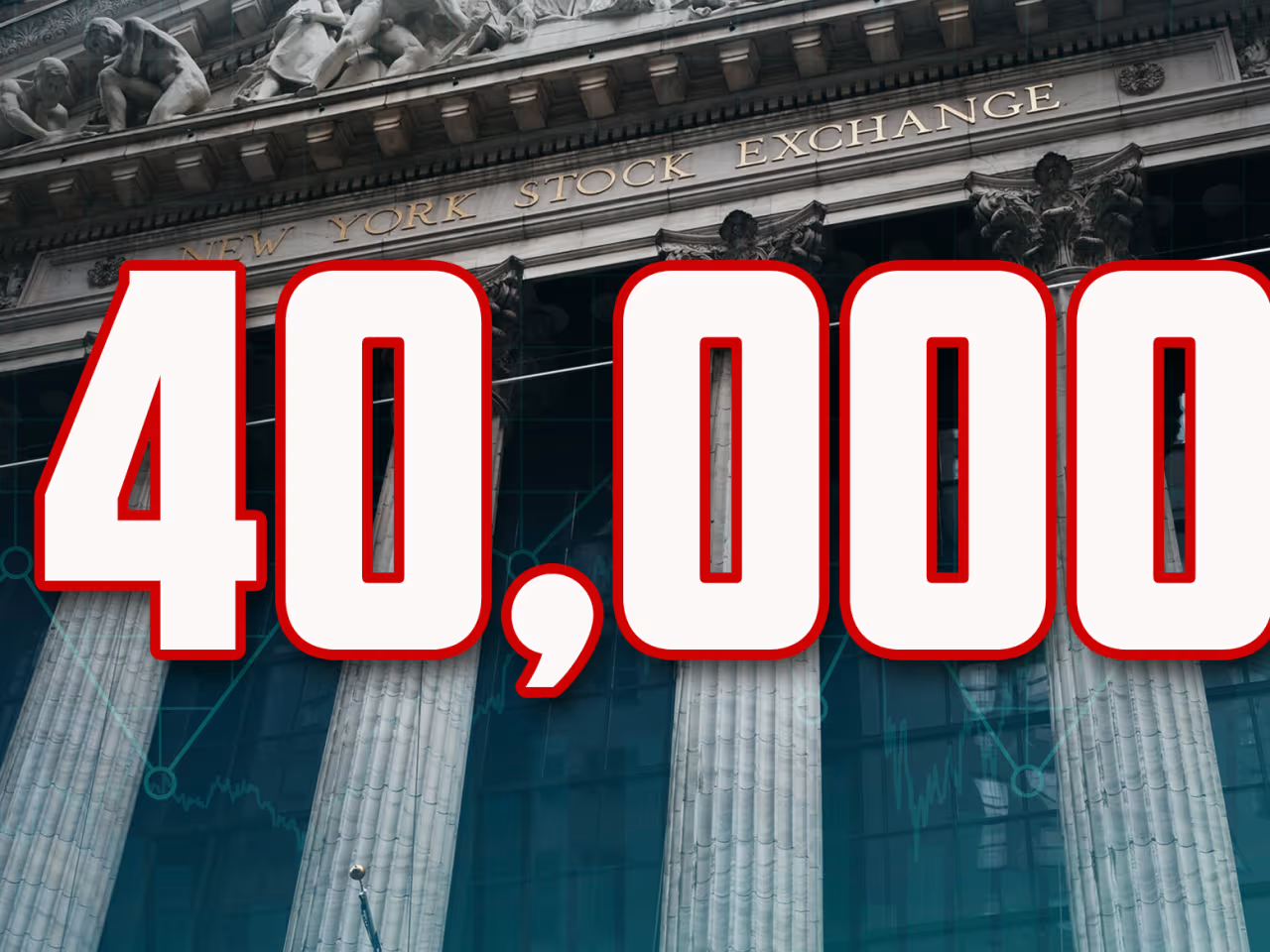
The Dow Jones Industrial Average crossed 40,000 for the first time in history on Thursday.

This is a significant and symbolic milestone for the index that tracks 30 of the most valuable publicly traded companies in the U.S.

The Dow is now up about 6% so far this year.

The recent rally in the Dow, S&P 500 and Nasdaq has been fueled by data showing inflation is cooling, which would allow the Federal Reserve to begin its long-awaited interest rate cuts.

Inflation data released on Wednesday showed that price increases slowed slightly from the annual rate recorded in the previous month, ending a surge of inflation that stretches back to the beginning of 2024.

In recent months, the Fed had all but abandoned its previous forecast of three quarter-point rate cuts this year. But the slowdown of price hikes offered hope of rekindling those plans.

“The combination of the Fed likely to be lowering interest rates because inflation is moderating with a resilient economy is a beautiful scenario for a bull market,” Ed Yardeni, the president of market advisory firm Yardeni Research and former chief investment strategist at Deutsche Bank’s U.S. equities division, told ABC News.

“It’s more enjoyable to say the market is going to these nice, round numbers in record-high territory than coming back down to them,” Yardeni added.

The inflation news on Wednesday sent each of the major stock indexes up more than 5% for the day, propelling all of them to record highs. In early trading on Thursday, the Dow had ticked up a quarter of a percentage point.

Observers have also attributed this year’s stock market rally to the rise in value of some major tech firms, driven largely by enthusiasm about artificial intelligence.

Inflation cools, reassuring Fed after unexpectedly hot gains in Q1

The yield on the benchmark 10-year Treasury note fell on investor speculation that slower inflation will prompt the Fed to sooner cut borrowing costs.

Dive Brief:

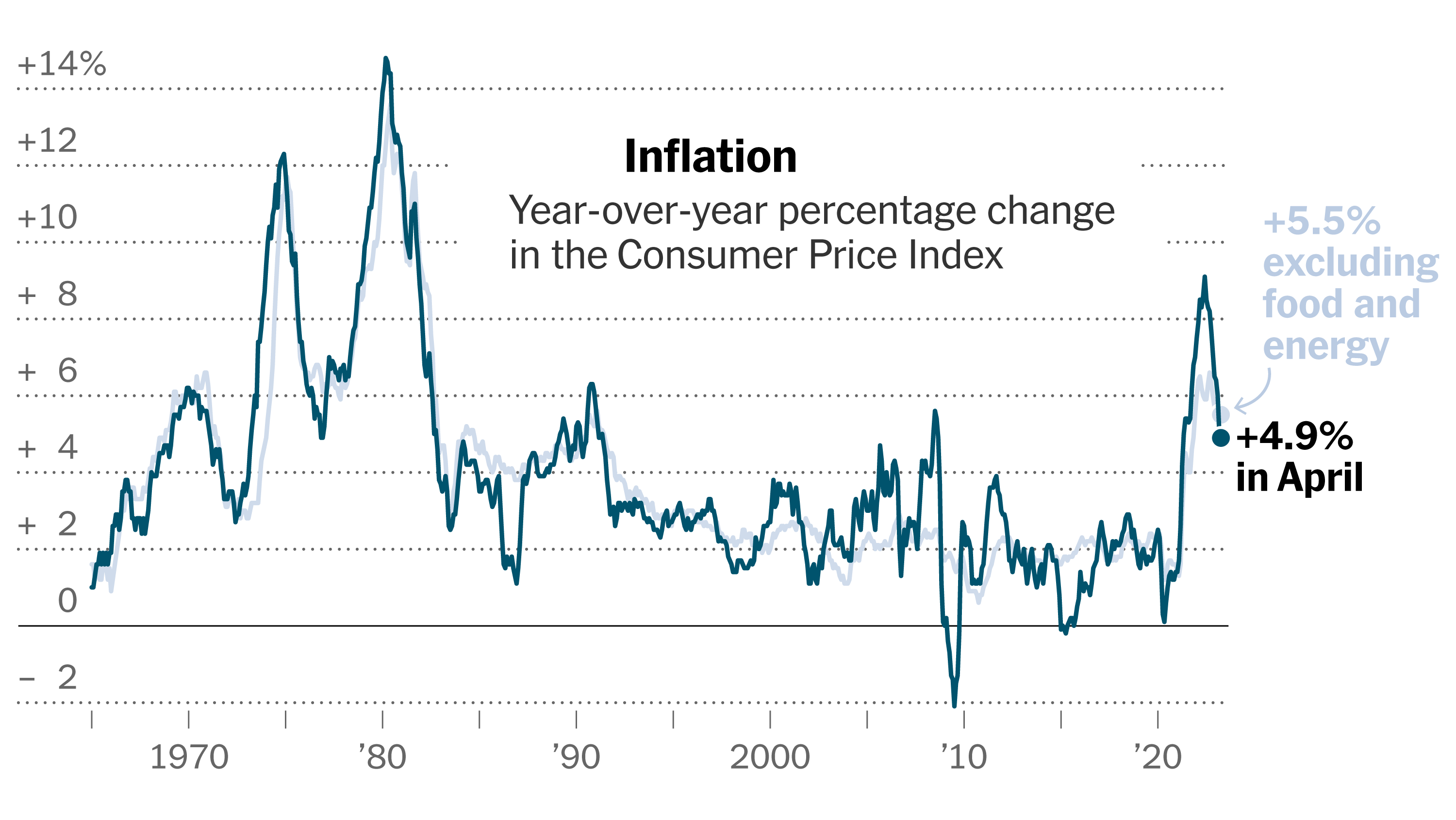
  • The consumer price index excluding volatile food and energy prices rose last month at the slowest pace this year, giving Federal Reserve policymakers some relief from a barrage of first-quarter data that shook confidence inflation will steadily slow to their 2% goal.
  • So-called core CPI gained 0.3% in April compared with 0.4% during the prior month, and eased to 3.6% on an annual basis from 3.8% in March, the Bureau of Labor Statistics said Wednesday. Shelter costs rose 0.4% last month, pushing up core CPI more than any other category. Prices for transportation, apparel and medical care also increased.
  • “Inflation should show some signs of more material disinflation over the coming months as upside surprises in Q1 reverse and shelter inflation continues to soften, particularly” during the second half of this year, David Page, head of macroeconomic research at AXA IM, said in a report.

Dive Insight:

Fed Chair Jerome Powell has repeatedly said this month that unexpectedly high first-quarter inflation eroded his confidence that price pressures are falling steadily enough to warrant a reduction in the highest federal funds rate in 23 years.

“I would say my confidence in that is not as high as it was, having seen these readings in the first three months of the year,” Powell said Tuesday.

Investor speculation that cooling inflation will prompt the Fed to sooner trim borrowing costs pushed down the yield on the benchmark Treasury note on Wednesday by about 0.1 percentage point to 3.86%. Equity prices rose.

“Today’s data may be a relief relative to past months, and that should reduce any fears that the Fed might have to raise rates,” Eric Winograd, developed market research director at AllianceBernstein, said in an email.

Still, “today’s data are not good enough to move the policy needle,” Winograd said, forecasting that the central bank will not cut the main interest rate until the fourth quarter.

“Unless the labor market weakens appreciably, it will take several months of inflation steadily decelerating before the Fed will be comfortable cutting rates,” he said.

Traders in interest rate futures put 69% odds that the Fed will trim the main interest rate by at least 0.5 percentage point by the end of this year, compared with 57% odds on Tuesday, according to the CME FedWatch Tool.

“The Fed is making progress, but taming inflation is taking time,” Scott Helfstein, head of investment strategy at Global X, said in an email response to questions.

“The Fed will probably be patient,” Helfstein said, forecasting either no change to the federal funds rate this year or at most a quarter-point cut in December. “A stable rate and inflation environment, most importantly, is good for companies.”

Powell predicted that inflation will eventually slow to a more moderate pace. “I expect that inflation will move back down on a monthly level, on a monthly basis, to levels that were more like the lower readings we were having last year,” Powell said Tuesday.

A separate report Wednesday showed consumers may be pocketing their wallets in response to higher borrowing costs and the waning of savings built during the pandemic.

Retail sales in April were unchanged from March, the Census Bureau said, releasing data that was lower than expected by economists. Growth in retail sales in March was marked down to 0.6% from 0.7%.

Still, “the consumer is okay,” Helfstein said, predicting that “economic growth will likely be driven by corporate investment through the back part of the year.”

Inflation pressures ease in April as consumer prices rise at slowest pace in three months

https://finance.yahoo.com/news/inflation-pressures-ease-in-april-as-consumer-prices-rise-at-slowest-pace-in-three-months-123222215.html

US consumer price increases cooled during the month of April, according to the latest data from the Bureau of Labor Statistics released Wednesday morning.

The Consumer Price Index (CPI) rose 0.3% over the previous month and 3.4% over the prior year in April, a slight deceleration from March’s 3.5% annual gain in prices and 0.4% month-over-month increase.

April’s monthly increase came in lower than economist forecasts of a 0.4% uptick. The annual rise in prices matched estimates, according to data from Bloomberg, and marked the slowest gain in three months.

On a “core” basis, which strips out the more volatile costs of food and gas, prices in April climbed 0.3% over the prior month and 3.6% over last year — cooler than March’s data. Both measures met economist expectations.

Investors now anticipate two 25 basis point cuts this year, down from the six cuts expected at the start of the year, according to updated Bloomberg data.

Markets rose following the data’s release, with the 10-year Treasury yield (^TNX) falling about 6 basis points to trade around 4.38%.

“The lack of a nasty surprise this time around is welcomed,” Bankrate senior economist analyst Mark Hamrick wrote in reaction to the print. Still, Hamrick added, “with the 3.4% year-over-year headline increase and 3.6% in the core (excluding food and energy), these remain irritatingly high. The status of the battle against inflation requires that interest rates remain elevated in the near-term.”

Following the data’s release, markets were pricing in a roughly 53% chance the Federal Reserve begins to cut rates at its September meeting, according to data from the CME FedWatch Tool. That’s up from about a 45% chance the month prior.

Shelter, gas prices remain sticky

Notable call-outs from the inflation print include the shelter index, which rose 5.5% on an unadjusted, annual basis, a slowdown from March. The index rose 0.4% month over month and was the largest factor in the monthly increase in core prices, according to the BLS.

Sticky shelter inflation is largely to blame for higher core inflation readings, according to economists.

The index for rent and owners’ equivalent rent (OER) each rose 0.4% on a monthly basis, matching March’s rise. Owners’ equivalent rent is the hypothetical rent a homeowner would pay for the same property.

Lodging away from home decreased 0.2% in April after rising 0.1% in March.

Energy prices continued to rise in April, buoyed by higher gas prices. The index jumped another 1.1% last month, matching March’s increase. On a yearly basis, the index climbed 2.6%.

Gas prices rose 2.8% from March to April after climbing 1.7% the previous month.

The food index increased 2.2% in April over the last year, with food prices flat from March to April. The index for food at home decreased 0.2% over the month while food away from home rose another 0.3%.

Other indexes that increased in April included motor vehicle insurance, medical care, apparel, and personal care. Motor vehicle insurance, a standout in March’s report after the category jumped 2.6%, climbed another 1.8% in April.

The indexes for used cars and trucks, household furnishings and operations, and new vehicles were among those that decreased over the month, according to the BLS.

Key Inflation Measure Falls To Lowest Rate Since Early 2021

TOPLINE

Inflation moderated as economists forecasted last month, according to the Federal Reserve’s favored inflation metric, bringing welcome news for investors, home buyers and consumers alike looking for interest rate cuts.

KEY FACTS

Americans spent 2.4% more in January than they did in January 2023, according to the personal consumption expenditures (PCE) price index released Thursday morning by the Bureau of Economic Analysis.

That meets consensus economist estimates of 2.4% annual PCE inflation and comes in lower than last month’s 2.6%.

It’s the lowest PCE reading since March 2021.

Core PCE inflation, which tracks expenditures for goods and services other than the less sticky food and services inputs, was 2.8% in January, in line with forecasts of 2.8%.

It’s similarly the lowest core PCE reading since March 2021 and checks in significantly lower than January 2023’s 4.7% inflation.

KEY BACKGROUND

Core PCE inflation, which is Fed Chairman Jerome Powell’s inflation measure of choice, is still well above the Fed’s long-term 2% target.

Earlier this month, PCE’s sister consumer price index (CPI) revealed far worse CPI inflation than economists projected, sending the S&P 500 stock index to its biggest loss in almost 12 months as sticky inflation would likely cause the Fed to delay the much-anticipated rate cuts until more tangible progress toward 2% inflation is apparent. CPI measures the average prices nationwide of a predetermined basket of goods and services, while PCE measures how much Americans actually spend monthly, earning the latter policymakers’ affection as it arguably paints a better picture of the health of Americans’ wallets.

The series of hotter than anticipated inflation data has dramatically pushed back expectations of when and by how much the Fed will slash rates in 2024. Higher inflation typically keeps rates higher for longer, making loans such as mortgages more expensive, exemplified by mortgage rates more than doubling over the last two years to their highest levels since the turn of the century.

The futures market currently prices in June as the most likely date of the first cut and 75 basis points of cuts as the most likely outcomeaccording to the CME Group’s FedWatch Tool, much softer than a month ago’s implied forecasts of the first reduction coming in May and 125 basis points of cuts.

U.S. economy adds whopping 353,000 jobs in January as labor market heats up

https://www.axios.com/2024/02/02/us-jobs-report-january-2024

The U.S. economy added 353,000 jobs in January, while the unemployment rate held at 3.7%, the Labor Department said Friday.

Why it matters: 

The first look at the 2024 labor market shows it’s on fire — not slowing down as previously thought.

Details: 

The January payroll figures show hiring picked up from the 333,000 added the prior month, which itself was revised higher by 117,000.

  • Job gains in November were revised slightly higher, too, by 9,000 to 182,000 jobs added.

What’s new: 

The hiring boom last month came amid strong job gains in health care, retail and professional and business services, while mining and oil and gas extraction are among the sectors that shed jobs.

  • Meanwhile, the labor force participation rate — the share of workers with or looking for a job — was 62.5% in January.
  • Average hourly earnings, a measure of wage growth, soared by 0.6%. Over the past 12 month, average hourly earnings increased by 4.5%.

The big picture: 

The data is the latest in recent weeks to show that the economy is revving up, with fading inflation and steady hiring — a welcome development for the Biden administration that is touting its economic agenda ahead of the 2024 election.

The intrigue:

The strong growth in both jobs and earnings will make the Federal Reserve reluctant to cut interest rates soon, out of fear that labor market strength could reverse progress on inflation.

  • Already this week, Fed chair Jerome Powell threw cold water on the idea of a March rate cut.

The bottom line:

Despite high profile layoffs at media and technology companies, the report shows that broader labor market is heating up.

Six Majority Beliefs about the U.S. Health System Compromise its Value Proposition

Last week was notable for healthcare because current events thrust it into the limelight…

Hospitals and emergency responders in Maine: Media attention to Gaza and the Speaker-less U.S. House of Representatives was temporarily suspended as the deaths of 18 in the U.S.’ 36h mass shooting in Lewiston, Maine took center stage. The immediate overload on Lewiston’s Central Maine Medical Center and Mass General where the 13 injured were treated (including 4 still hospitalized) drew media attention—largely gone by Friday when the shooter’s death by suicide was confirmed.

The New Speaker of the House: The GOP House of Representatives elected Mike Johnson, the 4-term Representative from Shreveport to the post vacant since October 3.

Johnson is no stranger to partisan positions on healthcare issues. As Chairman of the conservative-leaning Republican Steering Committee from 2019-2021, he led the group’s platform to dismantle the Affordable Care Act and supports a national restriction on abortions despite Senate GOP Leader McConnell’s preference it be left to states to decide.

With the prospect of a government shutdown November 17 due to inaction on the FY2024 federal budget, the 52-year-old lawyer faces delicate maneuvering around $106 billion proposed for Israel, the Ukraine, Taiwan and border security alongside appropriations for the health system that consumes 28% of entire federal outlays.

Health organizational business strategy announcements: Friction between physicians and hospital officials in Asheville (Mission) and Minnesota (Allina) attracted national coverage and brought attention to staffing, cultural and financial circumstances in these prominent organizations. —and on the heels of the Kaiser Permanente strike settlement. The divorce from Mass General by Dana Farber in Boston and announcements by GNC, Best Buy, Optum (re-branding NaviHealth) and Sanofi hit last week’s news cycle.

And indirectly, the 3Q 2023 GDP report by the Department of Commerce raised eyebrows: it was up 4.9%–far higher than expected prompting speculation that the Federal Open Market Committee (FOMC) will raise interest rates (again) at its meeting this week or next month. That means borrowing costs for struggling hospitals, nursing homes and consumers needing loans will go up along with household medical debt.

As news cycles go, this one was standard fare for healthcare: with the exception of business plan announcements by organizations or as elements of tragedies like Lewiston, Gaza or a pandemic,

the business of the health system—how it operates is largely uncovered and often subject to misinformation or disinformation.

That’s the problem: it’s background noise to most voters who can be stoked to action over a single issue when prompted by special interests (i.e., Abortion rights, surprise billing, price transparency et al) but remain inattentive and marginally informed about the bigger role it plays in our communities and country and where it’s heading long-term.

The narrative common to most boils down to these:

  • The U.S. health system is good, but it’s complicated. ‘How good’ depends on your insurance and your health—both are key.
  • The U.S. health system is expensive and profitable. It pays its executives well and its frontline workers unfairly.
  • The delivery system focuses on the sick and injured; prevention and public health matter less.
  • Hospitals and physicians are vital to the system; health insurers keep their costs down.
  • The U.S. system pays lip service to “customer service” and ‘engaged consumers.” It is spin not supported by actions.
  • The U.S. system needs to change dramatically.

In the next 3 weeks, attention will be on the federal budget: healthcare will be in the background unless temporarily an element of a mass tragedy. Each trade group will tout its accomplishments to regulators and pimp their advocacy punch list. Each company will gin-out news releases and commentary about the future of the system will default to think tanks and focused on a single issue of interest.

That’s the problem. In this era of social media, polarization, and mass transparency, these old ways of communicating no longer work. Left unattended, they undermine the value proposition on which the U.S. system is based.