20 hospitals, health systems that provide the most ‘unnecessary’ care: Johns Hopkins

Johns Hopkins study names health systems that provide the most 'unnecessary'  care | Modern Healthcare

Health systems that employed fewer primary care physicians, have higher bed counts or are investor owned were more likely to provide more unnecessary or low-value care, a study published Jan. 14 in JAMA found.

For the study, researchers from Baltimore-based Johns Hopkins University analyzed Medicare claims data at 3,745 hospitals for 17 low-value services. The low-value services were previously identified as unnecessary and included services such as pap smears for women older than 65, an abdominal CT scan with and without contrast and spinal fusions for back pain, according to the study.  

The researchers then rated the hospitals using an overuse index, which was based on the Medicare claims for the low-value healthcare services. Health systems rated at least 1.5 standard deviations or more above the average in the overuse index were considered over-users of low-value services.

Below is a breakdown of the 20 hospitals that provided the most unnecessary care based on the overuse index.

1. St. Dominic Health Services (Jackson, Miss.)

2. USMD Health System (Irving, Texas)

3. Community Medical Centers (Clovis, Calif.)

4. Care New England Health System (Providence, R.I.)

5. East Alabama Medical Center (Opelika)

6. Pocono Health System (East Stroudsburg, Pa.)

7. University Health Care System (Augusta, Ga.)

8. Deaconess Health System (Evansville, Ind.)

9. Congregation of the Sisters of St Joseph of Peace (Englewood Cliffs, N.J.)

10. Iredell Health System (Statesville, N.C.)

11. Sacred Heart HealthCare System (Allentown, Pa.)

12. Southeast Health (Dothan, Ala.)

13. Chesapeake (Va.) Regional Medical Center

14. Butler (Pa.) Health System

15. CarolinaEast Health System (New Bern, N.C.)

16. Ohio Valley Health Services and Education Corp. (Wheeling, W.Va.)

17. Slidell (La.) Memorial Hospital

18. Lakeland (Fla.) Regional Health System

19. North Kansas City (Mo.) Hospital

20. Temple University Health System (Philadelphia)

Read more here

The Pitfalls of Cost Sharing in Healthcare

The Pitfalls of Cost Sharing in Healthcare – Health Econ Bot

Cost-sharing is the practice of making individuals responsible for part of their health insurance costs beyond the monthly premiums they pay for health insurance – think things like deductibles and copayments. The practice is meant to inspire more thoughtful choices among consumers when it comes to healthcare decisions. However, the choices it inspires can often be more harmful than good.

25% of US healthcare spending is waste, study finds

https://www.beckershospitalreview.com/finance/25-of-us-healthcare-spending-is-waste-study-finds.html?oly_enc_id=2893H2397267F7G

Image result for Journal of the American Medical Association (JAMA) Publishes Humana Study on Health Care Spending


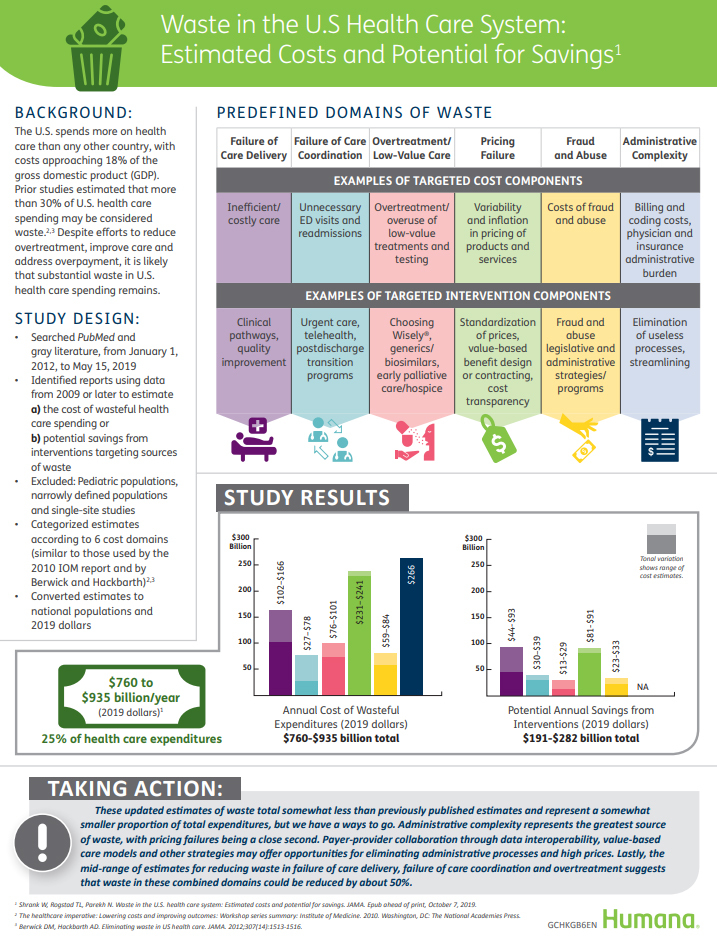
About 25 percent of U.S. healthcare spending can be classified as waste, according to a new study published in JAMA Oct. 7. 

For the study, researchers from Humana and the University of Pittsburgh School of Medicine analyzed 54 peer-reviewed studies, government reports and other medical literature to estimate the levels of waste in the U.S. healthcare system.

Researchers divided waste into six previously developed categories including: failure of care delivery; failure of care coordination; overtreatment or low-value care; pricing failure; fraud and waste; and administrative complexity. 

Administrative complexity accounted for the most waste with $265.6 billion annually, followed by pricing failure or inefficiencies, which accounted for up to $240.6 billion in waste per year.

Approximately $300 billion in waste accrued from failure of care delivery, failure of care coordination and overtreatment. The study estimated that about half of this waste could be avoided.

Overall, the researchers found that the cost of waste in the U.S. healthcare system ranges from $760 billion to $935 billion annually.

Of the $760 billion to $935 billion of waste, researchers estimated that using interventions found to reduce waste could cut between $191 billion and $282.1 billion in healthcare spending.

Access the full report here