CMS proposes a nearly 3% cut to Medicare physician pay for 2025

https://www.kaufmanhall.com/insights/blog/gist-weekly-july-12-2024

On Wednesday, the Centers for Medicare & Medicaid Services (CMS) issued its proposed annual changes to physician payments in its 2025 Medicare Physician Fee Schedule Proposed Rule. Required by statute to maintain budget neutrality, CMS is proposing to reduce the conversion factor—which translates the cost of providing medical services into physician payments—by 2.8%.

This is expected to lower physician payments by 2.93% on average. The proposed rule also includes new telehealth flexibilities, changes allowing eligible accountable care organizations access to a quarterly advance on their earned savings, and new payments for providers that help patients at high risk of overdose or suicide.

The Gist: With CMS proposing to reduce physician payments for the fifth straight year, the American Medical Association and other physician groups are once again calling on Congress to avert these cuts. 

Congress has previously responded with “Band-Aid” solutions to temporarily reduce or eliminate reductions for the next calendar year, but physician groups are demanding a more comprehensive fix that ties Medicare payment updates to the Medicare Economic Index, a measure of practice cost inflation. 

Medicare physician pay has declined 20% relative to practice costs from 2000 to 2021, and post-COVID inflation has only worsened the issue. Although lawmakers on Capitol Hill have explored various means of doing so, structural changes to Medicare budgetary policy face an uphill legislative battle in a presidential election year.

    Medicare Physician Payment Not Keeping Up

    https://www.kaufmanhall.com/insights/infographic/medicare-physician-payment-not-keeping

    Following the US Senate Finance Committee’s recent white paper on Medicare physician payment reform, the graphic above shows how Medicare payments to physicians have not kept pace with inflation. 

    The Medicare physician fee schedule conversion factor, which is used to assign dollar amounts to relative value units, decreased by eight percent between 2000 and 2024. 

    Over the same period, the Medicare Economic Index (MEI), which measures practice cost inflation, and Consumer Price Index rose 57 percent and 83 percent, respectively. Reductions to the conversion factor contributed to a 20 percent decline in Medicare physician pay relative to practice cost inflation from 2000 to 2021. 

    Physician practice margins in general have also worsened since COVID, not just due to Medicare payments. 

    Although net revenue per physician at system-affiliated clinics increased about 10 percent from 2020 to 2023,total expenses per physician rose about 27 percent, driven by a per physician clinical staffing expense increase of nearly the same amount. 

    Both the Senate Finance Committee’s white paper and a recently introduced House bill suggest tying the Medicare physician fee schedule conversion factor updates to the MEI, either partially or fully, but immediate legislative action in an election year appears unlikely. 

    In the meantime, physician practices continue to face a difficult operating environment with costs rising faster than revenues.

    Physicians beyond ‘breaking point’ want Medicare pay reform

    Physicians at the American Medical Association Annual Meeting called for an overhaul of the Medicare payment system, arguing that it is outdated and threatens the survival of independent practices and patients’ access to care.

    “This cannot wait; we are past the breaking point. Congress must urgently address physician concerns about Medicare to account for inflation and the post-pandemic economic reality facing practices nationwide,” AMA President Jack Resneck Jr., MD, said in a June 12 news release. “Our patients are counting on us to deliver the message that access to health care is jeopardized by Medicare’s payment system. Being mad isn’t enough. We will develop a campaign — targeted and grass roots — that will drive home our message.”

    Inflation, the pandemic, declining reimbursements and rising cost are making it more challenging for independent physicians to maintain their autonomy and are jeopardizing access to care, according to the AMA, which argues that CMS physician payments have declined 26 percent from 2001 to 2023 after accounting for inflation.

    In January, the Medicare Payment Advisory Commission called for a physician payment update tied to the Medicare Economic Index for the first time, and, in April, a group of House members introduced a bill that would provide annual inflation updates to the Medicare fee schedule based on the index.

    “Duct-taping the widening cracks of a dilapidated payment system has put us in this precarious situation,” Dr. Resneck said. “Physicians are united in our determination to build a solid foundation rather than further jury-rigging the system.”

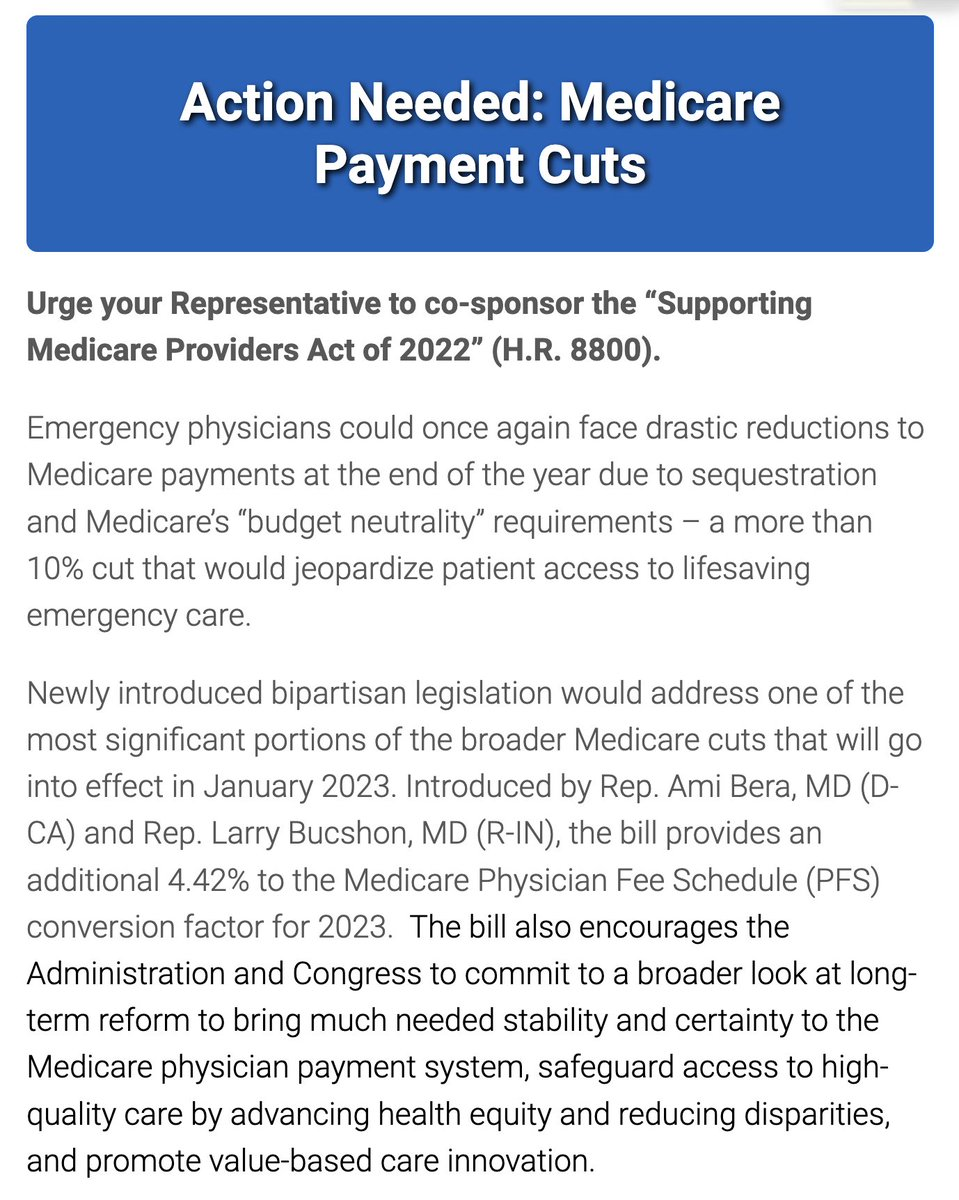
    H.R.8800 – Supporting Medicare Providers Act of 2022

    Due to the ongoing recess leading to the midterm elections, very important legislation introduced in September, H.R. 8800 – Supporting Medicare Providers Act of 2022, has stalled.

    This critical, bipartisan legislation would stabilize Medicare for physicians and patients because it:

    1. Stops the 4.42% of the Medicare cuts related to the budget neutrality adjustment in the Medicare Physician Fee Schedule (MPFS), helping to buoy physician practices that are still recovering from the pandemic;
    2. Protects patients access to care, particularly in underserved communities; and
    3. Provides a commitment to long-term Medicare payment reform.