Private equity (PE)-backed physician practices increase healthcare spending and utilization

https://mailchi.mp/6a3812741768/the-weekly-gist-september-9-2022?e=d1e747d2d8

A recent JAMA study of 578 US dermatology, gastroenterology, and ophthalmology practices acquired by PE firms from 2016 to 2020 found a steady rise in spending in the two years after acquisition, indicating that the average charge per commercial claim increased 20 percent, and the average allowed amount per claim rose 11 percent. It also found that, compared to a large control group with similar patient risk scores, PE-acquired practices saw new patient visits increase by 38 percent and total visit volume increase by 16 percent. 

The Gist: While the study’s authors note that these findings could be explained by changes in practice operations or management, they point out they could also be caused by an overutilization of profitable services not tied to an increase in value or benefit to the patient. 

We think the latter is likely the case here, and that this study provides evidence of PE-induced overutilization aimed at meeting aggressive growth targets.

But this is just the latest wave of ownership-induced overutilization: 20 years ago the same spotlight was on physician-owned imaging, cardiac, and other outpatient diagnostics, with several studies then documenting higher utilization in these facilities. Nonetheless, this latest trend is an important one to document and quantify, as the number of physicians working in PE-backed organizations continues to rise.
25% of US healthcare spending is waste, study finds

https://www.beckershospitalreview.com/finance/25-of-us-healthcare-spending-is-waste-study-finds.html?oly_enc_id=2893H2397267F7G

Image result for Journal of the American Medical Association (JAMA) Publishes Humana Study on Health Care Spending


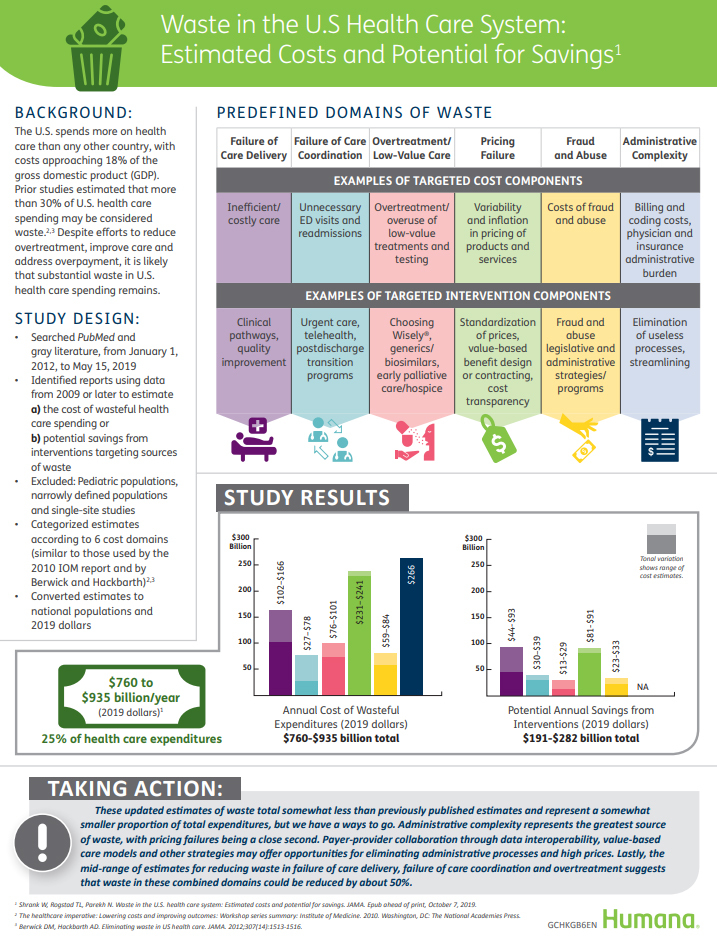
About 25 percent of U.S. healthcare spending can be classified as waste, according to a new study published in JAMA Oct. 7. 

For the study, researchers from Humana and the University of Pittsburgh School of Medicine analyzed 54 peer-reviewed studies, government reports and other medical literature to estimate the levels of waste in the U.S. healthcare system.

Researchers divided waste into six previously developed categories including: failure of care delivery; failure of care coordination; overtreatment or low-value care; pricing failure; fraud and waste; and administrative complexity. 

Administrative complexity accounted for the most waste with $265.6 billion annually, followed by pricing failure or inefficiencies, which accounted for up to $240.6 billion in waste per year.

Approximately $300 billion in waste accrued from failure of care delivery, failure of care coordination and overtreatment. The study estimated that about half of this waste could be avoided.

Overall, the researchers found that the cost of waste in the U.S. healthcare system ranges from $760 billion to $935 billion annually.

Of the $760 billion to $935 billion of waste, researchers estimated that using interventions found to reduce waste could cut between $191 billion and $282.1 billion in healthcare spending.

Access the full report here