

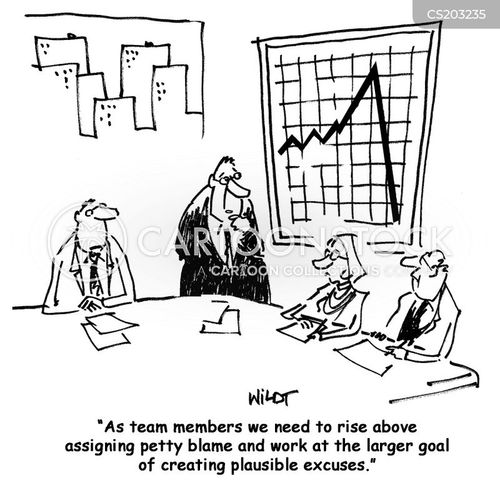
Cartoon – Creating Plausible Excuses

The struggle continues as hospital executives work overtime to return their organizations to necessary profitability, essential competitiveness, and offering an appropriate level of clinical access.
As noted in this blog several months ago, management guru Peter Drucker always maintained that hospitals were the hardest of all American organizations to run successfully. If Drucker were still alive, he would—without question—double down on that observation.
The question must be asked whether historical hospital leadership structures and strategies are still adequate to cope with a fast-changing healthcare industry that features a different level of financial problems, an unrecognizable workforce, and a shape-shifting patient population? This is a leadership question that requires a thoughtful and sophisticated answer.
To paraphrase Albert Einstein, we cannot solve our hospital management problems with the same level of leadership that created them.
So, we are collectively on the hunt for leadership and managerial solutions. The leadership ideas must be different, original, and challenge conventional thinking. Successful healthcare executives these days must be active readers and learners. Winning ideas are everywhere but you need to be both curious and aggressive to find them.
In that regard, let’s turn our curiosity toward the theories and teachings of Coach John Wooden. For our younger readers, John Wooden was the coach of the of the UCLA men’s basketball program from 1948 to 1975. During that time, he won 10 NCAA national championships in 12 years and at one point his teams won 88 games in a row. ESPN’s “Page 2” readers voted him the greatest coach of all time.
But John Wooden wasn’t just a basketball coach; he was a manager, an executive, a teacher, and a philosopher. There was nothing random or laissez-faire about his approach to leadership. Coach Wooden led through a series of principles that he applied with absolute consistency.
Players changed, the opposition changed, and external factors changed, but Coach Wooden’s essential approach to leadership did not vary or change.
The central tenet of Coach Wooden’s leadership philosophy was the somewhat Zen-like principle of “be quick—but don’t hurry.”
At first blush, this organizing principle doesn’t seem to make much sense, especially to the casual reader. John Wooden believed and taught that there were two keys to successful performance, both in sports and otherwise. First, quickness and a sense of urgency was absolutely necessary to winning in a competitive environment. But for Coach Wooden, quickness itself was not sufficient for consistent success. Quickness had to be accompanied by emotional and professional balance in order to achieve team and organizational excellence. So, from Coach Wooden’s perspective, a great athlete or a great executive had to not just move and think quickly, but also had to make sure that he or she was moving to a place of personal balance. Coach Wooden believed that this concept of personal balance was the key to real success at both the team and individual level. To find that place of balance you needed to be quick, but to retain that balance you had to be sure not to hurry. In other words, “be quick—but don’t hurry.”
“Be quick—but don’t hurry” was the central principle of John Wooden’s leadership style but “be quick—but don’t hurry” was also the platform on which an entire management and leadership theory was built. This led to other key Wooden tenets including:
This blog covers just a few of Coach Wooden’s many approaches to and commentaries on management and leadership. But the above observations are a useful start. It is important to disclose that this blog post was guided by and drew quotes from an excellent book, Be Quick—But Don’t Hurry: Finding Success in the Teachings of a Lifetime, which was written by Andrew Hill (a former UCLA player) with the assistance of John Wooden. The book was published by Simon & Schuster in 2001 but as readers can easily see, the book by Messrs. Hill and Wooden remains absolutely relevant today. The book is a short read but will prove to be a good use of your time and your curiosity.
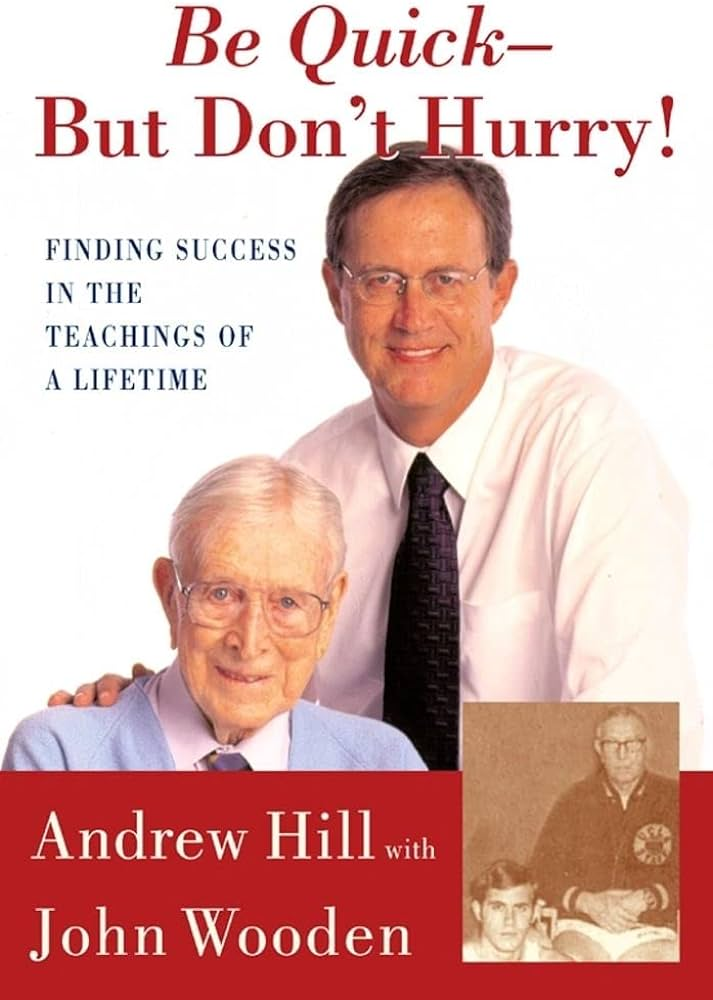
Learn and be smart. Those are the key attributes for today’s healthcare executives. Yesterday’s executive techniques are no longer getting the job done. Hospital leaders must be better in order to deal with the long list of obstacles that are preventing hospital success. Coach Wooden invented a unique roadmap to executive learning and leadership. That Wooden roadmap is definitely “old school,” but that roadmap and its attendant theories and methods are absolutely worth your attention.



The past year and a half has brought prolonged hand-wringing from executives about whether working from home is sustainable over the long-term.
Perhaps no voice on the issue has been louder than that of Jamie Dimon, CEO of JPMorgan Chase, who is against working from home as a new standard.
Remote work, Dimon has said, could hurt company culture and prevent some employees from advancement, especially younger bankers who may lose out on mentorship and training opportunities.
Working from home “doesn’t work for those who want to hustle. It doesn’t work for spontaneous idea generation. It doesn’t work for culture,” Dimon said in May, according to Banking Dive.
David Solomon, CEO of Goldman Sachs, believes the same. Remotely onboarding new analysts is “an aberration that we are going to correct as quickly as possible,” he said in February. “For a business like ours, which is an innovative, collaborative apprenticeship culture, this is not ideal … and it’s not a new normal.”
The same sentiments have not held true on the finance side. CFO Dive has spoken with finance chiefs working at mid-size and large companies throughout the U.S., Canada and Oceania, who reported no problems with remote work, maintaining the trend has not materially impacted their bottom lines.
With the advent of technology that allows for bridging the gap between remote and in-person work, most agile companies, particularly those who invested in digital before the pandemic made it an imperative, the finance team’s ability to accomplish tasks has remained largely uncompromised.
Some CFOs have even said that the migration to digital-first has come as a welcome respite from unnecessary meetings or in-person commitments.
“I’m a convert to remote work,” Justin Coulombe, CFO of Momentive, formerly known as SurveyMonkey, said. “Pre-pandemic, I believed teams worked best in the office, but I’ve come to realize that point of view was more shaped by my preferences and leadership style [rather than] our team’s actual ability to work effectively.”
Flexible working arrangements bring great value to Coulombe’s finance team, which spans beyond the company’s traditional geographic hubs.
“My current working theory: generally, the teams that may find in-office work more effective are those with heavy business partnering roles, like procurement and FP&A,” he said. “We’re a service function, so many times we’ll align to where our partners are and how they work.”
The world’s largest brewery, AB InBev, which owns Corona, Modelo, Stella Artois and Budweiser, currently operates in a flexible hybrid environment, its CFO, Fernando Tennenbaum, said, but he sees pros and cons to all approaches.
“Probably, in the future, there will be some combination of remote and in-person work,” he said. “Definitely, sometimes meeting in person is valuable, but it’s also possible to work remotely.”
At the start of the pandemic, when AB InBev was forced to close the books remotely for the first time, Tennenbaum was worried about everything coming together. But because his team paid a great deal of attention to the quarterly close process, on account of it being the first time they’d done it, everything went smoothly, which he took as “a great sign.”
Even so, Tennenbaum wouldn’t be able to pinpoint one role over another that would be best suited to return to in-person work permanently. “It’s more about maintaining people’s interactions than about any specific task,” he said.
“If anything, the pandemic proved remote work is essentially just as good as in-person; all jobs got done on time without sacrificing quality,” Kirsty Godfrey-Billy, CFO of New Zealand-based cloud accounting company Xero said. “Cloud accounting [allows for] pretty much all finance-related tasks to be done anywhere, anytime on a single, up-to-date general ledger.”
But in order to keep evolving and thriving as a profession, accountants must truly embrace technology and the changes that come with it, Godfrey-Billy added.
Laura Mineo says the longtime-distributed workforce at Rokt, an ecommerce tech company where she is CFO, positioned it well for the hybrid mode it currently uses.
“In my view, the importance of in-person work isn’t necessarily related to completing certain tasks, but to everything that surrounds those tasks and allows us to complete them more effectively and efficiently as we scale,” she said. “Things like knowledge sharing across functions, onboarding new employees, supporting other departments throughout our organization and maintaining the apprenticeship culture we prioritize are all easier and more effective in person.”
Marten Abrahamsen, CFO of financial services platform Fundbox, agrees. “As a whole, our finance team functions very well remotely,” he said.
However, Abrahamsen, who joined Fundbox weeks before the pandemic, has found the company’s strategic finance and corporate development teams stand to benefit most from in-person collaboration and discussion.
“These teams, in particular, engage in frequent white boarding sessions and healthy, back-and-forth debates that are best done in person,” he said.
Vanessa Kanu joined Canadian telecom giant TELUS International as CFO one year ago. In that time, completely virtually, TELUS pulled off the largest technology IPO in the history of the Toronto Stock Exchange, participated in investor roadshows and hosted its first two earnings calls.
She credits the company’s carrier-grade infrastructure, backed by cloud technologies, with allowing her and her team to simulate an in-office experience from home.
“That said, I do believe in-person meetings and events are valuable and offer unique moments for team-building and establishing more personal connections,” Kanu added. “Those interactions are especially helpful for new team member onboarding, training, and reinforcing a company’s culture.”

 HENRY KOTULA