Scripps CEO Chris Van Gorder on AHCA vote: Healthcare is personal, not political

http://www.beckershospitalreview.com/hospital-management-administration/scripps-ceo-chris-van-gorder-on-ahca-vote-healthcare-is-personal-not-political.html

Image result for chris van gorder

The House of Representatives on Thursday passed the American Health Care Act of 2017 by a 217-213 vote with all Democrats opposing.

Chris Van Gorder, president and CEO of San Diego-based Scripps Health, shared his reaction to the vote with Becker’s Hospital Review via email.

“Healthcare legislation approved by only one party will not last the test of time,” he wrote. Mr. Van Gorder believes the bill’s passage maintains the uncertainty around the future of healthcare and how it is going to be funded, while also creating fear and confusion among patients and healthcare providers.

“[T]his is just one more example of our elected officials refusing to compromise and work together for the good of the country,” he said. “Healthcare should not be political — it’s personal. It’s about life and death.”

Mr. Van Gorder urged elected officials to drop bipartisan arguments and work together to design a healthcare plan that increases coverage and access, improves quality and outcomes, and lowers costs.

“Good and sustainable legislation should come out of debate, compromise and the involvement of the experts — in this case, healthcare professionals,” he said. “We healthcare leaders stand ready to help.”

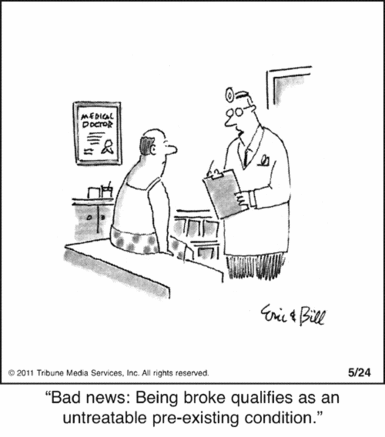
What Are Pre-Existing Conditions and What Would the GOP Bill Do?

http://www.nbcnews.com/health/health-care/what-are-pre-existing-conditions-what-would-gop-bill-do-n754836

Image: Planned Parenthood Funding Threatened By GOP Legislation

Important background for understanding what happened today in the House:

America has the only healthcare system in the world designed to avoid sick people. Private for-profit health insurers do whatever they can to insure groups of healthy people, because that’s where the profits are. They also make every effort to avoid sick people, because that’s where the costs are.

The Affordable Care Act puts healthy and sick people into the same insurance pool. But under the Republican bill that just passed the House, healthy people will no longer be subsidizing sick people.

Healthy people will be in their own insurance pool. Sick people will be grouped with other sick people in their own high-risk pool – which will result in such high premiums, co-payments, and deductibles that many if not most won’t be able to afford the cost.

Republicans say their bill creates a pool of money that will pay insurance companies to cover the higher costs of insuring sick people. Rubbish. Insurers will take the money and still charge sick people much higher premiums. Or avoid sick people altogether.

The only real alternative here is a single-payer system, such as Medicare for all, which would put all Americans into the same giant insurance pool. Not only would this be fairer, but it would also be far more efficient, because money wouldn’t be spent marketing and advertising to attract healthy people and avoid sick people.

Republicans’ plan to protect sick people has a long history of not protecting sick people

https://www.washingtonpost.com/news/wonk/wp/2017/05/05/republicans-plan-to-protect-sick-people-has-a-long-history-of-not-protecting-sick-people/?utm_term=.ae6a7d83164d&wpisrc=nl_wonk&wpmm=1

Image result for high risk pools insurance

Republicans technically have a plan for covering sick people: setting up a system that could do so, but, if history is any guide, wouldn’t.

Welcome to “high-risk pools,” the government-subsidized groups for people who — in the world where insurance companies can go back to their pre-Obamacare practice of discriminating against those with preexisting conditions — can’t get covered on their own. In theory, the pools can be a good way to make sure money is going to the people who need it the most. But in practice, they don’t tend to give out enough money in the first place. Which is why the GOP’s plan to repeal Obamacare’s protections for the sick and replace them with high-risk pools might literally be a life-or-death gamble for a lot of people.

Now, the first thing to know about high-risk pools is that they aren’t magic. They don’t make it any cheaper to cover sick people. That costs what it costs regardless of whether we pay for it with a combination of higher premiums and higher taxes (like Obamacare does), or with higher taxes alone (like high-risk pools would). And yes, it’s something that “we” have to pay for, since the most serious illnesses cost far more than anyone could pay on their own. Indeed, the sickest 5 percent of people make up 50 percent of health-care spending. Although there’s a big caveat here. The idea that high-risk pools won’t save any money is based on the assumption that, as President Trump put it, we won’t have people “dying in the streets.” In other words, that we’ll adequately fund the high-risk pools.

We haven’t in the past. Before Obamacare, you see, a lot of states had their own high-risk pools that were supposed to do what Republicans say they will today: cover sick people separately so that healthy people aren’t burdened with higher premiums. The only problem was they forgot to do that first part. State governments didn’t put anywhere near enough money into their high-risk pools, with the predictable result that these only slightly subsidized costs were still too expensive for a lot of people with preexisting conditions. And even then, they often faced lifetime limits on their coverage. Not to mention the fact that there were long waiting periods before you could join — not something, say, a cancer patient could afford.

Here’s why that matters now. Republicans don’t actually want to set up their own high-risk pool. They want the states to do that themselves — with $138 billion coming from Washington over the next 10 years. But there are three problems with this. First, this almost certainly isn’t enough money. Even conservatives like James Capretta and Tom Miller think that high-risk pools would need around $150 billion to $200 billion to work over the next decade. Emily Geeof the left-leaning Center for American Progress, meanwhile, thinks it’s more like $330 billion. Second, this money isn’t even required to go to high-risk pools. States could also use it to offset costs for healthy people in the individual market — which is what the nonpartisan Congressional Budget Office expects they’ll do. And third, this funding isn’t flexible. It’s a one-time grant that states won’t have an easy time supplementing since they have to balance their budgets every year. The result would be a much more precarious than the system we have now where sick people can’t be charged more and any subsidy they get automatically goes up with their premiums to try to keep them from being priced out of the market.


How Every Member Voted on the House Health Care Bill

Image result for How Every Member Voted on the House Health Care Bill

The House narrowly passed a health care bill on Thursday that would repeal and replace major parts of the Affordable Care Act. Every Democrat voted no, joining 20 Republicans.


The Next Step for the GOP Health Care Bill: A Skeptical Senate

Image result for Senate

As House Republicans on Thursday shoved their health care bill across the finish line, stuffing it with amendments and extra dollars to secure a hard-won majority, the lawmakers who will inherit the legislation delivered their own message from across the Capitol:

That’s cute.

On the Senate side, where several Republicans have long been deeply skeptical of the House effort, the bill is expected to undergo sweeping changes that might leave it unrecognizable — perhaps stripping away some of the provisions that helped earn the support of hard-right House members and ultimately secure its passage.

The Republicans’ narrow 52-member majority in the Senate leaves little room for defections, and several Republican senators have worried aloud about the House measure. Their concerns include insurance costs for poorer, older Americans and funding issues in states with high populations of hard-to-insure people.