Cigna Reports Q1 Gains, Announces ACA Marketplace Exit

Cigna’s earnings tell a story Wall Street loves but its retreat from the ACA Marketplace could accelerate a system already tipping toward collapse.

Cigna reported its first-quarter 2026 results last Thursday. Like most of the other big health insurance conglomerates that have reported so far, it did a better job of meeting Wall Street’s profit expectations in the first three months of the year than it did in all of 2025.

Total revenues rose 5% to $68.5 billion. Adjusted income from operations came in at $2.1 billion, or $7.79 per share — up 12% from a year ago, though missing analyst estimates by five cents. The company raised its full-year outlook for adjusted income from operations to at least $30.35 per share. David Cordani, in what he called a “somewhat bittersweet” moment as his final quarterly earnings call as CEO, described the results as reflecting “disciplined execution, deliberate portfolio shaping and a continued focus on targeted innovation.”

That jargon didn’t impress investors. Cigna’s stock price fell $3.19 on Thursday but was up 2.76% for the week, closing Friday at $282.90.

None of that is surprising. Cigna is a well-run company by the metrics Wall Street uses to measure well-run companies. What’s worth examining is what the numbers actually reveal about how the first quarter results were achieved and – equally if not more important – what Cigna announced alongside it.

Another big exit

The biggest news from Thursday’s release and call with analysts wasn’t about earnings. Cigna will stop offering plans on the Affordable Care Act marketplaces after the 2026 plan year. The exit will affect 369,000 members across 11 states, with coverage ending January 1, 2027.

Brian Evanko, who will succeed Cordani as CEO on July 1, framed the decision as a strategic choice to exit a market where Cigna is unlikely to achieve scale. “This is small business for us today, and it’s been shrinking in recent years,” he said.

He’s right about the numbers. What he didn’t say is why it’s shrinking — and what Cigna’s exit will do to the people left behind.

Cigna is by no means the first big insurer to announce an exit from the ACA Marketplace. Aetna pulled out at the end of 2025, forcing approximately 1 million members across 17 states to find new coverage for 2026. But even that headline understates the breadth of the retreat. At the end of 2025, when Congress chose not to renew some of the tax credits that had made ACA coverage affordable for millions of Americans, a wave of smaller insurers also left: Molina Healthcare announced significant changes to its service area; HAP CareSource exited Michigan; Chorus Community Health Plan withdrew; Mountain Health CO-OP left Wyoming; Primewell Health Services exited Arkansas and Mississippi; UM Health Plan and Michigan Care ended; and Celtic/WellCare left North Carolina. Blue Cross Blue Shield terminated PPO products in Arizona. And last month, Baylor Scott & White Health Plan announced it will no longer offer marketplace plans after the end of this year, affecting approximately 100,000 enrollees in Texas.

That means that before open enrollment for 2027 coverage even begins this fall, at least half a million people — Cigna’s 369,000 plus Baylor Scott & White’s 100,000, on top of the million who lost Aetna coverage last year — will either have to scramble to find comparable coverage (at a significantly higher price) or go uninsured.

And we may not yet know the full scope. Every spring and summer, health insurers file proposed premium rates with state regulators — filings that reveal what insurers are planning for the coming year. Those rate filings typically land in May and June. The Q2 earnings season follows in July and August. Each of those moments is an opportunity for another insurer to announce what Cigna announced Thursday. The exits we know about may be the beginning, not the end.

This is not a series of isolated corporate decisions. It is the beginning of a potential death spiral, and it is already in motion.

The mechanism is straightforward. ACA sign-ups for 2026 are already down by over 1 million people compared to the same period last year — the first decline since 2020. The main reason was the December 31, 2025 expiration of the enhanced premium tax credits that were enacted during the Biden administration. For subsidized enrollees who stayed in the same plan, average net premiums rose 114%. When premiums spike, the people who leave first are the healthy ones — younger, lower-utilization enrollees who do the math, decide the cost isn’t worth it and gamble that they’ll have another year of good health. The people who stay are the ones who have no choice: the chronically ill, the older, the people who know they will need care. The marketplace is already smaller and sicker, according to consultants and insurance executives, with more consumers choosing cheaper bronze plans that carry higher out-of-pocket costs.

A smaller, sicker pool means higher claims. Higher claims mean higher premiums. Higher premiums drive out even more healthy enrollees, which makes the pool sicker and more expensive still. And that is exactly what Evanko described when he noted that Cigna’s ACA enrollment had already dropped from 446,000 to 369,000 — a 17% decline in a single year.

The insurers aren’t abandoning a failed program. They are ensuring it fails — and then leaving before it does.

I wasn’t surprised to hear that Cigna is leaving the ACA Marketplace because it has never been a big player in the individual health insurance business. Around 90% of Cigna’s health plan enrollment is in its role as a third-party administrator (TPA) for large employers. The company also has sold all of its Medicare Advantage business.

What did surprise me was the company’s other big reveal: It has put its EviCore unit, which provides prior authorization and utilization management services to health plans (not just Cigna’s), up for sale. Evanko told analysts that the industry’s prior authorization standardization push (which I wrote about last Wednesday) could “open new doors for the EviCore business, which could potentially result in a partnership or a combination with complementary industry participants.”

EviCore is the prior authorization machinery — the infrastructure through which doctors’ requests for patient care get approved, delayed, or denied. Cigna is exploring selling it, or spinning it off, at precisely the moment that prior authorization is under the most intense public and regulatory scrutiny it has ever faced.

Think about what that means. Just days after the industry announced a voluntary reform campaign to standardize the prior authorization process, Cigna said it might sell the business unit that does the prior authorizing. That tells me that the company’s executives don’t think EviCore will be able to continue contributing to Cigna’s profits.

What the numbers say — and don’t

One of the most important numbers in any health insurer’s earnings report isn’t revenue. It’s the medical loss ratio — the percentage of premium dollars actually spent on patient care. The lower the MLR, the more the company keeps.

Cigna’s MLR for Q1 2026 was 79.8%, down from 82.2% a year ago. That 240-basis-point decline is the engine behind the strong earnings performance. For every dollar Cigna collected in premiums this quarter, it paid out roughly two cents less in medical claims than it did a year ago.

The company attributes the decline primarily to the 2025 sale of its Medicare Advantage business to Health Care Services Corporation — older, costlier populations leaving the risk pool.

What no analyst asked: Is the MLR decline connected to Cigna’s prior authorization practices? The company’s own Transparency Report, published in March, claims a 15% reduction in prior authorization volume. Did tighter scrutiny on the remaining high-cost requests contribute to lower medical costs and therefore a better MLR? We don’t know because Wall Street analysts chose not to ask.

Another thing analysts didn’t explore was litigation against its PBM, Express Scripts. Evernorth — the division that encompasses Express Scripts and that now accounts for 85% of Cigna’s revenue — generated $58.4 billion in adjusted revenues, driven by specialty drug volume and biosimilar adoption. What the earnings release doesn’t mention is that Express Scripts is currently the subject of federal RICO litigation alleging the company created a Swiss entity called Ascent Health Services to divert drug rebates away from plan sponsors and patients.

On Thursday’s call, analysts asked about Evernorth’s growth trajectory, capital deployment, the EviCore strategic review, and the CEO transition. No one asked what happens to the 369,000 people who will lose their Cigna coverage on January 1. No one asked whether the cascade of ACA exits constitutes a market failure requiring a policy response. No one asked what the prior authorization denial rate was for the quarter, or how many denials were later overturned on appeal.

Those questions have answers, but Wall Street analysts don’t ask because they assume most investors have little interest in such matters. And they are right.

Health Care Costs is the Issue Voters Can’t Afford to Ignore

New data shows middle-class Americans cutting essentials, dropping coverage, and delaying care — just as Pope Leo XIV calls health care a “moral imperative.”

Pope Leo XIV (who became pope a year ago this week) isn’t just the first American pontiff—he’s also, as a Chicago native and Villanova University alum, the first leader of the Roman Catholic Church to have experienced the U.S. health care system firsthand. So it shouldn’t come as a surprise that this world spiritual leader born as Robert Prevost would use his lofty new platform to call for radical change.

“Health cannot be a luxury for the few,” Leo told a recent conference on health care inequality in Europe organized by both Catholic bishops and the World Health Organization, adding that good health care is essential for social peace.

“Universal health coverage is not merely a technical goal to be achieved; it is primarily a moral imperative for societies that wish to call themselves just,” the pope said. “health care must be accessible to the most vulnerable, then, not only because their dignity requires it but also to prevent injustice from becoming a cause of conflict.”

In less than a year on the job, the new pontiff has shown a lot of political savvy, and a knack for good timing. Leo’s endorsement of health care as a human right coincided with a couple of new, important U.S. surveys showing that both rising insurance premiums and high out-of-pocket medical bills have become the major driver of an affordability crisis that is hitting middle-class families hard.

To back this up, the leading health care non-profit KFF conducted a followup survey with more than 800 Americans who last year had been enrolled in Affordable Care Act (ACA) insurance in 2025. It found broadly that most have been struggling to pay medical bills since Congress failed late last to extend the federal subsidies that had made ACA coverage affordable for many in recent years.

WATCH NOW

HEALTH CARE un-covered

WATCH NOW: Prior Authorization: Care, Delayed | EP 3

In the third episode of the HEALTH CARE un-covered Show, we take a deep dive into prior authorization’s toll — from doctors to federal policy — featuring Dr. Wendy Dean, Dr. Seth Glickman and Rep. Suzan DelBene (D-WA) on CMS’s new AI-driven WISeR model.


Watch the full episode here.

Most of the respondents (80%) said they were paying more now for health care than in 2025, with just over half (51%) reporting they are now spending “a lot more.” For middle-class Americans, the critical need to stay healthy has meant cutting their budget for other essentials. KFF found that a majority (55%) were reducing spending on food or other household basics, but that jumped to 62% for people getting treatment for chronic disease.

Faced with drastically higher monthly premiums, KFF found, has forced these families to make difficult, consequential choices. Some 28% switched into a different ACA plan in an effort to hold down their monthly premiums – which means much higher deductibles and thus the risk of large out-of-pocket medical expenses. Even worse, some 9% told the KFF survey that they have dropped health insurance altogether, which means they are one accident or major illness away from a financial disaster.

A 34-year-old Texan who dropped his Obamacare coverage told the KFF pollsters that the sole reason was the cost. “The prices are simply too high,” he said. “$800 a month for the absolute cheapest plan for two people. Our income is $120k, so we don’t qualify for subsidies in Texas. I don’t think we could afford our mortgage if I had to pay for health insurance.”

Another respondent reported that his “Income exceeded the subsidy limit, forcing us to pay the full cost, so we switched down to a bronze from a gold plan. Even doing that our premiums are 3 times what they were in 2025, with lower plan features and a higher deductible.”

About 22% of the KFF respondents said they are still insured, but not through the ACA Marketplace. In some cases that is because they were able to switch to an employers’ health plan or because they were now eligible for Medicare and Medicaid. But others, KFF noted, switched into different types of high-deductible plans or a cost-sharing group – solutions that often lead to considerable out-of-pocket expenses.

One 56-year-old Texas man surveyed by KFF said that as a reaction to the higher insurance premiums he would “attempt to use health care as little as possible” – with the hope that by carefully consulting with his doctors and pharmacists he would avoid paying any out-of-pocket expenses that aren’t absolutely necessary.

Patients are often left ‘out of network’ as hospitals, insurers clash over cost

No one wants to see health insurance premiums rise. Individuals, small businesses and large employers are already under inflationary pressures. But it will be far worse if health insurance companies fail to help address rising costs facing healthcare providers

Lengthy contract negotiations between health insurers and healthcare providers are becoming the norm, leaving patients — our shared customers — in a confusing and concerning ‘out-of-network’ status, while health insurers and providers point fingers at each other.

An overused but accurate phrase applies: healthcare providers are facing a perfect storm of pressures, particularly in California, and especially systems that serve large shares of Medi-Cal and Medicare patients. 

Among our nation’s 6,000 hospitals, our flagship hospital, Community Regional Medical Center in Fresno, serves the fourth highest percentage of Medicaid patients and is fifth for overall government reimbursement. 

While being one of America’s most essential hospitals is rewarding, recent federal changes designed to slow the growth of healthcare spending have resulted in a 15% reduction in Medicaid funding — roughly $1 trillion in cuts nationally over the next decade.

At the same time, California legislation increased the minimum wage for healthcare workers to $25 per hour. While there is none more deserving of this than healthcare professionals, the ripple effects are significant. At our organization these adjustments add $100 million annually in labor costs and will only grow. 

Further constraining hospitals are the legal requirements to treat anyone who arrives in their emergency departments, regardless of ability to pay. What other industry is required to provide service first and figure out how to get paid for it later? 

Our health system absorbed a $231 million reimbursement shortfall last year for the care of government-insured patients, and we must brace ourselves for more. Higher numbers of ER visits from underinsured patients, as well as higher levels of charity care and bad debt will further widen the gap between our cost for providing care and how much we’re reimbursed. 

In the meantime, insurance companies want hospitals to agree to rates that don’t keep pace with rising costs. While government payers offer predictable approval processes and payment timelines, private health insurers increasingly rely on cumbersome prior authorizations, payment denials, paying less for services and slow reimbursement. These practices add administrative costs, strain cash flow, reduce overall reimbursement and threaten our fiscal stability.

Insurers face pressure from employers and members to limit the growth of premiums. But too often, that pressure is used to resist necessary and reasonable rate increases for providers. Health insurers often blame providers for the high cost of care, but hospitals like ours are keenly focused on greater efficiency. In fact, we’re a low-cost leader when compared to the average California hospital. 

In some cases, insurance companies propose quality incentive programs as a substitute for adequate reimbursement, then publicly criticize health care providers when we find this unacceptable. I wholeheartedly support performance incentives as a tool for improvement, but not when these programs are used as a mechanism to transfer greater financial burden to hospitals.

As stalled negotiations become increasingly common, regulators and policymakers should take a broader view of healthcare costs by examining health insurer reserves, and their administrative and marketing expenses. 

For safety-net healthcare providers like us, modest profit margins are not just about staying afloat, they are critical to reinvestment in technology, facilities, our workforce, and public health initiatives that are essential to the communities we serve.

There is much at stake if payers win the war of words over contract rates. Access to healthcare services, healthcare jobs and the stability of institutions that communities rely on will diminish. 

When providers are forced to make deeper cuts to manage this convergence of pressures, patients ultimately pay the price.

How China Tripled Health Coverage in Less Than a Decade

Since 2000, most countries around the world have achieved or committed to pursuing universal coverage, or to ensuring their populations have “access to the full range of quality health services” without financial hardship. Nations have, however, pursued different paths to that end. China, with the world’s largest health system, achieved near-universal coverage in just over a decade. In 2000, less than a third of its citizens and permanent residents had coverage; by 2011, that figure had risen to 95 percent. While China’s highly centralized political system differs from many other countries, the government’s focus on rural and unemployed residents and its targeted health infrastructure investments can offer insights for policymakers around the world. China’s Pathway to Universal Coverage By the late 1990s, China’s collective and work-unit-based health insurance systems had largely collapsed following market reforms in the 1980s and 1990s. In 1998, the government launched Urban Employee Basic Medical Insurance (UEBMI), a mandatory program for employed people financed by a payroll tax. In response to the poor performance of the Chinese health system during the 2002 SARS outbreak, the Chinese government moved to make major improvements. This was realized in 2003 and 2007, when the New Rural Cooperative Medical Scheme and Urban Residents Basic Medical Insurance were introduced to cover rural residents and urban unemployed citizens, respectively. To reduce inequities between the two groups, both programs were merged in 2016 to create Urban and Rural Resident Basic Medical Insurance (URRBMI). Today, UEBMI and URRBMI make up China’s basic medical insurance, which partially covers in- and outpatient care, primary and mental health care, pharmaceuticals, traditional Chinese medicine, and dental and eye care. Coverage grew rapidly between 2008 and 2011 through significant government subsidies for those enrolled in the two programs that now make up URRBMI, as well as massive government investment in improving primary care and public hospitals, and establishing a national essential drug list.
Intl_Insights_exhibit_April-2026_China-coverage-expansion_vol48_800
Since these coverage gains, China has seen a significant improvement in overall health outcomes, including a seven-year increase in average life expectancy, a 73 percent decrease in maternal mortality, an 86 percent decrease in child mortality, and lower rates of communicable diseases. However, China’s basic medical insurance faces some key challenges. Given China’s lower per capita income and more limited fiscal capacity compared to the United States, the government prioritizes universal baseline coverage rather than comprehensive benefits, resulting in high out-of-pocket costs — roughly a third of total health expenditures. The basic medical insurance program also has struggled to address systemic inequities between rural and urban residents. For example, the urban employed populations covered by UEBMI receive more comprehensive benefits packages, including medical savings accounts for out-of-pocket expenses. Migrant workers — who make up a fifth of China’s population — are another demographic whose coverage can be fragmented, partly because of the difficulty transferring between different insurance programs if they move to and from rural and urban areas. China also faces major challenges in health care delivery. Lacking a strong primary care system or primary care gatekeeping, hospitals are vastly overused by patients. When you add growing care utilization by China’s rapidly aging population and some people dropping coverage due to rising premiums and copayments, you get a health system under increasing pressure. In 2025, to ease some of this strain, the government announced plans to incentivize long-term enrollment by increasing government subsidies for length of time enrolled and developing long-term care insurance programs focused on older people. America’s Patchwork Health Insurance System Prior to 2010, the United States relied on a fragmented, employment-based health insurance system made up of private, largely employer-sponsored insurance and public programs like Medicaid and Medicare. It left nearly 16 percent of the population, more than 40 million Americans, uninsured. More people gained coverage following full implementation of the Affordable Care Act (ACA) in 2014, which:Expanded Medicaid eligibilityPrevented coverage denials for people with preexisting conditionsAllowed young adults to stay on their parents’ insurance until age 26Established health insurance marketplaces to purchase private plans.By 2023, the U.S. uninsured rate declined to an all-time low of 7.9 percent. However, following passage of the Trump administration’s budget reconciliation bill in July 2025 — featuring $900 billion in Medicaid cuts over the next 10 years — the U.S. is expected to return to pre-ACA highs of nearly 40 million uninsured by 2034.
Intl_Insights_fact_800_vol48
U.S. coverage expansion relies heavily on voluntary enrollment in private plans, often with high deductibles and cost sharing, creating sizeable affordability barriers. In 2024, out-of-pocket costs increased to $1,632 per capita. For subsidized care through Medicaid or cost-sharing reductions, qualification is dependent on income and area of residence, creating variable coverage from state to state. While China structured its reforms to explicitly incorporate rural residents, unemployed urban residents, and migrant workers, U.S. coverage is hampered by the exclusion of groups like undocumented migrants and people with low incomes in non-Medicaid-expansion states. China and the United States have taken remarkably different paths to expanding health insurance coverage. The U.S. has relied on a fragmented public–private model with variable and dwindling government subsidies, resulting in persistent disparities in coverage and access — both of which are expected to only worsen in the coming decade. Meanwhile, despite a vastly different political structure to the U.S., China’s coverage gains are notable due to its massive population (nearly four times the U.S. population) and much lower per capita income. China offers a unique case study of a coordinated health insurance system designed to address disparities in access, ultimately achieving near-universal coverage in just over 10 years.

Hospitals That Sue You for Getting Sick

Hospitals in just one state filed 1.15 million lawsuits — enabled by insurance plans that shift costs to patients while shielding themselves from the fallout.

“People are having to choose between going to the hospital and staying home and dying. Because at least my family won’t be burdened with a lawsuit if I die at home.”

That’s not a line from a dystopian novel. It’s what a real patient — identified only as GV0242002 in court records — told researchers after being sued by Sentara Health, Virginia’s largest hospital system and its most prolific medical debt litigant.

A major new report from researchers at George Washington University Law School and Stanford University’s Clinical Excellence Research Center, produced with PatientRightsAdvocate.org, documents what happens when American health care’s hidden costs finally catch up with the people least able to pay them. The findings for Virginia alone are staggering: between 2010 and 2024, hospitals and medical providers filed 1.15 million lawsuits against patients, seeking to collect $1.4 billion in medical debt. They followed those suits with more than 400,000 garnishment orders targeting wages and bank accounts. Plaintiffs’ attorneys collected $87 million in fees. Courts tacked on another $46 million in costs. And some providers charged interest as high as 18% annually — four times the prevailing commercial rate — buried in consent documents patients signed while frightened, in pain, and in no position to negotiate.

Read the full report here.

Among the top garnishee employers? Walmart, public schools, grocery stores and the hospitals themselves. Nonprofit hospitals in Virginia filed more than 4,100 garnishment orders against their own employees.

As the report notes, the hospitals’ patients have almost no way of knowing how much an inpatient stay or an outpatient service will cost or how much they will be on the hook for even if they are insured. The researchers describe health care providers operating “with insurers as accomplices” in keeping prices hidden from patients. That word — accomplices — is important and appropriate. This is not just a hospital story with an insurance footnote. It is also an insurance story. Both hospitals and insurers are complicit, although I would argue that hospitals have to operate in a system that is increasingly controlled by Big Insurance. That said, the relationship between hospitals and insurers is symbiotic, and the cost-sharing requirements imposed by insurers and the opacity of the agreements they enter into with hospitals enables both parties to increase prices and premiums in a way that ensures a rate of medical inflation that is perennially much higher than regular inflation and wage increases.

Here is the mechanism. An insurer designs a health plan with a $4,000 or $6,000 or $8,000 deductible. A patient — let’s say she works at a Kroger in Charlottesville, covered by her employer’s plan — gets sick and goes to Sentara Martha Jefferson Hospital. She signs an admissions agreement she cannot meaningfully read, consenting to pay “charges” based on a chargemaster that reflects prices no willing purchaser would ever agree to. She receives care. Weeks later, she gets a bill she cannot understand, for an amount she cannot verify, tied to prices that were never disclosed. She can’t pay. The hospital refers the account to one of the 20 law firms that brought more than half of all medical debt cases in Virginia during this period. She gets sued. The insurer that collected her premium — and her employer’s premium contribution — faces no lawsuit, no garnishment, no reputational consequence. It moves on to the next enrollment cycle.

The report covers 2010 through 2024 — the first 14 years of the Affordable Care Act. The ACA expanded coverage and has saved countless lives. But it did not stop the proliferation of high-deductible health plans that left millions of newly insured Americans technically covered and financially exposed. In fact, the ACA legitimized them. Since 2000, employer-sponsored family health insurance premiums have risen 321%, according to data cited in the report, and deductibles and other out-of-pocket costs have also skyrocketed. Wages rose 123% over the same period.

Patients are not drowning in medical debt because they are irresponsible. They are drowning because the insurance industry spent years engineering products that shift financial risk onto health plan enrollees and then collecting ever-increasing premiums for doing so.

I should note one finding with particular resonance for me personally. Ballad Health — the dominant hospital system serving the Tri-Cities of Northeast Tennessee and Southwest Virginia, the region where I grew up — filed 26,300 lawsuits against patients during this period. Ballad was created through a controversial 2018 merger that was granted antitrust immunity under a rare state certificate of public advantage, in exchange for commitments to maintain services and community benefit. The merger eliminated competition across one of the poorest stretches of Appalachia, leaving patients in communities like Scott County, Lee County, and Wise County, Virginia — some of the most economically distressed in either state — with effectively no choice in where they seek care.

Whether Ballad has honored its merger commitments has been disputed ever since. What is no longer in dispute: The system that was handed a regional monopoly turned around and sued its captive patients tens of thousands of times. Wise County, for those who don’t know, is also where Remote Area Medical for years set up a makeshift clinic at the county fairgrounds — the place that first showed me, up close, what this industry does to people when it stops pretending.

Virginia’s legislature took a meaningful step last year to give patients some relief. Former Governor Glenn Youngkin signed the Medical Debt Protection Act last May, capping interest on medical debt at 3%, eliminating interest for the first 90 days, and barring hospitals from foreclosing on homes or placing property liens. Those are real protections, and they matter. But as the researchers note, the law does almost nothing about the hidden prices and opaque billing at the point of care that generate the debt in the first place. The legislature addressed the collection machinery. It did not touch the engine driving it.

That engine — high cost-sharing, hidden prices, insurer-designed benefit structures that make patients financially liable before they walk through the door — is what I’ll be examining in depth in the coming weeks, as the major insurers report their first-quarter 2026 earnings. The Virginia data describe how this system costs patients. The earnings reports will tell you how it benefits big insurers and their shareholders.

Stay with me.


Private Medicare plans get a break

After saying it wanted to keep federal payments to private Medicare plans roughly flat next year, the Trump administration reversed course on Monday and gave the insurers a $13 billion pay bump.

Why it matters: 

The average 2.48% pay increase for 2027 was on the high end of analysts’ expectations and marked a win for UnitedHealthcare, Humana and other Medicare Advantage plans, whose stocks tumbled after the administration’s initial proposal in January.

  • The plans will instead see an average increase of nearly 5% when payments are adjusted to reflect how sick enrollees appear, Medicare officials said.
  • The administration was swamped by tens of thousands of comments after the initial proposal of less than a 0.1% increase for 2027.

Driving the news: 

The pay increase reflects higher health cost growth in traditional Medicare that became apparent after additional data from the end of 2025 was crunched.

  • The Centers for Medicare and Medicaid Services also dropped a proposal to update payments to plans based on the health status and demographics of enrollees, which insurers said would have disrupted their ability to care for seniors.
  • Medicare officials said that it makes sense to give insurers more time to absorb prior “risk adjustment” updates.

The administration is moving forward with a plan to prevent insurers from adding diagnoses after reviewing patients’ medical records — a move that addresses coding practices that have received scrutiny and is expected to save nearly $7 billion next year.

What they’re saying: 

Some Medicare providers said the pay boost still doesn’t reflect economic realities, at a time when the cost of drugs, supplies and more patient visits is stoking medical inflation.

  • “When payments fail to keep pace with care delivery costs, the consequences are predictable,” said Jerry Penso, president of medical group association AMGA, predicting possible cuts to supplemental benefits like vision and dental, higher costs to beneficiaries and, in some instances, plans exiting markets.
  • Medicare Advantage enrollment declined in seven states this year as plans pulled out of some markets.

Between the lines: 

The administration’s original flat-funding proposal reflected bipartisan concern over how much money Medicare Advantage costs the health care system.

  • Policymakers’ concerns that health plans aren’t sufficiently lowering costs “will remain a headwind” for Medicare insurers, Duane Wright, senior health policy analyst at Bloomberg, said in an email.
  • Director of Medicare Chris Klomp said the finalized update aims to strike a balance between protecting seniors and protecting taxpayers.
  • “I’m sure that there will be folks on both sides of the equation who may have concerns about where we’ve landed,” he said.
  • “We’re certainly not abdicating responsibility [to taxpayers], nor are we saying that we are done.”

Zoom out: 

Medicare administrators late last week finalized a separate plan to overhaul Medicare Advantage’s quality reporting and ratings system, which they expect will increase payments to plans by $18.6 billion over the next decade.

  • “As health plans incorporate the policies released in recent days, they will continue to focus on keeping coverage and care as affordable as possible during this time of sharply rising medical costs,” Chris Bond, spokesperson for insurance lobbying group AHIP, said in a statement.

What we’re watching: 

Whether insurers run ads accusing the administration of cutting Medicare in the run-up to the midterm elections, as they did with the Biden administration in 2023.

Inside Big Insurance’s $1.7 Trillion Year | EP 2

In second episode of the HEALTH CARE un-covered Show, we walk you through the most recent earnings reports of seven of the largest for-profit health insurance corporations in the country.

Every three months, the nation’s largest health insurers release earnings statements filled with crammed financial tables, investor language and Wall Street jargon. Most people never see them. Even fewer try to understand what they really reveal about how the U.S. health care system works.

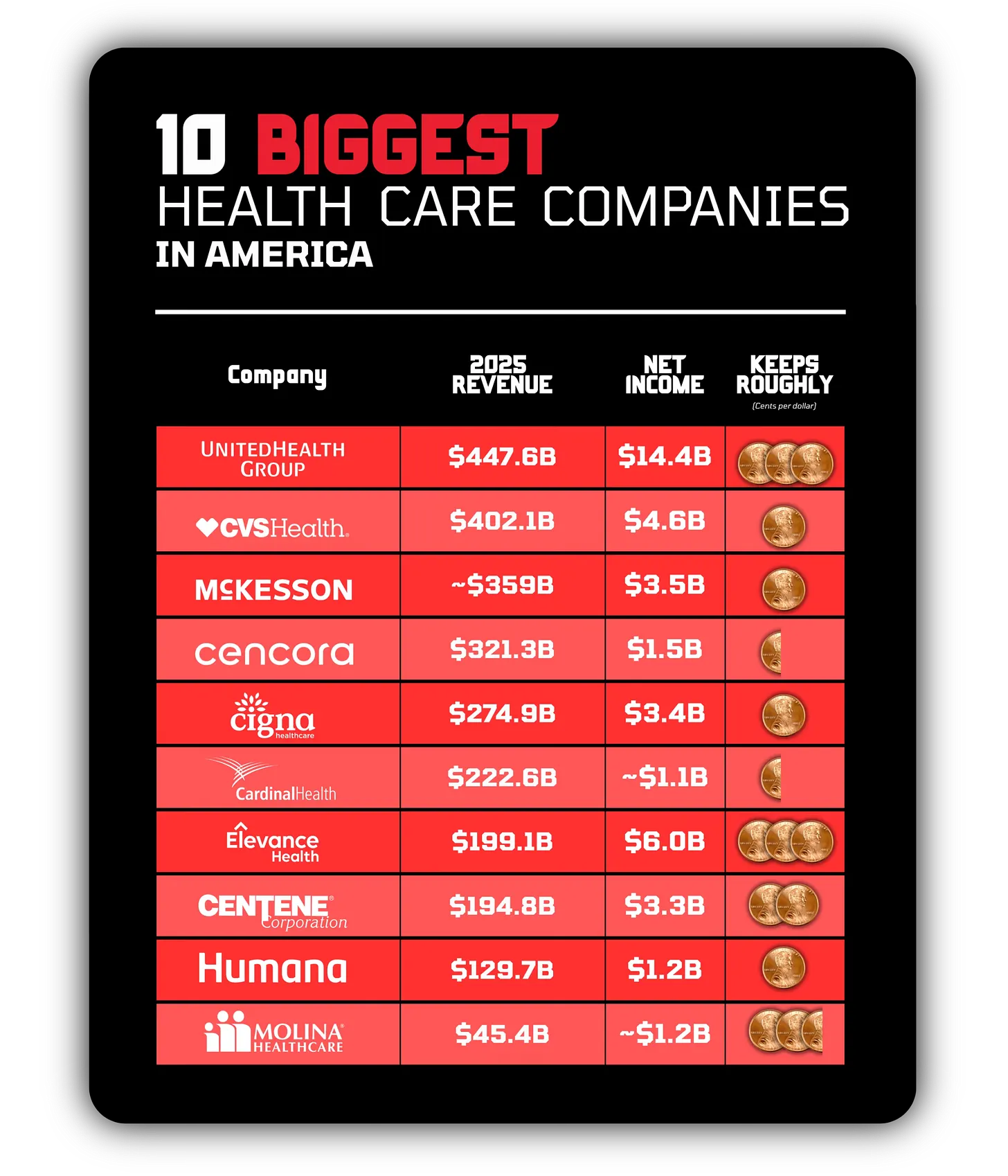
In second episode of the HEALTH CARE un-covered Show, we do something no one else does: walk you through the most recent earnings reports of seven of the largest for-profit health insurance corporations in the country — UnitedHealth Group, CVS Health (Aetna), Cigna, Elevance, Humana, Centene and Molina. As you’ll see, the results paint a striking picture of how powerful and profitable Big Insurance has become.

Together, those companies collected nearly $1.7 trillion in revenue in 2025, about $175 billion more than the year before and generated more than $54 billion in profits. Yet despite the record financial performance, the companies covered roughly 10 million fewer people than they did in 2024 – and ever-increasing chunks of their revenues are now coming from Americans’ tax dollars.

We show evidence of a trend reshaping the health care economy: self-dealing through insurers’ vertical integration and their huge government contracts, which accounts for much of the industry’s growth. For example, UnitedHealthcare now gets more than 77% of its revenue from government programs such as Medicare Advantage and Medicaid. As a reminder, Medicare Advantage is not traditional Medicare but a very profitable privatized version of the program that’s funded by taxpayers and that last year overpaid insurers by $84 billion.

We also examine stock buybacks. Between 2015 and 2025,these seven companies spent more than $137 billion buying back their own shares, a move that boosts earnings per share and enriches shareholders and top executives. That’s $137 billion that could have been used to reduce premiums and out-of-pocket expenses but went into the pockets of investors instead.

To put the numbers in perspective, we compare these insurers with some of America’s most recognizable corporations — from Chevron and PepsiCo to Bank of America and Salesforce. Most of the big seven generate more revenue than these household names. And many of the insurance conglomerates are growing faster than companies like Target, Uber, Disney and Starbucks.

We take viewers inside Wendell’s office to make sense of Big Insurance’s dense 2025 earnings reports.

You won’t find an analysis quite like this anywhere else.

You can also tune in here:

This episode has been re-uploaded with corrected numbers. For instance, Disney was listed as having revenues of $274.9B in 2025. The correct number is $94.4B. The percent change used in the original video (+80%) was correct.

Racing in the Wrong Direction

New data shows the U.S. is moving backward on coverage, not forward—raising a harder question: is the problem affordability, or priorities?

Will the U.S. ever provide health care for all its citizens?

The prospects are dim for enacting a system that provides services for the county’s entire population the way Europeans have done for decades. As the head of the German pharmaceutical association in Berlin once told me in an interview, “In the German system, nothing comes between us and our principle of solidarity.” I asked, “Even your profits?” “Not even our profits,” he replied.” Imagine any health care executive in the U.S., where the bottom line reigns supreme, daring to say a thing like that.

That interview with the German pharmaceutical executive came to mind again as I read the latest study from the Commonwealth Fund, which should be required reading for anyone interested in health policy and the future of the American system. The report by the Fund’s senior scholar, Sara Collins, said the Trump administration has “made it harder than ever for Americans to get good health insurance,” a conclusion that needs to be shared far and wide.

The administration itself predicts these changes will reduce enrollment in the Affordable Care Act marketplaces next year by 1.2 to 2 million people. The U.S. is falling backward in providing health care for all, a project that prompted Dr. Martin Luther King Jr. to observe long ago, “Of all the forms of inequality, injustice in health care is the most shocking and inhumane.”

At the Commonwealth Fund, Collins noted that those losses are on top of other changes expected to leave another 7.5 million people uninsured. Even though members of Congress hostile to the Affordable Care Act failed to repeal the act during Trump’s first term, Collins points out they still inflicted damage by whittling away at some of the law’s provisions. She reports that last year a majority of the public supported the Affordable Care Act’s enhanced premium tax credits, established in 2021. Republicans, however, did not pass legislation to extend those credits that helped millions of Americans, who now face annual premium increases of $750 to more than $4,000.

Does the destruction of the hard-won Affordable Care Act mean that a country as rich as ours cannot afford to pay for medical care like the rest of the world’s developed countries do, or does it mean those with clout don’t want those without to have health care? I am inclined to believe the latter.

That was not the only damage caused by the Trump administration. For example, a new rule for marketplace coverage increased out-of-pocket costs, eliminated special enrollment periods for those with low incomes, and put new restrictions on auto enrollment. In addition insurers raised premiums by 20% or more in many cases, hoping that those people who are healthy would not drop coverage and leave them with sick, and more costly, health plan enrollees. Such a strategy would be unheard of in countries with national health systems, where everyone is entitled to care.

“The Trump administration’s latest actions on the ACA marketplaces continue to make it as difficult and costly as possible for those with low and moderate incomes to get good health insurance and care they need,” Collins reported. “This will lead to more people with low and moderate incomes uninsured, underinsured, less healthy, and saddled with medical debt.”

Is this what Americans want for their health care system?

New Deductible Rules Allow for $31,000 Out-of-Pocket Maximum

Trump’s proposal would revive “catastrophic” plans with deductibles as high as $31,000 — shifting even more costs onto patients with cancer, chronic illness, and medical emergencies.

On Friday, Erica Bersin – who has two chronic illnesses, including multiple sclerosis – wrote about the challenges of finding a decent and affordable health plan in the ACA marketplace. As a sole proprietor, the only plan with a manageable premium ($330 a month) came with a $10,000 deductible. MS drugs are expensive and many people with the disease have to pay hundreds and sometimes thousands of dollars out of their own pockets before their coverage kicks in. Sadly, the way the ACA plans are structured, Americans with chronic conditions – and others who are diagnosed with cancer or have a heart attack or other acute medical event and have no option for coverage other than the ACA marketplace – are penalized financially far more than the rest of us..

But instead of helping those folks out, the Trump administration is proposing to change the marketplace in ways that will make a $10,000 deductible seem like a bargain. Say hello to a $31,000 family deductible. And even if you’re covered by an employer-sponsored plan and in no imminent danger of being enrolled in a plan like that, know that their reappearance (they were outlawed 16 years ago), will push your premiums even higher than they already are. That’s because hospitals and physician practices know people enrolled in those plans will not be able to pay their bills. They’ll have no option but to increase their prices to cover the additional bad debt.

Health insurance policies with deductibles that high were prevalent before the Affordable Care Act was enacted in 2010. When I was a health insurance executive, I knew some insurers were selling policies with family deductibles north of $50,000. Not only that, many of them had annual and lifetime caps and wouldn’t pay for any care related to a preexisting condition.

They were officially called “catastrophic” plans. Patient and consumer advocates had a more appropriate name for them: junk plans. They were outlawed by the ACA, and I thought they had been buried for good. Unfortunately, the Trump administration is bringing them back to life.

I’m sure my former colleagues in the health insurance business went to work immediately getting those plans ready to sell once again to unsuspecting customers. That’s because they can be very, very profitable. Imagine having to pay $50,000 – or even $31,000 – out of your own pocket every year before your insurer will cover the care your doctor says you need. Cigna, where I worked, as well as Aetna and UnitedHealthcare, the country’s biggest health insurers, sold plans like that and collected billions in premiums every month but paid little if anything out in claims during a given year.

When I first testified before Congress, I was one of three people at the witness table, and all of us knew a lot about those plans – including Nancy Metcalf, who was senior program editor at Consumer Reports at the time. She in particular knew about the many shortcomings of those plans because she had heard horror story after horror story from people who had enrolled in a junk plan. She urged lawmakers to outlaw them – or at least make insurers put warning labels on them so people would know what they were buying and how little protection those plans provided. As Nancy testified:

Consumers need to be told, in big letters, what their policy’s out-of-pocket limit is, and right next to it, in equally big letters, if there are any expenses that don’t count towards that. They need to know approximately what their out-of-pocket costs will be for expensive treatments such as cancer chemotherapy, or heart surgery, or infusions of patented biologic drugs. They need, in other words, a fighting chance not to be ripped off by junk insurance.

As Reed Abelson of The New York Times reported last week, the administration’s proposal “involves a type of plan known as a catastrophic or skinny policy. While they may be appropriate for someone who is young and healthy, a sudden emergency room or unexpected hospital stay could cost thousands of dollars in unforeseen bills. People with chronic medical conditions also might have to pay for much – if not all – of their care out of their own pockets.”

Commonwealth Fund president Joseph Betancourt pointed out in the Times’ story that people are already struggling to pay for their medical care:

There’s no doubt that we have an affordability crisis. As we move forward to shifting more of the burden to patients, there’s a chance to really exacerbate the crisis.

Abelson noted that under the proposed rule change, insurance companies could not only sell the catastrophic plans on a multiyear basis once again, they could also sell plans that do not offer an established network of hospitals and doctors. “Those plans,” she wrote, “would instead pay a fixed amount for a doctor’s visit or procedure, and patients would have to pay any difference in price.”

Abelson also warned of another risk associated with sky-high deductibles: Because their premiums are lower, they “will end up being used as the benchmark for the level of subsidies in a given market. People who want a traditional plan with an established network could end up paying more because they receive a lower subsidy.”

As I mentioned, all of us will likely pay more for our coverage when these plans become legal again next year. As BenefitsPro reported last month – quoting the CEO of Community Health Systems, a big hospital chain – most patients who are currently in ACA plans with lower but still high deductibles and coinsurance requirements can’t pay very much of the “big out-of-pocket bills” hospitals have to send them.

It’s only going to get worse.

The $10,000 Deductible and the Myth of ‘Affordable’ Care

How disappearing ACA subsidies, soaring premiums, and bureaucratic chaos nearly left a consultant with multiple sclerosis uninsured.

The business of health care is not broken; it is working exactly how it was intended. It was designed for people to pay in just in case something happens and then not to pay out when it does. It was intended to “maximize shareholder value.”

About 22 million Americans received enhanced premium subsidies in 2025. According to The Urban Institute and The Commonwealth Fund, it’s estimated that “7.3 million people will leave the ACA marketplace in 2026” due to the loss of the subsidies. About 5 million people will go uninsured, rather than find insurance elsewhere.

Some people have said their premiums and deductibles are doubling or even tripling with tens of thousands in deductibles before coverage kicks in. While absolutely imperfect, we must keep the Affordable Care Act intact for everyone otherwise the cost of Medicare, Medicaid, and private and employer-based insurance will skyrocket, resulting in millions of people losing coverage due to lack of affordability.

Accessible insurance is a huge part of living a healthy life. Because of this, we need to expand coverage and make it fair for everyone. The goal should be for every single person in the U.S. to have head-to-toe health care.

My Story

As a single-person LLC consultant, I have navigated the New York State Exchange (ACA) for years. It is the most expensive Exchange in the country for those who do not qualify for subsidies. If subsidies are received, an increase in income requires repayment via federal tax returns the following year.

For 2025, I resigned myself to a catastrophic plan at $330 per month with a $10,000 deductible, as other options approached $1,000 monthly. While applying in November 2024, my temporarily being in-between projects / contracts was interpreted by the NYS Exchange as being unemployed, which led me to unexpectedly qualify for Medicaid. The state market assured me that this was correct for consultants in my situation, and they “saw it all the time.”

However, during open enrollment in October 2025, I was informed that despite meeting the income threshold, I no longer qualified for either Medicaid or financial assistance / subsidies. The catastrophic plan doesn’t seem to exist now, and the “least expensive” option is $675 with poor / limited coverage. After four months, dozens of phone calls, six people (including an aide in my state assembly member’s office), and about 100 hours of everyone’s time, I have health insurance this year, for now.

Living with two chronic illnesses, including multiple sclerosis, my experience with a “government run” system over the last year has led me to believe that, for the most part, it works. Health care should be a right of birth, not a privilege for the rich.

This is just one person’s story. The rise in health care costs impacts everyone, but especially lower income Americans. You can see some of their fears, here.