

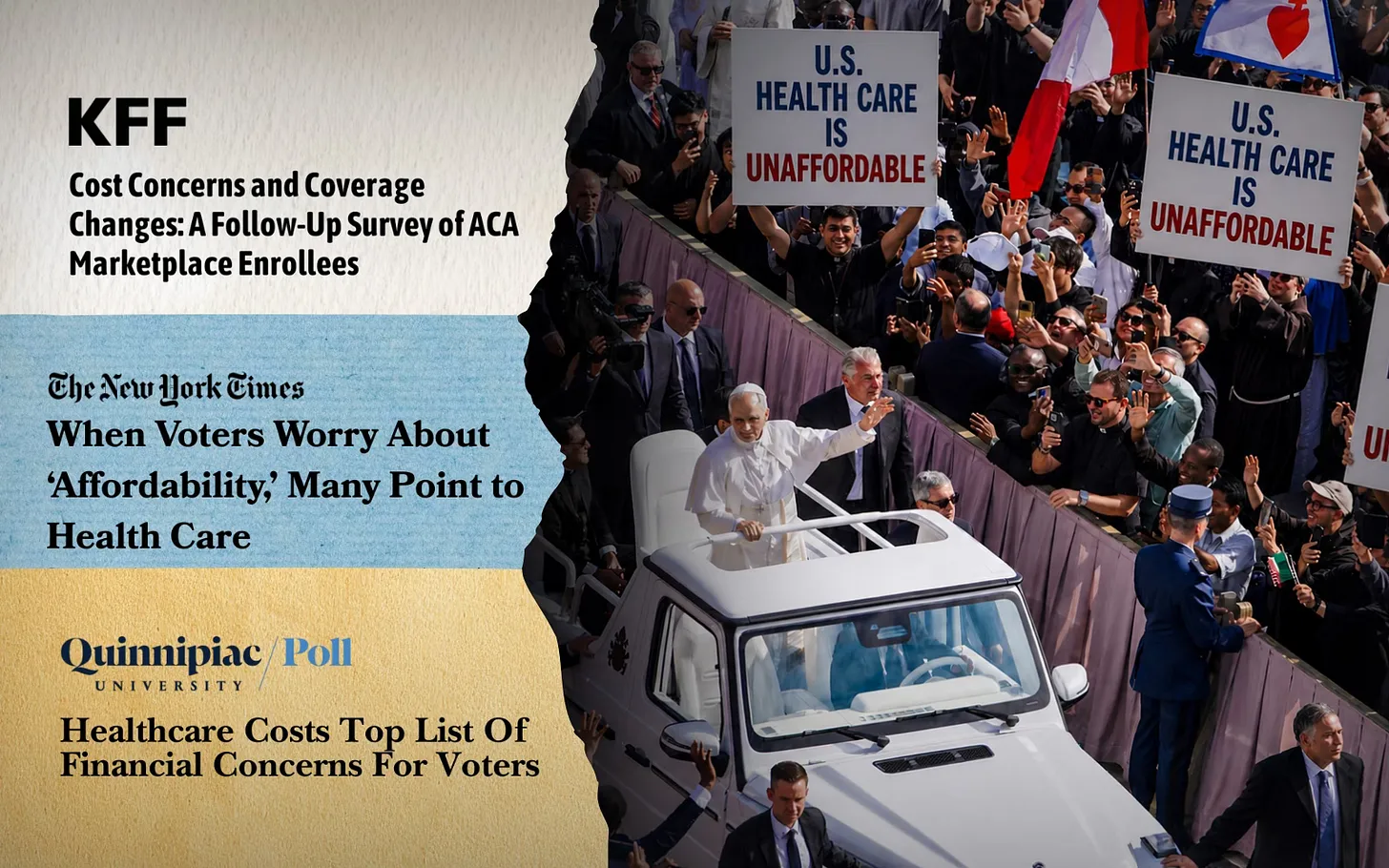
New data shows middle-class Americans cutting essentials, dropping coverage, and delaying care — just as Pope Leo XIV calls health care a “moral imperative.”
Pope Leo XIV (who became pope a year ago this week) isn’t just the first American pontiff—he’s also, as a Chicago native and Villanova University alum, the first leader of the Roman Catholic Church to have experienced the U.S. health care system firsthand. So it shouldn’t come as a surprise that this world spiritual leader born as Robert Prevost would use his lofty new platform to call for radical change.
“Health cannot be a luxury for the few,” Leo told a recent conference on health care inequality in Europe organized by both Catholic bishops and the World Health Organization, adding that good health care is essential for social peace.
“Universal health coverage is not merely a technical goal to be achieved; it is primarily a moral imperative for societies that wish to call themselves just,” the pope said. “health care must be accessible to the most vulnerable, then, not only because their dignity requires it but also to prevent injustice from becoming a cause of conflict.”
In less than a year on the job, the new pontiff has shown a lot of political savvy, and a knack for good timing. Leo’s endorsement of health care as a human right coincided with a couple of new, important U.S. surveys showing that both rising insurance premiums and high out-of-pocket medical bills have become the major driver of an affordability crisis that is hitting middle-class families hard.
To back this up, the leading health care non-profit KFF conducted a followup survey with more than 800 Americans who last year had been enrolled in Affordable Care Act (ACA) insurance in 2025. It found broadly that most have been struggling to pay medical bills since Congress failed late last to extend the federal subsidies that had made ACA coverage affordable for many in recent years.
WATCH NOW

WATCH NOW: Prior Authorization: Care, Delayed | EP 3
In the third episode of the HEALTH CARE un-covered Show, we take a deep dive into prior authorization’s toll — from doctors to federal policy — featuring Dr. Wendy Dean, Dr. Seth Glickman and Rep. Suzan DelBene (D-WA) on CMS’s new AI-driven WISeR model.
Watch the full episode here.
Most of the respondents (80%) said they were paying more now for health care than in 2025, with just over half (51%) reporting they are now spending “a lot more.” For middle-class Americans, the critical need to stay healthy has meant cutting their budget for other essentials. KFF found that a majority (55%) were reducing spending on food or other household basics, but that jumped to 62% for people getting treatment for chronic disease.
Faced with drastically higher monthly premiums, KFF found, has forced these families to make difficult, consequential choices. Some 28% switched into a different ACA plan in an effort to hold down their monthly premiums – which means much higher deductibles and thus the risk of large out-of-pocket medical expenses. Even worse, some 9% told the KFF survey that they have dropped health insurance altogether, which means they are one accident or major illness away from a financial disaster.
A 34-year-old Texan who dropped his Obamacare coverage told the KFF pollsters that the sole reason was the cost. “The prices are simply too high,” he said. “$800 a month for the absolute cheapest plan for two people. Our income is $120k, so we don’t qualify for subsidies in Texas. I don’t think we could afford our mortgage if I had to pay for health insurance.”
Another respondent reported that his “Income exceeded the subsidy limit, forcing us to pay the full cost, so we switched down to a bronze from a gold plan. Even doing that our premiums are 3 times what they were in 2025, with lower plan features and a higher deductible.”
About 22% of the KFF respondents said they are still insured, but not through the ACA Marketplace. In some cases that is because they were able to switch to an employers’ health plan or because they were now eligible for Medicare and Medicaid. But others, KFF noted, switched into different types of high-deductible plans or a cost-sharing group – solutions that often lead to considerable out-of-pocket expenses.
One 56-year-old Texas man surveyed by KFF said that as a reaction to the higher insurance premiums he would “attempt to use health care as little as possible” – with the hope that by carefully consulting with his doctors and pharmacists he would avoid paying any out-of-pocket expenses that aren’t absolutely necessary.

