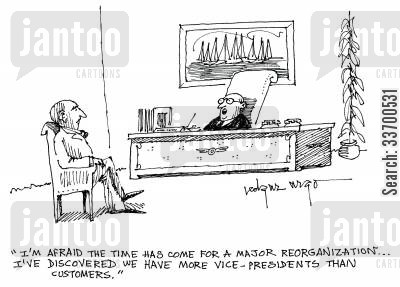
Cartoon – Liberated from the Tyranny of Thinking


Premiums, insurer choice, and overall stability of 2018 Affordable Care Act (ACA) marketplaces could be affected by decisions from Congress and the Trump Administration on the health law’s cost-sharing reduction provision. With a legal appeal pending on a lawsuit from the U.S. House, the federal government and Congress are in a position to choose whether to continue reimbursing insurers for the subsidies, which were established as part of the ACA to reduce out-of-pocket costs for lower-income people buying plans through the marketplaces. Failure to continue the payments would not only disrupt the marketplaces, but it also might signal a more obstructionist approach to the ACA, following House Republicans’ failed attempt at repeal. Continuing the payments could help to avoid further exits and premium increases by insurers.
On Thursday, April 6, the Kaiser Family Foundation hosted a web briefing for the media to explain how the cost-sharing reduction program works, where it stands now, and how consumers could be affected by either choice from the federal government. Panelists presented new analysis on the magnitude of the cost-sharing payments and how much premiums would have to rise in different states to compensate for insurers’ loss of federal funding.
Panelists included Gary Claxton and Larry Levitt, co-executive directors of the Foundation’s Study of Health Reform and Private Insurance. Rakesh Singh, the Foundation’s vice president of communications, moderated the discussion.
https://www.axios.com/a-warning-from-the-polls-about-letting-obamacare-explode-2347777457.html

President Trump has said the Democrats will take the fall politically if and when Obamacare “explodes.” But new polling shows that the public will hold Trump and the GOP accountable for failing to address problems in the marketplaces, not the Democrats. That means they’ll have to think twice about some of the moves they might make that could make the Affordable Care Act’s problems worse.
What’s on the line: The polling has direct implications for some of the specific actions Republicans could take, or not take, in the months ahead:
These steps would cause insurers to exit the non-group market, cause premiums to spike, and could leave millions without affordable coverage.
As the chart from our latest tracking poll shows, 62% of the public say Trump and the Republicans in Congress are in charge of the government and are responsible for problems with the ACA from now on; just 31% say President Obama and the Democrats are responsible. As is always the case with the ACA, there are party differences; 81% of Democrats and 65% of Independents said Trump and the Republicans “own it”, but just 35% of Republicans feel that way.
Trump has also said that the collapse of the ACA would bring Democrats to the table to forge a new “deal” with him on health care. That’s not impossible, but it seems unlikely: it’s hard to think of a single major element of health reform where the Democrats agree with the president and the Republicans.
As we saw when the Freedom Caucus refused to support the American Health Care Act because it wasn’t conservative enough for them, the substance and the details matter to policymakers far more than they appear to the President. He has suggested that he mostly wants a deal on health care.
Basic rules of politics seem to be holding up pretty well in the fights over the ACA. One rule, that benefits once conferred on the American people cannot be taken away, was a primary reason for the collapse of the GOP health care plan. The other: If severe problems develop in the marketplaces, or are caused by actions the administration takes to undermine the law, the party in charge gets the blame.
http://www.medpagetoday.com/hospitalbasedmedicine/generalhospitalpractice/64239
Medical device powerhouse Medtronic is testing the waters of hospital management, having begun operating a cardiac catheterization lab within a major U.S. hospital earlier this year.
UH Cleveland is the first U.S. facility to outsource its cath lab to a device maker – a new business model that’s met with some success in Europe, reportedly saving hospitals money while expanding Medtronic’s business portfolio.
With hospitals facing pressure to cut costs without sacrificing quality of care, they may be enticed to turn to well-heeled device and drug manufacturers willing to take over certain operations, and perhaps give their own products a boost in the process.
But such arrangements raise questions about how much control hospitals can retain over the operations — which run in their facilities and under their names — and how much freedom physicians will have to use devices from rival manufacturers.
Medtronic as Management
Medtronic launched its Hospital Solutions business in 2013, and its first foray into cath lab management came in 2014, when it acquired the Italian firm NGC Medical. It took over several outsourced catheterization labs in Italy, with the expectation of expanding NGC’s business outside that country.
Ron ten Hoedt, a Medtronic senior vice president and president for Europe, the Middle East, Africa & Canada, once said in a company meeting that Medtronic “needs to switch from a medical device company to a healthcare company,” according to a 2013 PriceWaterhouseCoopers report.
“If we want to be a part of the solution of the delivery of healthcare, then we need to risk-share, and we need to go into this market in a completely different way and with a completely different model,” ten Hoedt said.
Physician Concerns
Can doctors really remain unswayed in the hospital while working side by side with device company employees? Interventionalists said that freedom from pressure to use certain devices will be key to an ethical arrangement.
An anonymous source reported initial fears from UH Cleveland’s catheterization and electrophysiology lab operators that Medtronic would force them to use its durable goods when the deal was first proposed. They said their fears were assuaged, however, when it was clear that UH Cleveland was not going to push them to use Medtronic devices.
Morton Kern, MD, an interventionist and Chief of Medicine at VA Long Beach Health Care System in California, said doctors who work under this new management “will have to use their best judgment for which equipment to select.”
“If the equipment is equivalent, then it shouldn’t make a difference,” he said. “There is the perception that it could be a conflict, but it depends on who’s doing the ordering and the contracting. If it’s Medtronic, it doesn’t sound so kosher.”
“If there is separation between church and state, then there shouldn’t be a conflict of interest,” he added. “I don’t care who runs my lab as long as it works well and the equipment is current. From the doctor’s point of view, it should be invisible.”
Medical device powerhouse Medtronic is testing the waters of hospital management, having begun operating a cardiac catheterization lab within a major U.S. hospital earlier this year.
UH Cleveland is the first U.S. facility to outsource its cath lab to a device maker – a new business model that’s met with some success in Europe, reportedly saving hospitals money while expanding Medtronic’s business portfolio.
With hospitals facing pressure to cut costs without sacrificing quality of care, they may be enticed to turn to well-heeled device and drug manufacturers willing to take over certain operations, and perhaps give their own products a boost in the process.
But such arrangements raise questions about how much control hospitals can retain over the operations — which run in their facilities and under their names — and how much freedom physicians will have to use devices from rival manufacturers.

The problem of high prescription drug costs has no easy solution, analysts said Tuesday at an event here sponsored by Johns Hopkins University.
“It’s a major problem … and there’s no light at end of tunnel,” said Joshua Sharfstein, MD, associate dean for practice and training at Johns Hopkins University’s Bloomberg School of Public Health in Baltimore.
Overall drug costs are growing 10%-12% a year, “far quicker than wages or medical cost growth,” he added. “And it inhibits our ability to address public health problems. When we have a challenge like hepatitis C, when people can’t get treatment because of the [high cost], we’re all at risk.”
Although many ideas for solving the problem are being discussed, none are moving forward, Sharfstein said. He noted that things could get worse if, for example, Congress were to pass something like the House Republicans’ American Health Care Act, which would have resulted in the loss of health insurance for an estimated 24 million people.
“If you take 24 million people off of insurance, that generates pressure to get as much out of every insured person for pharmaceuticals as possible,” meaning that drug prices could rise even higher, he said. “It’s entirely possible you’d see that shift continue, and it could really worsen all the different challenges we have.”

For years, Republicans vowed that if they ever got control of the White House and both houses of Congress, the Affordable Care Act would quickly end up in the trash heap. As of January 20, those pieces were firmly in place.
Yet nearly 3 months later, the GOP appears no closer to enacting a repeal-and-replace bill than they were when Barack Obama was sitting in the Oval Office.
House Republican leaders have been unable to forge a consensus among its conservative and moderate wings as to what should come after the ACA. One bill had to be pulled from a floor vote when it became clear that neither the GOP’s Freedom Caucus nor Democrats would support it. And, earlier this week, a push led by top administration officials to appease the Republican conservatives — by making certain ACA elements retained in the GOP plan optional for states — was quickly declared dead on arrival.
MedPage Today asked physicians and policy experts why President Obama’s signature legislation is so hard to kill and whether Republicans might give up trying.
“Advocacy against the AHCA [American Health Care Act, the GOP’s initial repeal-and-replace bill] was broad and intense, with health care and public health organizations repeatedly raising concerns about health insurance coverage, access, and costs, including proposed dramatic changes to Medicaid funding that would preferentially hurt low-income people (including children), and risks of coverage gaps for those with chronic and pre-existing conditions,” wrote Jan Carney, MD, MPH, associate dean for public health and professor of medicine at the University of Vermont in Burlington, Vt., in an email.
Carney underscored the importance of the Congressional Budget Office’s report projecting a dramatic increase in the number of uninsured Americans — 14 million more in 2018 and 24 million more in 2026.
She also highlighted an April 4 Kaiser Family Foundation poll, which found 75% of Americans felt that Congress should work on fixing the ACA instead of repealing it.