Understanding the Intersection of Medicaid and Work

http://kff.org/medicaid/issue-brief/understanding-the-intersection-of-medicaid-and-work/

Figure 3: Industries with largest number of workers covered by Medicaid, 2015

Issue Brief

Medicaid is the nation’s public health insurance program for people with low incomes. Overall, the Medicaid program covers more than 70 million Americans, or 1 in 5, including many with complex and costly needs for care. Historically, nonelderly, non-disabled adults accounted for a small share (27%) of Medicaid enrollees; however, the enactment and implementation of the Affordable Care Act (ACA) has expanded coverage to nonelderly adults with income up to 138% FPL, or $16,394 for an individual in 2016. As of January 2017, 32 states have implemented the ACA Medicaid expansion. By design, the expansion extended coverage to the working poor (both parents and childless adults), most of whom do not otherwise have access to affordable coverage. With the expansion to more “able-bodied” adults, questions have arisen about tying work to eligibility.

President Trump may consider waiver proposals with a work requirement, and the Administration and leaders in Congress are considering proposals to repeal the ACA and to transform Medicaid from an entitlement program with guaranteed federal matching dollars for states to a block grant with no entitlement and capped funding. Such proposals would grant states additional flexibility to design and administer their programs and potentially include an option to allow states to impose a work requirement for Medicaid beneficiaries, which is not allowed under current law.  This issue brief examines the work status of non-elderly, non-disabled adults with Medicaid coverage to understand the potential implications of work requirement proposals in Medicaid.

Key Takeaways
This brief provides an overview of work status of non-disabled, adult Medicaid enrollees and examines some of the policy proposals around tying Medicaid coverage to work.

  • Among non-disabled, non-elderly Medicaid adults (including parents and childless adults — the group targeted by the Medicaid expansion) nearly 8 in 10 live in working families, and a majority are working themselves. However, nearly half of working Medicaid enrollees are employed by small firms, and many work in industries with low ESI offer rates.
  • Among the non-disabled, non-elderly adult Medicaid enrollees who were not working, most report major impediments to their ability to work.
  • Under current law, states cannot impose a work requirement as a condition of Medicaid eligibility, but some states have sought to impose a work requirement for the Medicaid expansion population through waivers; the prior administration did not approve these requests.  The issue of work requirements may be re-examined by the new administration and may be debated in Congress as part of broader efforts to restructure Medicaid financing and core federal requirements.


Compare Key Elements of ACA Repeal and Replace Proposals with New Interactive Tool

Compare Key Elements of ACA Repeal and Replace Proposals with New Interactive Tool

sbs-image-2.jpg

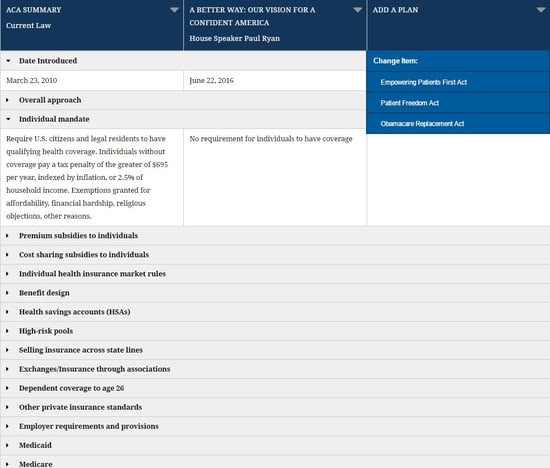
President Trump and Republicans in Congress have committed to repealing and replacing the Affordable Care Act. A new interactive tool from the Kaiser Family Foundation enables users to create side-by-side comparisons of major ACA alternative plans, now including 2017 proposals from Sen. Rand Paul and from Sen. Bill Cassidy.

With the tool, users can compare the plans’ approaches to more than a dozen key areas of health policy, including individual insurance market rules, requirements and provisions for employers, benefit design, Medicaid, and Medicare.

Detailed summaries of the Affordable Care Act and the following proposals are included:

  • Sen. Rand Paul’s Obamacare Replacement Act, 2017
  • Sen. Bill Cassidy’s Patient Freedom Act, 2017
  • House Speaker Paul Ryan’s A Better Way: Our Vision for a More Confident America, 2016
  • Empowering Patients First Act, 2015, introduced by Rep. Tom Price before he became secretary of Health and Human Services

Summaries of major new plans and updates to existing proposals will be added as they’re introduced.

Compare Proposals to Replace The Affordable Care Act


Republican Health Proposal Would Redirect Money From Poor to Rich

Image result for aca repeal

Republicans in Congress have been saying for months that they are working on a plan to repeal and replace Obamacare in the Trump era. Now we have the outline of that plan, and it looks as if it would redirect federal support away from poorer Americans and toward people who are wealthier.

A white paper drafted by House leadership and the staff of the House and Senate committees that oversee health policy details a structure that could replace large sections of the Affordable Care Act. Crucially, the proposal largely contains provisions that could be passed through a special budget process that requires only 50 Senate votes, and fulfills President Trump’s promise that the repeal and replacement of the law would take place “simultaneously.”

The plan would make major changes in how health care is financed for Americans who don’t get coverage from work. It would greatly expand the number of Americans who could benefit from federal help in buying health insurance, but it would change who benefits most from that support.

Obamacare, as the A.C.A. is known, extended health coverage to 20 million Americans through two main mechanisms. It expanded Medicaid coverage to Americans below or just above the poverty line in states that participated, and it offered income-based tax credits for middle-income people to buy their own insurance. Obamacare was a redistributive law, transferring money from rich to poor.

The Republican plan would alter both of those programs, changing the winners and losers. It would substantially cut funding for states in providing free insurance to low-income adults through Medicaid. And it would change how tax credits are distributed by giving all Americans not covered through work a flat credit by age, regardless of income.

That means that the biggest financial benefits would go to older Americans, like, say, Secretary of State Rex Tillerson. If he didn’t have a job in the Trump cabinet and access to government coverage, a 64-year-old multimillionaire like him would get the same amount of financial assistance as someone his age, living in poverty, and he would get substantially more money than a poor, young person.

Trump tries to save Obamacare exchanges while undermining them

http://www.latimes.com/opinion/la-ol-trump-obamacare-exchanges-20170215-story.html

Image result for Trump tries to save Obamacare exchanges while undermining them

With the drive to “repeal and replace” Obamacare losing steam, the Trump administration quietly moved to shore up a key feature of the healthcare law this week: the state exchanges where people shop for non-group coverage. And to its credit, Trump’s Department of Health and Human Services zeroed in on some of the factors that have led a handful of major insurers to leave the exchanges.

But before you praise (or condemn) Trump for coming to Obamacare’s rescue, consider this: Another arm of the new administration has taken a step that could undo much of the work the department is trying to do, and leave the exchanges no better off — and possibly in worse shape — than they are today.

The real threat to the exchanges’ health remains the specter of Congress enacting a law that repeals all or part of Obamacare in two or three years. Planting such a legislative time bomb would have an immediate impact, sending the market for non-group insurance policies quickly into chaos, according to analysts from both sides of the political spectrum. As John Rother of the pro-Obamacare National Coalition on Health Care put it, “[N]o market stabilization effort can succeed if policymakers disrupt existing coverage arrangements rather than improving on them.”

A core problem for the exchanges, which serve people not covered by a large employer’s group health plan, is that the people shopping there are running up larger healthcare bills than insurers expected. That’s resulted in losses for many insurers, persuading some to withdraw from the market and others to jack up premiums sharply.

Some critics argue that these trends are signs of Obamacare’s impending doom; the law’s supporters say they’re just growing pains, and there’s still plenty of evidence that the exchanges are sustainable (albeit with some adjustments). California’s experience is a case in point — its exchange, Covered California, still offers shoppers two or more options in every region, and its premium increases have been modest compared to the rest of the country’s.

California provides model to replace the Affordable Care Act

http://www.sacbee.com/opinion/op-ed/soapbox/article132714019.html

The new administration and Congress are under intense pressure to craft a market-based alternative to the Affordable Care Act. It won’t be easy. To achieve the financial stability required to make the market work, reformers should heed some important lessons from California.

Health plans and risk-taking medical groups essentially made a “deal” with Congress to participate in the ACA. They agreed to cover applicants with pre-existing conditions without charging higher premiums in return for: an expanded individual market driven by a federal mandate that everyone buy insurance; premium and cost-sharing subsidies financed by insurers and the government; and three federal risk-mitigation programs to help stabilize the new marketplaces.

It didn’t work out. Many health plans were priced incorrectly because more sick people enrolled and fewer healthy people signed up than expected. To compound the problem, Congress held up billions of dollars in promised payments from the federal risk corridor program to partially offset losses.

Most health plans responded by raising premiums. This year, premiums on the federally run exchanges rose about 25 percent, raising the annual benchmark premium to $5,586 for single coverage. Even then, about two-thirds of insurers are losing money in the individual market, several in the hundreds of millions of dollars.

For a model of how government and health insurers can work together to sustainably expand coverage and ensure stable markets, Congress should examine what happened in California.

Covered California, the state-run marketplace, took several steps to ensure long-term health plan involvement. The result has been a robust, competitive exchange that covered 1.5 million people in 2016 across 12 insurers. Premium increases were half the national average.

Here are the California approaches that any federal replacement plan should encourage other states to adopt:

Has the ACA Been a Job Killer? 2016 Update

http://www.rwjf.org/content/dam/farm/reports/issue_briefs/2017/rwjf435131

Image result for aca JOBS

The Affordable Care Act (ACA) has had little to no adverse effects on employment through 2016.

The Issue

The ACA contains several provisions that could impact jobs, including: the employer mandate, the expansion of Medicaid benefits to low-income adults, and the provision of tax credit subsidies to individuals enrolling in the health insurance marketplaces.

Key Findings

  • In 2016, actual and expected employment rates were both 71.8 percent, indicating no ACA-associated effect on overall employment, based on the Census Bureau’s monthly Current Population Survey from January 2000 through December 2016.
  • Despite a downtrend in part-time work since 2013, part-time work did not fall as much as expected, with the 2016 part-time employment rate 6 percent higher than expected, based on pre-ACA patterns.
Conclusion

Based on an analysis of employment, number of hours worked per week among workers, and part-time employment, researchers find that the Affordable Care Act has had little to no adverse effects on employment through 2016, while increasing health insurance coverage for 20 million Americans.

THE SHAMEFUL REPUBLICAN ASSAULT ON MEDICAID

http://www.newyorker.com/news/john-cassidy/the-shameful-republican-assault-on-medicaid?mbid=social_facebook

Image result for medicaid

In terms of political theatre, Donald Trump’s press conference on Thursday was the event of the week, or maybe the year. Strictly in policy terms, though, it was less important than the media briefing that Paul Ryan, the House Speaker, and other House Republican leaders held, also on Thursday, about their plans to abolish Obamacare and replace it with some version of what we might call Trumpcare, or maybe Trump/Ryancare.

There are still huge questions about what this new system will look like, and when it might be enacted. In a new seventeen-page paper, “Obamacare Repeal and Replace,” the G.O.P. lawmakers outlined proposals that are familiar from a plan that Ryan put out last year. They included expanded health savings accounts, financial aid for the establishment of high-risk pools at the state level, and the replacement of income-based subsidies to purchase individual insurance with universal tax credits.

But the paper also contained some huge gaps. It didn’t say how large the new tax credits would be, or how they and other elements of the reform would be paid for. To pay for its provisions, the 2010 Affordable Care Act levied more than a trillion dollars in tax increases over a decade. The Republican replacement will, in all likelihood, cover millions fewer people than Obamacare, but it will still have to be paid for. Ryan and his colleagues were largely silent on where the tax burden would fall.

For all this deliberate obfuscation, though, House Republicans are now being very clear about one thing: whatever legislation emerges after the Senate and the White House have weighed in, it will almost certainly roll back the Obama Administration’s expansion of Medicaid, the federal health-insurance program for poverty-stricken and low-income households. Under the outline released on Thursday, the current Medicaid system would be replaced by block grants to the states, and the extra federal money that went to Medicaid as part of the A.C.A. would gradually be removed. In effect, the Medicaid expansion would be slowly suffocated.

Outline of GOP plan to replace ACA has few surprises

http://www.healthcaredive.com/news/outline-of-gop-plan-to-replace-aca-has-few-surprises/436472/

Image result for aca repeal

Dive Brief:

  • An outline of the Republican plan to replace the Affordable Care Act was leaked Thursday after a meeting among Senate Republicans, The New York Times reports.
  • The document is a blueprint modeled after the House Republican’s plan called A Better Way, with age-based tax credits to help people buy insurance and more reliance on health savings accounts.
  • President Donald Trump said in a tweet early Friday that repeal and replace of the ACA is “moving fast” and House Speaker Paul Ryan said earlier this week he expects legislation to be introduced possibly as early as next week.

Dive Insight:

The GOP plan leaked Thursday contains few surprises but does leave out some key areas. It makes no mention of changing Medicare into a premium support plan, which Ryan has supported but Trump has been wary of.

The plan also makes no mention of how it would be paid for. Bloomberg has reported, however, that the GOP may be considering capping the tax break on employer-sponsored health insurance. This would be a major tax policy change. Policy analysts tend to support the idea but it could be a tough sell for lawmakers eyeing reelection.

The plan does address Medicaid, and essentially guts the expansion put forward by the ACA. It would roll back the generous cost sharing for states that expand eligibility and give states either a fixed sum per beneficiary or a block grant. Either way, far fewer people would be covered, leading to more uninsured and without access to care.

This could be unpopular, even among fellow Republicans. A handful of GOP governors in expansion states have said the move has improved healthcare access and their state’s economy.

Congress returns Tuesday and Republican leaders will push for legislation to be introduced as soon as they receive more guidance from the Congressional Budget Office, which is scoring some of their proposals.

A bleak week for Obamacare

http://www.politico.com/story/2017/02/obamacare-trump-congress-repeal-replace-235074

Image result for obamacare

Aetna’s CEO sees a ‘death spiral’ and the Trump administration’s stabilization plan may be too little, too late.


AEH: Safety-nets will face $40.5B in losses without similar ACA replacement

http://www.beckershospitalreview.com/finance/america-s-essential-hospitals-says-it-will-face-40-5b-in-losses-without-similar-aca-replacement.html

Image result for Safety-nets ACA replacement

Washington D.C.-based America’s Essential Hospitals said if Congress repeals the ACA and does not replace it with a “comparable” plan, its safety-net hospital members will lose up to $40.5 billion nationwide.

The losses would reflect the decrease in coverage under an ACA repeal, cuts to Medicaid disproportionate share hospital funding and Medicare from 2018 through 2026, according to the association’s policy brief.

In addition, the association said even if Congress followed a December 2015 repeal plan, which rescinded the Medicaid DSH cuts, its members would face a $16.8 billion loss over the same period.

“These numbers really show what’s at stake for the patients who depend on the doors being open at essential hospitals,” said Bruce Siegel, MD, president and CEO of America’s Essential Hospitals. “These are unsustainable losses that would jeopardize vital services and access to care in communities across the country.”