Payer trade groups slam short-term health plan proposal

https://www.healthcaredive.com/news/payer-trade-groups-slam-short-term-health-plan-proposal/521941/


More organizations, including Aetna and the American Medical Association, submitted comments on the proposed rule Monday.

Dive Brief:

  • The Alliance of Community Health Plans (ACHP) and America’s Health Insurance Plans (AHIP) both slammed CMS’ proposal to expand short-term, limited duration (STLD) insurance plans, saying the proposed rule would undermine key consumer protections, lead to higher premiums in the individual market and jeopardize market stability.
  • The proposed rule, pushed by the Trump administration as a way to increase access to cheaper plan alternatives and sidestep the Affordable Care Act, would allow consumers to purchase plans for up to 12 months that do not adhere to federal rules for individual health insurance. STLD plans can charge those with pre-existing conditions more and may not cover ACA essential health benefits such as prescription drug coverage.
  • The insurance lobbies argued that other policy mechanisms would be more effective at improving the individual health insurance market. AHIP pointed to increasing 1332 state waiver flexibility and the adoption of regulations aimed at preventing improper steering of Medicare and Medicaid consumers into the individual market, and ACHP advocated for the creation of a federal reinsurance program as more effective ways to promote affordable coverage.

Dive Insight:

The comments are indicative that many insurers are hesitant to back health plans that lack the consumer protections the ACA put into place due to a fear such plans would destabilize the individual market. Monday is the last day to submit comments on the rule.

new Kaiser Family Foundation brief notes that many middle-income people not shielded by premium subsidies in the individual market would likely see premium costs increase. Combined with the individual mandate penalty being zeroed out, the effort to increase STLD plans could result in fewer individuals enrolled in the ACA market, adversely impacting its stability.

“Short-term plans were designed for consumers to use as temporary, stop-gap measures when moving between plans – not as long-term replacements for health insurance,” ACHP CEO Ceci Connolly said in a statement. “A broad, stable risk pool is crucial for providing affordable coverage and care. ACHP believes that other policy options, such as reinsurance, would be far more effective at promoting high-quality, affordable coverage and care for all Americans.”

ACHP argued the proposed rule should not be finalized, saying the current status-quo limit of 90 days should be maintained.

AHIP called for any final rule to limit the duration of STLD plans to six months, adding that the plans should be required to have a plain-language disclosure that the plans should not be considered comprehensive health insurance. The group argued that the effective date of any final rule should come no sooner than Jan. 1, 2020.

“As the Departments advance policies to expand access to lower-cost coverage choices for a subgroup of consumers, it is critical to improve the affordability of comprehensive coverage options for all Americans, regardless of health status,” Matthew Eyles, AHIP COO, wrote in the group’s comment.

But major insurer Aetna, which left AHIP in 2016, said in its comment STLD plans “can be a valuable option for many consumers.”

The insurer argued that such plans must be transparent with disclosure language, limit any look-back period for pre-existing conditions to 12 months and define a minimum floor of benefits including inpatient hospital services, physician services, mental health and substance abuse services and one annual physical and annual well-woman visit before the deductible.

A group of Senate Democrats were among those asking for the rule to not be finalized, arguing it “could increase costs and reduce access to quality coverage for millions of Americans, harm people with pre-existing conditions, and force premium increases on older Americans.”

The American Medical Association also echoed the insurance lobby’s concern, saying STLD plans would endanger the coverage gains of the past decade and destabilize the market. AMA argued the administration should withdraw the proposed rule, saying it is “a step in the wrong direction and will lead to a proliferation of inadequate health insurance policies in the market.”

A joint comment of 21 consumer advocates, including March of Dimes and the American Cancer Society Cancer Action Network, also called for withdrawing the proposal.

PhRMA voiced concern in its comment over the lack of prescription drug coverage in STLD plans, citing an analysis that found than 71% of such plans do not cover outpatient prescription drugs. “If consumers can renew these plans for an extended period, it increases the chances that consumers may find themselves diagnosed with a new condition that can be effectively treated by an innovative drug at a time when they are covered by a short-term plan that does not cover prescriptions drugs,” PhRMA wrote.

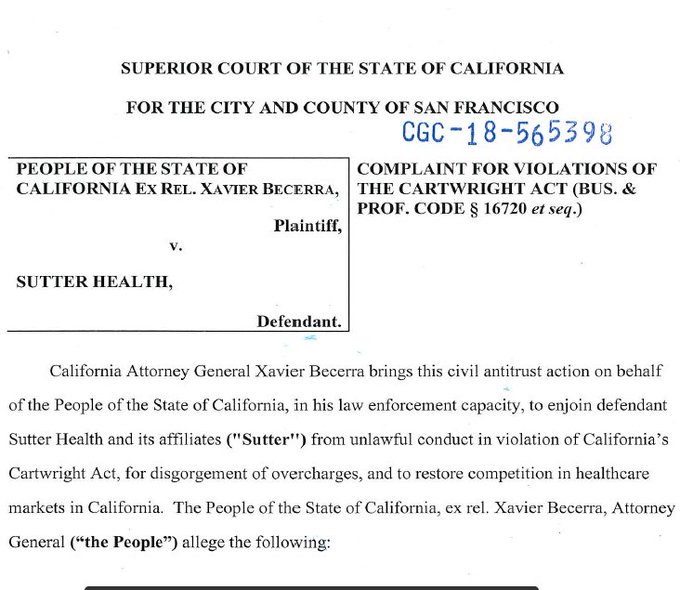


California attorney general sues Sutter Health for anticompetitive practices

https://www.fiercehealthcare.com/regulatory/california-ag-sues-sutter-health-for-anticompetitive-practices?mkt_tok=eyJpIjoiTkdNMU56bGxOVGRpWlRRMyIsInQiOiJOQmExNkliUVBkRFNHMGRBUFZiRG5MazRJVHJxQjFvRTl3NjVNV0pxeDlHc0dyVEhBS01HRjlcL1ZLaXFcL3hpOHVzVkxtdEpZb1BPYTc3SE82VnN3U05nejlNNEVOWUhhY2h2NThFdUluTjY1SU5zUkgxZEExRTFTemI5a3dSNkZJIn0%3D&mrkid=959610

Gavel

California’s attorney general has filed a lawsuit against Sutter Health, the largest system in the northern part of the state, claiming the organization’s anticompetitive practices have driven up healthcare prices throughout the region

The charges in the lawsuit (PDF) are “not new to Sutter,” AG Xavier Becerra said at a press conference Friday afternoon. The filing follows a statewide investigation into healthcare costs that revealed wide price disparities between the northern and southern parts of the state.

“Sutter Health is throwing its weight around in the healthcare market, engaging in illegal, anticompetitive pricing that hurts California families,” Becerra said in an announcement. “Big business should not be able to throttle competition at the expense of patients.”

Sutter was able to jack up prices for care at its facilities in several ways, according to the lawsuit:

  • Forcing insurance companies to negotiate with it in an “all-or-nothing” systemwide fashion
  • Blocking payers from offering patients low-cost health plan options
  • Charging extremely high rates for out-of-network visits
  • Limiting price transparency

Karen Garner, a spokesperson for Sutter, said in a statement emailed to FierceHealthcare that the system is “aware that a complaint was filed, but we have not seen it at this time, so we cannot comment on specific claims.”

Garner said that data from the state’s Office of Statewide Health Planning and Development show lower prices at Sutter Health facilities compared to other providers operating in Northern California. Sutter has also kept rate increases for its health plan in “low single digits since 2012,” she said.

“It’s also important to note that healthy competition and choice exists across Northern California,” Garner said. “There are 15 major hospital systems and 142 hospitals in Northern California, including Kaiser Permanente, Dignity, Adventist, Tenet, UC and more. And health plans can elect to include or exclude parts of the Sutter Health system from their networks, and health plans have been doing so for many years.”

Multiple California employers and labor unions have taken action against the health system for anticompetitive practices prior to the AG’s involvement. Sutter came under fire late last year after it was revealed that in 2015 it destroyed 192 boxes of documents that these entities sought as evidence, which the system said was a regrettable mistake.

A California judge said there was “no good reason” for Sutter to have destroyed the documents and said the “most generous interpretation” was that the system was “grossly reckless.”

The AG’s lawsuit also alleges that in addition to driving up healthcare costs in Northern California, Sutter’s actions enriched its executives, and fueled acquisitions that led to further consolidation and funding for its own health plan.

Becerra’s office was spurred to act, according to the announcement, following the release earlier this week of a report from the University of California that detailed how much consolidation has impacted healthcare costs in the state, with northern regions especially affected.

The average cost for an inpatient stay in Northern California was $223,278, compared to an average of $131,586 in the southern regions, according to the report (PDF).

Kathleen Foote, senior assistant attorney general in California who heads the antitrust unit, said at the press conference that taking action against Sutter’s practices should lead to increased competition that benefits both price and care quality.

A video of the full press conference is embedded below:


Why Your Pharmacist Can’t Tell You That $20 Prescription Could Cost Only $8

As consumers face rapidly rising drug costs, states across the country are moving to block “gag clauses” that prohibit pharmacists from telling customers that they could save money by paying cash for prescription drugs rather than using their health insurance.

Many pharmacists have expressed frustration about such provisions in their contracts with the powerful companies that manage drug benefits for insurers and employers. The clauses force the pharmacists to remain silent as, for example, a consumer pays $125 under her insurance plan for an influenza drug that would have cost $100 if purchased with cash.

Much of the difference often goes to the drug benefit managers.

Federal and state officials say they share the pharmacists’ concerns, and they have started taking action. At least five states have adopted laws to make sure pharmacists can inform patients about less costly ways to obtain their medicines, and at least a dozen others are considering legislation to prohibit gag clauses, according to the National Conference of State Legislatures.

Senator Susan Collins, Republican of Maine, said that after meeting recently with a group of pharmacists in her state, she was “outraged” to learn about the gag orders.

“I can’t tell you how frustrated these pharmacists were that they were unable to give that information to their customers, who they knew were struggling to pay a high co-pay,” Ms. Collins said.

Alex M. Azar II, the new secretary of health and human services, who was a top executive at the drugmaker Eli Lilly for nearly 10 years, echoed that concern. “That shouldn’t be happening,” he said.

Pharmacy benefit managers say they hold down costs for consumers by negotiating prices with drug manufacturers and retail drugstores, but their practices have come under intense scrutiny.

The White House Council of Economic Advisers said in a report this month that large pharmacy benefit managers “exercise undue market power” and generate “outsized profits for themselves.”

Steven F. Moore, whose family owns Condo Pharmacy in Plattsburgh, N.Y., said the restrictions on pharmacists’ ability to discuss prices with patients were “incredibly frustrating.”

Mr. Moore offered this example of how the pricing works: A consumer filling a prescription for a drug to treat diabetes or high blood pressure may owe $20 if he uses insurance coverage. By contrast, a consumer paying cash might have to pay $8 to $15.

Mark Merritt, the president and chief executive of the Pharmaceutical Care Management Association, which represents benefit managers, said he agreed that consumers should pay the lower amount.

As for the use of gag clauses, he said: “It’s not condoned by the industry. We don’t defend it. It has occurred on rare occasions, but it’s an outlier practice that we oppose.”

However, Thomas E. Menighan, the chief executive of the American Pharmacists Association, said that such clauses were “not an outlier,” but instead a relatively common practice. Under many contracts, he said, “the pharmacist cannot volunteer the fact that a medicine is less expensive if you pay the cash price and we don’t run it through your health plan.”

A bipartisan measure that took effect in Connecticut this year prohibits the gag clauses. It was introduced by the top Democrat in the Connecticut Senate, Martin M. Looney, and the top Republican, Len Fasano.

“This is information that consumers should have,” Mr. Looney said in an interview, “but that they were denied under the somewhat arbitrary and capricious contracts that pharmacists were required to abide by.”

Mr. Fasano said that consumers were sometimes paying three or four times as much when they used their insurance as they would have paid without it. “That’s price gouging,” he said in an interview.

The legislation, Mr. Fasano said, encountered “a lot of resistance” from large pharmacy benefit managers and some insurance companies.

In North Carolina, a new law says that pharmacists “shall have the right” to provide insured customers with information about their insurance co-payments and less costly alternatives.

A new Georgia law says that a pharmacist may not be penalized for disclosing such information to a customer. Maine has adopted a similar law.

In North Dakota, a new law explicitly bans gag orders. It says that a pharmacy or pharmacist may provide information that “may include the cost and clinical efficacy of a more affordable alternative drug if one is available.”

The North Dakota law also says that a pharmacy benefit manager or insurer may not charge a co-payment that exceeds the actual cost of a medication.

The lobby for drug benefit companies, the Pharmaceutical Care Management Association, has filed suit in federal court to block the North Dakota law, saying it imposes “onerous new restrictions on pharmacy benefit managers.”

Specifically, it says, the North Dakota law could require the disclosure of “proprietary trade secrets,” including information about how drug prices are set. “P.B.M.–pharmacy contracts typically preclude a pharmacy from disclosing to the patient the amount of a reimbursement,” the lawsuit says.

Gov. Asa Hutchinson of Arkansas, a Republican, said this past week that he would call a special session of the State Legislature to authorize the regulation of pharmacy benefit managers by the state’s Insurance Department.

He said he feared that some independent pharmacists receiving “inadequate reimbursement” from the benefit managers might go out of business, reducing patients’ access to care, especially in rural areas.


Hospital CEO pay soars as limitation efforts stumble

http://www.fiercehealthcare.com/healthcare/hospital-ceo-pay-soars-as-limitation-efforts-stumble?utm_medium=nl&utm_source=internal&mrkid=959610&mkt_tok=eyJpIjoiWWpneVlUYzNNamxqT1RZeCIsInQiOiJYa3JjTitjbjB0cW4wNnd6VDVRUTZHMUdtYUM5a0Yxd1A3bW1rQzMwU0hmMStleVhSTHBkRW5EYWEzWXRrVlwvcFwvV080QVROc1MybitpTkF1TTF4YUNobHNRT2hrRStmZHNZMktcL3MzOXZkbz0ifQ%3D%3D

Healthcare has some of the highest CEO pay growth of any industry and it shows no signs of slowing down.

In Massachusetts, hospital chief executives saw a pay bump throughout the state from 2013 to 2014, with the steepest raise of all going to Brigham and Women’s Hospital President Elizabeth Nabel, M.D., according to the Boston Business Journal.

The newspaper reports that Nabel’s total compensation soared 120 percent to $5.5 million in 2014. To put that in perspective, the publication noted that Gary Gottlieb, M.D., CEO of Brigham and Women’s parent company Partners Healthcare, and Nabel’s boss at the time, made $3.1 million. Most of Nabel’s compensation–$3.9 million–wasn’t even base salary, but rather retirement and nontaxable benefits.

Central Ohio hospital chief executives are seeing similarly big paydays, according to Columbus Business First. For example, Dave Blom, chief executive of Columbus’ OhioHealth Corp., led the region in compensation, with his base salary and performance bonuses coming to $2.64 million, with Steven Gabbe, M.D., who served as CEO of Ohio State University Wexner Medical Center January to March 2015, a distant second with $1.57 million.

The exorbitant paychecks for hospital CEOs have raised concerns among some consumer advocates, who say they hurt patients, but efforts to rein them in have had limited success.

20 things to know about balance billing

http://www.beckershospitalreview.com/finance/20-things-to-know-about-balance-billing.html

Medicine and Dollars

As payers and providers wage war over reimbursement rates for medical services, patients have been increasingly strapped with unanticipated healthcare bills that can have detrimental financial effects.

The practice of balance billing refers to a physician’s ability to bill the patient for an outstanding balance after the insurance company submits its portion of the bill. Out-of-network physicians, not bound by contractual, in-network rate agreements, have the ability to bill patients for the entire remaining balance.

Balance billing may occur when a patient receives a bill for an episode of care previously believed to be in-network and therefore covered by the insurance company, or when an insurance company contributes less money for a medical service than a patient expected.

In recent years, the rise in out-of-network payer-provider reimbursement clashes have spawned a growing number of balance billing cases. Last October, Aetna discouraged members from seeking emergency medical care at in-network Allegheny Health Network hospitals in Pittsburgh after out-of-network emergency physicians began ‘aggressively’ balance billing policy holders. In a more drastic move, UnitedHealthcare announced last year the insurer would no longer cover medical bills for members who unknowingly received out-of-network treatment by physicians at in-network hospitals.

Patients, caught in the financial crosshairs, often feel powerless to negotiate costs. Consumer advocacy groups and federal and state legislators are turning their attention to balance billing practices this year with renewed vigor, forcing payers and providers to find other ways to settle financial disagreements.

As Valeant’s CEO Apologizes, the Rest of the Industry Keeps Hiking Drug Prices

http://www.thefiscaltimes.com/2016/04/27/Valeant-s-CEO-Apologizes-Rest-Industry-Keeps-Hiking-Drug-Prices?utm_campaign=541c47950e351dbe08037e5f&utm_source=boomtrain&utm_medium=email&bt_alias=eyJ1c2VySWQiOiJmNzlkMTEyZi03NTg3LTQwMGMtYWNjNC04ZDBiMTQwZmM0YTUifQ%3D%3D

“It used to be the drug companies only took one price increase a year,” Dr. Steve Miller, chief medical officer at Express Scripts, a major drug-benefit manager, told the Times. “Now what they’re doing is taking multiple price increases multiple times a year.”