Governors urge keeping US health law’s individual mandate

http://abcnews.go.com/Health/wireStory/apnewsbreak-governors-health-care-plan-retains-mandate-49537497

Image result for individual mandate


A bipartisan governor duo is urging Congress to retain the federal health care law’s unpopular individual mandate while seeking to stabilize individual insurance markets as lawmakers work on a long-term replacement.

The recommendation is part of a compromise plan that’s designed to be palatable to both parties. It was endorsed by six other governors.

Ohio Gov. John Kasich, a Republican, and Colorado Gov. John Hickenlooper, a Democrat, shared their plan in a letter to congressional leaders Thursday. They acknowledge that retaining the mandate may be a difficult sell for Congress, which has failed so far to pass a replacement health care bill.

“The current mandate is unpopular, but for the time being it is perhaps the most important incentive for healthy people to enroll in coverage,” they wrote to House and Senate leaders of both parties.

Experts concur that keeping younger, healthier people in the insurance pool protects against costs ballooning out of control.

The penalty and coverage requirement, or individual mandates, were intended to nudge healthy people into the insurance market. They have consistently polled negatively with Americans. In an Associated Press-NORC Center for Public Affairs Research poll conducted in July, 48 percent of those surveyed favored repealing the mandate, while 35 percent opposed repeal.

Kasich and Hickenlooper’s letter was signed by Republican Gov. Brian Sandoval of Nevada; Democratic Govs. Tom Wolf of Pennsylvania, John Bel Edwards of Louisiana, Steve Bullock of Montana and Terry McAuliffe of Virginia; and Alaska Gov. Bill Walker, a one-time Republican no longer affiliated with a political party.

After Republicans’ failure to pass a replacement of President Barack Obama’s health care law, Kasich and Hickenlooper teamed up to push for health care exchanges that would stabilize the market and assure affordability. Both took pains to quash speculation that their collaboration and public appearances suggested a bipartisan presidential ticket was in the making for 2020.

Hickenlooper emphasized Thursday that steadying individual markets is a top — and time-driven — priority. Addressing Medicaid expansion costs and other health care elements can follow, he told reporters in Denver.

“Is this going to fix all that is broken with our health care system? No,” he said. “If we can demonstrate success at stabilizing the individual markets, then we can move to the other parts of health care as well.”

Kasich and Hickenlooper also recommended that President Donald Trump commit to cost-sharing reduction payments to insurers and that Congress fund those offsets at least through 2019. Those payments reimburse insurers for providing low-income people with legally required reductions on copays and deductibles. If Trump follows through on threats to pull the plug, premiums would jump about 20 percent.

Kasich said the proposal satisfies the concerns of all parties studying the health care law.

“If you want to keep what you have, you can,” the Ohio governor said Thursday. “We’ve stabilized everything up front, but then over time, we open up the doors to innovation and individual plans, within guardrails.”

The governors support creating a temporary stability fund that states could tap to reduce premiums and limit losses; continuing to fund educational outreach and enrollment efforts under the Affordable Care Act; exempting insurers that agree to cover underserved counties from the federal health insurance tax; and supporting states’ efforts to find creative solutions for covering the uninsured.

The governors said states can pursue lots of options without federal assistance, but in some cases they are “constrained by federal law and regulation from being truly innovative.”

Kasich and Hickenlooper are expected to be in Washington next week to testify on their proposal. But congressional action on even a modest compromise is expected to be difficult following years of harsh partisan battling over the Republican drive to dismantle the health care law.

Bipartisan group of governors calls on Congress to shore up elements of Affordable Care Act

https://www.washingtonpost.com/national/health-science/bipartisan-group-of-governors-calls-on-congress-to-shore-up-elements-of-affordable-care-act/2017/08/31/7853b978-8e71-11e7-84c0-02cc069f2c37_story.html?utm_term=.3975c59ec12b

Image result for bipartisanship

A bipartisan group of governors is trying to jump-start efforts to strengthen private insurance under the Affordable Care Act, urging Congress to take prompt steps to stabilize marketplaces created by law while giving states more freedom from its rules.

In a blueprint issued Thursday, the eight governors ask House and Senate leaders of both parties to take several steps to reverse the rising rates and dwindling choices facing many of the 10 million Americans who buy health plans on their own through ACA marketplaces.

Specifically, the state leaders say Congress should devote money for at least two years toward “cost-sharing subsidies” that the 2010 health-care law promises to pay ACA insurers to offset deductibles and other out-of-pocket expenses for lower-income customers. The House sued the Obama administration over the subsidies’ legality, and President Trump has repeatedly suggested that he might halt the payments — sending tremors through insurance companies in the marketplaces.

Five days before the House and Senate return to Washington, the governors also recommend preserving “for now” the ACA’s requirement that most Americans carry health insurance. Though this rule is unpopular, they concluded that it is “for the time being … perhaps the most important incentive for healthy people to enroll in coverage.”

The proposal also calls for a federal fund, to be available for two years, to buffer insurers from high-cost customers, and for the government to foster competition in ACA marketplaces by encouraging insurers to move into counties with only one company. Those that do would have the law’s insurer taxes waived on health plans sold in those locations.

Led by Ohio Gov. John Kasich (R) and Colorado Gov. John Hickenlooper (D), the blueprint essentially fleshes out the contours of four principals that many of the same governors recommended to Senate leaders in June. It focuses on the insurance market for individuals and families that buy coverage on their own — a fraction of the country’s consumers with private insurance but a perennially shaky part of the industry that the ACA was designed to strengthen.

Greg Moody, a longtime health-care aide to Kasich, said the blueprint is also an acknowledgment of the failure this year of Republicans who control Congress to deliver on their years-long goal of replacing the ACA. “We’ve recently seen how difficult that is,” Moody said.

The blueprint envisions a quick federal boost to shore up the marketplace for the coming year, while deferring to states longer term to experiment with potential changes in insurance subsidies, for instance, or different forms of penalties for consumers who drop coverage.

The proposal was released Thursday so that it would attract attention before two days of hearings scheduled next week by the Senate’s health committee, which will explore bipartisan ideas for improving the law and its marketplaces.

The other governors who signed on are Brian Sandoval (R-Nev.), Tom Wolf (D-Pa.), Bill Walker (I-Alaska), Terry McAuliffe (D-Va.), John Bel Edwards (D-La.) and Steve Bullock (D-Mont.).

After repeal scare, Obamacare has never been more popular

https://www.cbsnews.com/news/obamacare-repeal-has-never-been-more-popular/

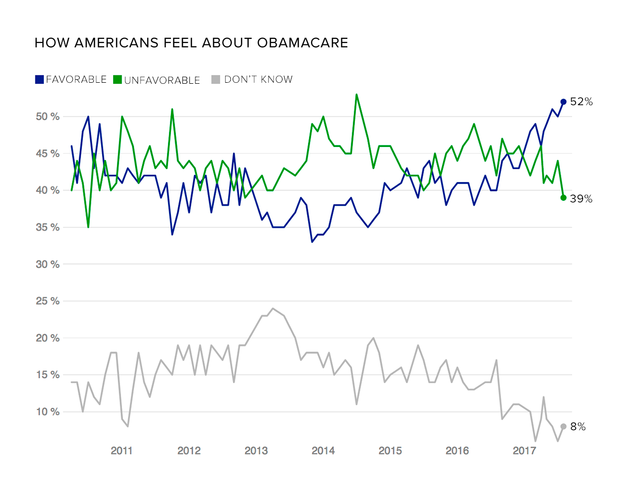
obamacare-sentiment.png

Underscoring the adage that you don’t know what you’ve got until it’s (almost) gone, the popularity of Obamacare is surging.

Only weeks after Republicans in Congress failed to repeal the landmark health reform law, 52 percent of respondents hold a favorable view of the Affordable Care Act (ACA), according to a recent Kaiser Family Foundation August poll. That’s up 10 percentage points since June of last year and nearly 20 points since November 2013, when public support for the ACA was at its nadir.

A July poll by CBS News after the repeal effort collapsed found that a plurality of Americans favor a bipartisan push in Congress to improve Obamacare.

The shift in sentiment coincides with other positive developments for Obamacare following its close call in Washington. With several large, and some smaller, insurers pulling out of the program over the past year or so, until recently it looked as if more than 92,000 participants spread out over 82 counties would have no insurer in their local health care exchanges, Cynthia Cox, associate director of Kaiser Family Foundation, said. But state insurance commissioners and other officials in states in jeopardy of losing Obamacare coverage have worked closely with insurers to negotiate continued coverage.

In Ohio, for instance, there were 20 counties without insurers, but officials ultimately convinced five health plans to cover all but one. Then, on August 24, the Ohio Department of Insurance announced that Paulding County, the last “bare county” in the country, would be covered by insurer CareSource.

In addition, the exchange marketplace overall has shown signs of stabilizing. After big financial losses in 2014 and 2015, individual market insurers saw improved performance in 2016, a trend that has continued this year, according to a different Kaiser Family Foundation study.

If Obamacare’s popularity is up, the program’s shortcomings remain clear. At last count, more than 2.6 million enrollees across 1,300 counties were expected to have only one insurer in their exchanges. More insurers also could pull out or move to sharply increase their premiums. The deadline for insurance companies to commit to participate in an exchange is September 27.

Until then, many insurers are watching closely to see if the Trump Administration will continue funding the federal cost-sharing subsidies that help low-income members pay for deductibles, co-pays and other out-of-pocket costs. Industry players are also waiting or Senate hearings to start after Labor Day in which which insurance commissioners, lawmakers and state governors are expected to testify about what can be done to stabilize the individual marketplace.

Meanwhile, some states are beginning to take matters into their own hands, moving to rewrite the ACA rules by applying for what’s known as a “Section 1332” waiver. Oklahoma is asking for a waiver to establish its own reinsurance program using some federal funds, which would cover the highest-cost individual marketplace cases. Alaska recently received approval for a similar reinsurance waiver. Oklahoma, however, is also looking ahead to more major structural changes that may spur debate.

Iowa, which is undergoing huge premium increases in its individual marketplace, has submitted a waiver that would overhaul the state’s insurance marketplace by redistributing federal tax credit money. The plan would create a single standard health plan and offer a flat tax credit based on age and income.

Critics argue this would increase health care costs significantly for Iowa’s low-income population, putting coverage out of reach for many. Proponents argue that increasing Iowa’s pool of healthy insured people is the best way to stabilize Iowa’s individual market and lower premiums for everyone.

Terminating Cost-Sharing Reduction Payments

http://www.healthaffairs.org/podcasts/terminating-cost-sharing-reduction-payments

Image result for the blame game

In a WTOP-FM interview, Alan Weil assesses the CBO’s report on the impact on premiums and the deficit if CSR payments were eliminated.


State officials take center stage in ACA stabilization efforts

http://www.fiercehealthcare.com/aca/state-officials-take-center-stage-aca-stabilization-efforts?mkt_tok=eyJpIjoiTXpka1pUSXhNMll5WldZeiIsInQiOiJCNWJNNHZ4Y1RxVHpCckY1WSswVGsyMjVpNituQ2RVUVp0UElNMmtqTlhkVUVQWFVINFhNU1RwcE9aU0Rad3Y3aFNhNjZWVXY3Ym02bXVkZFk3U3F6Y1pvbGJ4Rno4ZWM2M21jTUpcL2pVM3BsSnJNU2RWcVE1NEZDV1wvaUZzR1FmIn0%3D&mrkid=959610&utm_medium=nl&utm_source=internal

John Kasich speaking at lectern

As efforts to stabilize the Affordable Care Act exchanges begin to take shape, it’s become increasingly clear that states will play a major role.

On Tuesday, Sen. Lamar Alexander, R-Tenn., and Sen. Patty Murray, R-Wash., announced that the Senate’s upcoming bipartisan healthcare hearings will feature testimony from “those closest to the problem”—state insurance commissioners and governors. The hearings are planned for Sept. 6 and 7.

“These state leaders understand full well the challenges facing healthcare today, and many have been outspoken about how the uncertainty caused by this administration has impacted the individual insurance market and therefore families’ premiums for 2018,” Murray said.

Alexander said the goal is to pass a “small, bipartisan and balanced” ACA exchange stabilization package before the Sept. 27 deadline for insurers to lock in their final plans for 2018. He also wants the package to fund cost-sharing reduction payments and “give states more flexibility in approving insurance policies” by improving section 1332 of the ACA.

Kasich, Hickenlooper join the fray

Two state governors, meanwhile, are preparing to offer up their own healthcare plan even before the Senate hearings begin. Ohio Governor John Kasich, a Republican, and Colorado Gov. John Hickenlooper, a Democrat, told Colorado Public Radio on Monday that they hope to unveil the plan within a week.

Previously, Hickenlooper and Kasich joined other state governors in speaking out against the House version of an ACA repeal-and-replace bill, arguing in a letter to Senate leaders that it “calls into question coverage for the vulnerable and fails to provide the necessary resources to ensure that no one is left out, while shifting significant costs to the states.”

That letter, as well as a Washington Post op-ed authored by Kasich and Hickenlooper, outlined a set of core principles for bipartisan healthcare reform—principles that their upcoming ACA stabilization plan will build upon, according to the CPR article. They include improving affordability, restoring stability to insurance markets, providing state flexibility, encouraging innovation and improving the regulatory environment.

Iowa submits stabilization plan

At least one state, though, isn’t waiting on Congress to rescue its individual health insurance market.

On Monday, Iowa officials submitted their application for federal regulators to approve the “Iowa Stopgap Measure,” a short-term stabilization plan formulated by the state’s insurance commissioner with the help of local health plans.

In the application (PDF), Iowa Gov. Kim Reynolds urged federal officials to quickly approve the measure, noting the state faces “an immediate collapsing market that could leave thousands without health insurance and the rest with 56% or higher premium rate increases.”

The plan, which requires the use of a section 1332 waiver, would redirect the $305 million in federal funding that currently goes toward the ACA’s premium tax credits and instead fund fixed, age- and income-based premium subsidies for consumers.

It would also use federal funds to implement a reinsurance program that will reimburse insurers for high-cost individuals who incur claims greater than $100,000 on an annual basis. As part of the program, insurers would have to agree to care-management protocols.


Special Report—How to fix the Affordable Care Act

Click to access FierceHealthcare-HowtofixtheAffordaleCareAct.pdf

Image result for aca

As Congress prepares to get back to business, the industry is holding its collective breath to see if healthcare reform will fall off the agenda. It’s pretty clear that rushing through repeal, replace or repair legislation or letting the Affordable Care Act fail isn’t the answer. In this special report, FierceHealthcare’s editors—experts on the business of healthcare—outline ways to fix the nation’s healthcare system.

Time Crunch Among Hurdles for Bipartisan Senate Push to Bolster ACA

https://morningconsult.com/2017/08/18/time-crunch-among-hurdles-bipartisan-senate-push-bolster-aca/

Image result for aca


The leaders of a key Senate committee say they are cautiously optimistic about reaching a deal to shore up the Affordable Care Act’s individual marketplaces, but even with a bipartisan effort, it is far from certain whether they can hash out an agreement in time.

The Senate Health, Education, Labor and Pensions Committee leaders of both parties have set a self-imposed mid-September deadline for a bipartisan agreement. To keep lingering animosity from the Obamacare repeal fight from seeping into negotiations, Chairman Lamar Alexander has made clear that what he’s seeking is far from comprehensive.

The bill will have to be “small, bipartisan and balanced,” the Tennessee Republican said in a statement Wednesday.

Above all, Democrats want to make sure insurers continue to receive payments that help them cover out-of-pocket costs for some low-income patients. President Donald Trump has threatened to cut off the payments, and the administration has kept insurers on tenterhooks by making them only on a month-to-month basis.

Without the subsidies, known as cost-sharing reductions, some insurers warn they’ll be forced pull out of the ACA markets or hike premiums. The companies need certainty about payments at the latest by Sept. 27, the final deadline for them to decide whether to sell Obamacare plans in 2018.

If the committee can reach agreement next month, it would still be a challenge to get a bill through the full Senate and House before the key deadline for insurers. And Trump would still have to sign a bill into law that extends payments he is loath to continue.

The potential for chaos was highlighted this week when the nonpartisan Congressional Budget Office released a report estimating average premiums would rise 20 percent next year and the federal deficit would grow by $194 billion by 2026 if the administration stops paying.

While some conservative hard-liners want to cut off the CSRs, Alexander and other top Republicans have shown they’re willing to work with Democrats to have Congress extend the payments.

Sen. Patty Murray of Washington, the panel’s ranking Democrat, on Thursday called for quick action.

“People across the country are facing much higher premiums next year because of uncertainty driven by the Trump Administration, so I hope Republicans will join Democrats to act quickly to protect patients and families from paying more for care they need — and then continue working in a bipartisan way to make health care more affordable, accessible, and higher quality for all,” Murray said in a statement.

Democrats also want some sort of reinsurance program, an idea that has bipartisan support and would help insurers pay for their most expensive enrollees.

But in return for extending CSRs and including reinsurance, Republicans want to give states more authority over their health care systems, and Democrats could balk at some of their proposals.

Alexander has specifically pointed to changing the ACA’s 1332 waiver program, which allows states to opt out of key ACA regulations as long as it doesn’t lead to reduced coverage, skimpier benefits, more expensive insurance or a higher federal deficit.

In remarks to reporters earlier this month, Alexander noted a proposal that would eliminate all of those requirements besides increasing the federal deficit, in order to give states “more of an opportunity to approve insurance plans.” The plan, which was included in Senate Republicans’ health overhaul bill, would also bar the administration from rejecting a waiver as long as it doesn’t increase the federal deficit.

Democrats would likely oppose that proposal, wary of allowing states to undercut key Obamacare requirements without those other conditions in place.

Sen. Tim Kaine (D-Va.) said he’s interested in a proposal from Sens. Bill Cassidy (R-La.) and Susan Collins (R-Maine) to let states replace Obamacare’s most contentious provision — the mandate requiring people to purchase health insurance or pay a penalty — with a system that automatically enrolls individuals in low-cost coverage if they don’t do so on their own.

Backers of this approach argue it would offer comparable coverage to the individual mandate while being less intrusive, allowing people to opt out.

“I think that’s intriguing,” Kaine said earlier this month in a brief interview. “We ought to have that discussion, but you can’t blow the mandate without something to bring people into the program and do what insurance needs to do, which is to spread risk.”

But auto-enrollment has raised concerns among some liberal health care analysts, including over how to implement and administer such a system. The outstanding questions cast doubt on whether it could garner enough backing to be included in the stabilization bill.

Trump needs to stop sabotaging Obamacare — before it’s too late

https://www.washingtonpost.com/opinions/trump-needs-to-stop-sabotaging-obamacare–before-its-too-late/2017/08/17/1c1404ba-8133-11e7-902a-2a9f2d808496_story.html?utm_term=.40564141606c

THE CONGRESSIONAL Budget Office released on Tuesday yet another damning report on health care, this time highlighting the damage President Trump will do if he continues his Obamacare sabotage campaign. Over the next few weeks, during which the government and insurers must sort out what will happen to Obamacare insurance markets next year, everyone in the administration and every member of Congress must recognize that they have no more time to entertain repeal-and-replace fantasies. The fate of the health-insurance markets on which millions of people rely hangs on their willingness to accept reality.

The Trump administration has shown some flexibility. The Department of Health and Human Services last week offered insurers an extra few weeks to file rates for next year. Earlier, Alaska got $323 million in federal money to backstop its individual insurance market in a reinsurance arrangement that could drive down premiums and serve as a model for stabilizing insurance markets across the nation. Though Mr. Trump has repeatedly vowed to let Obamacare collapse, these moves show willingness to bolster, not undermine, the insurance markets that Obamacare created.

Yet the administration has stoked more uncertainty than it has allayed, leaving the health system in peril. The White House has been deciding month-to-month whether to keep important subsidy payments flowing to insurance companies — payments that were simply assumed during the Obama administration. Without these payments, insurers would have to jack up premiums or leave Obamacare markets next year. The CBO estimated Tuesday that average premiums would jump by 20 percent next year if the Trump administration pulled them. Moreover, because of how the payments interact with other elements of the health-care system, the government would end up losing money — $194 billion over a decade.

Though it would be irrational to subvert the health-care system and the budget, Mr. Trump has repeatedly threatened to do so. His officials also have taken steps in that direction, pulling advertisements meant to encourage people to enroll in health insurance, cutting programs that helped people sign up, railing about Obamacare’s “victims” and generally insisting, against the facts, that the law is a disaster. The administration’s moves to weaken the individual mandate, which requires all Americans to carry health coverage and underpins the Obamacare system, have led insurers to contemplate increasing premiums or leaving the system.

The president wanted and failed to overhaul Obamacare. That does not excuse him from faithfully executing the law. Unless Mr. Trump wants to be blamed for health-care chaos, the administration’s mixed messages must stop. Mr. Trump should commit to keeping the subsidies going permanently, to enforcing the individual mandate and to working with Congress on a bipartisan bill that would bolster insurance markets.

The broad strokes are clear: Democrats would ensure that subsidy payments are made permanent and Republicans would get more flexibility for states in administering Obamacare. More money should also go into reinsurance programs like Alaska’s. Though such a bill might come too late to hold down 2018 premiums, serious legislative activity could persuade insurers to stay in the market, riding out next year with the promise of a more stable situation in 2019.

All of this would be easier if the administration would commit to a strategy of stewardship, not sabotage.

Podcast: ‘What The Health?’ Why Is It So Difficult To Control Drug Prices?

http://khn.org/news/podcast-what-the-health-why-is-it-so-difficult-to-control-drug-prices/?utm_campaign=KFF%3A%20The%20Latest&utm_source=hs_email&utm_medium=email&utm_content=55441015&_hsenc=p2ANqtz-9e7_gZXAdvCjfT8GtdskXSSOirfF7966DDJa4zoZD9o34ccah4IJn9ru3eZt6HEtUGe2i4BhJZUdiiRH2KC7RVkVAPOQ&_hsmi=55441015

Mary Agnes Carey of Kaiser Health News, Sarah Karlin-Smith of Politico, Margot Sanger-Katz of The New York Times and Julie Appleby of Kaiser Health News discuss the recent extension of cost-sharing subsidies for millions of low-income beneficiaries on the Affordable Care Act’s marketplaces — as well as the state of play on Capitol Hill and in the states concerning efforts to lower prescription drug costs.

What’s the Near-Term Outlook for the Affordable Care Act?

http://www.kff.org/health-reform/issue-brief/whats-the-near-term-outlook-for-the-affordable-care-act/?utm_campaign=KFF-2017-August-Health-Reform-Outlook-ACA&utm_medium=email&_hsenc=p2ANqtz-_EbLjzmzMtjCe5gWysdKFOYAKOhLUxytBE9QiRYkFON8iXqISeYScKKovbN72gQpEReUlNwoqtEivO7NiGu6poWGxL1A&utm_content=54950542&utm_source=hs_email&hsCtaTracking=b35f36e5-60c0-4e14-ba27-3e14c4025b79%7Cf0a0cb87-2715-4168-b499-2000076067bf

If Congress abandons efforts to repeal and replace the Affordable Care Act (ACA), President Trump has said he would “let Obamacare fail.” This Q&A examines what could happen if the Affordable Care Act, also called “Obamacare,” remains the law and what it might mean to let Obamacare fail.

Is Obamacare failing?

The Affordable Care Act was a major piece of legislation that affects virtually all payers in the U.S. health system, including Medicaid, Medicare, employer-sponsored insurance, and coverage people buy on their own. One of the biggest changes under the health reform law was the expansion of the Medicaid program, which now covers nearly 75 million people, about 14 million of whom are signed up under the expansion. Most Americans, including most Republicans, believe the Medicaid program is working well.

When people talk about the idea of the ACA failing, they are usually referring to the exchange markets, also called Marketplaces. These markets, which first opened in 2014, are part of the broader individual insurance market where just 5-7% of the U.S. population gets their insurance. People who get insurance from other sources like their work or Medicaid are not directly affected by what happens in the individual insurance market.

The exchange markets have not been without problems: There have been some notable exits by insurance companies and premium increases going into 2017, and in the early years of the exchanges, insurers were losing money. The structure of the ACA’s premium subsidies – which rise along with premiums and cap what consumers have to pay for a benchmark plans a percentage of their income – prevents the market from deteriorating into a “death spiral.” However, premiums could become unaffordable in some parts of the country for people with incomes in excess of 400% of the poverty level, who are ineligible for premium assistance.

Insurer participation in this market has received a great deal of attention, as about 1 in 3 counties – primarily rural areas – have only one insurer on exchange. Rural counties have historically had limited competition even before the ACA, but data now available because of the Affordable Care Act brings the urban/rural divide into sharper focus. On average at the state level, competition in the individual market has been relatively stable – neither improving nor worsening.

Premiums in the reformed individual market started out relatively low and remained low in the first few years – about 12% lower than the Congressional Budget Office had projected as of 2016 –before increasing more rapidly in 2017. Most (83%) of the 12 million people buying their own coverage on the exchange receive subsidies and therefore are not as affected by the premium increases, but many of the approximately 9 million people buying off-exchange may have difficulty affording coverage, despite having higher incomes. As might be expected, after taking into account financial assistance and protections for people with pre-existing conditions, some people ended up paying more and others paying less than they did before the ACA. Our early polling in this market found that people in this market were nearly evenly split between paying more and paying less. About 3 millionpeople who remain uninsured are not eligible for assistance or employer coverage and many of them may be going without coverage due to costs.

Our recent analysis of first quarter 2017 insurer financial results finds that the market is not showing signs of collapse. Rather, insurers are on track to be profitable and the market appears to be stabilizing in the country overall. In other words, those premium increases going into 2017 may have been enough to make the market stable without discouraging too many healthy people from signing up. However, there are still markets – particularly rural ones – that are fragile.

How would administrative actions affect market stability?

Despite signs that the individual insurance market is generally stabilizing on its own, certain administrative actions could cause the market to destabilize again. Actions the Administration might take that would weaken the market include:

STOP ENFORCING OR WEAKEN THE INDIVIDUAL MANDATE

The individual mandate is the Obamacare requirement that most people either have insurance or pay a penalty. The purpose of it is to get young and healthy people into the market to bring down average costs. If there are not enough young and healthy people signing up, insurers have to raise premiums. If the administration signals it will either stop enforcement of the individual mandate or give broad exemptions, insurers will respond by raising premiums or exiting the market. The Congressional Budget Office (CBO) estimates that without the individual mandate, premiums in the individual insurance market could rise by 20%.

SCALE BACK OUTREACH AND CONSUMER ASSISTANCE

The individual market is often a transitional source of insurance when life circumstances change. People who are temporality unemployed, in school, or early retirees make up a substantial share of the individual market. Additionally, people in this market often experience income volatility and may cycle between Medicaid and subsidized exchange coverage. Those who are sick will be most likely to seek insurance coverage on their own when they go through a change in life circumstances, but outreach and consumer assistance programs – particularly those targeted at young and healthy individuals – can help balance out the risk pool and bring down average costs.

This coming open enrollment period (November 1 – December 15, 2017) is shorter than previous periods and may require more outreach to get people signed up before the deadline. This will also be the first enrollment period run from start to finish by the Trump administration and it is not yet clear how much outreach the administration will take on. Toward the end of the last open enrollment period, the Trump administration cut marketing and more recently has used outreach funds for messages critical of the health care law.

STOP MAKING COST-SHARING SUBSIDY PAYMENTS

Under the Affordable Care Act, insurers are required to offer low-deductible plans to low-income people (58% of marketplace enrollees benefit from these cost-sharing subsidies). For the lowest-income enrollees, these subsidies can bring down the deductible from a few thousand dollars to a couple hundred dollars (Figure 2 below). Providing these higher-value plans to low-income enrollees costs insurers more money (an estimated $10 billion dollars in 2018), so under the ACA the federal government reimburses insurers in the form of a cost-sharing subsidy payment. However, these payments are the subject of a lawsuit and the Administration has signaled they might stop making payments.

If these payments stop, we estimate that insurers would need to raise rates on silver-level plans – which are the only plans where consumers can access cost-sharing reductions – by 19 percent, with states that did not expand Medicaid (primarily red states) facing higher premium increases (Figure 3 below). Lower-income marketplace enrollees receiving premium subsidies would be protected from premium increases because subsidies would rise as well. However, higher-income enrollees not receiving premium subsidies would face higher premiums if insurers expect cost-sharing subsidy payments to end.

The combined effect of these policy changes (not enforcing the individual mandate and defunding cost-sharing subsidies) could cause some insurers to raise premiums on some plans by as much as 40 percentage points higher than they otherwise would. Because premium subsidies increase as premiums rise, administrative actions that cause premiums to rise can also cause taxpayer costs to increase. For example, we estimate that ending cost-sharing subsidy payments could increase net federal costs by about $2.3 billion per year.

Insurers have already submitted their preliminary premiums for the upcoming calendar year to state regulators. Since there has not been clarity on these issues, some insurers are already assuming that the Trump Administration or Congress may take an action that would destabilize the market. Some companies have either significantly raised premiums for next year, scaled back their footprints, or made plans to exit the exchange or individual market all together. Insurers are still negotiating rates for 2018, so if they do not get clarity soon, premiums could go up even more or more insurers could leave.

Again, these premium increases would only affect people who buy their own insurance (particularly middle-income or upper-middle-income people who buy their own insurance without a subsidy to offset the costs), and this group does not make up a large share of the American public. Nonetheless, more insurer exits or large premium increases on the exchange markets could be seen as Obamacare failing. It is worth noting, though, that a majority (64 percent) of the public – including 53 percent of Republicans – say that because President Trump and Republicans in Congress are now in control of the government, they are responsible for any problems with the ACA moving forward.

What happens if the market fails?

Following some announcements of 2018 exits by major insurers, there are some counties at risk of having no insurer on the exchange next year. This would be a first; thus far, all counties have had at least one insurer on the exchange. As negotiations between insurers and state regulators are still underway, there is still time for other insurers to come in and fill these gaps. Thus far, in most cases, a new or expanding insurer has already moved in to cover counties once thought to be “bare.” However, administrative actions that destabilize the market could encourage more insurers to exit.

If no exchange insurer ultimately moves in to some of these counties, people buying their own insurance will not be able to get subsidies and would have to pay full price for insurance. Paying for unsubsidized insurance would be particularly difficult for low-income and older adults living in high-cost areas like many rural parts of the country. Our subsidy calculator can show the difference in cost. For example, in Knox County Ohio, a low-income 60-year-old could get a silver plan for $83 per month but would have to pay $775 per month if he bought that plan without a subsidy, plus he would have a higher deductible because he would no longer benefit from cost sharing subsidies that are only available on the exchange. That same person would also qualify for a free ($0 premium) bronze plan if he buys on exchange, but off-exchange without a subsidy he would have to pay more than $600 per month for a similar plan. People shopping for coverage off-exchange in a county left without an exchange insurer – particularly lower income or older exchange shoppers – may not be able to afford any option and may drop their coverage.

If the market becomes destabilized, and particularly if the individual mandate is not enforced, insurers may decide to exit the off-exchange market as well. This would mean that people in these counties who would otherwise buy their own insurance may not have any option even if they could afford to pay full price.

What might be done to strengthen the Marketplaces?

Although the individual health insurance market is stabilizing on average, insurer financial performance varies and some companies in some states are still struggling. Additionally, some insurers have already decided to increase premiums significantly or exit the market in 2018 on the assumption that the Trump Administration or Congress will take actions that destabilize the market. Although there are many ideas on both the left and the right for how to improve these markets, there are not many options that have bipartisan support.

One possible policy response that could receive bipartisan support would be to reestablish a reinsuranceprogram. Reinsurance programs provide funds to insurers that enroll high-cost (sicker) individuals and can work to lower premiums. The Affordable Care Act included a reinsurance program but it was temporary and phased out in 2016. Republicans in Congress and the Administration have also signaled a willingness to establish reinsurance programs: Both the House and Senate repeal bills included stability funds for reinsurance and Health and Human Services Secretary Price has supported Alaska’s request for a waiver to support its reinsurance program. Though such a program could receive bipartisan support, it would require additional funds (for example, taxing insurers in other markets).

Additional state flexibility to address local challenges in implementing the health care law may also receive some bipartisan support. The challenge of attracting insurers to rural areas or certain states, for example, may warrant state-specific solutions – either as part of the ACA’s waiver program or by Congress giving states additional flexibility.