Irma forces 35 hospitals across 3 states to evacuate: 9 things to know

http://www.beckershospitalreview.com/patient-flow/irma-forces-35-hospitals-across-3-states-to-evacuate-9-things-to-know.html

Image result for hurricane irma

Hurricane Irma hit southwest Florida Sunday and continued its destructive march north, forcing at least 35 hospitals across Florida, Georgia and South Carolina to evacuate patients or shut down. Downgraded to a tropical storm Monday morning, Irma still presents a major threat to many healthcare facilities.

Here are nine things to know.

1. As of Saturday afternoon, most of Florida’s hospitals remained open, the Florida Hospital Association told STAT. In advance of the hurricane, healthcare facilities across the state evacuated nearly 1,900 patients.

2. Four hospitals in the Florida Keys — Lower Keys Medical Center in Key West, Fishermen’s Hospital in Marathon, Mariners Hospital in Tavernier and Depoo Hospital in Key West — were among the first healthcare facilities in the state to close last week ahead of the hurricane, according to STAT.

3. In Miami, Mercy Hospital, part of Nashville, Tenn.-based HCA Healthcare, closed Friday after evacuating 200 patients. The patients were transferred to other HCA facilities. The Miami Cancer Institute, part of Coral Gables-based Baptist Health South Florida, also closed.

4. Mt. Sinai Hospital in Miami opened two conference rooms to house 30 expectant couples who were unable to leave during the hurricane. The women are 36 or more weeks pregnant and unable to travel, according to WHDH.

5. Naples, Fla.-based NCH Healthcare System stayed open during the hurricane and provided shelter for hundreds of evacuees, according to the Naples Daily News.

6. On Florida’s west coast, at least five hospitals have closed. Tampa General Hospital, the region’s only Level 1 trauma center, stayed open. As of Sunday, about 650 patients were in the hospital. A group of physicians, nurses and other staff will care for patients throughout the remainder of the storm, according to the Tampa Bay Times.

7. In central Florida, Cape Canaveral Hospital closed after evacuating patients last week, according to STAT.

8. In Georgia, Candler Hospital in Savannah transferred patients to St. Joseph’s Hospital in Savannah. Officials said St. Joseph’s Hospital “is better equipped to handle the long-term needs of our caregivers, medical staff and any patients who are too sick to be discharged or evacuated.”

9. In South Carolina, Hilton Head Hospital evacuated all patients and suspended services.

Storm Harvey could financially hurt already strained Houston hospitals

http://www.reuters.com/article/us-storm-harvey-healthcare/storm-harvey-could-financially-hurt-already-strained-houston-hospitals-idUSKCN1B92T2

Image result for houston hospitals under water


Structural improvements over the last decade to Houston hospitals have helped them so far to avoid devastation like Hurricane Katrina in New Orleans in 2005, but the pounding it is receiving from Tropical Storm Harvey is expected to financially hobble many already strained Texas medical centers.

The storm has forced hospitals to cancel surgeries, evacuate patients and contend with food and supply shortages. Even bigger challenges are expected in coming months when people who have lost homes and jobs avoid medical treatment or seek charitable care.

“A lot of hospitals already were burdened by uncompensated care…they were already struggling, and this will make things much harder,” said Vivian Ho, a healthcare economist at Rice University.

Rice has been temporarily closed because of the slow-moving storm that has killed at least 11 people since Friday and paralyzed Houston, the fourth most-populous city in the United States with a U.S.-census estimated 2.3 million.

Houston’s healthcare industry includes some of the most prestigious institutions in the country and has grown to accommodate a rising population in recent years.

But uncertainty about changes to U.S. health insurance policy, the region’s shrinking energy sector and Texas’ high percentage of uninsured have forced several Houston hospitals to cut thousands of jobs this year and post millions of dollars in losses, even before the storm.

Investment bank Jefferies warned in an Aug. 28 note that Harvey could have a significant impact on Texas healthcare providers, especially HCA Healthcare Inc, which has “11 percent of its beds in the areas impacted by severe weather.”

Texas Hospital Association spokesman Lance Lunsford said medical centers made significant improvements after buildings were damaged by Tropical Storm Allison in 2001.

Harvey broke rainfall records for the continental United States, with one site south of Houston recording 49.2 inches (1.25 meters) of precipitation.

Flooding prompted MD Anderson on Monday to cancel appointments and surgeries until Wednesday at the earliest, St. Luke’s Hospital closed one of its branches, and flooding at Ben Taub Hospital shut its food service.

MD Anderson on Monday told employees not part of its storm “ride out” team to stay home.

Roads around the cancer center’s main hospital were impassible, and a doctor posted photos of flooding that reached into the hospital lobby.

MD Anderson’s economic impact to the area is about $35 billion, according to its web site. Its 21 hospitals and affiliated institutions employ more than 106,000 people.

Harvey pounded the nation’s chemical epicenter. What’s in the foul-smelling floodwater left behind?

http://www.latimes.com/nation/nationnow/la-na-houston-chemical-plant-20170831-story.html
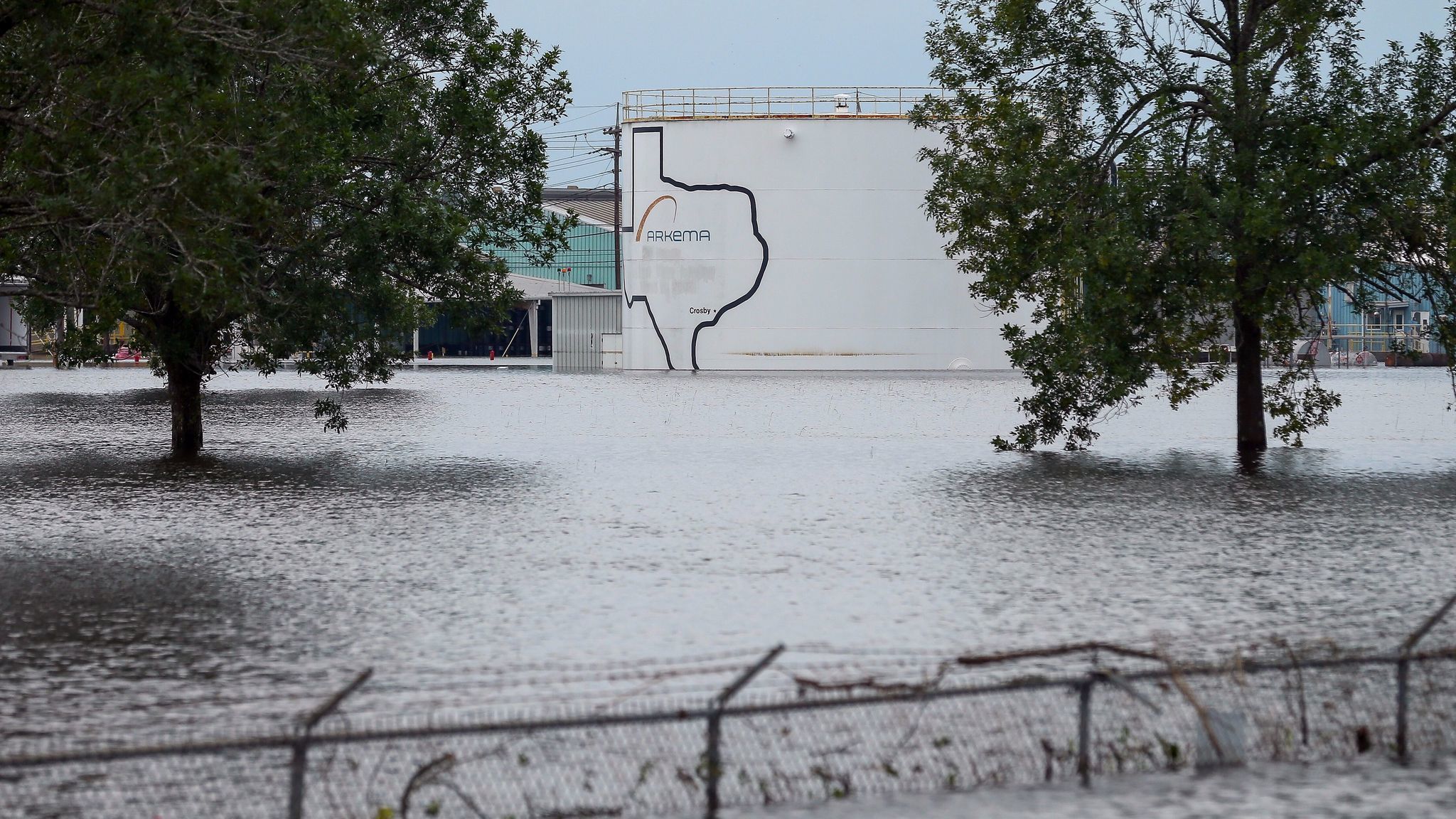
Image result for Harvey pounded the nation's chemical epicenter. What's in the foul-smelling floodwater left behind?

The pounding rains of Hurricane Harvey washed over the conduits, cooling towers, ethylene crackers and other esoteric equipment of the nation’s largest complex of chemical plants and petroleum refineries, leaving behind small lakes of brown, foul-smelling water whose contents are a mystery.

Broken tanks, factory fires and ruptured pipes are thought to have released a cocktail of toxic chemicals into the waters. Explosions that released thick black smoke were reported at the Arkema Inc. chemical plant, where floods knocked out the electricity, leaving the facility outside Houston without refrigeration needed to protect volatile chemicals.

Meanwhile, emissions into the air have soared as the petrochemical industry shut down and then started up chemical operations, a cycle that causes an uptick in releases.

The potential health problems were magnified by overflowing sewers, inoperative treatment plants and the residues of animal waste, including carcasses.

Nobody is sure how much long-term health impact, if any, will result from the tidal wave of toxins and bacteria that swept through the nation’s fourth largest city.

Exhaustive investigations by the Environmental Protection Agency and the National Academy of Engineering after Hurricane Katrina, in which floodwaters languished in New Orleans for about six weeks, showed that toxic concentrations and the resulting exposures were too low to cause significant long-term health problems.

That festering flood caused a stench for weeks that left soldiers gagging for air as they flew helicopters 2,000 feet over the city. The Army Corps of Engineers had to pump the water out of New Orleans, much of which lies below sea level.

A report by the National Academy of Engineering in March 2006 said the floodwaters contained elevated levels of contaminants. The inorganic compounds were below drinking-water standards, while arsenic levels, attributed in part to lawn fertilizer, were above those standards.

The EPA took 1,800 samples of residue and soil from across the New Orleans area after Hurricanes Katrina and Rita and found that generally “the sediments left behind by the flooding from the hurricanes are not expected to cause adverse health impacts to individuals returning to New Orleans.”

The situation is far different in Houston, where the floodwaters are receding much faster.

But because Houston is far more industrialized, Harvey could have a much larger potential for leaving a toxic trail.

Without question, air emissions rose significantly during and after the storm, said Elena Craft, a toxicologist and senior scientist at the Texas branch of the Environmental Defense Fund.

The industry shutdown and startup cycle released 2 million pounds of pollutants, equal to 40% of all the emissions from 2016, Craft said, based on reports the industry made to the Texas Commission on Environmental Quality.

“In a few days, we have had months of exposure,” Craft said.

Marathon Oil, for example, reported to the state that heavy rain had pounded the roof of a storage tank so hard that it tilted, exposing gasoline to the air.

The emissions reports also included such carcinogens and suspected carcinogens as benzene and butadiene.

Craft said that sewage treatment plants in Beaumont went off line. A pipe carrying anhydrous hydrogen chloride was compromised in La Porte. Harris County’s 26 federal Superfund toxic waste sites may have been affected, including one that contains dioxins from a former paper mill along the San Jacinto River.

The fire at the Arkema chemical plant in Crosby released organic hydrogen peroxide, which officials said is an irritant but not toxic.

Tommy Newsom, who lives about 7 miles from the plant, said he felt fine but wondered what other chemicals might be involved. “Who knows how much of what they’re telling us is true?” he said.

“I think the wind’s in my favor,” said Newsom, a 60-year-old port worker, pointing to Texas state and U.S. flags at the entrance to his housing development.

Jennifer Sass, a senior scientist with the Natural Resources Defense Council’s health program, said the situation in Houston is a perfect breeding ground for hepatitis and tetanus.

“The flood is so large and slow-moving and the area is packed with dirty industries that are poorly regulated. Because the oil and gas industries down here are not as safe, we are concerned those toxins and chemicals are leaking,” she said.

Texas regulators urged caution. “Floodwaters may contain many hazards, including infectious organisms, intestinal bacteria, and other disease agents,” the Texas Commission on Environmental Quality said in a statement. “Precautions should be taken by anyone involved in cleanup activities or any others who may be exposed to floodwaters.”

The American Chemistry Council said its members are in constant communication with state and federal regulators about the status of their operations.

“Hurricane Harvey has presented extreme and unique challenges for the city of Houston and the surrounding areas in southeast Texas and Louisiana, warranting an unprecedented response effort, including that by local industry,” the trade group said in a statement.

Podcast: ‘What The Health?’ Hurricane Harvey And Health Costs

Podcast: ‘What The Health?’ Hurricane Harvey And Health Costs

Image result for hurricane relief

Hurricane Harvey and its torrential aftermath disrupted everything on the Texas and Louisiana coasts — including health care. Patients can expect months of chaos, as their providers scramble just to get back to work and sort out medical records. In addition, the storm may end up killing, injuring and sickening many more people, as toxins such as mold and chemical explosions take their toll.

Even so, Harvey could have been worse, says a panel of experienced health care journalists on the latest Kaiser Health News “What the Health?” podcast. That’s because the medical infrastructure, unlike in many previous national disasters, held up relatively well. Hospitals planned for flooding, to the point that underground tunnels connecting one to another could be sealed off with “submarine doors” to keep the water from invading every facility.

Julie Rovner of Kaiser Health News, Joanne Kenen of Politico and Margot Sanger-Katz of The New York Times also discuss what impact the relief effort in Washington could have on an already jampacked September agenda. The pressing need for money to rebuild in Texas and Louisiana could complicate and delay other important congressional decisions, including deliberations on stabilizing or changing the Affordable Care Act.

Also this week: an interview with KHN Editor-in-Chief Elisabeth Rosenthal, author of “An American Sickness,” about why medical care costs so much.

Whose Lives Should Be Saved? Researchers Ask the Public

In a church basement in a poor East Baltimore neighborhood, a Johns Hopkins doctor enlisted residents to help answer one of the most fraught questions in public health: When a surge of patients — from a disaster, disease outbreak or terrorist attack — overwhelms hospitals, how should you ration care? Whose lives should be saved first?

For the past several years, Dr. Lee Daugherty Biddison, a critical care physician at Johns Hopkins, and colleagues have led an unusual public debate around Maryland, from Zion Baptist Church in East Baltimore to a wellness center in wealthy Howard County to a hospital on the rural Eastern Shore. Preparing to make recommendations for state officials that could serve as a national model, the researchers heard hundreds of citizens discuss whether a doctor could remove one patient from lifesaving equipment, like a ventilator, to make way for another who might have a better chance of recovering, or take age into consideration in setting priorities.

At that first public forum in 2012 in East Baltimore, Cierra Brown, a former Johns Hopkins Hospital custodian, said she favored a random approach like a lottery. “I don’t think any of us should choose whether a person should live or die,” she said.

Alex Brecht, a youth program developer sitting across from her, said he thought children should be favored over adults. “Just looking at them, seeing their smiles, they have so much potential,” he said.

“Who’s going to raise them?” asked Tiffany Jackson, another participant.

The effort is among the first times, Dr. Daugherty Biddison said, that a state has gathered informed public opinion on these questions before devising policy on them. “I don’t want to be in a position of making these decisions without knowing what you think,” she told the residents. “We as providers,” she said, “don’t want to make those decisions in isolation.”

Rationing already occurs in delivering medical care in the United States, though some practices are little acknowledged. Committees struggle regularly over policies for allocating scarce organs for transplant.

During widespread drug shortages in recent years, doctors have sometimes chosen among cancer patients for proven chemotherapy regimens and among surgical patients for the most effective anesthetics. And doctors sometimes have to choose among patients who need treatment in intensive care units, which are often filled to capacity.