

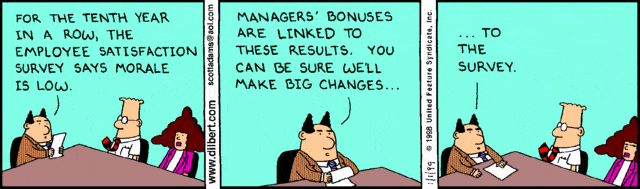
Cartoon – You can be sure we’ll make big changes
A Better Boss or a Pay Raise? What Would YOUR Employees Choose?

Ask yourself this question: If I gave my employees a choice between receiving a pay raise or me becoming a better boss, which would they choose?
Chances are you’d probably say your employees would choose a pay raise, right? I mean, after all, who wouldn’t want more money? Taking a few liberties with the classic song Money by Barrett Strong, your employees are probably saying “Your leadership gives me such a thrill, but your leadership don’t pay my bills, I need money!”
Getting a pay raise would be an immediately tangible reward that everyone could literally take to the bank. Besides, it’s not like you need any dramatic improvement as a boss, right? Sure, you may not be the greatest leader in the world, but there’s a whole lot of bosses plenty worse than you. Your people would definitely choose a pay raise, you say.
Well, you’d be wrong. One study showed that 65% of Americans would choose a better boss over a pay raise. How do you like them apples?
In many of our training courses we do a “best boss” exercise. We ask participants to share the characteristics of the person who was their best boss, and as you can see from the list below, many of these traits are ones you can develop and master with just a bit of effort and focus.
My best boss…
Unfortunately, too many leaders are unwilling to admit they could use a bit of improvement, and too many organizations tolerate poor managerial performance (free whitepaper: 7 Ways Poor Managers Are Costing Your Company Money). But as you can see from this list, becoming a best boss isn’t rocket science. It’s within the grasp of any leader who is willing to put in a bit of work to improve his/her craft.

When Texas Health Resources hires new staff members to work in its revenue cycle department, it’s now required — for most functions, anyway — that they work virtually from home. Staff who have been there since before the virtual implementation have the choice, but many choose to go the route of the new hires. It’s a nice perk for the employees, but an even nicer one for the system, which has seen productivity increase significantly since taking this approach.
James Logsdon, THR’s vice president of revenue cycle operations and strategic revenue services, said the concept emerged in 2011 during the Super Bowl.
Dallas was the host city that year, and the big game took place in the midst of a rare ice storm. Logsdon came into work with the wind still whipping and noticed immediately that the office was like a ghost town, with few employees in sight. The system lost three to four days of productivity because people simply couldn’t make it into work, and thus a challenge was born: Turn revenue cycle operations 100 percent virtual within a year.
“It started out as a business continuity plan, but progressed into an initiative,” said Logsdon, recalling the event during the Healthcare Financial Management Association‘s annual ANI conference in Orlando. “It was a drive.”
It took longer than a year, and it may never reach 100 percent; some functions have to stay in-house, particularly with the jobs that involve direct patient interaction. But the effects have been noticeable. Employee satisfaction and morale are at an all-time high, and the turnover rate has been reduced substantially. The system used to lose revenue cycle employees to jobs that paid 10 or 15 cents an hour more, but no longer.
The linchpin of the program’s success is quality. It can’t budge an inch, and employees have to be held accountable.
“The metrics have to be award-winning,” said Logsdon. “You’ve got to set the expectation that this is a privilege. It’s something that could potentially be taken away. Basically, the message was, ‘Don’t let me down.'”
So far they haven’t, and part of the reason is the flexibility the virtual job affords them. Workers are allowed to set their own schedules as long as they put in the minimum eight hours. At whatever hours they’re at their best is when THR wants them to work.
Benefits aren’t just limited to reduced turnover and higher productivity, either. The system allows for better use of its real estate. Where there were cubicles packed tightly together like honeycomb bees, there are now classrooms, war rooms and revenue cycle training areas.
All that saves the system money, since it now uses its existing space for such purposes rather than expanding its footprint. New revenue cycle personnel are expected to work at least 90 days in the office while they undergo their training and education, but after that, they’re released to their virtual offices.
That’s not to say there aren’t challenges. Logsdon said that in some instances employees feel a sense of entitlement, resisting requests to return to the office when the need arises. There are also distractions that differ from the usual office distractions — children, neighbors, friends and family can sometimes intercede. To address this, THR conducts unannounced site visits to make sure everything’s copacetic.
The arrangement has created some new challenges for management, as they now have to ensure employees are using the right equipment and protocols and have an appropriately speedy internet connection. Few issues have arisen.
“Productivity is a topic that always comes up,” said Logsdon. “The requirement for employees, in writing, is to increase productivity by 5 percent. They have no problem hitting it. It’s amazing what you can pull out of people when they’re motivated by the right reasons.”

“You can give out bonuses, trinkets, t-shirts and keychains. But at the end of the day people want to be listened to and feel valued, respected and cared for by their colleagues and the leadership team.”
 HENRY KOTULA