Next U.S. Restructuring Epidemic: Sick Health-Care Companies

https://www.bloomberg.com/news/articles/2017-11-27/next-u-s-restructuring-epidemic-sick-health-care-companies

  • Rural hospitals seen as among hardest hit by regulatory change
  • Technological shifts and urgent care reshaping industry

A growing number of health-care companies may face near-death experiences of their own.

 A wave of hospitals and other medical companies are likely to restructure their debt or file for bankruptcy in the coming year, following the recent spate of failing retailers and energy drillers, according to restructuring professionals. Regulatory changes, technological advances and the rise of urgent-care centers have created a “perfect storm” for health-care companies, said David Neier, a partner in the New York office of law firm Winston & Strawn LLC.
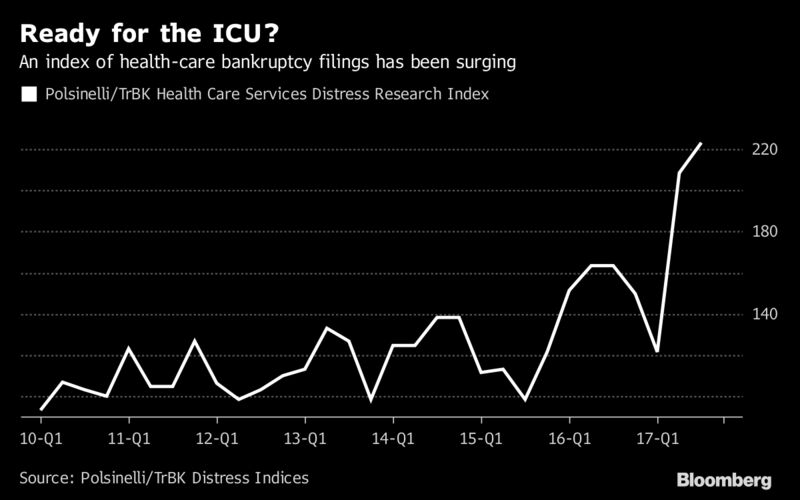
Some signs are already there: Health-care bankruptcy filings have more than tripled this year according to data compiled by Bloomberg, and an index of Chapter 11 filings by companies with more than $1 million of assets has reached record highs in four of the last six quarters, according to law firm Polsinelli PC. Junk bonds from companies in the industry have dropped 1.4 percent this month, a steeper decline than the broader high-yield market, according to Bloomberg Barclays index data.
The pain for the sector comes as bankruptcy filings across the broader economy have plunged since 2010.
Hospitals, including private rural ones, may be among the hardest hit, Winston & Strawn’s Neier said. The Affordable Care Act, known as Obamacare, reduced payments to hospitals that serve a large number of poor and uninsured patients, known as “disproportionate share hospitals,” on the theory that more patients would be insured under the law. Congress delayed those cuts several times, but didn’t do so for the current fiscal year, which may “single-handedly throw hospitals into immediate financial distress — many operate on less than one day’s cash,” he said in an interview.

“Smaller hospitals have already been struggling for years,” said Kristin Going, a partner in the New York office of Drinker, Biddle & Reath LLP. Both lawyers declined to discuss specific companies. Since 2010, a growing number of patients have enrolled in high-deductible health plans that force them to shoulder more of costs when they get treatment, according to the U.S. Centers for Disease Control and Prevention. That has translated into more bad debt from customers for hospitals and other providers.

Some publicly traded hospital companies that were already under pressure from high debt loads have been further buffeted by this year’s hurricanes. Community Health Systems Inc., with $1.9 billion in debt maturing in 2019, has suffered doctor revolts over crumbling, cash-strapped facilities, as well as losses linked to the storms in Texas and Florida earlier this year. A representative for Community Health didn’t return a call seeking comment.

Signs of Distress

Jorian Rose, partner in the New York office of Baker & Hostetler LLP, said many health-care restructurings are already going on under the radar right now. Rose, Going and Neier are members of the Turnaround Management Association, a group for bankruptcy and restructuring professionals.

The Polsinelli Health Care Services Distress Research index, which tracks bankruptcy filings for companies with more than $1 million in assets, shows that activity has surged 123 percent since the fourth quarter of 2010. By comparison, the law firm said, the general index that tracks Chapter 11 filings in the U.S. is down nearly 58 percent from 2010. The Affordable Care Act, which Republican lawmakers have been looking to repeal, replace, defund, or otherwise change, was cited as one of the systemic changes rocking the sector.

Since 1997, health-care cases have made up only 5.25 percent of all U.S. bankruptcy filings, according to Bloomberg data. Year to date, they already comprise 7.25 percent of all filings. Emergency-room operator Adeptus Health, cancer-care provider 21st Century Oncology, and cancer treatment specialist California Proton Treatment are the largest filings. Those statistics exclude pharmaceutical company Concordia, which is restructuring in Canada, and Preferred Care Inc., one of the U.S.’s largest nursing home groups, operating 108 assisted living facilities.

Problems for the sector aren’t limited to U.S. companies. Israeli drugmaker Teva Pharmaceutical Industries Ltd., saddled with debt that’s more than double its market value, is putting together a “detailed restructuring plan” after the company has slashed its profit forecasts, cut its dividend, signaled it may sell new shares, and reduced its goal for paying down debt this year. It announced a management shakeup on Monday.

Distress among health-care companies can spread to other parts of the economy. Quality Care Properties Inc., for example, is a real estate investment trust with a struggling tenant, HCR Manorcare Inc. Moody’s Investors Service said in an October report that if HCR Manorcare files for bankruptcy, Quality Care could also need to amend the terms of its own debt. Representatives for HCR Manorcare and Quality Care didn’t return calls seeking comment.

Moody’s assigns ‘Aa3’ rating to MultiCare Health System’s bonds

https://www.beckershospitalreview.com/finance/moody-s-assigns-aa3-rating-to-multicare-health-system-s-bonds.html

Image result for multicare health system


Moody’s Investors Service assigned its “Aa3” rating to Tacoma, Wash.-based MultiCare Health System’s proposed $318 million series 2017A and 2017B revenue bonds.

Additionally, Moody’s affirmed the “Aa3” rating on MultiCare Health’s parity debt, affecting $847 million of rated debt.

The affirmation and assignment are a result of several factors, including the health system’s strong market position, greater revenue diversity and recent acquisition of two hospitals in Spokane, Wash. Moody’s also acknowledged MultiCare Health’s weaker operating performance in fiscal year 2016 and more than 30 percent increase in debt and risks associated with integrating into the Spokane market.

The outlook was revised to negative from stable, reflecting the health system’s increased debt burden and anticipated decreases in profitability as the health system integrates into a new market.

Moody’s downgrades UPMC to ‘A1’

http://www.beckershospitalreview.com/finance/moody-s-downgrades-upmc-to-a1.html

Image result for university of pittsburgh medical center


Moody’s Investors Service downgraded Pittsburgh-based UPMC from “Aa3” to “A1,” affecting $2.9 billion of debt.

In addition, Moody’s downgraded UPMC-Hamot’s bonds, which are parity obligations for UMPC, from “Aa3” to “A1.”

The downgrade is a result of several factors including UPMC’s rapid expansion project, high execution risk following the acquisition of Harrisburg, Pa.-based PinnacleHealth and a new service area with high competition. Moody’s also acknowledged UPMC’s increased debt burden, below average financial performance and suppressed margins. Offsetting an additional notch downgrade is UPMC’s strong market position, integration of various hospital acquisitions and core competency in acute care management.

The outlook is negative, reflecting Moody’s expectation that UPMC’s rapid expansion may pose financial and cultural stress.