The CFO Confidence Crisis

https://www.kornferry.com/institute/CFO-succession-plan?mkt_tok=eyJpIjoiTlRJM09UWmxNREpqT1RGaSIsInQiOiJMcEhLaTZabUw0N1QxcTN3OUlqWVA4eldPcG1XRlwvWXJzbzVnM3c1M1JUYkNuRGhvTWFQTG9PenhJbnByOXkwcitLazlkbTh1UTBKQzEwRmx5YmMwZE9aWU1Hb0ZhdTkwVUp1RGhOUTJSNDU4UVpzcFZVSm9mVjE3K1NNTWkrNHIifQ%3D%3D

Few roles are as important as the chief financial officer at most companies, but the CFOs today who are thinking about tomorrow are growing nervous about a key talent issue. They just don’t think anyone else in the company can assume their role.

Indeed, according to a new Korn Ferry survey, 81% of CFOs surveyed say they want to groom the next CFO internally, but they don’t believe that there’s a viable candidate in-house. Currently, about half of new roles are filled internally. 

“The current CFO is the one charged with identifying and developing that talent, and since they know best the skills required to meet what’s coming, they are realizing the internal bench isn’t fully prepared,” says Bryan Proctor, senior client partner and Global Financial Officers practice lead at Korn Ferry.

The lack of confidence is owed in part to CFOs feeling that their firms’ leadership development programs haven’t kept up with the rapidly changing role of CFO. Core functions such as finance and accounting are increasingly being combined under one role, with CFOs citing a lack of resources or skills and career development opportunities as reasons for the merging. Korn Ferry surveyed more than 700 CFOs worldwide, asking them about their own internal talent pipelines. The top two abilities CFOs feel their direct reports need to develop are “leadership skills and executive presence” and “strategic thinking.” 

“The tapestry of skills and experiences CFOs of today and tomorrow need are vastly different than what was needed in the past,” says John Petzold, senior client partner and CXO Optimization lead at Korn Ferry. “The reason subfunctions are merging is because the focus is less on a role or person and more about the capabilities that need to be covered by a set of individuals.”

In essence, the CFO function is being deconstructed for optimization. Leaders are breaking down necessary functions based on their organization’s strategy and identifying people with a combination of those skills and piecing them together to get the right set of talent to execute against that plan. Core financial functions such as taxes, capital allocation, and M&A still need to be done accurately and in compliance with regulations, of course. But experts say the CFO role is becoming more about adapting and deploying talent in the most efficient manner possible. 

“The leadership profile of the future CFO is less about tactical, direct experience, and more about learning agility, adaptability, and big-picture global perspective,” says Proctor. “That kind of nimbleness and ability to pivot isn’t naturally ingrained in the typical CPA.” 


Leadership Forged In Crisis

http://www.leadershipdigital.com/edition/daily-management-development-2017-11-03?open-article-id=7475661&article-title=leadership-forged-in-crisis&blog-domain=leadershipnow.com&blog-title=leading-blog

Forged In Crisis

LEADERSHIP development is a very personal endeavor. The better you become, the better your leadership becomes.

It is a misconception of leadership that if you engage in the best practices of a great leader, you will become that leader. Applying the idea that if I do this or if I have this quality I will become a great leader like my chosen mentor, can derail your leadership development.

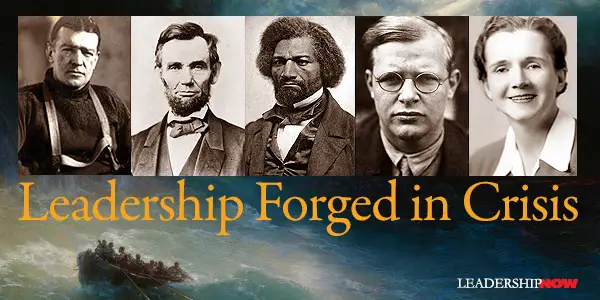
That said, there are principles you can discover that if adhered to will propel you in the right direction. Harvard professor Nancy Koehn illuminates some of these principles for us in Forged in Crisis as seen through the lives of five exemplary leaders: polar explorer Ernest Shackleton, President Abraham Lincoln, legendary abolitionist Frederick Douglass, Nazi-resisting clergyman Dietrich Bonhoeffer, and environmental crusader Rachel Carson. These principles set the stage for leadership effectiveness, but the decision to step into leadership is yours alone.

Koehn borrows from David Foster Wallace and defines an effective leader as one “who can help us overcome the limitations of our own individual laziness and selfishness and weakness and fear and get us to do better, harder things than we can get ourselves to do on our own.”

Coach Tom Landry said it this way: “Leadership is getting someone to do what they don’t want to do, to achieve what they want to achieve.” Henry Kissinger said, “The task of the leader is to get his people from where they are to where they have not been.” It’s intentional influence. But the ability to do that doesn’t come to us naturally. We have to work at it. But that’s good news. We can all get there. Leaders are not born, they are forged.

Each of the leaders Koehn has chosen faced an uncertain outcome in the midst of a crisis. Shackleton was marooned on an Antarctic ice floe trying to bring his men home alive; Lincoln was on the verge of seeing the Union collapse even as he tried to save it; escaped slave Douglass faced possible capture while wanting to free black Americans held in slavery; Bonhoeffer was agonizing over how to counter absolute evil with faith while imprisoned by the Gestapo; Carson raced against the cancer ravaging her to finish her book Silent Spring, in a bid to save the planet.

The crisis that can break one person can give birth to leadership in another. It’s a conscious choice to lead. Koehn brings out key lessons common to these people as they struggled with their thoughts in what were do or die situations. Here are some of the lessons that we should all take to heart:

They Were Made, Not Born

These leaders “were made into effective leaders as they walked their respective paths, tried to understand what was happening around them, and encountered failure and disappointment.”

They Were Ambitious but…

“The drive to make their respective marks was important in shaping them. It took each of them some of the way. But then, interestingly, ambition ceased to motivate and influence them as it once had. As they discovered a larger purpose and embraced it, each found his or her impetus, strength, and validation in the mission itself.” And importantly, Koehn adds, that “their leadership was partly shaped by a willingness to subordinate personal drive in a broader end, one inexorably linked with service to others.”

They Did the Inner Work of Leadership

They all worked on themselves, looking for opportunities to grow. “They did not do this as a single endeavor, but rather as a lifelong project in which they each kept working on themselves, learning specific lessons, developing more resilience, and using these resources to lead more effectively.”

(“Lincoln would have been flummoxed by talk of authentic leadership when he told a few constituents in 1862 that he did not have the luxury of publically expressing his disappointment about Union army defeats.”)

They Understood the Importance of Solitude

These leaders learned to detach themselves from the situation in order to see things from different perspectives. They “learned how to step back from a specific instant, assess the larger landscape, take the measure of their own emotions, and only then make a decision about what, if anything, they wanted to do.” Reflection and solitude helped them stay focused on the big picture.

They Learned to Manage Their Emotions

In dark moments, what Bonhoeffer called a “boundary situation,” they determined to manage their emotions. It was not willful blindness or forced optimism. They knew what they were up against. “Because they did, they used their emotional awareness and discipline to concentrate directly, almost exclusively, on how to move forward, how to take the next step, however small.” These people realized that “the emotional penetrability they experienced and that caused them so much suffering was also a door into new insights about themselves and new ways of being in the world.”

They Learned to Respond Rather Than to React

“At times, doing nothing at all was the best action each of these leaders could take. Time and time again as president, [Lincoln] refused to be goaded by the force of his own emotions or of those around him into taking precipitate action that might compromise his larger mission. Even when he was at his most frustrated, he managed somehow to acknowledge his feelings without acting on them in a way that was destructive to larger matters.”

They Were Resilient

Though these leaders didn’t always see a way through in the heat of the moment, “they vowed to find a way through the obstacles they confronted. They came out the other side of calamity without falling through the floorboards of doubt, without giving up on their mission and themselves.”

All five leaders were well chosen because of their humanity. They were not born leaders. They became leaders through successes, but mostly through failures and mistakes. Leaders can come from anywhere. As we look around the world today, if we are looking for larger-than-life heroes, we misunderstand what leadership is.

Although these leaders appear to be larger than life to us now, as you read their stories you see that they are you and me. They are ordinary people in turbulent and trying circumstances. They were often overwhelmed and depressed, but they kept moving on. What distinguishes these people from many of the leaders we see today is their approach to the experiences of their lives. Throughout their lives, they purposefully extracted the lessons they needed to grow. It was thoughtful and intentional. If you go through life any other way, you are just collecting experiences to no end. Experiences alone ensure nothing. We must reflect on them to gain insights and learn from them.


Wanted: Leaders for tomorrow’s emergency room

http://www.healthcaredive.com/news/wanted-leaders-for-tomorrows-emergency-room/448757/

A conversation with Bill Haylon, CEO of Leaders For Today

Economic anxieties need not correlate with a high unemployment rate. Take it from business leaders across multiple U.S. industries: Their biggest challenge is not a lack of job openings for thousands of qualified candidates — it’s a lack of candidates for thousands of openings.

HR professionals are used to hearing about skill shortages in manufacturingand other blue-collar work, but perhaps more understated are gaps in the STEM fields.

Careers in nursing and medicine, which often require years of additional, specialized education are hard to fill. Physician assistant openings were one of the most in-demand fields near the end of 2016, according to the American Staffing Association. But hospitals aren’t just struggling to find people to staff operating rooms. They face a much bigger challenge in a lack of leadership skills.

HR Dive/Healthcare Dive spoke with staffing firm Leaders For Today’s CEO Bill Haylon about the root of leadership gaps in healthcare, and how hospital HR departments can confront the problem. Our conversation has been lightly edited for length and clarity.

HR Dive: When hospitals come to a healthcare staffing firm like Leaders For Today, what are they asking for?

Bill Haylon: What we’re really doing is helping them find people who have particular sets of skills. We provide staffing on an interim basis. A hospital or healthcare system comes to us and says, “we really need somebody who can fix and lead our case management department,” “we need somebody who’s got certain technical skills and leadership skills.” We’re not actually training individuals, we’re finding people who fill those slots.

We’re going out and finding people, who they can either hire full time or on an interim basis. We’ll look for, on average, a little more than six spots, and we’ll start from a pool of people that we have that we’ve worked with before.

We’re not really doing training, but training is one of the problems in the healthcare world.

HR Dive: When you look for potential staffers, what kind of skills do they have? What stands out the most to the healthcare systems you work with?

Haylon: There are certain skills that go across all positions, and there are certain skills that are specific to a position because we can hire for. For example, we have a team that focuses on OR people, while others focus on case management, hospital finance, physician management, practice management, etc.

Across the board, what we focus on is, first and foremost, trying to find people who have been steady with or who have stayed with an organization for some period of time and developed within that. In other words, we try and stay away from what we call “jumpers” — people that have a job for a year, two years, and then try and go on their next role.

Unfortunately, that’s counter to what occurs in the industry. People in the hospital industry jump all the time.

We try and get some stability in their job, because we believe they learn more that way [when it comes to] both the technical skills and leadership skills. Of course, you look for the basic things: education, undergraduate work, master’s degree and other certifications.

You’re trying to vet the person along, so a lot of time you’re talking about different situations, different experiences, how they’ve handled them in the past or how they might handle them in the future. It could be a difficult position to deal with, a union situation, a quality situation, a safety situation. And you try to understand what their thought-making process is.

HR Dive: What skills are hardest to come by in the medical world, given that a lot of industries are seeing skills shortages?

Haylon: There’s an enormous shortage of talent within the hospital industry in all key levels. It was going on before Obamacare, and now with Obamacare and more people being covered, each organization is seeing a big uptick in the number of patients they see. It’s really gotten to be a very critical moment.

The most difficult job category is the O.R., the second hardest is case management and the third hardest is physician practice management.

From a skill set perspective, it’s leadership. Most of those in leadership positions are people who were nurses or doctors. When you go to school, you do not learn about financial statements, management skills or leadership. You’re learning how to suture, avoid infections and open up rib cages.

You take a person who has been a staff nurse for [a certain number] of years, and they decide they want to go into a leadership role. Because there’s a shortage of people, they are put in those spots well before they’re ready. They don’t have any training; hospitals do not train people for career development or leadership, and so you’re just kind of winging it. You get people who are very quickly over their head in their positions.

HR Dive: What can hospitals change about the way they operate to help develop those skills, or is that simply not possible given their bandwidth?

Haylon: They make it harder than it is. The reality is that hospitals consolidate, so they’re parts of bigger systems. You have a director in the O.R. who could be managing 440 people. That’s a lot of people. This was the case for one hospital we worked with, and the person running that OR had been a staff nurse and morphed to this role. But her [previous] role had been running a small hospital where she had 30 people, and now she’s up to 440 people, and it’s over her head.

So the reality is that they need to start thinking about different skill sets, and the obvious one is an MBA. When you’re the director of a 440-person O.R., you’re not seeing patients anymore. You’re doing hiring and scheduling. You’re developing quality programs and safety programs. You’re trying to get the surgeons on board. You’re never seeing a patient; that’s a different set of skills.

You don’t need to be clinical, you need to be a manager and a leader. It could be an MBA, it could be a master’s in health. But you need more than clinical training.

So what hospitals do [by recruiting for a certain skillset] is totally reactive as opposed to being proactive and developing people.

HR Dive: Do you see a shift in terms of the skills that physicians and other professionals are being taught in school?

Haylon: You’re being taught technical skills, clinical skills, whatever your specialty is. You go to medical school, do your residency, maybe followed by a fellowship, and it’s all technical skills. Physicians [are also] getting way more specialized than they used to be.

Typically the people who have jobs [in healthcare leadership] have gone and gotten additional training and education on their own.

Physicians and nurses are not trained in school to run big organizations. Plus, they’re doing research, and they’ve got to handle anybody that comes into the OR and the ER. It’s hard enough to get training for it, and it’s beyond belief if you don’t have training.

HR Dive: What else should hospital systems be mindful of when looking for leadership in the medical workforce?

Haylon: When you look at survey data from across the hospital industry, you see that people are staying in positions for incredibly short periods of time. Forty percent of people right now in key positions in hospitals have been in their position two years or less. Another 40% expect to leave in the next two years. What happens is that hospitals have a hole, and they need better leaders, so they poach from somebody else.

So the director of a surgical department will be a manager at a small hospital, then become a manager at a bigger hospital, then a manager at a bigger hospital, then a director at a small hospital, then a director at a bigger hospital, and finally a director at a bigger hospital. They just keep poaching from each other.

The problem is it’s the same people who are circling through. The people you’re hiring never had the time to put in place good, quality programs, [including] safety programs and productivity programs, because they’re not there long enough. They can’t make it stick in just two years; these are very complicated things.

And so that’s the result of what you’re talking about. The lack of training and development shows itself in this poaching and job hopping in the hospital world. It is like no industry you have ever seen before.

In other industries, an enormous amount of resources are put into training, so people stay in those industries and move up. You take up greater responsibilities, but they invest a lot in you as a developing person. The hospitals invest almost nothing. It’s up to the individual to go and figure it out on your own. Get your MBA, take this class, get a certification from the hospital association. But you’re not developing your own people.

Other organizations develop their own people because they want to be the best at what they do — they want to differentiate themselves. The only way they can do that is to develop their own people. Because hospitals don’t do that, there really is no differentiation, and hence, they struggle.

So this lack of training and the lack of development ends up creating an industry where everybody knows they’re going to jump all the time. You’ve got hospitals that have hired their sixth CEO in seven years. So the question is: If you’re a patient and you have knowledge of this, would you want to go to that hospital?

If you have that sort of instability at the top spot, then it’s going to trickle all the way down. Healthcare is complicated; it takes a while to figure out orders in place that are going to work. If they have quality problems, or safety problems, you can’t fix them that quickly. You’ve got to have someone who understands the lay of the land and can make a difference.

EVERYTHING GOOD IN LEADERSHIP BEGINS WITH…

https://leadershipfreak.wordpress.com/2016/09/10/everything-good-in-leadership-begins-with/

everything-good-in-leadership-begins-with-humility

What working definitions of humility might you offer?

CEO turnover: Have a strong succession plan, groom leaders from within

http://healthcare-executive-insight.advanceweb.com/Features/Articles/Leadership-Recruitment-and-Development.aspx

Report finds that 98% of surveyed healthcare leaders would consider job change.

http://www.fiercehealthcare.com/story/ceo-turnover-have-strong-succession-plan-groom-leaders-within/2016-05-17?utm_medium=nl&utm_source=internal&mrkid=959610&mkt_tok=eyJpIjoiTm1ReU1ETmhZekl6WkRKbCIsInQiOiI4YUNJS1wvTFR1clVEdEptMk05Q1pQQXpQZTkwa1ZCZTV0cURjaWgrdXNRNmZFcFFvY1YyN1ZiYU9hTkplZ1pmODZ2bGxzaHJoWG93TEtTSDNDc0hlUUtnb251TDlMR3hFZTJ2czlTU243Zms9In0%253D


What It Takes to Be a Great Leader

https://www.bcgperspectives.com/ted-at-bcg/?utm_source=201605POP&utm_medium=Email&utm_campaign=otr#video/aUYSDEYdmzw

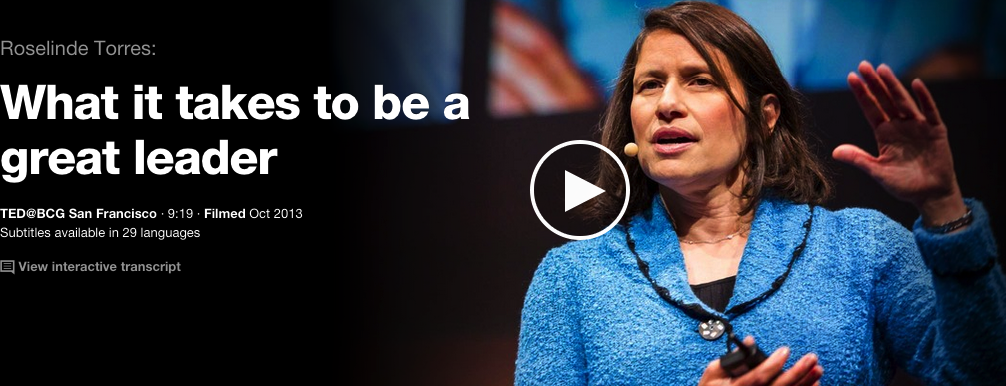
What it takes to be a great leader

There are many leadership programs available today, from one-day workshops to corporate training programs. But chances are, these won’t really help. In this clear, candid talk, Roselinde Torres describes 25 years observing truly great leaders at work and shares the three simple but crucial questions that would-be company chiefs need to ask to thrive in the future. Roselinde is a senior partner and managing director in BCG’s New York office. A senior leader in the firm’s People & Organization practice area, she is also the company’s resident expert on leadership, a topic she has studied her entire career.