The feud between the National Rifle Association and the medical community still rages on, with the latest round coming from physicians who released an editorial saying they disagree with the NRA, published in the journal Annals of Internal Medicine on Monday.
In a tweet this month, the NRA told “anti-gun” doctors to “stay in their lane” after a series of research papers about firearm injuries and deaths was published in the Annals of Internal Medicine, including new recommendations to reduce gun violence.
The rate of gun deaths in the United States rose to about 12 per 100,000 people, the second consecutive increase after a period of relative stability.
The rate of gun deaths in the United States rose in 2016 to about 12 per 100,000 people, the Centers for Disease Control and Prevention said in a report released on Friday. That was up from a rate of about 11 for every 100,000 people in 2015, and it reflected the second consecutive year that the mortality rate in that category rose in the United States.
The report, compiled by the C.D.C.’s National Center for Health Statistics, showed preliminary data that came after several years in which the rate was relatively flat.
“The fact that we are seeing increases in the firearm-related deaths after a long period where it has been stable is concerning,” Bob Anderson, chief of the mortality statistics branch at the health statistics center, said in a telephone interview on Friday. “It is a pretty sharp increase for one year.”
Mr. Anderson also said the rates for the first quarter of this year showed an upward trend, compared with the same three-month period of 2016.
“It clearly shows an increase,” he said, while emphasizing the data was preliminary. “With firearm-related deaths it is seasonal — the rates generally are a little higher in the middle of the year than they are at the end of the year,” he added. “Homicides are more common in the summer.”
More than 33,000 people die in firearm-related deaths in the United States every year, according to an annual average compiled from C.D.C. data.
The data released on Friday did single out other causes of death in the United States that were higher than the firearm-related rate. The drug overdose rate, for example, was almost 20 deaths per 100,000 last year, up from 16.3 in 2015.
The death rate for diabetes was about 25 per 100,000 people; cancer was 185 per l00,000, and heart disease about 196 deaths per 100,000 people.
But statistics about gun deaths, nearly two-thirds of which are suicides, have been ingrained in the national discourse in the United States, particularly after mass shootings, such as the one in Las Vegas last month in which 58 people were killed, and in debates over legislation related to guns.
In June 2016, the 49 fatalities in the Pulse nightclub shooting in Orlando represented one of the highest death tolls in a single mass shooting in recent United States history. But gun violence researchers note that although mass shooting fatalities account for no more than 2 percent of total deaths from firearm violence, they are having an outsize effect.
Garen J. Wintemute, director of the Violence Prevention Research Program at the University of California, Davis, School of Medicine, wrote in the Annals of Internal Medicine after the Las Vegas shooting that mass killings are “reshaping the character of American public life.”
“Whoever we are, they happen to people just like us; they happen in places just like our places,” he wrote. “We all sense that we are at risk.”
Dr. Wintemute said the latest C.D.C. report means the nation is approaching two decades since there has been any substantial improvement in the rate of gun deaths. The rate for the first three months of 2017 was about the same as the corresponding period in 2016. Hopefully, that is a sign it will level off again, Dr. Wintemute told The Associated Press.
Mr. Anderson said the data was not broken down by states, which each have different levels of comprehensiveness in their reporting to the federal agency. “As they get more and more timely we hope to include state-level information in these reports,” he said.
Suicides account for about 60 percent of firearm-related deaths, and homicides about 36 percent, Mr. Anderson said. Unintentional firearm deaths and those related to law enforcement officials account for about 1.3 percent each. The rest are undetermined.
The final data for 2016 will be released in the first week of December, Mr. Anderson said. “It could be this is a sort of blip, where it will stabilize again,” he said. “It is hard to predict.”
“We’ll be talking about gun laws as time goes by,” President Trump promised all too casually after the Las Vegas gunman took 58 lives in a rapid-fire slaughter. Time is indeed going by, and the silence is alarming as the Republican Congress and Mr. Trump, the devoted candidate of the National Rifle Association, duck their responsibility to confront the public health crisis of gun deaths.
There were so many hundreds of casualties in Las Vegas that many were treated by local Air Force surgeons who found themselves serving as specialists in triage — in a civilian fire zone. “These were definitely injuries you would see in a war zone,” one of the doctors told The Washington Post. Victims bled from single wounds through the chest and abdomen because the gunman shot from a high perch with military-style weapons adapted to shoot rapidly downward into the concert audience that was his chosen target.
This is the domestic war zone now bedeviling the nation as Washington looks the other way. Republican leaders are once again contriving to divert public attention to the challenges of mental illness, whereas the core issue is and has been the egregious availability of military-style weapons that the gun industry and the N.R.A. are lethally marketing to civilians. The talk of outlawing the “bump stock” device that heightened the Vegas gunman’s rapid fire is similarly diversionary, since the problem is the weapon, not the latest accessory.
Washington has also hobbled basic research into what is clearly a public health disaster. In 1996, the Centers for Disease Control and Prevention was barred from spending any funds “to advocate or promote gun control.” Full and accurate federal information has been choked off repeatedly since then. Research ordered by President Barack Obama following the Sandy Hook Elementary School massacre of 20 children in 2012 was never carried out. California, by contrast, has chosen a more enlightened path. Reacting to the 2015 gun killings in San Bernardino, the state in July created the Firearm Violence Research Center at the University at California at Davis to get beyond the hobbles the gun lobby and Congress have put on federal researchers.
If there is any bright spot it is that little more than a third of American households own a gun now, compared with 50 percent in earlier decades. Still, this has driven the industry to try to sell more guns to fewer Americans, from battlefield-type weapons to the concealed-carry pistols marketed as stylish vigilante accessories. According to a 2015 study by Harvard and Northeastern Universities, 3 percent of American adults own half the nation’s guns — averaging a startling 17 guns apiece.
The Las Vegas shooter was one of these hard-core arsenal owners. He stockpiled dozens of weapons, apparently with no one, and no law, to question the practice or his rationale. The government should be asking how he was able to do this, and how it could have been prevented. To the nation’s continuing sorrow, however, it’s clear little can be expected of the president and congressional leaders as time goes by and the next mass shooting draws nearer.
Good morning … Our thoughts are with the victims of the horrific mass shooting in Las Vegas, and their families. If you haven’t yet, spend a minute with this graphic, from the Axios visuals team. Whatever your opinions about gun control, mental health interventions, or any other questions of public policy, it’s a stark look at the human toll of mass shootings.
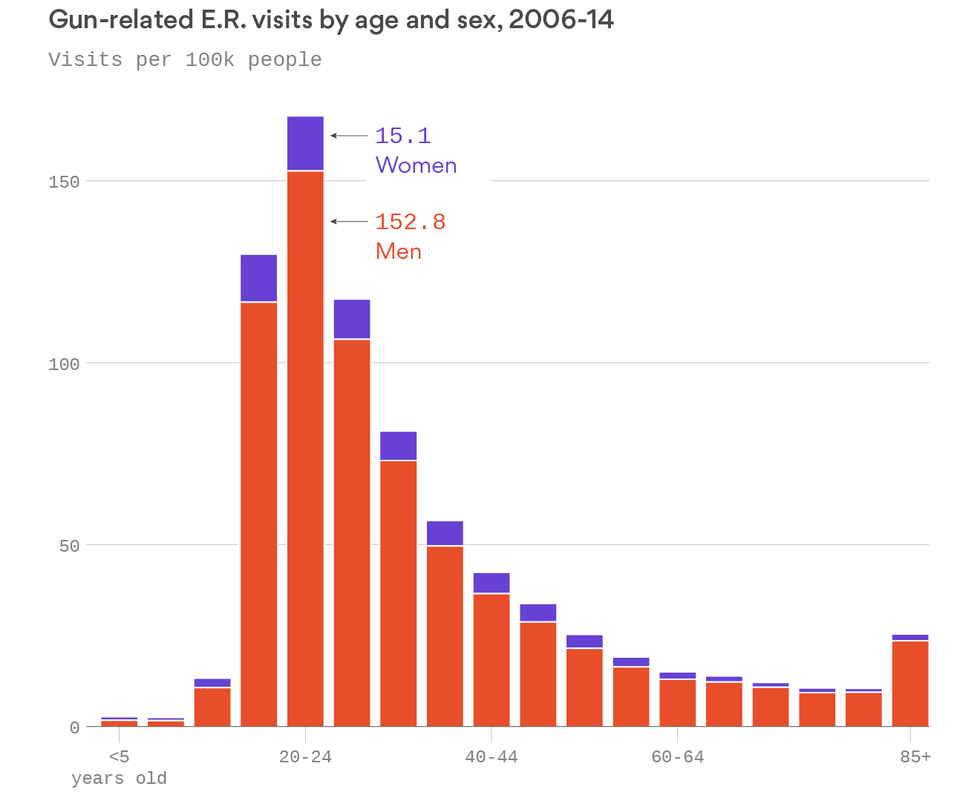
Gun-related injuries send thousands of people to emergency rooms every year, even aside from mass shootings like the tragedy in Las Vegas. In 2015 alone, almost 35,000 people died from gun-related homicides and suicides, and the “clinical burden” from non-fatal gun injuries was three times higher, according to new research published in Health Affairs.
Men make up the vast majority of firearm-related E.R. admissions, and young men — ages 15-30 — are especially likely to end up in the hospital because of a gun.
A plurality of gun-related E.R. admissions resulted from an assault, followed by accidents, which accounted for about 35% of admissions.
Most patients admitted to emergency rooms with firearm-related injuries were discharged, either to home or other facilities. Roughly 37% were admitted for inpatient care, and about 5% died in the emergency room.
Go deeper:Health Affairs is providing free access to this study. You can read the whole thing here.


 HENRY KOTULA